Nifty 50
- Kotak Mahindra Bank₹4408.10 (1.88%)
- Titan Company₹4,377-173.00 (-3.80%)
- BSE₹3,35651.00 (1.54%)
- Adani Enterprises₹2,743-106.90 (-3.75%)
- Bharti Airtel₹1,833.9023.40 (1.29%)
- Hindalco Industries₹910.85-29.65 (-3.15%)
- ICICI Bank₹1,357.5014.70 (1.09%)
- JSW Steel₹1,230-29.60 (-2.35%)
- Coal India₹414.502.85 (0.69%)
- Bharat Electronics₹378.30-9.10 (-2.35%)
- Max Healthcare₹9085.50 (0.61%)
- Infosys₹992-21.85 (-2.16%)
- HDFC Life Insurance ₹546.052.10 (0.39%)
- Asian Paints₹2,372.10-52.10 (-2.15%)
- Bajaj Finance₹963.850.75 (0.08%)
- Mahindra & Mahindra₹2,800-55.00 (-1.93%)
- Apollo Hospitals₹7,9172.50 (0.03%)
- Adani Ports₹1,750.10-33.30 (-1.87%)
- L&T₹3,701.50-68.50 (-1.82%)

- Offerings
- Tools & Platforms
Tools & Calculators
- Open API
- Calculators
- SIP Calculator
- CAGR Calculator
- Compound Interest Calculator
- FD Calculator
- RD Calculator
- EPF Calculator
- Retirement Calculator
- HDFC SIP Calculator
- Mutual Fund Return Calculator
- Lumpsum Calculator
- Step Up SIP Calculator
- ETF SIP Calculator
- Brokerage Calculator
- Equity Margin Calculator
- SWP Calculator
- EMI Calculator
- MTF Calculator
- Margin Pledge Calculator
- Algo Strategy
- Markets
Stocks
F&O
Mutual Funds
- More
- Market Volatility Perceived as Opportunity After 25 Years of Crisis
- SIP Flows Cross ₹27,000 Crore per Month, Enabling Long-Term Wealth Creation
- Mutual Fund Holdings Rise from 5% to 30% in Five Years
- Nine Out of Ten Retail Investors Make a Loss on Derivatives During Pandemic
- HDFC Securities Cuts Derivatives to 12% of Revenue from Industry Average of 90%
- Fintech Disruption Increases Access but Elicits Careless Trading
- Digital Transactions Hit 92% from 30% in a Decade
- Final Thoughts
- Market Volatility Perceived as Opportunity After 25 Years of Crisis
- SIP Flows Cross ₹27,000 Crore per Month, Enabling Long-Term Wealth Creation
- Mutual Fund Holdings Rise from 5% to 30% in Five Years
- Nine Out of Ten Retail Investors Make a Loss on Derivatives During Pandemic
- HDFC Securities Cuts Derivatives to 12% of Revenue from Industry Average of 90%
- Fintech Disruption Increases Access but Elicits Careless Trading
- Digital Transactions Hit 92% from 30% in a Decade
- Final Thoughts
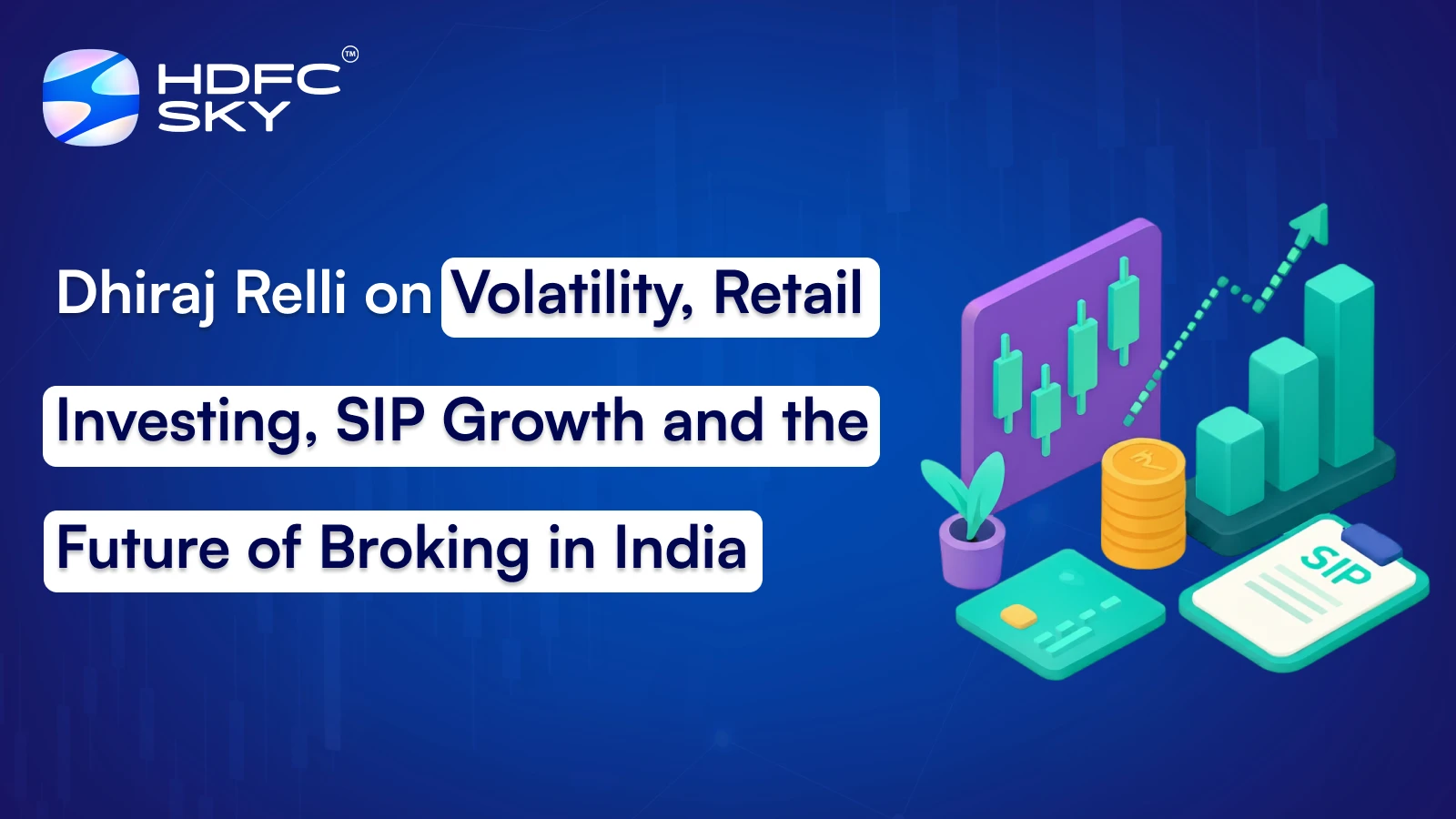
Dhiraj Relli on Volatility, Retail Investing, SIP Growth and the Future of Broking in India
By Dhiraj Relli | Updated at: Sep 25, 2025 03:18 PM IST
Open Free Demat Account
Open Free Demat Account
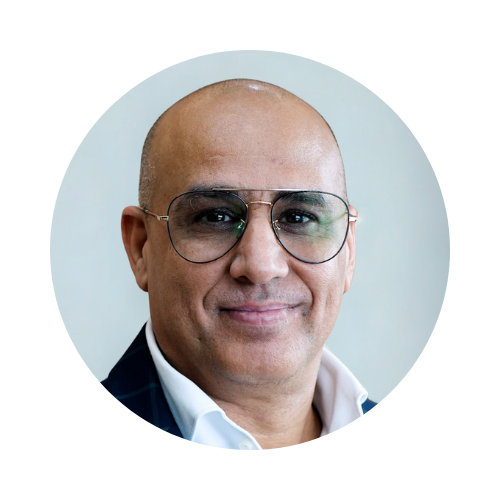
Stock markets are often volatile, swinging between their abrupt highs and instant lows. Such ups and downs might give some investors anxiety, but some regard them as a great opportunity. In a recent Simple Hai! episode HDFC Securities Managing Director and CEO Dhiraj Relli was invited by seasoned business journalist Vivek Law to share his view on the way investor sentiment has changed over the years, the extent to which Systematic Investment Plans (SIPs) have gained traction, fintech disruption, and the future of the broking business.
Relli also spoke about leadership, mindfulness, and personal discipline, offering insights from a high-pressure professional environment.
Market Volatility Perceived as Opportunity After 25 Years of Crisis
Relli pointed out that volatility is inherent in financial markets. What has changed in the past 25 years is investor sentiment towards such volatility. Earlier, slight movements in the market itself would trigger panic among retail investors. But over time, crisis like the Harshad Mehta scam, the 2008 global financial crisis, and the Covid-19 pandemic, have influenced the understanding of investors.
Retail investors today consider volatility as an opportunity to invest more instead of exiting the market. In the last five or six years, one can observe this mindset shift has become increasingly evident with more and more investors remaining invested even during falling markets and using declines in a strategic way to maximize long-term returns.
SIP Flows Cross ₹27,000 Crore per Month, Enabling Long-Term Wealth Creation
Relli recalled his experience of selling Systematic Investment Plans (SIPs) in 1999 when the technology bubble had swept India. Then, hardly any investors held on for the long term in the market. However, SIPs transformed wealth creation by promoting systematic, disciplined, and regular investing.
Presently, the monthly SIP flows exceed ₹27,000 crore, which brings considerable stability to Indian markets and even offsets foreign institutional investor selling pressure for the long term. Higher SIP participation is a fine illustration of how retail investors are increasingly shifting towards valuing stable long-term returns instead of attempting short-term returns or attempting to time the market.
Mutual Fund Holdings Rise from 5% to 30% in Five Years
During the last five years, investor retention in mutual fund schemes has increased significantly from 5% to 30%. While investor tenures are still short on an average basis, investor confidence in equities has increased significantly.
Even tax-saving schemes such as ELSS, which have lock-ins of three years, have retained investors beyond mandatory tenure, suggesting individuals are increasingly considering equity a credible long-term investment.
This is part of overall Indian cultural shift where investors are today appreciative of stability derived from continued, systematic investing and less prone to exit markets because of short-term fluctuations.
Nine Out of Ten Retail Investors Make a Loss on Derivatives During Pandemic
The pandemic witnessed all-time high opening of new demat accounts, but not all investors gained equally. SEBI stated that nine out of ten retail investors lost money, especially trading derivatives. Relli stated that speculative behaviour is rooted deeply in India, traditionally in the form of lotteries, chit funds, and other short-term betting. The pandemic cemented the trend as millennial investors with mobile and cash tried to outperform the market.
Even though some benefited by reaping small profits initially, most lost significant money. Relli clarified that the outcome was because the larger ecosystem of brokers, fintech platforms, and regulators made it convenient to use without proper investor education.
HDFC Securities Cuts Derivatives to 12% of Revenue from Industry Average of 90%
Relli explained how HDFC Securities consciously keeps its derivative exposure at 10–12% of revenue, compared to 90% in the industry otherwise. He pointed out that derivatives are used for hedging, not for speculation, and warned that derivatives are used by most investors as gambles.
This conservative approach is more client-protective and ensures stable revenue streams, indicating the company’s focus on prudence and not chasing short-term gains. This kind of approach indicates that these risk-averse, cautious approaches can be employed alongside business development in a competitive financial marketplace.
Fintech Disruption Increases Access but Elicits Careless Trading
Vivek Law inquired about the effect of fintech startups, which have eliminated brokerage charges and created advanced platforms. Relli conceded their popularity, stating that fintech made mass investing a reality through reaching out to small towns and rural belts that were otherwise inaccessible to conventional brokers. The platforms simplify transactions and make investing easy and accessible.
But he also cautioned that cheaper cost of transactions would result in indiscriminate speculation and trading. Though fintech contributes positively towards the accessibility of the market and to the convenience of investors, it has to be regulated in a good manner so that convenience does not turn into financial risk for new investors.
Digital Transactions Hit 92% from 30% in a Decade
Relli added that fintech disruption in transaction-based business is simple, fund-based and lending business need trust, capital, and stability over the long term and therefore speedy disruption is not easy. HDFC Securities has been careful in keeping up with technology.
Over the past decade, online customers who have made the shift are up from 30% to 92%. This steep increase demonstrates that digital adoption can co-exist with prudence, allowing investors to benefit from technology while being protected. It also reflects the general tendency of increased retail involvement wherein ease and education go hand in hand for a better investment habit.
Final Thoughts
The conversation signals the transition of the Indian retail investor towards disciplined, long-term wealth generation through SIPs and mutual fund investments. Speculative trading in derivatives is still a challenge, but companies charting a middle ground with technology adoption and prudence, like HDFC Securities, reflect how the potential of fintech and investor education help in building a sustainable broking model.


Open Free Demat Account
Open Free Demat Account
Popular Posts
- 10 Interesting Facts About NSE You Probably Didn’t KnowLast Updated: Sep 30, 2026
- 8-4-3 Rule of SIP - How Does That Work?Last Updated: Jul 30, 2025
- Let's view more exciting Post!
Popular Post from Leadership Voice
- Indian IPO Frenzy Continues, but HDFC Securities CEO Says Market Not EuphoricLast Updated: Nov 11, 2025
- How RegTech C͏an Sa͏fegua͏rd Market Integ͏r͏ity Amid India’s͏ New͏ Onl͏ine Gaming LawLast Updated: Sep 25, 2025
- Let's view more exciting Post!
Popular Post from Blogs
- “Bounce Back” Theme Gains Traction in 2026Last Updated: Apr 8, 2026
- 5 Takeaways for Tax Payers from the Budget 2025Last Updated: Jan 29, 2026
- Let’s view more exciting Posts


Invest Anytime, Anywhere


By signing up I certify terms, conditions & privacy policy