Nifty 50
- Kotak Mahindra Bank₹4408.10 (1.88%)
- Titan Company₹4,377-173.00 (-3.80%)
- BSE₹3,35651.00 (1.54%)
- Adani Enterprises₹2,743-106.90 (-3.75%)
- Bharti Airtel₹1,833.9023.40 (1.29%)
- Hindalco Industries₹910.85-29.65 (-3.15%)
- ICICI Bank₹1,357.5014.70 (1.09%)
- JSW Steel₹1,230-29.60 (-2.35%)
- Coal India₹414.502.85 (0.69%)
- Bharat Electronics₹378.30-9.10 (-2.35%)
- Max Healthcare₹9085.50 (0.61%)
- Infosys₹992-21.85 (-2.16%)
- HDFC Life Insurance ₹546.052.10 (0.39%)
- Asian Paints₹2,372.10-52.10 (-2.15%)
- Bajaj Finance₹963.850.75 (0.08%)
- Mahindra & Mahindra₹2,800-55.00 (-1.93%)
- Apollo Hospitals₹7,9172.50 (0.03%)
- Adani Ports₹1,750.10-33.30 (-1.87%)
- L&T₹3,701.50-68.50 (-1.82%)

- Offerings
- Tools & Platforms
Tools & Calculators
- Open API
- Calculators
- SIP Calculator
- CAGR Calculator
- Compound Interest Calculator
- FD Calculator
- RD Calculator
- EPF Calculator
- Retirement Calculator
- HDFC SIP Calculator
- Mutual Fund Return Calculator
- Lumpsum Calculator
- Step Up SIP Calculator
- ETF SIP Calculator
- Brokerage Calculator
- Equity Margin Calculator
- SWP Calculator
- EMI Calculator
- MTF Calculator
- Margin Pledge Calculator
- Algo Strategy
- Markets
Stocks
F&O
Mutual Funds
- More
Why Stock Markets Tend To Fall When Governments Increase Import Duties?
By HDFC SKY | Published at: May 26, 2025 02:14 AM IST
Open Free Demat Account
Open Free Demat Account
When governments raise import duties, stock markets tend to respond negatively and fall. This happens because when import duties are raised it adversely impacts international trade. The share of international trade in GDP has increased significantly. Currently, international trade makes up around 60% of global GDP.
A decline in international trade due to higher import duties adversely impacts global GDP. Countries that raise import duties are more likely to see an economic slowdown and an increase in the inflation rate. Therefore, stock markets often react negatively when import duties are raised.
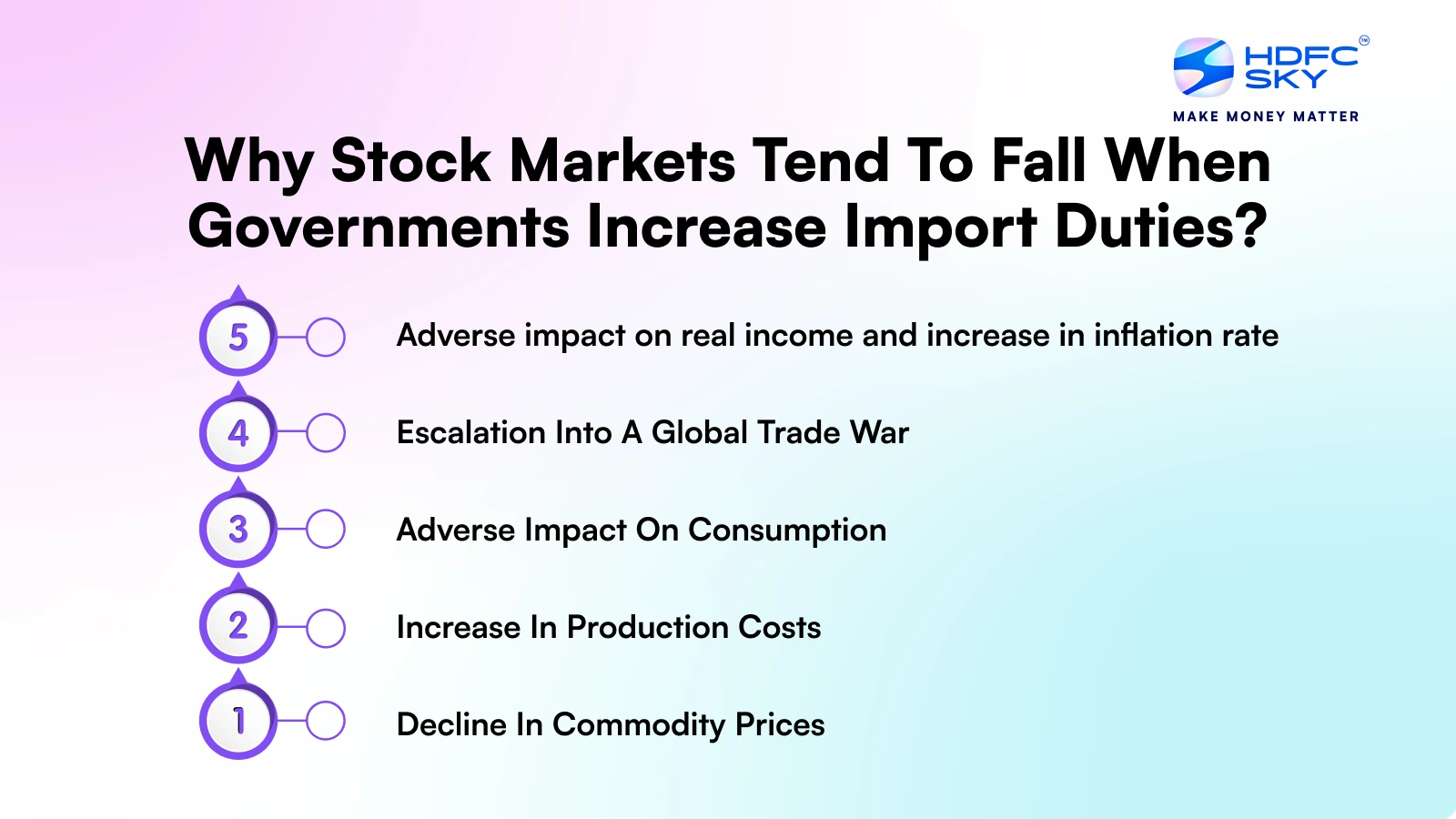
Adverse impact on real income and increase in inflation rate
While higher import duties may offer protection to certain domestic industries from foreign competition, they often have a negative impact on the general population. The prices of goods on which import duties have been levied or raised increase. People have to pay more to buy the same goods. This increase in prices lowers their real income.
If a government increases import duties on a wide range of goods, then it can lead to an increase in the overall inflation rate. To control this inflation, central banks may increase interest rates and pursue a contractionary monetary policy. Higher interest rates typically slow down the broader economy.
Escalation Into A Global Trade War
When one country increases import duties on goods of other countries, other countries also tend to retaliate by increasing import duties on the goods of that country. The risk of a global trade war increases. A global trade war can plunge the entire world into an economic recession.
Decline In Commodity Prices
An economic slowdown caused by higher import tariffs results in a decline in commodity prices. Commodity prices go up when demand for commodities goes up during periods of economic boom. Similarly, when there is an economic slowdown or recession, demand for commodities goes down. This, in turn, lowers the prices of commodities. Hence, stock prices of companies that produce commodities, such as oil, copper, etc., go down when import duties in international trade go up. These companies often make up a large part of major stock indices. Likewise, the stock prices of companies that manufacture export-oriented goods also go down when a country to which they export their goods increases import duties.
Increase In Production Costs
We live in an age where manufacturing has become globally integrated. A car that is assembled in Chennai in India or Detroit in the USA may have many components that are manufactured in other parts of the world. So even if the companies producing these cars sell their cars only in the domestic market, an increase in import duties still hurts them. This is because the imported components that they use in their cars become costlier because of higher import duties. So stock prices of many manufacturing companies also go down when import duties are increased sharply.
Adverse Impact On Consumption
Higher inflation caused by higher import duties lowers the real income of people, as aforementioned. With the same income, they are able to buy fewer goods and services. As a result, overall consumption in the economy tends to slow down.
This decline in consumption also affects stock markets. Consumption-related stocks, particularly stock prices of FMCG companies and discretionary goods companies, get negatively affected by higher import duties and often experience a drop in their share prices.
Conclusion
Various economic studies have conclusively proved that higher import duties are, in general, bad for the overall economy. As a result, stock markets often react negatively, especially when such duties are imposed by a major economy.



Open Free Demat Account
Open Free Demat Account
Popular Posts
- 10 Interesting Facts About NSE You Probably Didn’t KnowLast Updated: Sep 30, 2026
- 8-4-3 Rule of SIP - How Does That Work?Last Updated: Jul 30, 2025
- Let's view more exciting Post!
Popular Post from Share Market
- New Pre‑Open Rules Go Live on 7 September 2026Last Updated: Sep 4, 2026
- Trap Alert: How to Identify Common Market TrapsLast Updated: Apr 24, 2026
- When the King of Skies Encounters TurbulenceLast Updated: Jan 28, 2026
- HDFC Securities Partners with smallcase to Launch Model Portfolios on HDFC SKYLast Updated: Nov 28, 2025
- HDFC Securities Introduces SKY Signals on HDFC SKY to Strengthen Research-Driven Investments for Retail CustomersLast Updated: Nov 20, 2025
- Let's view more exciting Post!
Popular Post from Blogs
- “Bounce Back” Theme Gains Traction in 2026Last Updated: Apr 8, 2026
- 5 Takeaways for Tax Payers from the Budget 2025Last Updated: Jan 29, 2026
- Let’s view more exciting Posts


Invest Anytime, Anywhere


By signing up I certify terms, conditions & privacy policy