Nifty 50
- Kotak Mahindra Bank₹4408.10 (1.88%)
- Titan Company₹4,377-173.00 (-3.80%)
- BSE₹3,35651.00 (1.54%)
- Adani Enterprises₹2,743-106.90 (-3.75%)
- Bharti Airtel₹1,833.9023.40 (1.29%)
- Hindalco Industries₹910.85-29.65 (-3.15%)
- ICICI Bank₹1,357.5014.70 (1.09%)
- JSW Steel₹1,230-29.60 (-2.35%)
- Coal India₹414.502.85 (0.69%)
- Bharat Electronics₹378.30-9.10 (-2.35%)
- Max Healthcare₹9085.50 (0.61%)
- Infosys₹992-21.85 (-2.16%)
- HDFC Life Insurance ₹546.052.10 (0.39%)
- Asian Paints₹2,372.10-52.10 (-2.15%)
- Bajaj Finance₹963.850.75 (0.08%)
- Mahindra & Mahindra₹2,800-55.00 (-1.93%)
- Apollo Hospitals₹7,9172.50 (0.03%)
- Adani Ports₹1,750.10-33.30 (-1.87%)
- L&T₹3,701.50-68.50 (-1.82%)

- Offerings
- Tools & Platforms
Tools & Calculators
- Open API
- Calculators
- SIP Calculator
- CAGR Calculator
- Compound Interest Calculator
- FD Calculator
- RD Calculator
- EPF Calculator
- Retirement Calculator
- HDFC SIP Calculator
- Mutual Fund Return Calculator
- Lumpsum Calculator
- Step Up SIP Calculator
- ETF SIP Calculator
- Brokerage Calculator
- Equity Margin Calculator
- SWP Calculator
- EMI Calculator
- MTF Calculator
- Margin Pledge Calculator
- Algo Strategy
- Markets
Stocks
F&O
Mutual Funds
- More
What is Wealth Effect?
By HDFC SKY | Published at: May 26, 2025 02:13 AM IST
Open Free Demat Account
Open Free Demat Account
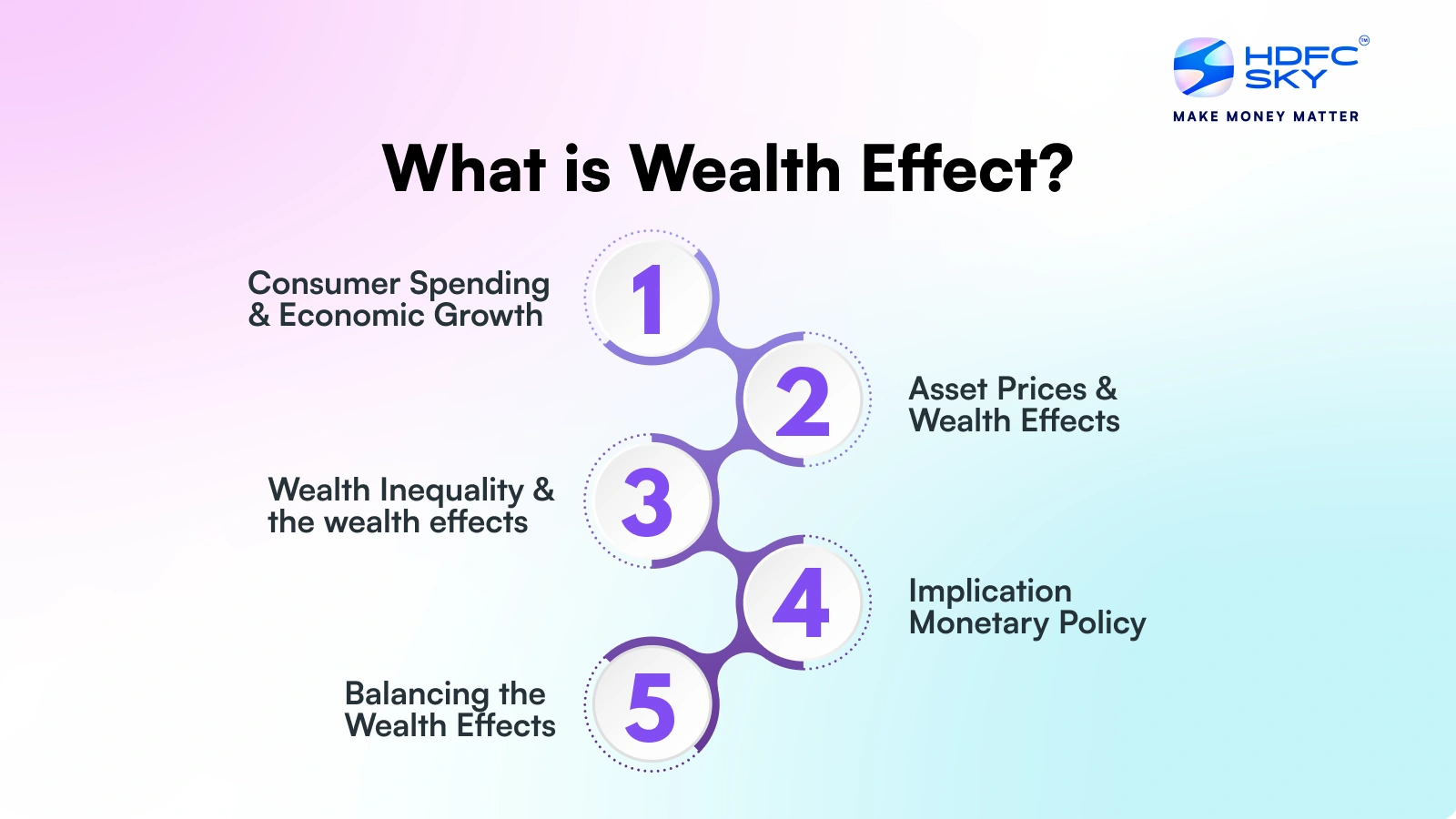
The wealth effect refers to the phenomenon where people tend to consume and spend more when they perceive an increase in their wealth—and vice versa. It is important to understand the meaning of wealth. Wealth is different from income. Wealth is the value of assets that you own. This includes the value of the property, stocks, cash, and other financial assets that you own. Income, on the other hand, is the stream of money that you receive from your work, profession, business, rent, etc.
People Spend And Consume More When Their Wealth Goes Up
People tend to spend and consume more when their income goes up. Similarly, they also tend to spend and consume more when they see that the value of the assets that they own go up. For example, suppose an individual owns some listed stocks. When the market prices of these listed stocks go up, the wealth effect theory suggests that the individual is likely to spend and consume more. It needs to be noted here that the individual may not have realised any actual gain because they have not sold the stocks at the higher market price. However, just the perception of increased wealth due to rising prices can lead to greater consumption. Various studies conducted on the topic have concluded that wealth effect holds in reality.
Similarly, when people see that the value of their assets is declining, they tend to spend and consume less. The wealth effect is, therefore, an important determinant of the overall state of the economy. When the stock markets are on the rise, consumption tends to go up in the economy because of the wealth effect. Similarly, when stock markets fall continuously, it may have an adverse impact on consumption in the economy, i.e., consumption tends to slow down.
Marginal Propensity To Consume
The marginal propensity to consume (MPC) is the change in consumption resulting from a 1-unit change in wealth. For example, if people tend to increase consumption or spending by 50 paise when their wealth goes up by Re 1, then the marginal propensity to consume is 0.50. The higher the value of MPC, the more significant the wealth effect will be.
Wealth Effect and GDP Growth
Different countries and places will have different marginal propensity to consume. Countries where consumption culture is strong have a higher marginal propensity to consume. People in these cultures spend more when their wealth increases. Countries where the culture of consumption is not strong have a lower marginal propensity to consume. According to data published in The Economist, the marginal propensity to consume for a $1 increase in wealth in the USA is currently around 24 cents. This means that an average American citizen tends to increase consumption by 24 cents when wealth goes up by $1. Marginal Propensity to consume is likely to be lower for India because it has a weaker culture of consumption than United States.
In countries like India and the USA, consumption forms the largest component of GDP. As a result, the wealth effect can significantly influence a nation’s GDP growth.
Conclusion
The wealth effect is an important concept to understand, especially for those who invest and trade. It provides insight into one of the key drivers of economic growth. By understanding this concept, individuals can make more informed investment decisions.



Open Free Demat Account
Open Free Demat Account
Popular Posts
- 10 Interesting Facts About NSE You Probably Didn’t KnowLast Updated: Sep 30, 2026
- 8-4-3 Rule of SIP - How Does That Work?Last Updated: Jul 30, 2025
- Let's view more exciting Post!
Popular Post from Trading Strategies
- How to Connect HDFC SKY with Claude Desktop (Step-by-Step MCP Setup)Last Updated: Aug 28, 2026
- HDFC Sky + OpenAlgo: A Beginner's Guide to Setting Up a Self-Hosted Algo Trading SystemLast Updated: Aug 28, 2026
- HDFC SKY Open API: A Complete Guide to Building Smarter Investment and Trading ApplicationsLast Updated: Aug 6, 2026
- How to Generate Your HDFC SKY API Key and Access Token (Step-by-Step)Last Updated: Aug 6, 2026
- Changes in Expiry Day for Index Derivatives on BSE & NSELast Updated: Dec 20, 2024
- Let's view more exciting Post!
Popular Post from Blogs
- “Bounce Back” Theme Gains Traction in 2026Last Updated: Apr 8, 2026
- 5 Takeaways for Tax Payers from the Budget 2025Last Updated: Jan 29, 2026
- Let’s view more exciting Posts


Invest Anytime, Anywhere


By signing up I certify terms, conditions & privacy policy