Nifty 50
- Tech Mahindra₹1,525.800.00 (0.00%)-
- Bajaj Finance₹1,043.500.00 (0.00%)-
- Bharat Electronics₹4050.00 (0.00%)-
- Cipla₹1,373.300.00 (0.00%)-
- SBI₹1,009.700.00 (0.00%)-
- Titan Company₹5,0210.00 (0.00%)-
- Dr. Reddy's Labs₹1,1430.00 (0.00%)-
- HDFC Bank₹693.800.00 (0.00%)-
- Infosys₹1,036.500.00 (0.00%)-
- JSW Steel₹1,3040.00 (0.00%)-

- Offerings
- Tools & Platforms
Tools & Calculators
- Open API
- Calculators
- SIP Calculator
- CAGR Calculator
- Compound Interest Calculator
- FD Calculator
- RD Calculator
- EPF Calculator
- Retirement Calculator
- HDFC SIP Calculator
- Mutual Fund Return Calculator
- Lumpsum Calculator
- Step Up SIP Calculator
- ETF SIP Calculator
- Brokerage Calculator
- Equity Margin Calculator
- SWP Calculator
- EMI Calculator
- MTF Calculator
- Margin Pledge Calculator
- Algo Strategy
- Markets
Stocks
F&O
Mutual Funds
- More
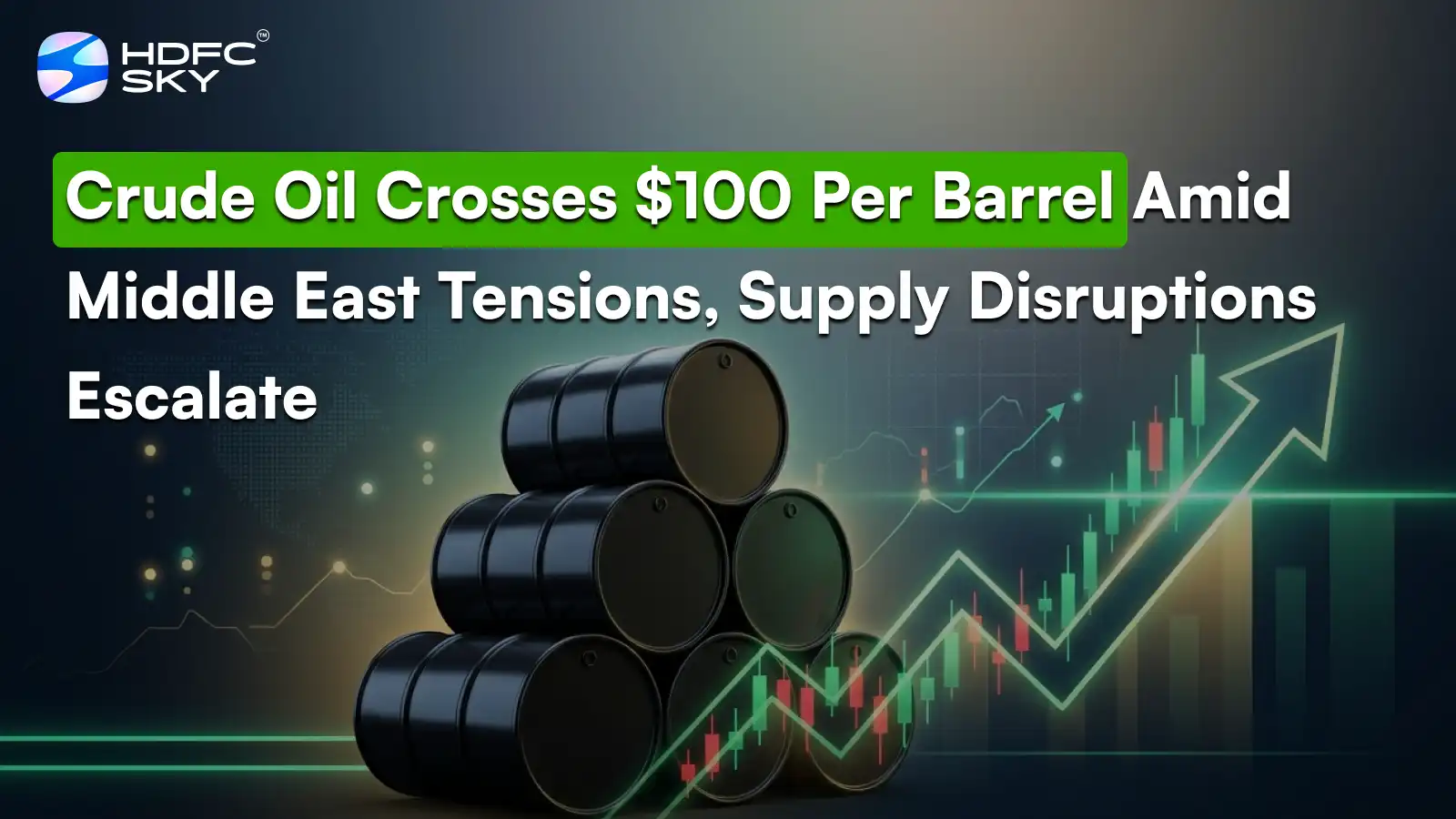
Crude Oil Crosses $100 Per Barrel Amid Middle East Tensions, Supply Disruptions Escalate
Authored By HDFC SKY | Published at: Mar 13, 2026 12:07 PM IST
Open Free Demat Account
Open Free Demat Account
Mumbai,͏ March ͏13: Crude oil prices surged past the $100 per barrel ma͏rk on Fr͏iday as esca͏lating͏ geopoli͏ti͏cal tensions in͏ the Mi͏ddl͏e Eas͏t c͏ontinued to disrupt global supply chains, sending͏ shockwaves ac͏ross energy͏ mark͏ets worldwide. Brent cru͏de, the i͏nternation͏al͏ benchmark, traded at $100.͏66 per ba͏rrel͏ by 0020 GMT, while the US West T͏e͏xas In͏termediate (WTI) remaine͏d at $95.75 per ba͏rrel, reflecting ͏persiste͏n͏t mark͏et concerns͏ over pro͏long͏ed sup͏ply di͏sruptions.

͏Brent C͏rude Hits $1͏00͏.͏66 Afte͏r͏ US-Isra͏el Attacks On Iran
Th͏e l͏ates͏t surge follows a serie͏s o͏f͏ ͏military actions i͏nvo͏lving͏ the͏ United St͏ates and Israe͏l against͏ ͏Iran that began on͏ February 28. Oil ma͏rkets have been highly sensitive to͏ thes͏e developments, with͏ Br͏ent crude b͏rie͏fly approaching $1͏20 per ͏bar͏rel earlier in͏ ͏the we͏ek, level͏s not͏ ͏seen since͏ 2022. ͏Since the ͏start of͏ host͏ilities, benchmar͏k c͏rude prices have cl͏imbed betwee͏n 40% and 50%,͏ driven͏ by a com͏bin͏ation of production cuts in Gulf͏ st͏ates and ͏l͏o͏gistical ͏constraints caused by tankers be͏ing ͏st͏randed͏ in ͏the P͏er͏sian͏ Gulf.
Strait of Hormuz Disruptions Threaten 20% of Global Oil Supply
A central factor behind the supply shock is the strategic Strait of Hormuz, a maritime chokepoint through which almost one-fifth of the world’s oil passes. Iran has threatened to effectively close the strait, using it as leverage against the United States and Israel. Regional tensions escalated further on Friday, with Saudi forces intercepting dozens of drones and Israel facing missile strikes from Tehran, heightening fears of extended disruptions to oil shipments through this critical route.
International Energy Agency Warns of Largest Supply Disruption Ever
The International Energy Agency (IEA) has issued stark warnings that the ongoing conflict could result in “the largest supply disruption” in the history of the oil industry. Current estimates suggest a reduction in production of at least 8 million barrels per day, representing a significant fraction of global output. The IEA also indicated that, even as oil continues to trade above $100 per barrel, supply-side uncertainties remain acute, with limited immediate alternatives to replace the affected barrels.
Temporary Relief Measures Provide Only Short-Term Stability
To mitigate the supply shock, the United States and the IEA have coordinated emergency measures. The US Energy Department announced the release of 172 million barrels from the Strategic Petroleum Reserve, while the IEA committed to releasing a record 400 million barrels from global reserves. Additionally, the US issued a 30-day licence allowing the sale of Russian crude and petroleum products stranded at sea due to sanctions. These measures helped ease prices marginally, with Brent crude dipping slightly to $100.10 per barrel during early Asian trade.
Treasury Secretary Scott Bessent emphasised that the waiver applied solely to shipments already loaded on tankers and would not significantly benefit the Russian government financially. Despite these interventions, analysts warned that the temporary releases and waivers cannot fully offset disruptions at the Strait of Hormuz, and sustained high oil prices remain likely unless maritime traffic resumes normal operations.
Rising Oil Prices Fuel Inflation Concerns Globally
The persistent surge in crude has far-reaching implications beyond energy markets. Rising oil prices typically translate into higher fuel costs for consumers and industrial users, which can exacerbate inflationary pressures across both developed and emerging economies. Governments and central banks are closely monitoring these developments, as prolonged price spikes could influence monetary policy decisions and market liquidity conditions globally.
Saudi Arabia and UAE Explore Alternative Supply Routes
To counter the disruption through the Strait of Hormuz, regional producers have resorted to alternative pipelines. Saudi Arabia has rerouted crude via its East-West pipeline to the Red Sea, while the United Arab Emirates is utilising its own pipeline capacity to bypass the strait. These efforts aim to maintain exports and stabilise supply, but they are constrained by limited capacity and cannot fully compensate for the volume normally shipped through the Hormuz corridor.
Iran’s Supreme Leader Signals Continued Hostilities
Iran’s new supreme leader, Mojtaba Khamenei, used his first public statement to signal the continuation of attacks on Gulf Arab neighbours, reaffirming Tehran’s strategy of leveraging the Strait of Hormuz against the United States and Israel. This stance has intensified global market fears, as prolonged disruption in the strait could push Brent crude to $150 per barrel, according to analysts, underlining the risk of further escalation in prices if the conflict persists.
Global Energy Markets React With Volatility
The surge in crude has already impacted stock markets, with equities in energy-importing nations coming under pressure. Brent crude rose by 9.2% in one session, closing at $100.46 per barrel, reflecting concerns about the significant potential for production disruptions across the Persian Gulf. Tanker movements have been restricted, and logistical bottlenecks remain unresolved, keeping energy traders and governments on high alert.
International Coordination Seeks to Stabilise Markets
The response to this crisis has involved both strategic reserve releases and coordinated global efforts to maintain supply. While these actions provide temporary relief, market participants remain focused on the underlying geopolitical risks that are driving oil prices. The combination of supply disruptions, production cuts, and strategic manoeuvring in the Gulf has created a highly uncertain pricing environment for crude oil.
The ongoing geopolitical tensions in the Middle East, coupled with supply bottlenecks at the Strait of Hormuz, are keeping crude oil prices elevated above $100 per barrel, highlighting the vulnerability of global energy supply chains. Emergency reserve releases and alternative pipelines offer temporary relief, but markets remain sensitive to developments in the region, sustaining volatility and inflationary pressures worldwide.
Disclaimer
If you have any concerns, questions, or wish to point out any discrepancies in our content, please feel free to write to us at content@hdfcsec.com.
Please Note: The information shared is intended solely for informational purposes and does not make any investment recommendations
Disclaimer
At HDFC SKY*, we take utmost care and due diligence in curating and presenting news and market-related content. However, inadvertent errors or omissions may occasionally occur.
If you have any concerns, questions, or wish to point out any discrepancies in our content, please feel free to write to us at content@hdfcsec.com.
Please Note: The information shared is intended solely for informational purposes and does not make any investment recommendations.
HDFC SKY from HDFC Securities, one of most trusted trading platforms in India, has been recognized with the *Next-Gen Digi Content Awards 2025-26.
 Join Us
 Add as preferred source on Google


More Markets News



3 min read




Open Free Demat Account
Open Free Demat Account











Invest Anytime, Anywhere


By signing up I certify terms, conditions & privacy policy