Nifty 50
- Dr. Reddy's Labs₹1,229.4032.40 (2.71%)
- Apollo Hospitals₹7,775-252.50 (-3.15%)
- Bajaj Auto₹10,034256.00 (2.62%)
- ITC₹257.90-8.10 (-3.05%)
- Tata Motors PV₹284.454.55 (1.63%)
- Tech Mahindra₹1,471-43.10 (-2.85%)
- Bharat Electronics₹373.905.75 (1.56%)
- L&T₹3,627.50-75.80 (-2.05%)
- BSE₹3,330.2043.00 (1.31%)
- Max Healthcare₹865.95-17.85 (-2.02%)
- Cipla₹1,317.4016.40 (1.26%)
- Hindalco Industries₹882.50-17.85 (-1.98%)
- Eicher Motors₹7,11969.00 (0.98%)
- Hindustan Unilever₹1,820.70-36.00 (-1.94%)
- Mahindra & Mahindra₹2,81316.80 (0.60%)
- SBI₹941-18.10 (-1.89%)
- Kotak Mahindra Bank₹443.402.40 (0.54%)
- Coal India₹404.80-6.75 (-1.64%)
- HCL Technologies₹1,2236.30 (0.52%)
- Bharti Airtel₹1,778.70-26.40 (-1.46%)

- Offerings
- Tools & Platforms
Tools & Calculators
- Open API
- Calculators
- SIP Calculator
- CAGR Calculator
- Compound Interest Calculator
- FD Calculator
- RD Calculator
- EPF Calculator
- Retirement Calculator
- HDFC SIP Calculator
- Mutual Fund Return Calculator
- Lumpsum Calculator
- Step Up SIP Calculator
- ETF SIP Calculator
- Brokerage Calculator
- Equity Margin Calculator
- SWP Calculator
- EMI Calculator
- MTF Calculator
- Margin Pledge Calculator
- Algo Strategy
- Markets
Stocks
F&O
Mutual Funds
- More
Crude Oil Prices May Drop to $55-60 by December 2025: S&P
Authored By Shishta Dutta | Last Modified: Oct 14, 2025 06:11 PM IST
Open Free Demat Account
Open Free Demat Account
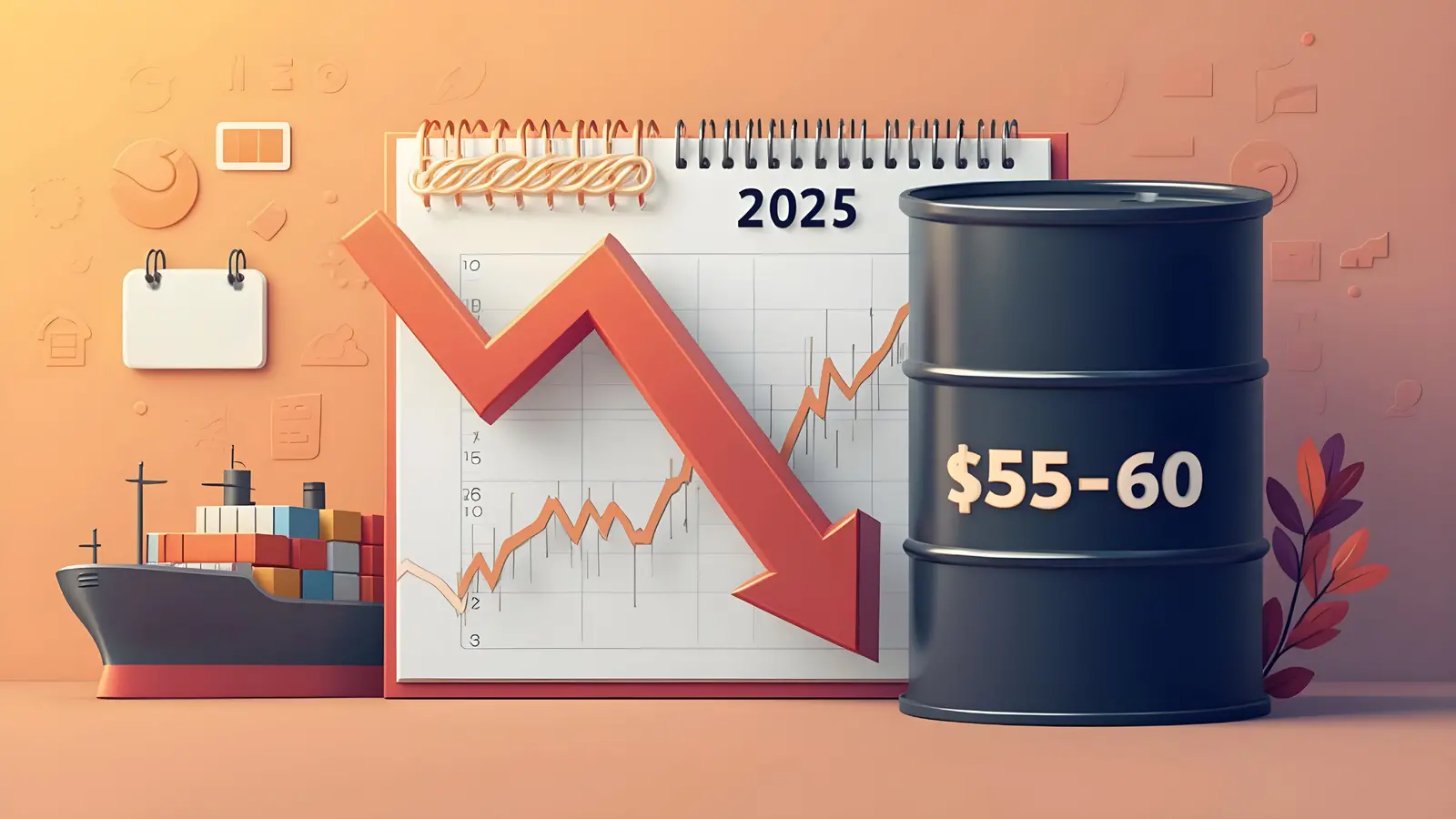
Thursday, July 3: Crude oil markets are facing significant headwinds, with a confluence of potential oversupply and weakening global demand expected to exert downward pressure in the second half of 2025. Premasish Das, Executive Director for Oil Markets Research and Analysis at S&P Global Commodity Insights, projects Brent crude prices could decline to $55–60 per barrel by December 2025.

Geopolitical and Tariff Risks Remain
A major factor contributing to market uncertainty is the ongoing geopolitical landscape, particularly concerning US tariffs. With a critical deadline approaching on July 9, the lack of substantial progress in resolving trade tensions raises concerns about potential escalation, especially with President Donald Trump’s possible reactions. Das commented, “The outcome is unpredictable. Much of the economic activity was front-loaded into the first half because of the known 10% tariff. As a result, we expect a noticeable slowdown in activity and oil demand in H2-CY2025.”
Brent Crude Forecast: Averaging Just Above $60 in H2
S&P Global’s forecast indicates that Brent crude will likely average slightly above $60 per barrel in the second half of 2025, culminating in a decline to the $55–60 range by year-end. This projection is based on the assumption that OPEC+ will not take aggressive measures to defend prices amidst a sluggish demand environment. Any deviation from this strategy by the cartel could, however, alter the outlook.
Demand Growth Slowing in India and China
Demand growth for refined products is showing signs of slowing in major Asian economies. India’s demand is anticipated to grow by only 110,000 barrels per day (b/d) in 2025, reaching 5.4 million b/d. Similarly, China is expected to see a modest increase from 16.9 million to 17.1 million b/d. This limited growth is largely driven by demand for petrochemical feedstocks such as LPG and naphtha, while demand for traditional fuels like gasoline and diesel is either stagnating or decreasing.
In India, the lower-than-expected demand growth is further impacted by the increasing adoption of alternative fuels like Compressed Natural Gas (CNG) and a rising penetration of electric vehicles (EVs). While this trend, coupled with slowing automobile sales, might be temporary, Das reiterated India’s long-term significance as a crucial growth market for oil.
OPEC+ Strategy Shifting
Despite the subdued demand outlook, some OPEC+ members are reportedly increasing their output. This move is influenced by factors like foreign investments and strategic repositioning. Saudi Arabia, which has shouldered the majority of production cuts, may be re-evaluating its stance. The group could potentially allow prices to fall, intending to revisit their production strategies later, possibly to pressure high-cost US producers, reminiscent of their strategy in 2014–15.
Viability Thresholds for Producers
From a cost perspective, West Asian producers maintain low operational costs, often below $20 per barrel. However, their fiscal break-even points, necessary to balance national budgets, are considerably higher, closer to $80–90 per barrel. Das suggested that the $60–70 per barrel range represents a “sweet spot” for most producers. He also cautioned that prolonged periods with prices below $60 could adversely impact US producers, potentially leading to political intervention to support domestic oil output.
What’s in the Future?
The oil market appears poised for a turbulent second half of 2025, influenced by multiple variables including ongoing geopolitical tensions, trade policy uncertainties, and a generally sluggish global economy. Premasish Das’s projection of Brent crude potentially falling to $55–60 a barrel underscores a prevailing bearish sentiment in the sector, emphasising the complex interplay of supply, demand, and geopolitical factors.
Disclaimer: At HDFC SKY, we take utmost care and due diligence in curating and presenting news and market-related content. However, inadvertent errors or omissions may occasionally occur.
If you have any concerns, questions, or wish to point out any discrepancies in our content, please feel free to write to us at content@hdfcsec.com
Please note that the information shared is intended solely for informational purposes and does not make any investment recommendations
 Join Us
 Add as preferred source on Google


More International News






Open Free Demat Account
Open Free Demat Account












Invest Anytime, Anywhere


By signing up I certify terms, conditions & privacy policy