Union Budget 2026-27: GDP Slowdown Weighs on Tax Collections but Fiscal Prudence Maintained
Authored By Prime Research | Last Modified: Feb 2, 2026 04:15 PM IST
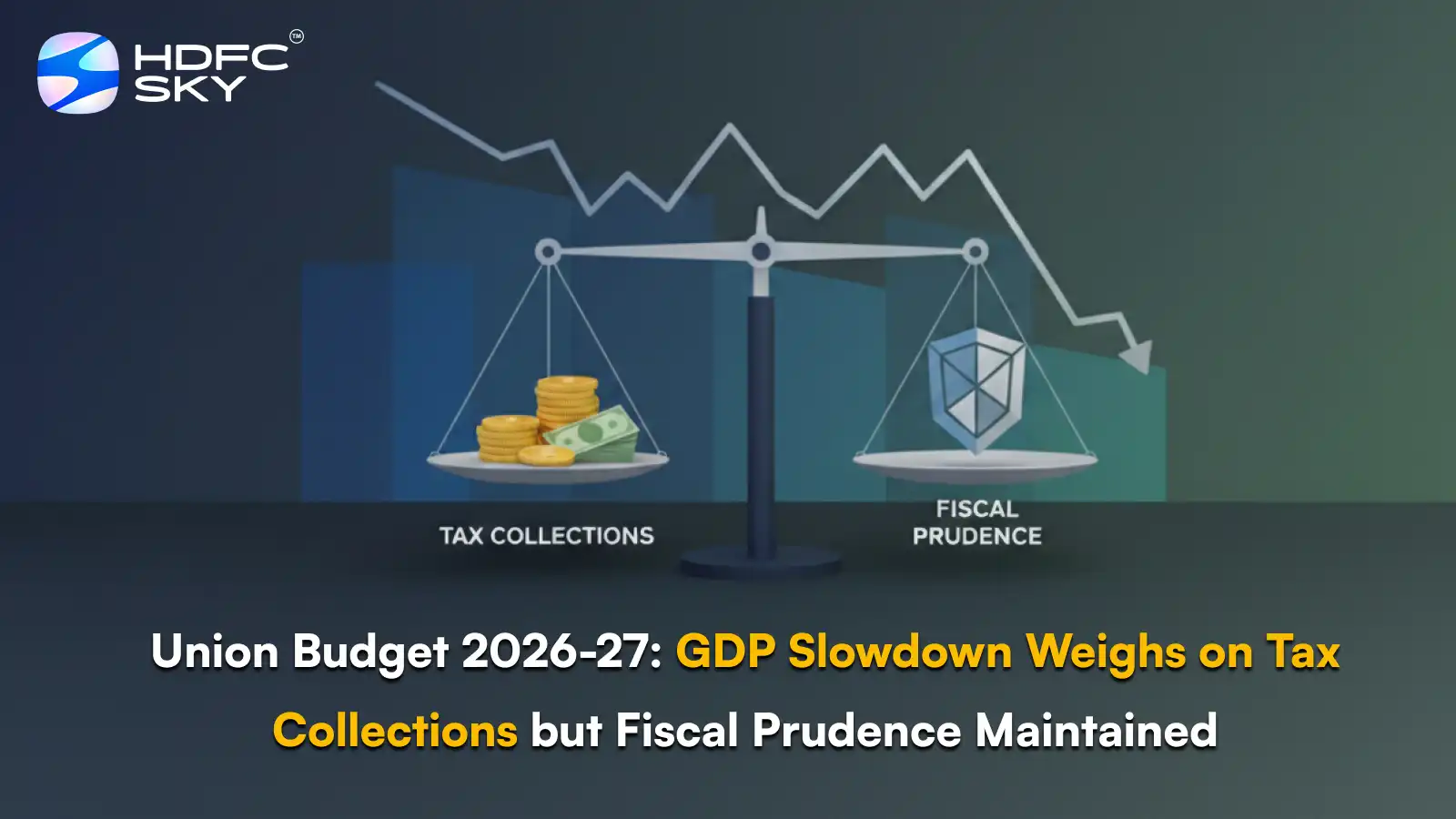
The FY27 Union budget did not deliver any major policy reform or any lucrative freebie for consumers. It rather remained focussed on charting a growth-oriented roadmap for “Viksit Bharat”. It was unequivocally reflected in the highest-ever capex allocation of INR 12.72trn (+11.5% YoY) while maintaining a fiscal deficit target of 4.3% (-10bps YoY) for FY27BE. The budget prioritized manufacturing growth through special programmes for semiconductors, metals, biopharma, container manufacturing, textiles, chemical parks, electronics manufacturing and MSMEs. However, raising the STT on futures and options under current market participants.
- Revenue: There was a marked improvement in corporate income tax collection, which grew at 12.4% in FY26RE as compared to the estimated 9.7% in FY26BE and 8.3% recorded in FY25. On the other hand, individual income tax collection declined sharply to 6.2% in FY26 due to tax slabs rationalisation and a nominal GDP slowdown, as compared to FY26BE estimates of 16.4% and a growth of 18.2% in FY25. This personal income tax slowdown led to a subdued overall tax growth of ~9% in FY26RE (13.4% growth estimated in FY26BE). On the indirect taxes front, GST collection growth also remained subdued at ~2% in FY26RE (14.7%), while customs and excise grew strongly at 11.5% in FY26RE benefiting from FY26 budget estimates of 4.4%. As a result, overall net tax revenue to the centre delivered a significant miss at 7% growth in FY26RE (FY26BE: 13.5%).
- Expenditure: The shortfall observed in revenue collection led to lower-than-estimated growth for rural development (FY26RE: 3%, FY26BE: 30%), urban development (FY26RE:7.4%, FY26BE: 82%), and telecom & IT. Due to emergency procurement, defence allocation was higher than estimates (FY26RE: 26%, FY26BE: 9%). Expenditure toward food and fertiliser subsidies was also higher than budget estimates (FY26RE: 11.6%, FY26BE: 0%). FY27BE is expected to witness higher allocation toward rural development, transport, education, urban development, T& telecom, and energy while subsidies will witness a YoY degrowth.
- The capex budget is estimated to grow by 11.5% to INR 12.7trn in FY27BE as against INR 10.95trn achieved in FY26RE (-9% of FY26BE). With IEBR, Capex is estimated to grow to INR 14.3trn in FY27BE (+11.7% as against FY26RE). While aggregate capex budget for FY27 is expected to grow steadily at a pace like previous years, the focus on various sectors viz. road transport, railways, defence, and power contribute ~65% of overall FY27BE capex.
- It is worth noticing that capex budget growth for road transports and railways were flattish as the rationale to growth is maintained to grow at 8-1% and 10.5%, respectively in FY27BE. Led by the rising need of sovereign protection in the wake of geopolitical uncertainties, defence budget allocation has gone up by 17.0% YoY in FY27BE. Loans to states for capex grew massively by 30% in FY27BE to INR 2.0 trn vis-à-vis FY26RE. In our view, government’s strategy of bringing investment led growth in the country is being executed without any deterrence. As fiscal deficit is also under control, we can expect capex to grow steadily in the coming years as well.
- Subsidies towards fertiliser, food and petroleum are projected to decline marginally by ~5% to INR 4.1 trn in FY27BE as against FY25RE. Food subsidy budget will decline by INR ~8% to INR 1.7bn in FY27BE coupled with flattish allocation of ~INR 2.2trn towards fertiliser.
- Delivering a fiscal deficit of 4.4% for FY26RE is a welcome achievement, as it has improved from 9.1% in FY21 steadily without compromising on the capex, which has grown approx. three-fold in the same period. Clinching with demonstrated fiscal prudence so far, government has estimated fiscal deficit for FY27BE at 4.3% of GDP. With current debt to GDP ratio of ~55.6%, government aims to reach a level of 50% by FY31. The fiscal deficit estimate for FY27BE rests on key assumptions (explained further).
- Realistic nominal GDP growth of 10.0% in FY27BE vis-à-vis 8% in FY26RE. It can be noted that real growth recorded in FY26 was 7.4% but subdued inflation led low GDP deflator brought down nominal growth. Real GDP is estimated to grow between 6.8–7% p.a. in FY27BE and inflation is projected to bounce back to ~3.5% average levels in FY27.
- Conservative estimates of 7.2% growth in net tax revenue to Centre in FY27BE (7% in FY26RE), despite estimated rise in nominal GDP growth. This is projected to be led by ~11.4% and 12.8% YoY growth in direct tax and customs & excise duty respectively; while GST is estimated to degrow by ~3% YoY in FY27BE. Dividends from RBI and PSUs are INR 3.16trn and INR 750bn respectively in FY27BE (as against INR 3.05 trn and INR 710bn respectively in FY26RE). Further, gross tax to GDP is projected to decline to 11.2% in FY27BE from 11.4% in FY26RE (direct tax growth only 10 bps to 6.9%, indirect tax reducing by 40 bps to 4.3%).
- In our view, net tax revenue to the center has upside risk as nominal GDP grows faster in FY27 vis-à-vis FY26 with the help of inflation and a realistic expectation of ~7% real GDP. Further, aligning with the recent trends, RBI, and PSU dividends are expected to be met. Additionally, the assumption of a 3% YoY loss on GST collection also seems aggressive and compliance increases due to slab rationalization. Hence, overall fiscal deficit target is expected to be met.
- For financing this fiscal deficit, gross market borrowing is projected to increase to INR 17.2trn in FY27BE vis-à-vis INR 14.6trn in FY26RE, a 17.8% growth. At the face of it, it appears to be a detrimental to government’s fiscal prudence, but considering higher repayment estimated this fiscal (46% YoY growth), it can be concluded that net market borrowing is estimated to rise by a miniscule ~3.6% in FY27BE vis-à-vis FY26RE. Reliance on small savings securities is still significant (~23.5% of debt receipts in FY27BE, as against 24.6% in FY26RE). We believe benign fiscal deficit of FY26RE and lower estimates for FY27BE (by 10 bps) will keep 10-year bond yields subdued in the medium term.
Union Budget 2026-27: Key Policy Announcements
- Electronics Components Manufacturing Scheme: Outlay has almost doubled to INR 400bn to capitalize on received investment commitments far outpacing the target.
- Railway corridors: To promote sustainable passenger systems, seven high speed rail corridors are being developed between major cities as ‘growth connectors’.
- Restructuring of PFC and REC: Under the Viksit Bharat vision for NBFCs, restructuring of PFC and REC is taking place as the first step to enhance scale and efficiency.
- Biopharma SHAKTI: With an outlay of INR 100bn Biopharma SHAKTI has been proposed to develop India as a global Biopharma manufacturing hub.
- Rare Earth Permanent Magnets Scheme: Dedicated Rare Earth Corridors are being established across four states to promote self reliance through mining, research, and manufacturing.
- Increase in STT: STT on Futures has been increased 0.05% from 0.02%. Also, STT on premium and exercise of options are raised to 0.15% from 0.1% and 0.125%, respectively.
- Attracting Investments in Data Centers: Tax holiday proposed up to 2047 for any foreign company procuring data center services from India.
- Buyback tax: Buybacks will now be taxed as capital gains which will make them more tax efficient than dividends for distribution of share of profits.
- Container Manufacturing Scheme: A scheme is introduced with an allocation of INR 100 bn over 5 years to create a globally competitive container manufacturing ecosystem.
- Union Budget FY27 reflects the government’s undeterred focus on uplifting economy through long term sustainable investments, without compromising on fiscal policies. Overall, in our view, the government has delivered a balanced budget without any major reform but has provided adequate support to high growth niche sectors such as biopharma, data centres, rare earth metals, chemicals and textiles.
- Sector impact: Positive for industrials, EMS, mining, infrastructure, and pharmaceuticals. Neutral for consumers.
Disclaimer:
This report has been prepared by HDFC Securities Ltd and is solely for information of the recipient only. The report must not be used as a singular basis of any investment decision. The views herein are of a general nature and do not consider the risk appetite or the particular circumstances of an individual investor; readers are requested to take professional advice before investing. This report may have been refined using AI tools to enhance clarity and readability.
Nothing in this document should be construed as investment advice. Each recipient of this document should make such investigations as they deem necessary to arrive at an independent evaluation of an investment in securities of the companies referred in this document (including merits and risks) and should consult their own advisors to determine merits and risks of such investment. The information and opinions contained herein have been compiled or arrived at, based upon information obtained in good faith from sources believed to be reliable. Such information has not been independently verified and no guarantee, representation or warranty, express or implied, is made as to its accuracy, completeness or correctness. All such information and opinions are subject to change without notice. Descriptions of any company or companies or their securities mentioned herein are not intended to be complete. HSL is not obligated to update this report for such changes. HSL has the right to make changes and modifications at any time.
This report is not directed to, or intended for display, downloading, printing, reproduction or for distribution to use by, any person or entity who is a citizen or resident or located in any locality, state, country or other jurisdiction where such distribution, publication, reproduction, availability or use would be contrary to law or regulation or what would subject HSL or its affiliates to any registration or licensing requirement within such jurisdiction.
If this report is inadvertently or has reached any person in such country, especially, United States of America, the same should be ignored and brought to the attention of the sender. This document may not be reproduced, distributed or published in whole or in part, directly or indirectly, for any purposes or in any manner.
Foreign currencies denominated securities, where mentioned, are subject to exchange rate fluctuations, which could have an adverse effect on their value or price, or the income derived from them. In addition, investors in securities such as ADRs, the values of which are influenced by foreign currencies effectively assume currency risk. It should not be considered to be taken as an offer to sell or a solicitation to buy any security.
This document is not, and should not, be construed as an offer or solicitation of an offer, to buy or sell any securities or other financial instruments. This report should not be construed as an invitation or solicitation to do business with HSL. HSL may from time to time solicit from, or perform brokerage, or other services for, any company mentioned in this mail and/or its attachments.
HSL and its affiliated company(ies), their directors and employees may: (a) from time to time, have a long or short position in, and buy or sell the securities of the company(ies) mentioned herein or (b) be engaged in any other transaction involving such securities and earn brokerage or other compensation or act as a market maker in the financial instruments of the company(ies) discussed herein or act as an advisor or lender/borrower to such company(ies) or may have any other potential conflict of interests with respect to any recommendation and other related information and opinions.
HSL, its directors, analysts or employees do not take any responsibility, financial or otherwise, for the losses or the damages sustained due to the investments made or any action taken on basis of this report, including but not restricted to, fluctuation in the prices of shares and bonds, changes in the currency rates, diminution in the NAVs, reduction in the dividends or income etc.
HSL and other group companies, its directors, associates, employees may have various positions in any of the stocks, securities and financial instruments dealt in the report, or may make sell or purchase or other deals in these securities from time to time or may deal in other securities of the companies / organizations described in this report. As regards the associates of HSL please refer the website.
HSL or its associates might have managed or co-managed public offering of securities for the subject company or might have been mandated by the subject company for any other assignment in the past twelve months.
HSL or its associates might have received any compensation from the companies mentioned in the report during the preceding twelve months from the date of this report for services in respect of managing or co-managing public offerings, corporate finance, investment banking or merchant banking, brokerage services or other advisory service or a merger or specific transaction in the normal course of business.
HSL or its analysts did not receive any compensation or other benefits from the companies mentioned in the report or third party in connection with preparation of the research report. Accordingly, neither HSL nor Research Analysts have any material conflict of interest at the time of publication of this report. Compensation of our Research Analysts is not based on any specific merchant banking, investment banking or brokerage service transactions. HSL may have issued other reports that are inconsistent and reach different conclusion from the information presented in this report.
Research entity has not been engaged in market making activity for the subject company. Research analyst has not served as an officer, director or employee of the subject company. We have not received any compensation/benefits from the subject company or third party in connection with the Research Report.
Please note that HDFC Securities has a proprietary trading desk. This desk maintains an arm’s length distance with the Research team and all its activities are segregated from Research activities. The proprietary desk operates independently, potentially leading to investment decisions that may deviate from research views.
HDFC Securities Limited, I Think Techno Campus, Building – b, “Alpha”, Office Floor 8, Near Kanjurmarg Station, Opp. Crompton Greaves, Kanjurmarg (East), Mumbai 400 042 Phone: (022) 3075 3400 Fax: (022) 2496 5066
Compliance Officer: Mr Milan V Karker Email: complianceofficer@hdfcsec.com Phone: (022) 3045 3600
For grievance redressal contact Customer Care Team Email: customercare@hdfcsec.com Phone: (022) 3901 9400
HDFC Securities Limited. SEBI Reg. No.: INESE, BSE, MSEI, MCX: INZ000186537; AMFI Reg. No. ARN: 13549; PFRDA Reg. No. POP: 11092018; IRDA Corporate Agent License No.: CA0062; SEBI Research Analyst Reg. No.: INH000002475; SEBI Investment Adviser Reg. No.: INA000011538; CIN – U67120MH2000PLC152193 Investment in securities market are subject to market risks. Read all the related documents carefully before investing.
Mutual Funds Investments are subject to market risks. Please read the offer and scheme related documents carefully before investing.
Registration granted by SEBI, membership of BASL (in case of IAs) and certification from NISM in no way guarantee performance of the intermediary or provide any assurance of returns to investors.
 Join Us
 Add as preferred source on Google