India’s Economy Zooms Ahead: Q1 GDP Growth Hits a Five‑Quarter High of 7.8%
Authored By Shishta Dutta | Last Modified: Oct 7, 2025 10:00 AM IST
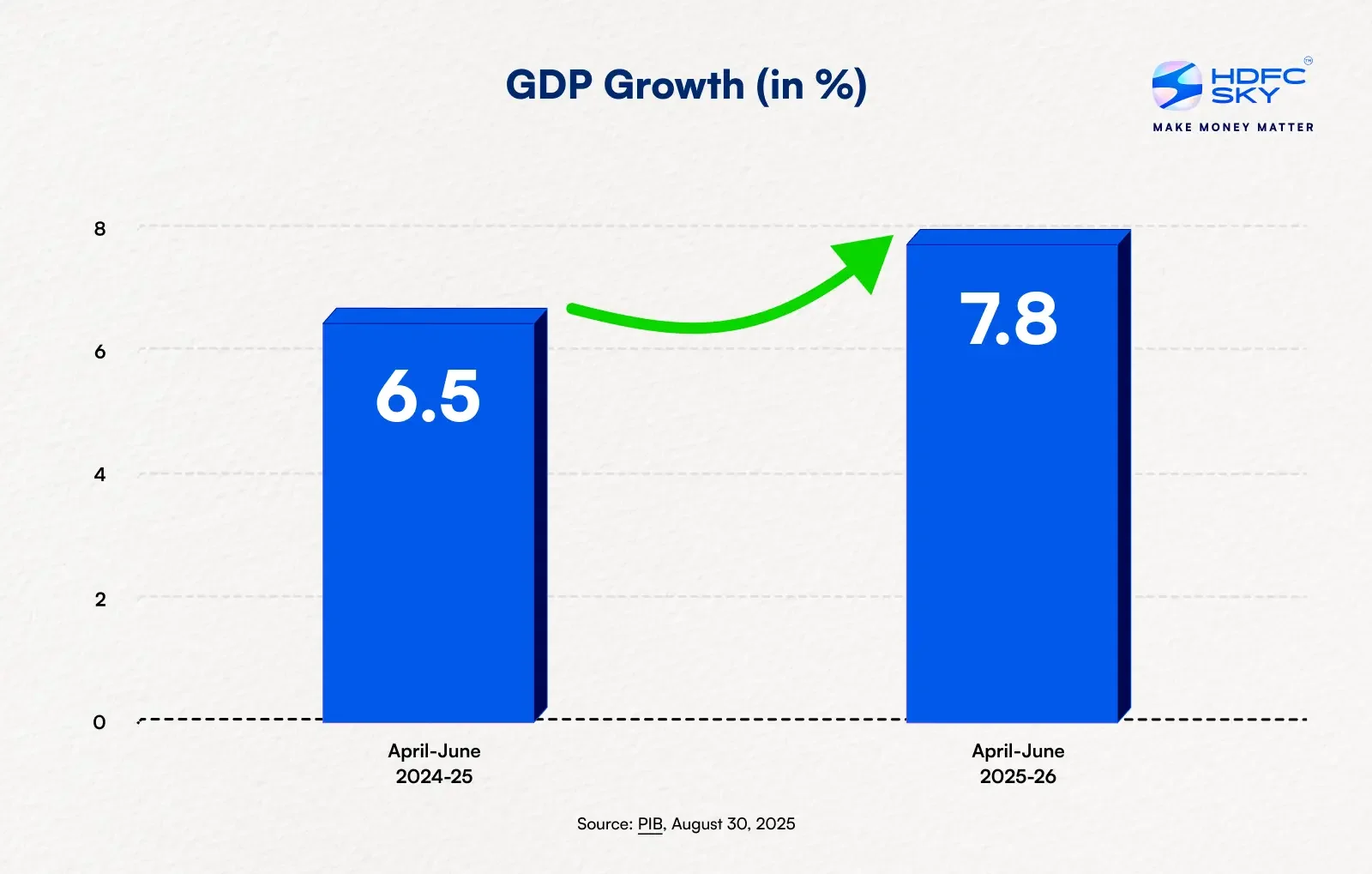
In the opening quarter (Q1 FY26) of the financial year 2025-26 (April to June), India’s economy expanded impressively, recording a 7.8 percent year-on-year growth in real Gross Domestic Product (GDP). This sharp rise marks a significant jump from the 6.5 percent growth achieved in the same quarter last year (Q1 FY25).
India, now the world’s fourth-largest economy, is projected to climb to third place by 2030 , with GDP expected to reach $7.3 trillion .
The 7.8% growth also comes amid geopolitical uncertainties, global supply chain adjustments, and energy market volatility. India’s ability to navigate these headwinds, while maintaining high growth, underscores the economy’s increasing maturity and shock absorption capacity.
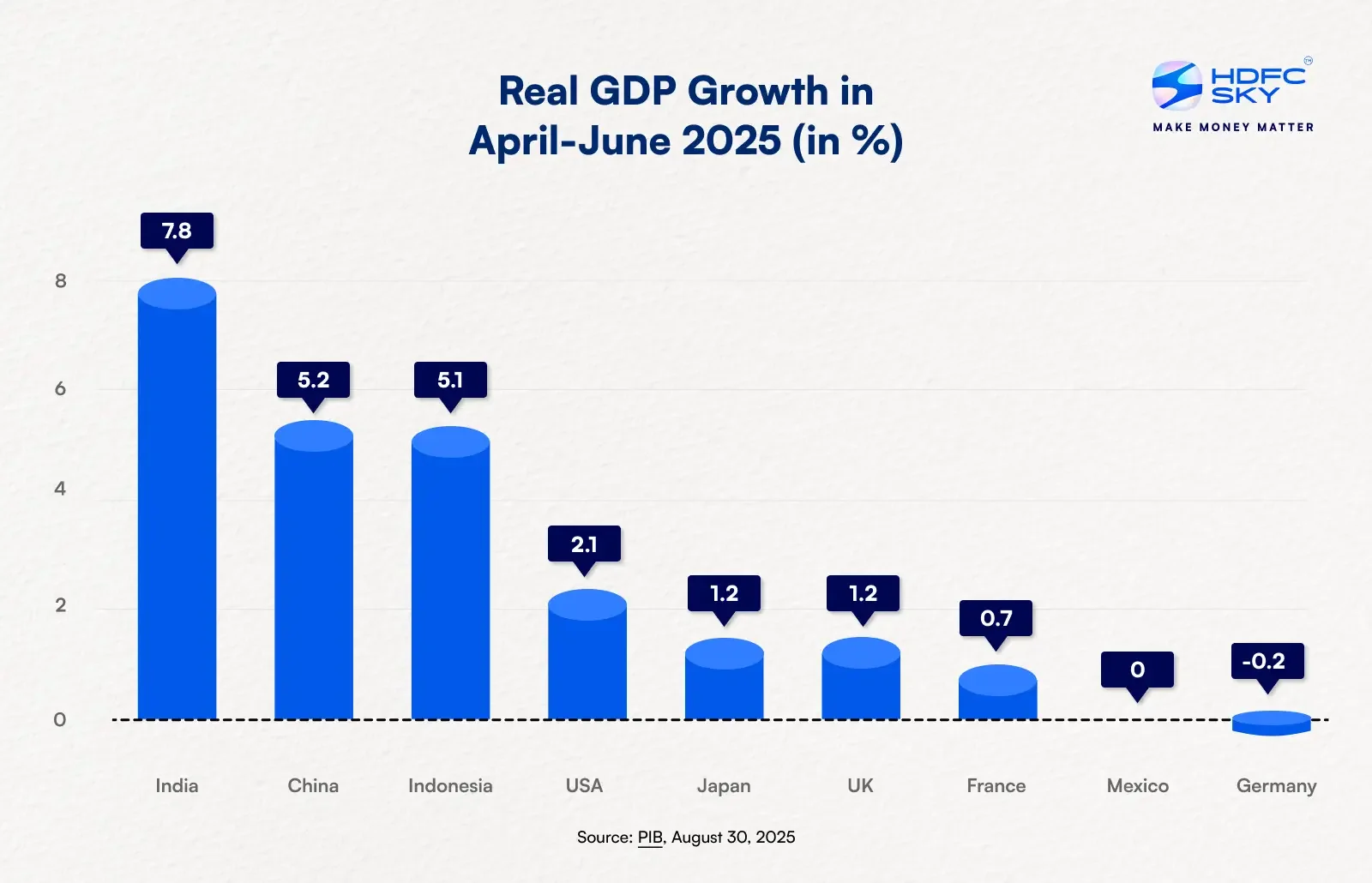
This acceleration reaffirms India’s role as the fastest-growing major economy in the world. Analysts and policymakers highlight the role of robust domestic demand, stable agricultural output, and policy measures in creating a conducive environment for the economy to flourish.
Understanding the Numbers
When we look at the numbers behind this growth, real GDP in Q1 FY26 was estimated at ₹47.89 lakh crore, up from ₹44.42 lakh crore in the year-ago period (Q1 FY25).
Similarly, Nominal GDP, which factors in price changes (inflation), also witnessed solid growth at 8.8 percent, reaching ₹86.05 lakh crore ( in Q1 FY26) from ₹79.08 lakh crore last year (Q1 FY25).
This healthy rise in nominal figures indicates that, beyond increases in real output, price dynamics and demand conditions have also played a part in boosting economic numbers.
Sectoral Momentum: Agriculture to Services
Breaking things down by sectors reveals a story of broad-based growth:
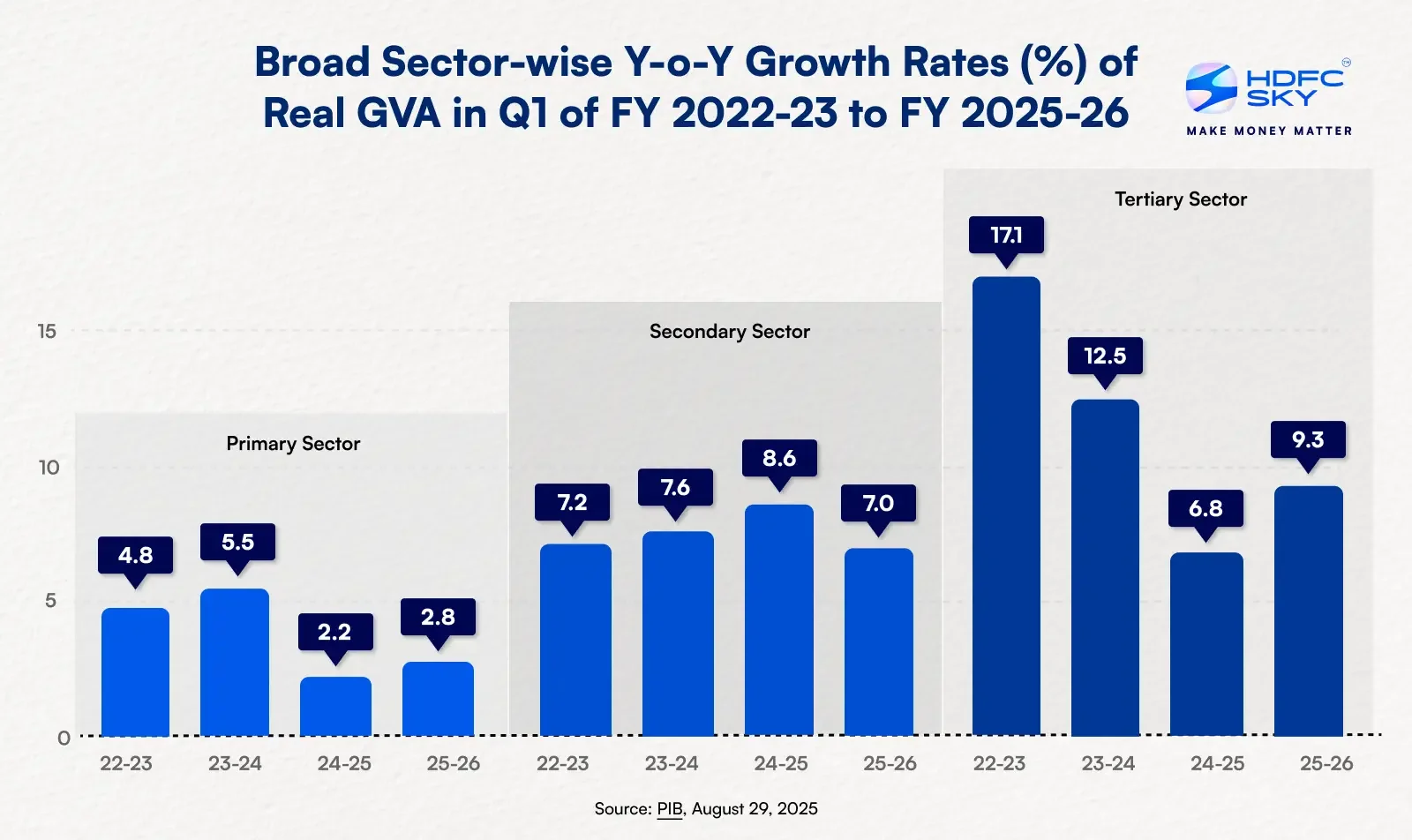
Primary Sector (Agriculture and Allied Sector): Expanded by around 3.7 percen t, more than double its pace from a year earlier.
Secondary Sector: Manufacturing and construction were particularly dynamic, posting growth rates of 7.7 percent and 7.6 percent respectively, both exceeding the 7.5 percent mark.
Tertiary Sector (Services): The standout performer, with growth surging to 9.3 percent compared to 6.8 percent a year earlier.
This across-the-board strength indicates that expansion was not confined to one area, rather, it reflected rising momentum across agriculture, industry, and services alike.
Even when looking at the broad sector-wise year-on-year growth rates in real GVA from Q1 of FY23 to FY26, the tertiary sector stands out as a high-performing segment, while the primary and secondary sectors are also catching up.
What Fueled the Upsurge?
Several key factors contributed to India’s lively economic start to FY 2025‑26. First, strong consumer demand appears to have driven domestic growth. With inflation easing and households reclaiming spending momentum, economic activity across markets picked up nicely.
The government’s policies also played a supporting role. Increased public consumption, renewed capital expenditure, and reforms such as next-generation GST and employment schemes helped sustain confidence among businesses and investors.
India’s stable macroeconomic environment, combined with comparatively low inflation and improvements in employment conditions, bolstered its attractiveness as a global investment destination.
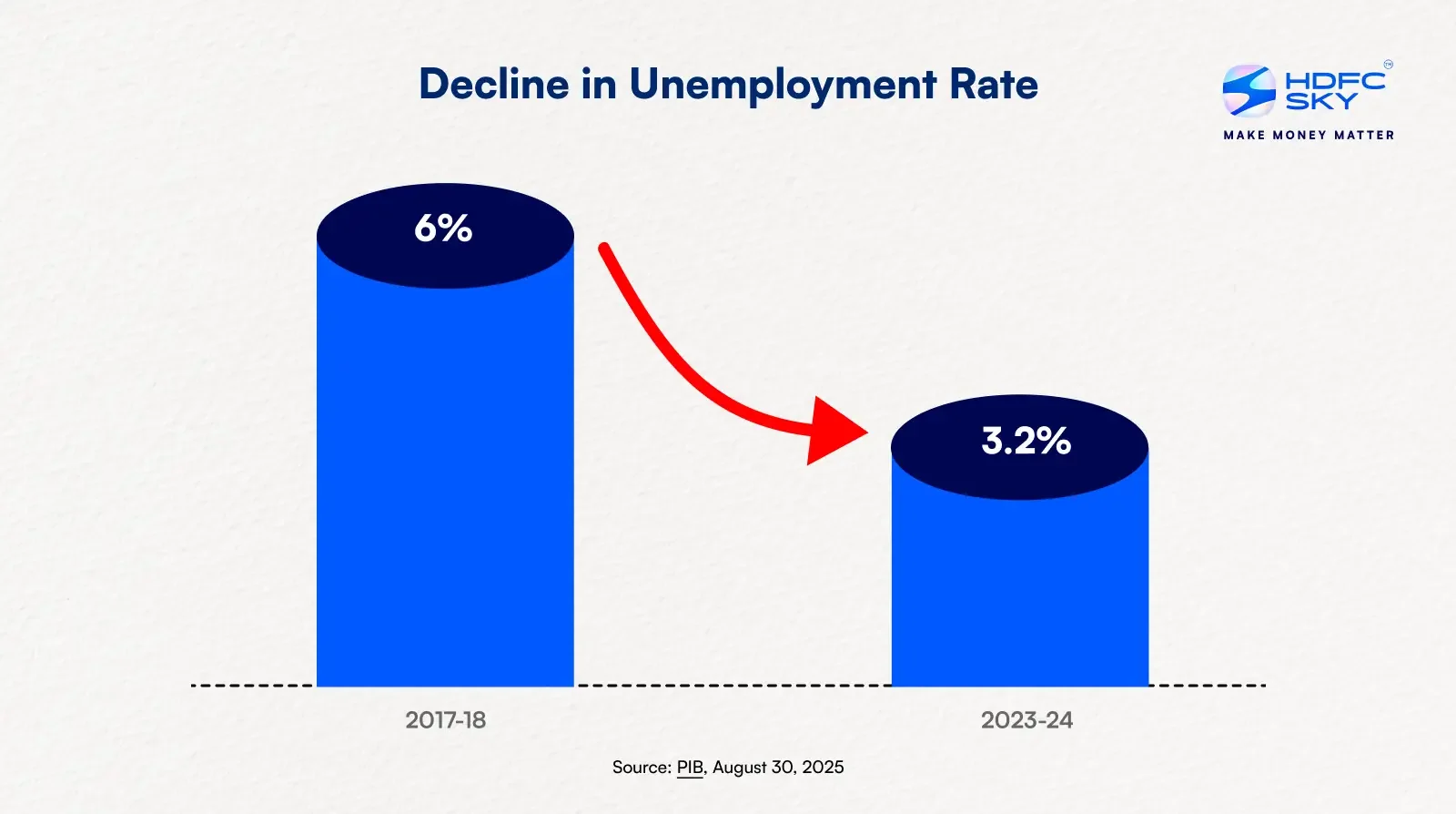
The country has witnessed a remarkable improvement in its labour market performance. The unemployment rate fell sharply from 6.0% in 2017-18 to just 3.2% in 2023-24, reflecting deeper workforce absorption into productive sectors.
Even more encouraging is the trend among young people, the youth unemployment rate dropped from 17.8% to 10.2% in the same time frame, now well below the global average of 13.3%, as noted in the ILO’s World Employment and Social Outlook 2024.
These shifts point to a more inclusive recovery, driven not just by output growth but also by expanding livelihood opportunities.
Looking Forward: Sustainability and Risks
While the numbers are encouraging, experts caution that sustaining this pace of growth will not be straightforward.
Some experts believe that the reported 7.8% real GDP growth may be a bit higher than the actual growth because of the use of very low deflators, especially in services and manufacturing. A deflator is used to remove the effect of inflation when measuring real growth. If this inflation is underestimated, it can make the economy look like it’s growing faster than it really is.
For example, if prices went up by ₹5 but only ₹2 is accounted for, the remaining ₹3 gets wrongly counted as extra growth. This issue is more common in the services sector, where prices are harder to track. So, while the economy is growing, the pace may be slightly overstated.
On the external front, global trade challenges could weigh on future performance. Rising targeted U.S. tariffs on Indian exports, especially in sectors like textiles and chemicals, may dampen growth later in the year
Economists remain cautiously optimistic. Many retain full-year growth forecasts around 6-6.5 percent , suggesting that while the start was stronger than expected, a slowdown in the latter half of the year remains a possibility.
.
A Balanced Perspective
India’s economic performance in Q1 FY 2025‑26 is undoubtedly strong. Rapid expansion across key sectors, rising consumer demand, and timely policy interventions combine to paint an encouraging picture. The rise across agriculture, manufacturing, construction, and services underscores a resilient and multifaceted economy.
Yet, there’s reason to temper enthusiasm. External risks, especially related to trade, and potential downturns in investment or urban demand could slow momentum. Realistic expectations and policy vigilance will be crucial in steering through the rest of the year.
Conclusion
India’s economy kicked off FY 2025‑26 on a strong note with 7.8 percent GDP growth, its best in five quarters. This performance reflects broad-based strength and sound fundamentals, giving the country a competitive edge as global growth slows.
Looking ahead, the challenge will be to build on this start and navigate headwinds with agility. Sustained reforms, support for investment, and resilience amid global pressures will be key. If India manages that, its trajectory toward becoming the world’s third-largest economy by 2030 seems well within reach.
Disclaimer: At HDFC SKY, we take utmost care and due diligence in curating and presenting news and market-related content. However, inadvertent errors or omissions may occasionally occur.
If you have any concerns, questions, or wish to point out any discrepancies in our content, please feel free to write to us at content@hdfcsec.com.
Please note that the information shared is intended solely for informational purposes and does not make any investment recommendations
 Join Us
 Add as preferred source on Google