ISM 2.0 Announced; Electronics Component Manufacturing Scheme Expanded to Rs 40,000 Crore
Authored By HDFC SKY | Published at: Feb 1, 2026 04:23 PM IST
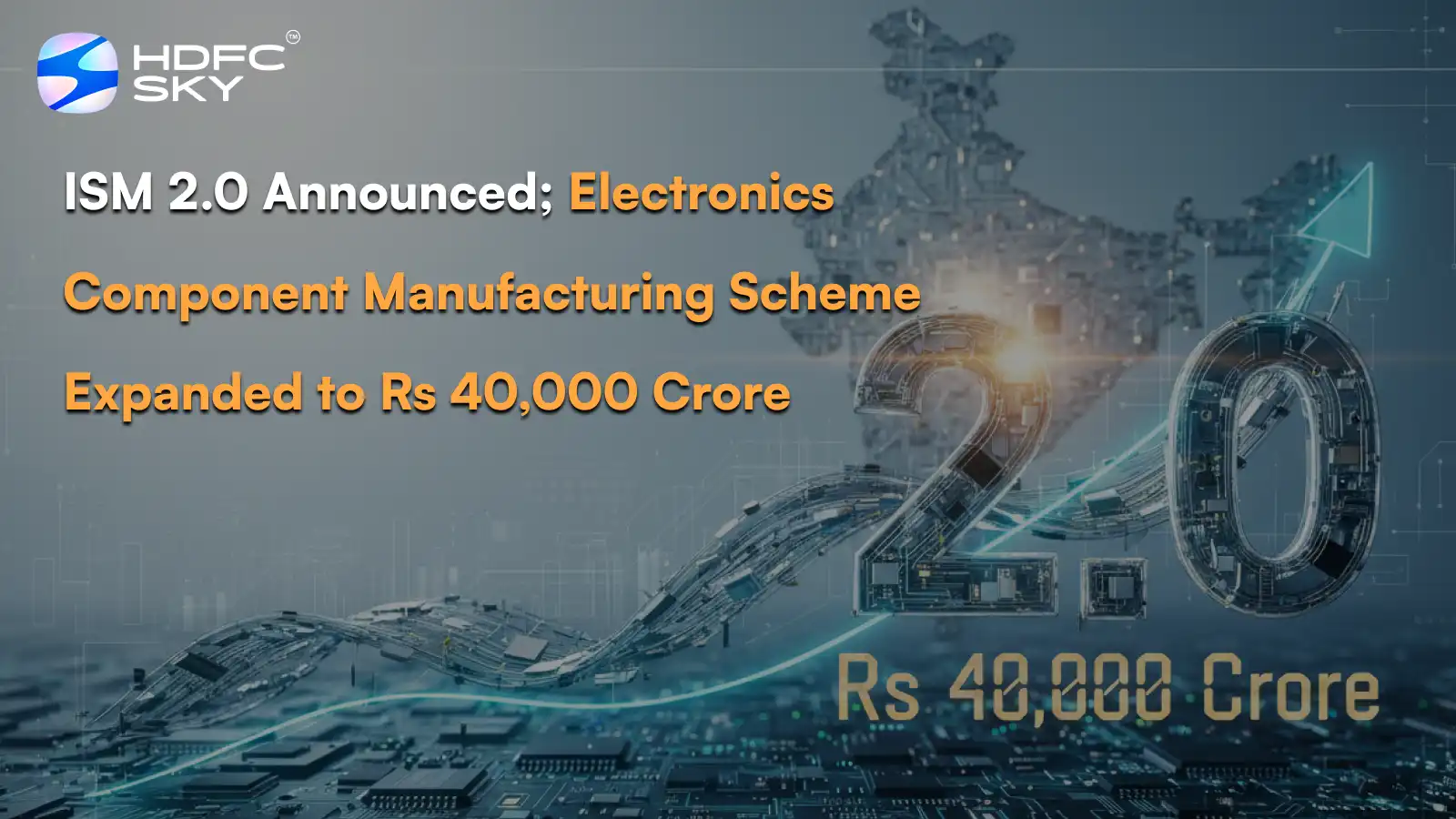
Mumbai, February 1, 2026: While presenting the Union Budget 2026-27 today, Finance Minister Nirmala Sitharaman announced the India Semiconductor Mission (ISM) 2.0, marking a renewed push to strengthen India’s semiconductor ecosystem.
This preparation mostly concentrated on India’s larger plan to lessen reliance on imports, encourage homegrown production, and generate a variety of employment opportunities. ISM 1.0, which improved India’s standing in the semiconductor value chain, served as the basis for the new phase.
Key Highlights of ISM 2.0
Under the new strategy, the government has increased the amount allocated for the Electronic Component Manufacturing (ECM) scheme to ₹40,000 crore from the earlier amount.
During the presentation, the Finance Minister stated that ISM 2.0 will focus on manufacturing semiconductor equipment and materials in India, thus developing excellent chip design capabilities. This is expected to boost both domestic and global supply chains.
Building India’s Complete Semiconductor Ecosystem
ISM 2.0 seeks to advance India’s position in the global semiconductor sector, whereas ISM 1.0 was mainly concerned with attracting semiconductor production units and assembly factories.
The Indian government primarily concentrates on manufacturing its own semiconductor materials and equipment. These are mostly dependent on imports. India intends to produce robust and powerful semiconductors for a range of uses, like car electronics and smartphones.
Expected Impact on Jobs, Investment and Exports
The programme aims to create high-value jobs in chip design, system-level integration, and advanced electronics manufacturing, and it is also expected to help build domestic intellectual property and boost India’s position in the semiconductor value chain.
With the implementation of ISM 2.0 and the expansion of electronics component manufacturing, the framework is well-positioned to attract new foreign direct investment. This would help support the growth of electronics exports in the medium to long term.
Over time, these steps are meant to minimise India’s dependency on foreign components. This would be done while also promoting scale, competitiveness, and job creation.
Government Rationale and Policy Direction
The introduction of ISM 2.0 and the growth of the electronics manufacturing ecosystem, according to the Union Budget 2026–2027 projections, highlight the government’s emphasis on developing a robust domestic semiconductor base. In addition to supporting India’s overarching goal of bolstering self-reliance in essential technologies, the policy approach is in line with the growing worldwide demand for semiconductors.
It aims to foster an environment that is favourable to long-term investment, technology development, and advanced manufacturing.
Disclaimer: At HDFC SKY, we take utmost care and due diligence in curating and presenting news and market-related content. However, inadvertent errors or omissions may occasionally occur.
If you have any concerns, questions, or wish to point out any discrepancies in our content, please feel free to write to us at content@hdfcsec.com.
Please note that the information shared is intended solely for informational purposes and does not make any investment recommendations
 Join Us
 Add as preferred source on Google