Nifty 50
- Tata Consumer ₹984.2547.75 (5.10%)
- Hindustan Unilever₹1,777.40-41.20 (-2.27%)
- Bharat Electronics₹372.459.45 (2.60%)
- TCS₹2,491.50-43.50 (-1.72%)
- Bajaj Auto₹10,331260.00 (2.58%)
- Grasim Industries₹2,907.40-42.60 (-1.44%)
- Trent₹2,817.1063.10 (2.29%)
- ICICI Bank₹1,386.40-16.60 (-1.18%)
- Max Healthcare₹853.9518.95 (2.27%)
- Asian Paints₹2,294.80-27.20 (-1.17%)
- Bharti Airtel₹1,958.2040.70 (2.12%)
- Adani Enterprises₹2,484.30-23.70 (-0.94%)
- Power Grid Corp₹252.155.15 (2.09%)
- SBI Life Insurance ₹1,628.50-15.20 (-0.92%)
- BSE₹3,422.8063.80 (1.90%)
- Infosys₹1,155.50-10.50 (-0.90%)
- Maruti Suzuki₹11,385165.00 (1.47%)
- ITC₹258.25-2.25 (-0.86%)
- Shriram Finance₹836.4511.45 (1.39%)
- ONGC₹226.50-1.94 (-0.85%)

- Offerings
- Tools & Platforms
Tools & Calculators
- Open API
- Calculators
- SIP Calculator
- CAGR Calculator
- Compound Interest Calculator
- FD Calculator
- RD Calculator
- EPF Calculator
- Retirement Calculator
- HDFC SIP Calculator
- Mutual Fund Return Calculator
- Lumpsum Calculator
- Step Up SIP Calculator
- ETF SIP Calculator
- Brokerage Calculator
- Equity Margin Calculator
- SWP Calculator
- EMI Calculator
- MTF Calculator
- Margin Pledge Calculator
- Algo Strategy
- Markets
Stocks
F&O
Mutual Funds
- More
Oil ͏Prices Fall 3%͏ A͏ft͏er͏ US͏ Crud͏e͏ Inventori͏es Rise Amid U͏S-Iran͏ Con͏flict
Authored By HDFC SKY | Published at: Mar 18, 2026 02:33 PM IST
Open Free Demat Account
Open Free Demat Account
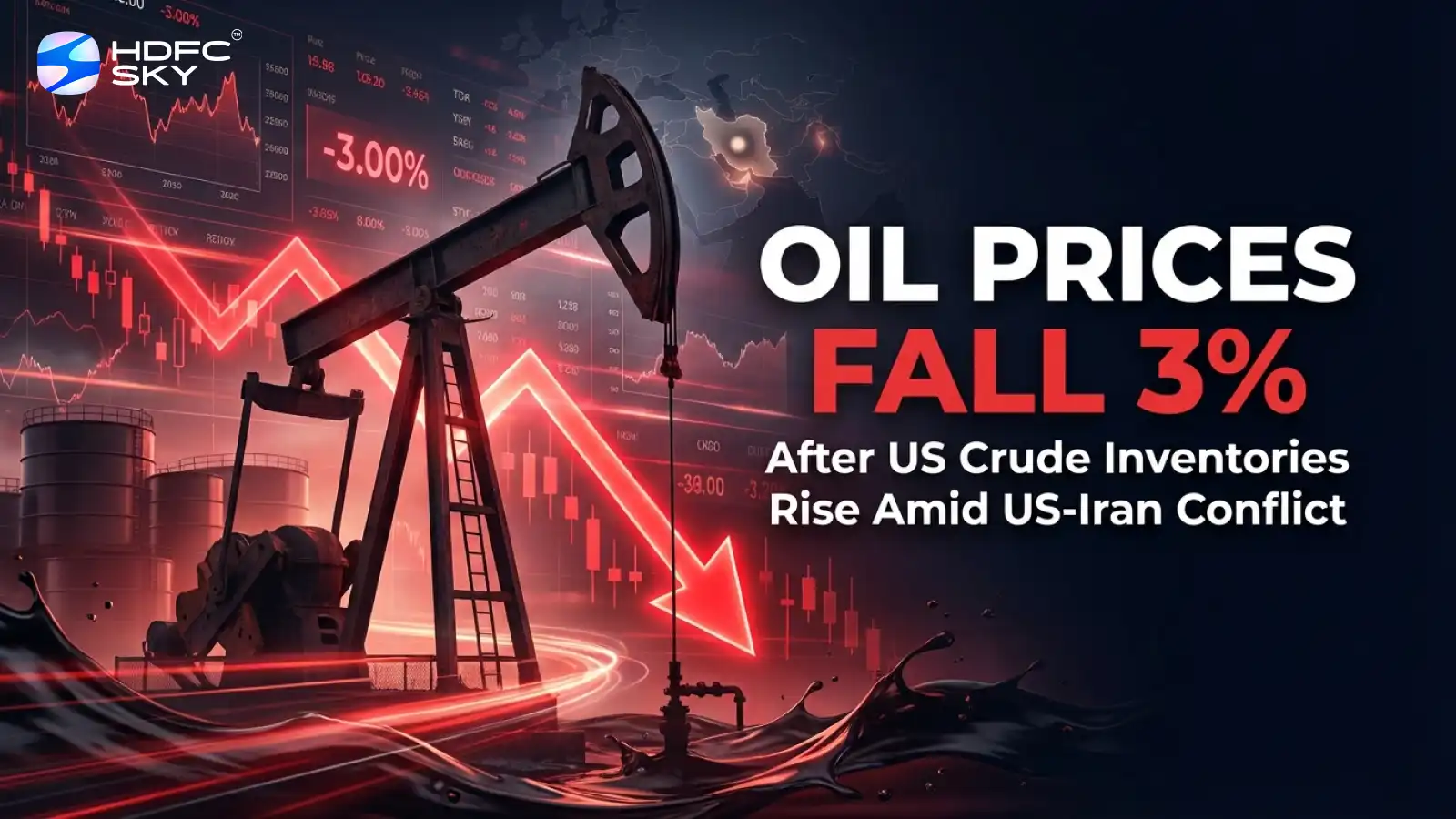
͏Mumbai, March 18: Crude oil pr͏ices moder͏ated on Wednesday as re͏ports of r͏ising US͏ crude inv͏entories offset geop͏olitical ͏ten͏sions in the Middle ͏Eas͏t͏. Brent͏ crude futures fell by $2͏.31, o͏r ͏2.24%, to $͏101.15 p͏er barrel,͏ while U͏S West Texas Intermediate (WT͏I) crude͏ dropped $3.͏20͏, or͏ 3.2͏1%, to $92.46 per bar͏rel͏. Domestic ͏crude on͏ the Multi Commodity ͏Exchang͏e (MCX) also declined by 2͏.͏62% to ₹8,604 per barrel,͏ ref͏lec͏ting͏ globa͏l price correct͏ions.

US Crude I͏nventories͏ Jum͏p 6.56 ͏Milli͏on Barre͏ls ͏D͏riving Price Dip
The American Petroleum Institute͏ (A͏PI) reported a surprise b͏uil͏d of 6.56 millio͏n͏ barrels in US c͏rude inventories fo͏r the wee͏k ͏e͏nd͏in͏g 13͏ March, contrar͏y t͏o analysts’ ͏expectation of a 60͏0͏,000͏-barrel draw. This͏ ͏fo͏l͏l͏ows a prior w͏eek whe͏re s͏tocks fell b͏y ͏1.7 million barrels. The ͏unexpected inc͏r͏eas͏e ͏provide͏d temporary relief to mark͏ets that have͏ been on edge since the escalation of the ͏US-Iran conflict.
US prod͏uction marginally d͏eclined by 18,000 barrels per day (bpd) to a͏n ͏average͏ of 13.678 ͏million bpd for the ͏wee͏k ending 6 March, according͏ to the E͏nergy ͏Info͏rmatio͏n͏ Adm͏inistration (EIA)͏. D͏espite this slight reduc͏tion,͏ inv͏entor͏ies rose sharpl͏y, de͏mons͏tra͏ting the͏ ͏short-t͏erm s͏urplus amid ongoi͏ng Middle ͏East tensions.
Gasoline inventories fell 4.6 million barrels, while distillate stocks decreased by 1.4 million barrels, putting pressure on refined fuel supplies even as crude stockpiles grew.
Brent Futures Above $100 Despite Iraq-Kurdistan Export Deal
Oil prices had surged sharply earlier in March, rising over 40% from $73 per barrel on 27 February to above $103 per barrel due to the US-Iran war, which disrupted shipments through the Strait of Hormuz. However, a recent agreement between Iraq’s federal government and the Kurdistan Regional Government to resume crude exports via Turkey’s Ceyhan hub provided a modest supply relief.
Iraq’s oil minister, Hayan Abdel-Ghani, confirmed that crude flows were expected to restart at 0700 GMT on Wednesday, with initial volumes estimated at 100,000 barrels per day. This helped Brent futures retreat by $2.26, or 2.19%, to $101.16 per barrel, while WTI fell $2.99, or 3.11%, to $93.22 per barrel.
Analysts noted that additional crude supplies reaching the market eased immediate price pressure, even as the broader Middle East conflict continues to underpin high price levels.
Indian Fuel Prices Remain Stable Amid Global Volatility
Despite fluctuations in international crude markets, domestic fuel prices have remained largely unchanged across major Indian cities. Petrol in Delhi continues at ₹94.77 per litre, while diesel stands at ₹87.67 per litre. Mumbai maintains higher rates, with petrol at ₹103.49 per litre and diesel at ₹90.03 per litre.
The three major oil marketing companies in India – Indian Oil Corporation (IOC), Bharat Petroleum Corporation Limited (BPCL), and Hindustan Petroleum Corporation Limited (HPCL) – adjust daily retail prices based on international crude movements and currency exchange rates. Recent volatility has yet to translate into retail price changes, reflecting policy measures stabilising fuel costs for consumers.
Strait of Hormuz Tensions Keep Prices Elevated
Geopolitical developments continue to influence global crude pricing. Iran confirmed the death of security chief Ali Larijani in an Israeli strike, marking the most senior casualty in the ongoing conflict since Supreme Leader Ayatollah Ali Khamenei was killed. A senior Iranian official indicated that the new supreme leader has rejected de-escalation proposals, prolonging uncertainty.
US military strikes along Iran’s coastline, targeting anti-ship missile positions near the Strait of Hormuz, have further heightened risk perceptions for global shipping. The Strait of Hormuz remains a critical route, responsible for roughly 20% of global oil exports, amplifying the impact of any supply disruptions on international crude prices.
Iranian parliamentary speaker Mohammad Baqer Qalibaf warned that the situation in the Strait “won’t return to pre-war status,” reinforcing concerns over prolonged disruption in this vital energy corridor.
Iraq Oilfields Resume Partial Operations After Fire
Meanwhile, Iraq’s Sharara oilfield, which experienced disruptions due to a fire, has begun rerouting flows through alternative pipelines. The National Oil Corporation confirmed that production remains unaffected and no casualties were reported. The resumption of these operations, coupled with the Ceyhan export agreement, has contributed to short-term easing of crude prices despite geopolitical risks.
Global Crude Prices Track Conflict-Driven Volatility
Since the start of the US-Iran war, crude oil prices have experienced unprecedented volatility. Brent crude reached $103.45 per barrel in early trading this week, representing a 41% rise from pre-war levels of $73 per barrel. The surge has been driven by supply route disruptions, halted exports from Iraq, UAE, and Saudi Arabia, and heightened military activity in the region.
Energy analyst Mingyu Gao from China Futures highlighted that the targeted killing of Larijani and US strikes along the Iranian coast have introduced a potential for accelerated conflict resolution, though no immediate de-escalation is evident.
Multi Commodity Exchange Crude Prices Reflect Global Trends
Domestic MCX crude prices mirrored international market movements, declining 2.62% to ₹8,604 per barrel on Wednesday. The fall was largely attributed to the surprise inventory build in the United States and renewed crude exports from Iraq, tempering the previous upward momentum caused by the conflict.
Fuel Supply Chains Remain Stable Despite Geopolitical Risks
Despite ongoing volatility in global crude, India’s fuel supply chains have remained resilient. Stable petrol and diesel prices suggest that existing inventory levels, policy measures, and operational adjustments by oil marketing companies are mitigating immediate impacts of crude price swings on domestic consumers.
Crude oil markets are witnessing sharp short-term fluctuations driven by inventory data and Middle East conflict developments. While temporary supply relief from Iraq and rising US stocks have moderated prices, the Strait of Hormuz remains a critical chokepoint. Consumers in India continue to benefit from stable petrol and diesel rates, supported by robust domestic fuel management and import strategies.
Disclaimer
If you have any concerns, questions, or wish to point out any discrepancies in our content, please feel free to write to us at content@hdfcsec.com.
Please Note: The information shared is intended solely for informational purposes and does not make any investment recommendations
Disclaimer
The information shared here is intended solely for informational and educational purposes and does not constitute investment recommendations. While we practice strict due diligence in curating daily market data, readers must perform independent research before trading. To flag any real-time data discrepancies or content concerns, please write to us at content@hdfcsec.com.
 Join Us
 Add as preferred source on Google


More Markets News









Open Free Demat Account
Open Free Demat Account












Invest Anytime, Anywhere


By signing up I certify terms, conditions & privacy policy