Nifty 50
- Apollo Hospitals₹8,027.50361.50 (4.72%)
- BSE₹3,287.20-47.60 (-1.43%)
- ITC₹26611.00 (4.31%)
- Reliance Industries₹1,170.30-7.70 (-0.65%)
- Eicher Motors₹7,050282.50 (4.17%)
- JSW Steel₹1,168-7.20 (-0.61%)
- TCS₹2,15680.00 (3.85%)
- Cipla₹1,301-5.80 (-0.44%)
- HCL Technologies₹1,216.7039.80 (3.38%)
- Adani Ports₹1,76153.00 (3.10%)
- Infosys₹1,023.4026.40 (2.65%)
- Shriram Finance₹940.4523.20 (2.53%)
- Tata Motors PV₹279.906.90 (2.53%)
- UltraTech Cement₹10,675249.00 (2.39%)

- Offerings
- Tools & Platforms
Tools & Calculators
- Open API
- Calculators
- SIP Calculator
- CAGR Calculator
- Compound Interest Calculator
- FD Calculator
- RD Calculator
- EPF Calculator
- Retirement Calculator
- HDFC SIP Calculator
- Mutual Fund Return Calculator
- Lumpsum Calculator
- Step Up SIP Calculator
- ETF SIP Calculator
- Brokerage Calculator
- Equity Margin Calculator
- SWP Calculator
- EMI Calculator
- MTF Calculator
- Margin Pledge Calculator
- Algo Strategy
- Markets
Stocks
F&O
Mutual Funds
- More
- The Real Investor Experience: Portfolios Under Pressure
- The Challenge of Market Timing in Volatile Conditions
- Valuation Context and Market Positioning
- A VUCA World and the Role of Global Uncertainty
- What Investors Can Do: Staggered Investing and Portfolio Optimization
- The Big Review: Purpose and Relevance
- Guidance for New Investors Navigating Their First Cycle
- A Stock Picker’s Market
- What Could Bring Foreign Investors Back
- SIP Flows as a Stabilising Force
- IPO Markets: Expansion with Temporary Pauses
- Final Takeaway: Focus on What is within Control
- The Real Investor Experience: Portfolios Under Pressure
- The Challenge of Market Timing in Volatile Conditions
- Valuation Context and Market Positioning
- A VUCA World and the Role of Global Uncertainty
- What Investors Can Do: Staggered Investing and Portfolio Optimization
- The Big Review: Purpose and Relevance
- Guidance for New Investors Navigating Their First Cycle
- A Stock Picker’s Market
- What Could Bring Foreign Investors Back
- SIP Flows as a Stabilising Force
- IPO Markets: Expansion with Temporary Pauses
- Final Takeaway: Focus on What is within Control
Navigating Uncertainty in Indian Markets: Insights from HDFC Securities MD & CEO Dhiraj Relli Podcast
By HDFC SKY | Updated at: Apr 10, 2026 09:05 PM IST
Open Free Demat Account
Open Free Demat Account
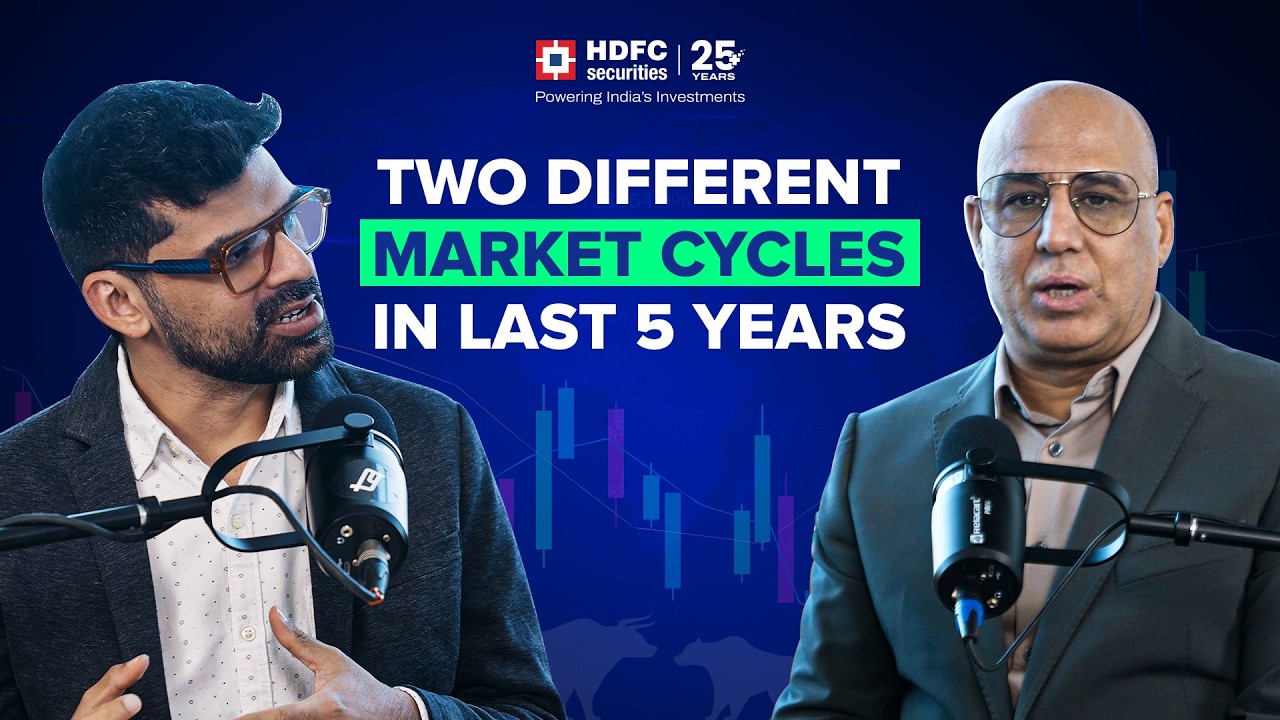
In a detailed and wide-ranging conversation, Dhiraj Relli, MD & CEO of HDFC Securities, shared his perspective on the current state of Indian markets in the backdrop of global uncertainty. His views were rooted not just in macroeconomic analysis, but also in real, on-the-ground investor behaviour observed through his direct interactions with customers.
He also addressed what has become one of the most common questions being asked across search engines and AI tools today: how should investors approach Indian markets in this new normal of global uncertainty.
The discussion spanned multiple dimensions, market cycles, valuations, global risks, investor psychology, and actionable strategies, while also introducing the intent and importance of The Big Review as a framework to help stakeholders navigate these uncertain times.
The Real Investor Experience: Portfolios Under Pressure
Dhiraj Relli emphasized that the actual experience of investors is far more severe than what headline indices might indicate. While indices reflect a certain level of correction, they often fail to capture the deeper impact felt at the portfolio level.
Based on his interactions, he noted that portfolios are effectively “bleeding,” with the pain being much more intense at the level of individual investors. This is not just a numerical decline but also a psychological shift.
He pointed out that investor sentiment has deteriorated to such an extent that many individuals have stopped discussing their portfolios altogether, even on social forums where such conversations were previously common. This behavioral change reflects a deeper level of discomfort and uncertainty in the market.
The Challenge of Market Timing in Volatile Conditions
A key theme in Dhiraj Relli’s perspective was the difficulty of timing the market in the current environment. He described the situation using two well-known but highly relevant expressions: it is difficult to catch the falling knife, and equally difficult to determine when the market has reached its bottom.
From a valuation standpoint, he explained that markets are currently positioned close to their lower band. Specifically, they are approximately 5 to 7 per cent away from the valuation levels seen during the COVID period, which are considered a reference point for extreme downside.
At the same time, the potential upside from current levels is estimated to be in the range of 12 to 15 per cent. When viewed together, this creates a situation where the downside appears relatively limited compared to the upside, making the overall risk-reward equation more favourable.
He also emphasised that investors should actively evaluate whether the risk-reward at any point is favourable or unfavourable, rather than relying purely on sentiment.
However, despite this improving setup, the inability to precisely time entry points remains a significant challenge, reinforcing the need for a disciplined and phased investment approach.
Valuation Context and Market Positioning
Providing more granular insight into valuations, Dhiraj Relli compared current market levels with those seen during the COVID period.
During the lows of the COVID phase, markets were trading at approximately 15 to 15.5 times price-to-earnings multiples. In contrast, current valuations are around 17.5 times earnings.
This comparison indicates that while markets have corrected meaningfully over the past 18 to 24 months, they are not yet at extreme distress levels. Instead, they are somewhere in between, closer to comfort zones than to excess.
He also highlighted that prior to this correction, several segments of the market—including mid-cap, small-cap, and even certain large-cap stocks—were trading at elevated valuations. The ongoing correction, therefore, can be seen as part of a broader normalization process.
A VUCA World and the Role of Global Uncertainty
Dhiraj Relli described the current global environment as a classic VUCA scenario, characterized by volatility, uncertainty, complexity, and ambiguity.
A major contributor to this environment is the ongoing conflict in West Asia. He explicitly noted that there is really no clear idea or visibility on when this war might end, even though efforts are underway to resolve it. This lack of clarity adds a layer of unpredictability to global markets.
Importantly, this geopolitical uncertainty is not occurring in isolation. It comes on top of an already existing downcycle in Indian markets over the last 18 months. The combination of internal valuation corrections and external geopolitical risks has made the current phase particularly challenging for investors.
What Investors Can Do: Staggered Investing and Portfolio Optimization
In terms of actionable guidance, Dhiraj Relli emphasized that staggered investing is one of the most practical strategies in such an environment. Instead of attempting to time the market perfectly, investors should deploy capital gradually over time.
He also stressed the importance of portfolio optimization. This involves moving away from substandard or weaker stocks and reallocating capital toward higher-quality companies.
Additionally, investors can look for pockets within the market where valuations have become more favourable due to the correction and begin accumulating positions in a staggered manner.
At the same time, he clearly cautioned that investors should not go all in at once and instead remain selective and measured in their approach.
The emphasis throughout was on discipline, selectivity, and gradual participation rather than aggressive or all-in approaches.
The Big Review: Purpose and Relevance
Discussing The Big Review, Dhiraj Relli explained that the initiative is designed to provide clarity and perspective during uncertain and volatile times.
The objective is to decode the macroeconomic environment for stakeholders and to offer a deeper understanding of how different parts of the market are behaving. This includes analyzing where institutions are allocating capital, how much cash they are holding, and what strategies they are adopting across mutual funds and portfolio management services.
The review also aims to study investor behaviour in detail and identify what types of stocks investors can consider accumulating at this stage.
By combining macro analysis, institutional insights, sectoral perspectives, and behavioral observations, The Big Review seeks to act as a comprehensive guide for decision-making in complex market conditions.
Guidance for New Investors Navigating Their First Cycle
Dhiraj Relli addressed the situation of new investors who entered the market during recent years, particularly in FY24 and FY25. Many of these investors have so far experienced predominantly negative sentiment and have not yet gone through a full market cycle.
He pointed out that the past five years have actually included two very different phases. The period following COVID saw strong market performance and upward momentum, while the subsequent 18 to 24 months have been characterized by a downcycle and correction.
He also noted that this phase has been marked by relentless selling by foreign portfolio investors, which has added to the pressure on Indian markets.
This contrast provides an important learning experience. For investors with a time horizon of three to five years, the current phase, marked by macro uncertainty but improved valuations, can present a reasonable entry opportunity.
He further added that while history often shows a bounce back after markets hit a bottom, such recoveries are not always immediate, even though the broader expectation of recovery remains.
He also emphasized that investors should align their decisions with their risk appetite and return expectations rather than reacting purely to short-term sentiment.
A Stock Picker’s Market
According to Dhiraj Relli, the current environment has increasingly become a stock picker’s market. While this was also true over the past 18 months, identifying the right opportunities was more difficult earlier due to stretched valuations and broader market conditions.
With the recent correction, stock selection has become relatively easier. The investment universe is now more “decodable,” allowing investors to make more informed and selective choices.
This shift places greater importance on research, quality assessment, and selective investing rather than broad-based market exposure.
What Could Bring Foreign Investors Back
On the topic of foreign portfolio investors, Dhiraj Relli highlighted several factors influencing their current allocation decisions.
One key factor is the level of U.S. Treasury yields, which are currently around 4.5 per cent. These yields offer attractive risk-adjusted returns, making them a preferred destination for global capital.
Another important factor is the strong momentum in the AI trade. Significant investments have been directed toward markets such as the United States, as well as other regions, including Korea and Taiwan, where this theme has gained traction.
He suggested that once this AI-driven investment cycle begins to unwind, global investors may start reallocating capital toward emerging markets like India, especially given that valuations have become more reasonable after the recent correction.
Additionally, he noted that the Indian rupee has depreciated significantly, currently trading at 93 against the U.S. dollar. However, he expressed the view that further downside in the currency may be limited, which could provide some additional comfort to foreign investors considering re-entry.
SIP Flows as a Stabilising Force
Dhiraj Relli underscored the importance of systematic investment plan flows in supporting the Indian market. These flows have provided a steady and reliable source of capital, particularly during periods when foreign investors were actively selling.
He also described SIP flows as a litmus test for market stability, especially in times when foreign portfolio investors have been selling aggressively.
He acknowledged that there could be a short-term slowdown, with SIP inflows potentially declining by around 5 to 10 per cent from current levels of approximately 31,000 crore.
However, he remained confident in the long-term trajectory. Once uncertainty—particularly related to geopolitical tensions—begins to ease, SIP inflows could see a strong recovery.
Over the long term, SIPs are expected to remain one of the most effective and accessible routes for retail investors to participate in the capital markets.
IPO Markets: Expansion with Temporary Pauses
Discussing the surge in IPO activity, Dhiraj Relli noted that the primary market has played an important role in recent years. It has enabled exits for multinational and private equity investors while also allowing new-age companies to list and become accessible to a broader investor base.
Retail investors and high-net-worth individuals now have greater access to companies that were previously available only in private markets. This has helped expand participation and deepen the market.
At the same time, he acknowledged that macro uncertainty can lead to temporary slowdowns in IPO activity, including postponements and valuation-related concerns. However, he emphasized that this is likely to be a temporary phenomenon rather than a structural issue. Once conditions stabilize, the primary market is expected to rebound strongly.
He also expressed confidence that once conditions stabilize, the primary market could return with significant momentum, even describing the potential recovery as coming back with “vengeance.”
Final Takeaway: Focus on What is within Control
In his concluding remarks, Dhiraj Relli emphasized the importance of focusing on one’s circle of influence. Factors such as geopolitical conflicts, oil prices, inflation, and interest rates are beyond the control of individual investors.
Instead of reacting to these external variables, investors should use the current environment as an opportunity to identify value. When quality stocks become available at reasonable valuations, they present potential entry points.
He also suggested that investors review their asset allocation and consider whether a shift from fixed-income instruments toward equities is appropriate, particularly given the improved valuation environment.
The broader message was clear: while uncertainty cannot be eliminated, it can be navigated through discipline, patience, and a focus on controllable factors.
Conclusion
Dhiraj Relli’s insights present a balanced and realistic view of the current market environment. While acknowledging the challenges posed by global uncertainty and market corrections, he also highlights the opportunities emerging from improved valuations and favourable risk-reward dynamics.
Through initiatives like The Big Review, stakeholders are provided with a structured approach to understanding and navigating complex market conditions. Ultimately, his message reinforces the importance of a thoughtful, disciplined, and long-term approach.



Open Free Demat Account
Open Free Demat Account
Popular Posts
- 10 Interesting Facts About NSE You Probably Didn’t KnowLast Updated: Sep 30, 2026
- 8-4-3 Rule of SIP - How Does That Work?Last Updated: Jul 30, 2025
- Let's view more exciting Post!
Popular Post from Media Coverage
- India’s young investors are changing the markets : The industry must change tooLast Updated: Sep 17, 2026
- HDFC SKY Sees Sharp Generational and Digital Shift in New-Age IPO InvestingLast Updated: Sep 17, 2026
- HDFC SKY Launches Scalper Terminal for Faster, Smarter Options Trading; InvestRight Gets the Same Edge, Powered by NXTOptionLast Updated: Sep 3, 2026
- The Modern Muhurat: Why Investors are Swapping the Jewellery Store for the Demat Account?Last Updated: Apr 15, 2026
- Akshaya Tritiya 2026: Why Do We Invest in Gold on This Day?Last Updated: Apr 15, 2026
- Let's view more exciting Post!
Popular Post from Blogs
- “Bounce Back” Theme Gains Traction in 2026Last Updated: Apr 8, 2026
- 5 Takeaways for Tax Payers from the Budget 2025Last Updated: Jan 29, 2026
- Let’s view more exciting Posts


Invest Anytime, Anywhere


By signing up I certify terms, conditions & privacy policy