Nifty 50
- Eternal₹317.4012.95 (4.25%)
- Shriram Finance₹865-35.90 (-3.98%)
- Apollo Hospitals₹7,730125.50 (1.65%)
- Adani Enterprises₹2,477-73.00 (-2.86%)
- ONGC₹227.502.50 (1.11%)
- JSW Steel₹1,185.50-34.50 (-2.83%)
- Asian Paints₹2,30722.20 (0.97%)
- Jio Financial ₹205.03-5.77 (-2.74%)
- TCS₹2,53023.10 (0.92%)
- Tata Steel₹167.67-4.66 (-2.70%)
- UltraTech Cement₹11,05092.00 (0.84%)
- Adani Ports₹1,702.70-47.30 (-2.70%)
- Maruti Suzuki₹11,23060.00 (0.54%)
- Tech Mahindra₹1,790-39.10 (-2.14%)
- Cipla₹1,3387.10 (0.53%)
- Tata Motors PV₹264.60-5.40 (-2.00%)
- Reliance Industries₹1,1905.50 (0.46%)
- Hindalco Industries₹869.85-15.75 (-1.78%)
- Axis Bank₹1,217.505.50 (0.45%)
- Trent₹2,727.50-48.30 (-1.74%)

- Offerings
- Tools & Platforms
Tools & Calculators
- Open API
- Calculators
- SIP Calculator
- CAGR Calculator
- Compound Interest Calculator
- FD Calculator
- RD Calculator
- EPF Calculator
- Retirement Calculator
- HDFC SIP Calculator
- Mutual Fund Return Calculator
- Lumpsum Calculator
- Step Up SIP Calculator
- ETF SIP Calculator
- Brokerage Calculator
- Equity Margin Calculator
- SWP Calculator
- EMI Calculator
- MTF Calculator
- Margin Pledge Calculator
- Algo Strategy
- Markets
Stocks
F&O
Mutual Funds
- More
From Tariffs to Trade Power: How India, China, and Russia Are Rising Together
Authored By Shishta Dutta | Published at: Sep 8, 2025 10:33 AM IST
Open Free Demat Account
Open Free Demat Account
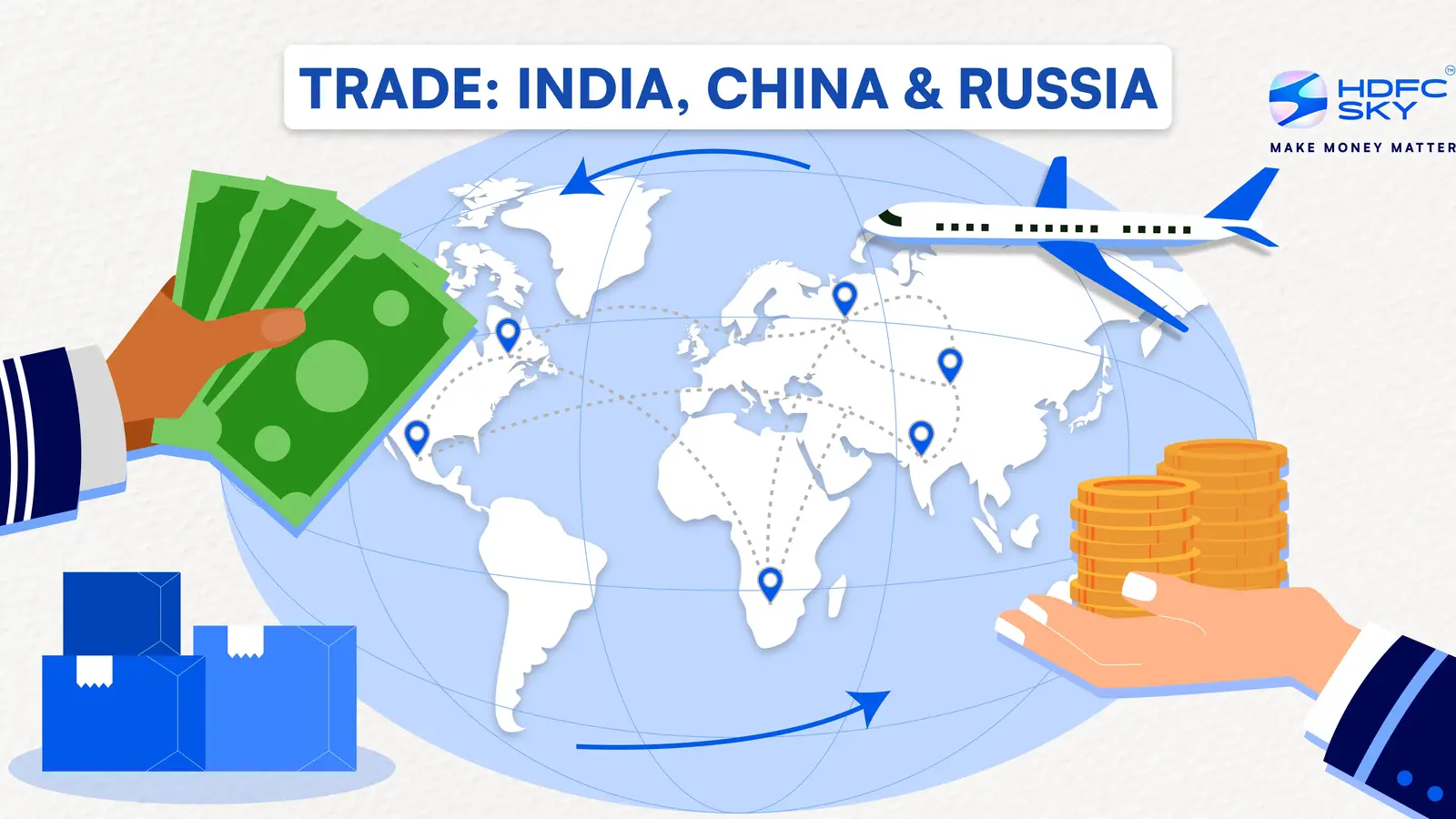
A historic economic shift is taking place in India, China, and Russia as US tariffs rise and the Russia-Ukraine war continues. China drives manufacturing, Russia powers energy, and India leads in digital and services.
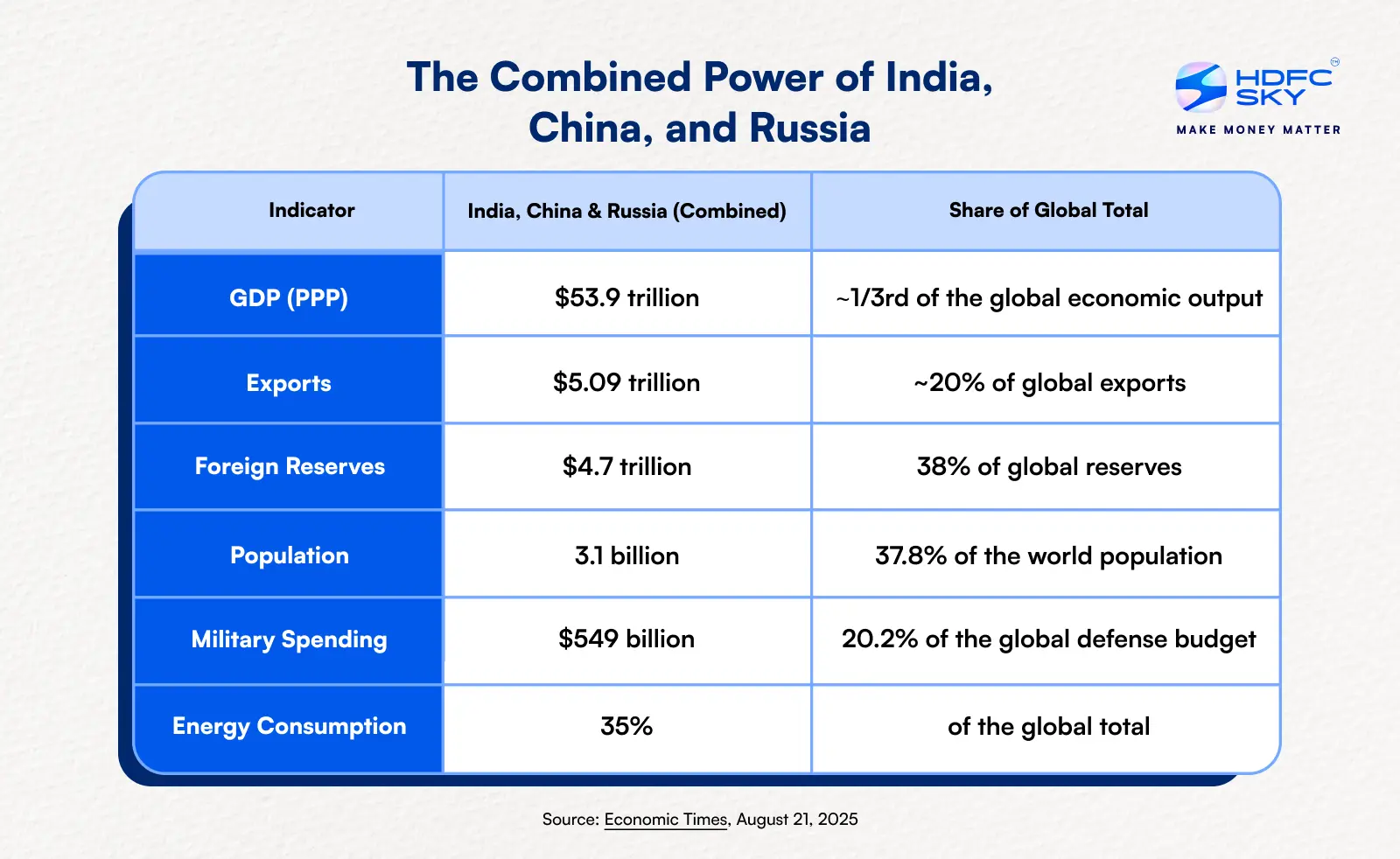
Together, they could build an economic bloc worth nearly $54 trillion (Purchasing Power Parity) , almost one-third of global gross domestic product (GDP). This new alliance can redraw the geopolitical map and reshape supply chains, which can also challenge the dollar’s hold on world trade. It also creates new opportunities for investment, technology, and bold policy changes.

GDP (Nominal) vs GDP (PPP)
Nominal GDP is the total monetary value of all final goods and services produced within a country in a given year, measured at current market prices and converted to U.S. dollars using exchange rates.
GDP (PPP) measures the same output but adjusts for differences in local costs of living through a common basket of goods, giving a more realistic basis for comparing economies.
Nominal GDP is most useful for assessing global market size and trade power, while PPP better reflects living standards. For example, because goods are cheaper in India than in the U.S., India’s GDP (PPP) appears much larger than its nominal GDP
When Sanctions Created New Supply Chains
US President Donald Trump’s trade war has hit countries trading with Russia by imposing steep tariffs. Now, India’s oil imports are facing penalties as high as 50% . The goal was to cut Russia’s export revenue and push India to scale back ties.
Instead, India and China bypassed Western banks and paid for Russian energy in rupees and yuan. This shift has changed trade patterns and strengthened new routes like the International North-South Transport Corridor, which is boosting Asia-Eurasia commerce.
Economic Partnership
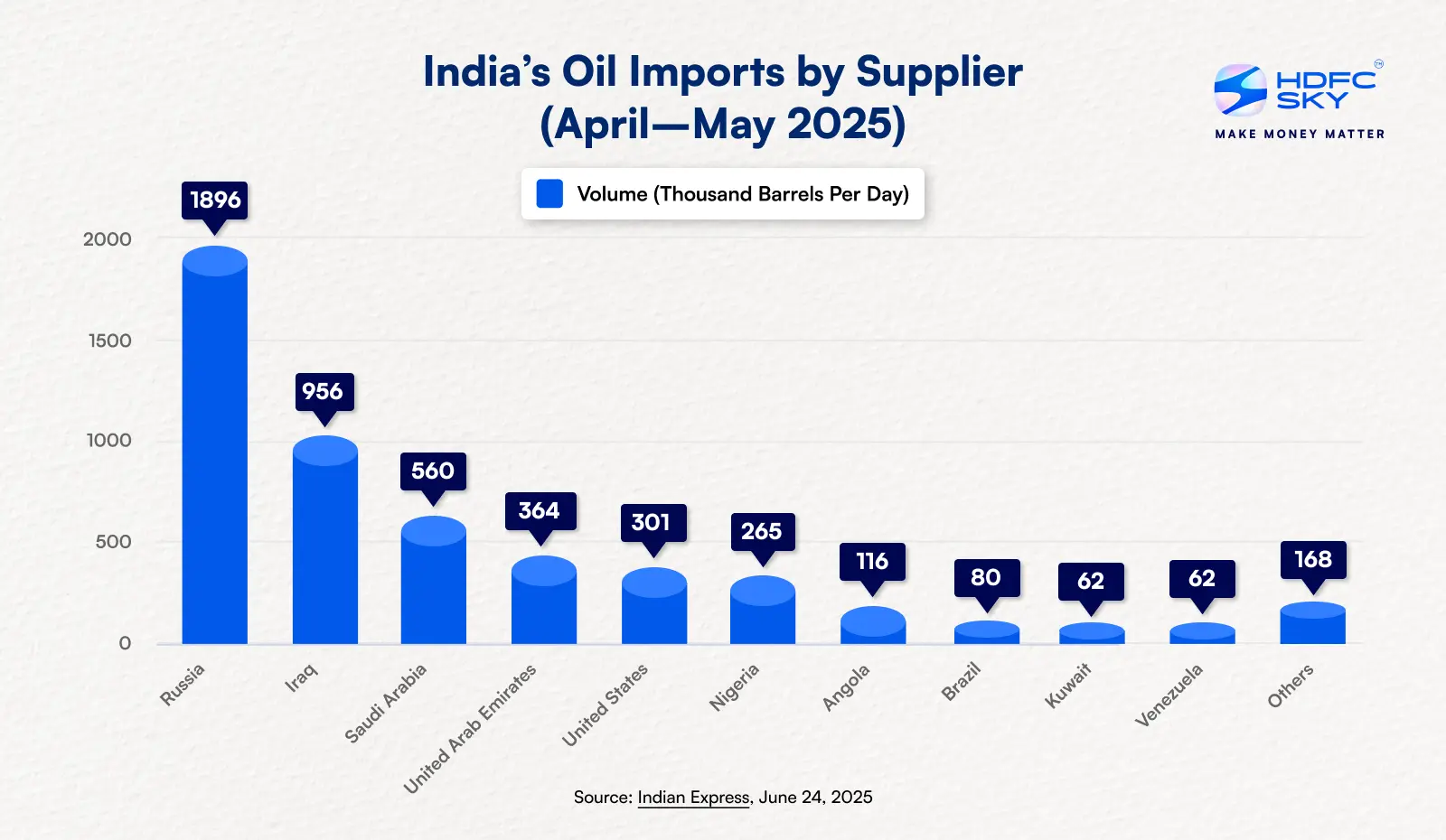
India and Russia share a Special and Privileged Strategic Partnership that has grown for over 70 years . Their ties cover trade, defense, energy, science, and technology. Russia supplies a big part of India’s oil, and both countries are building an “Energy Bridge” with nuclear, hydrocarbons, hydel, and renewable projects. They are expanding nuclear power at Kudankulam and planning joint work in Arctic oil and gas. More trade now uses their own currencies, cutting reliance on outside systems. Both sides are also discussing a free trade deal with the Eurasian Economic Union to boost business and industry.
This growing partnership is part of a much larger realignment. When we look at India, China, and Russia together, the scale of their combined power becomes clear.
Modernisation and Industrial Cooperation
On August 6th, India and Russia held the 11th Session of their Working Group on Modernization and Industrial Cooperation to strengthen industrial ties. Both sides are working together in aerospace, carbon fiber production, 3D printing, and mining for key minerals .
The motive here was to boost cooperation in aluminium, fertilizers, railways, and mining technology . They also agreed to share technology in new areas like waste management. This way, both countries have to rely less on Western nations for exports and advanced technology.
How Defence Fuels India’s Economic Development
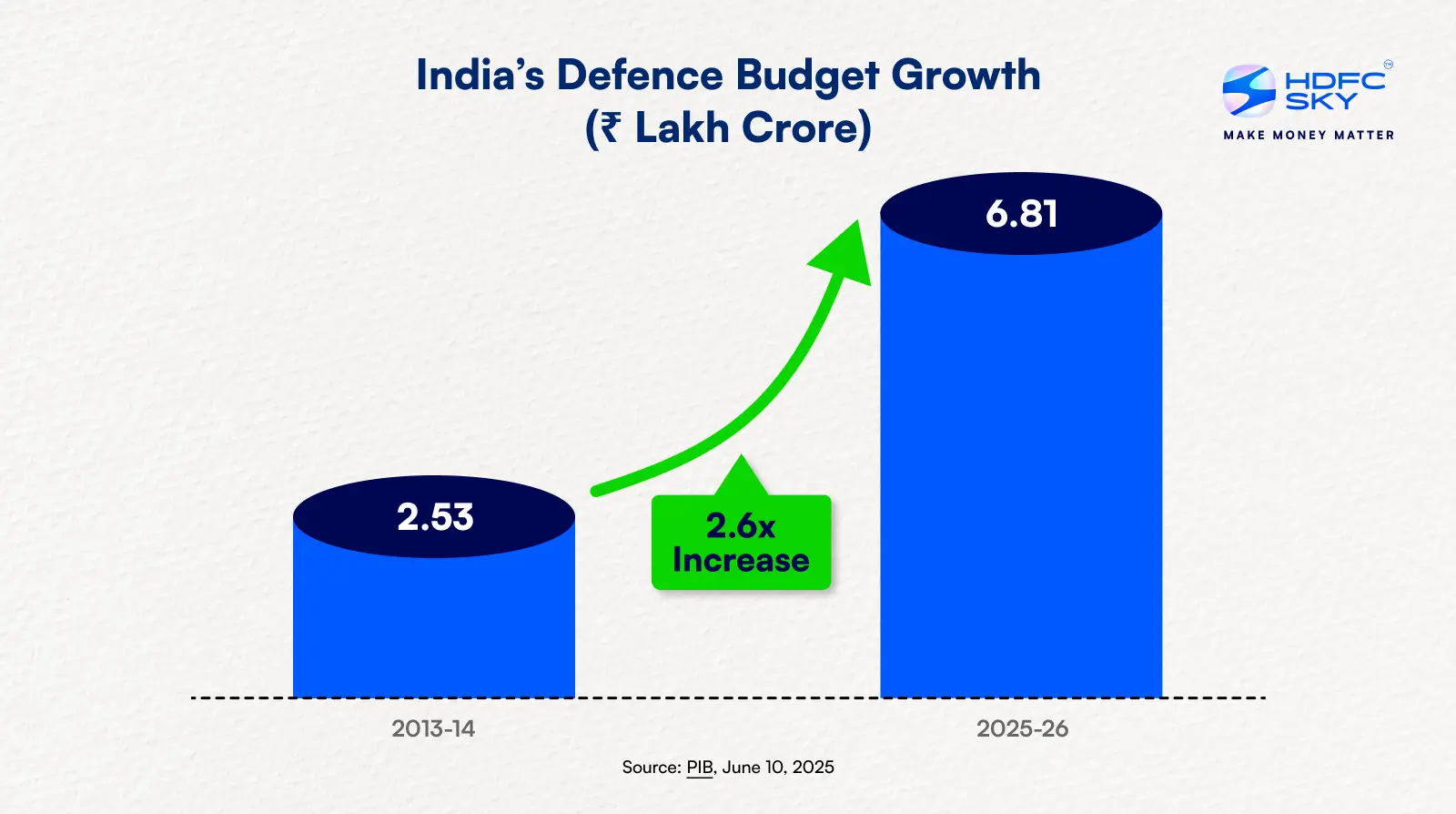
At the Chanakya Defence Dialogue 2024 , Defence Minister Rajnath Singh stressed that security and development go hand in hand . Defence spending and new military projects create jobs and boost local industries. Strong security also brings in technology and supports growth.
He highlighted that making weapons in India builds skills, reduces imports, and narrows the trade gap. The government’s push for ‘Aatmanirbharta’ (self-reliance) links defence directly to national progress. Singh also pointed out that regular talks, joint drills, and technology sharing with partners like Russia strengthen India’s position and steady its growth.
How India, China, and Russia Are Redefining Global Trade
India, China, and Russia are reshaping global trade by working more closely with each other and using their own currencies instead of the US dollar.
India’s trade with the Russia-led EAEU (Eurasian Economic Union) has jumped to $69 billion in 2024 , thanks mainly to discounted Russian oil.
India’s exports to Russia have also doubled in recent years, rising from $2.39 billion in FY19 to $4.88 billion in FY25 . Both countries are even looking to restart a rupee-ruble payment system to cut down dependence on the dollar.
China and Russia’s trade ties are even stronger. Their trade is now over $200 billion and nearly 95% of deals happen in yuan and rubles instead of dollars.
Together, these moves show a clear push toward using regional currencies and building a multipolar trade system that reduces US dominance in global markets.
Conclusion
India, China, and Russia are building more than a short-term partnership. Their growing alliance is changing global affairs. Built on years of cooperation, pushed further by US tariffs and sanctions, and strengthened by new technology and finance, this $54 trillion group is challenging today’s world order. They are starting joint projects, building infrastructure, and changing trade routes.
The biggest outcome could be a new global system where power, independence, and resilience matter most. For governments and investors everywhere, this alliance will shape the future in a big way.
Disclaimer:At HDFC SKY, we take utmost care and due diligence in curating and presenting news and market-related content. However, inadvertent errors or omissions may occasionally occur.
If you have any concerns, questions, or wish to point out any discrepancies in our content, please feel free to write to us at content@hdfcsec.com.
Please note that the information shared is intended solely for informational purposes and does not make any investment recommendations
 Join Us
 Add as preferred source on Google


More International News



Open Free Demat Account
Open Free Demat Account









Invest Anytime, Anywhere


By signing up I certify terms, conditions & privacy policy