Nifty 50
- Tata Consumer ₹976.4039.90 (4.26%)
- Hindustan Unilever₹1,788-30.60 (-1.68%)
- Bajaj Auto₹10,326255.00 (2.53%)
- Grasim Industries₹2,906.40-43.60 (-1.48%)
- Bharti Airtel₹1,962.8045.30 (2.36%)
- TCS₹2,498.90-36.10 (-1.42%)
- Max Healthcare₹853.9518.95 (2.27%)
- ICICI Bank₹1,385.90-17.10 (-1.22%)
- Bharat Electronics₹3718.00 (2.20%)
- Adani Enterprises₹2,479.80-28.20 (-1.12%)
- Power Grid Corp₹252.205.20 (2.11%)
- Asian Paints₹2,296-26.00 (-1.12%)
- BSE₹3,42768.00 (2.02%)
- SBI Life Insurance ₹1,627-16.70 (-1.02%)
- Trent₹2,807.9053.90 (1.96%)
- HCL Technologies₹1,403-14.00 (-0.99%)
- NTPC₹305.505.50 (1.83%)
- ITC₹258.10-2.40 (-0.92%)
- Shriram Finance₹835.8010.80 (1.31%)
- UltraTech Cement₹11,079-101.00 (-0.90%)

- Offerings
- Tools & Platforms
Tools & Calculators
- Open API
- Calculators
- SIP Calculator
- CAGR Calculator
- Compound Interest Calculator
- FD Calculator
- RD Calculator
- EPF Calculator
- Retirement Calculator
- HDFC SIP Calculator
- Mutual Fund Return Calculator
- Lumpsum Calculator
- Step Up SIP Calculator
- ETF SIP Calculator
- Brokerage Calculator
- Equity Margin Calculator
- SWP Calculator
- EMI Calculator
- MTF Calculator
- Margin Pledge Calculator
- Algo Strategy
- Markets
Stocks
F&O
Mutual Funds
- More
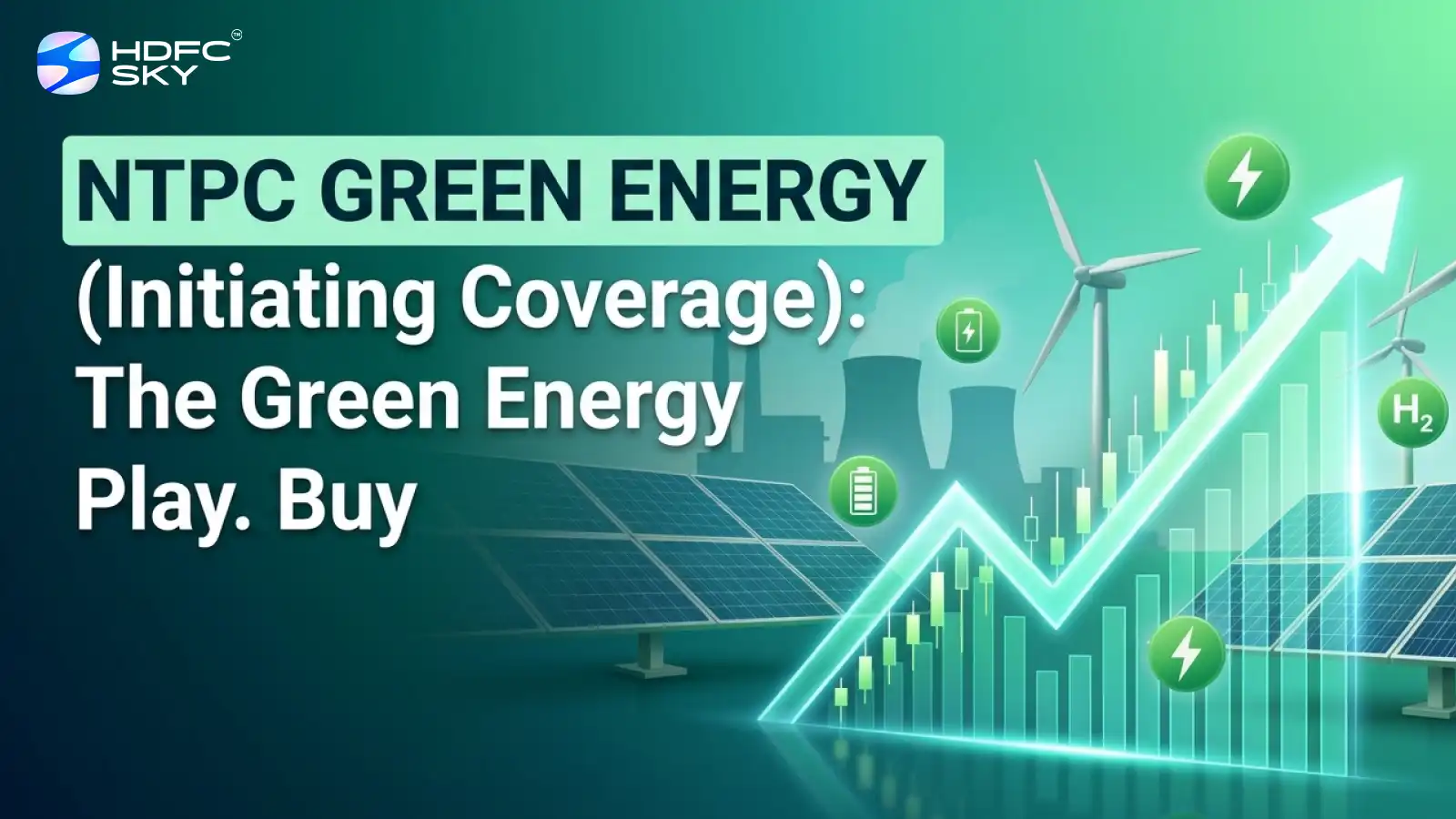
NTPC Green Energy (Initiating Coverage): The Green Energy Play. Buy
Authored By Prime Research | Last Modified: Mar 17, 2026 01:17 PM IST
Open Free Demat Account
Open Free Demat Account
We initiate coverage of NTPC Green Energy Ltd (NGEL) with a BUY and a TP of INR 121 at 14.5x EV/EBITDA FY29 EBIDTA discounted at 12% to arrive at Mar-28 TP. NGEL is the renewable energy arm of NTPC Ltd (NTPC), India’s leading energy producer, with a strong presence in thermal energy. Through NGEL, NTPC plans to expand its existing renewable energy operating capacity from ~8GW as of Dec’25 to 60GW by FY32. As of December 2025, NGEL has a presence in nine states, through subsidiaries as well as JVs. NGEL’s capacity addition plans, backed by NTPC’s proven execution, positions it to capture India’s accelerating renewable energy demand. Alignment with the government’s 500GW RE plan target by FY30 provides a substantial growth runway, while a clear focus on profitable growth and disciplined capital allocation enhances NGEL’s investment appeal. Strong parent support from NTPC—its vision, resources, and deep industry experience—helps de risk execution. NTPC Group’s goal of 45-50% non fossil portfolio and 60GW RE by 2032 underpins NGEL’s long term pipeline visibility. Collectively, these factors position NGEL favourably for sustainable scaling creation of lasting shareholder value. NTPC, via NGEL, aims to build and diversify its expertise and capacity in new energy growth areas like Energy Storage Systems (ESS), Green Hydrogen, Electrolysers, and Green Ammonia production, which have seen wide industry participation in the form of capacity building and investment commitments in recent years, and are expected to contribute significantly to the Indian economy.
Enhanced demand visibility due to expected economic growth: India is currently the most populous country with another ~300 million people to be added to the population by 2060, as per the UN. Population growth as well as increasing per capita GDP and purchasing power are expected to increase energy demand and increase energy generation. Given that India’s GDP per capita growing at an ~7-8% CAGR since 2000 and our view that it will continue to outpace global growth rates, we believe energy demand will meaningfully rise in India. Our analysis of per capita GDP and per capital power consumption growth with developed economies suggests 0.9-1.1x power demand elasticity to GDP growth, which augurs well for Tier 1 RE developers.
NGEL is NTPC backed; enjoys trust of PSU/state governments/financial institutions: which according to us is one the most formidable competitive advantages. We believe this as NGEL may benefit from support of states and partnerships with state RE engines, PSU JV, and partnerships including C&I opportunities. The company’s plan to deploy large GW volumes makes it a formidable capital consumption platform, which financial institutions like. Scale benefits help better supply chain sourcing of raw material and capital (domestic and global). The theme of “Green” also has access to the lowest global cost of capital.
Ability to quickly expand and execute large-scale projects: NTPC Ltd (the parent company) has more than 50 years of experience (founded in 1975) in executing large-scale energy projects in India. NGEL is expected to benefit from its parent’s expertise to deliver better execution. As large capacities continue to get commissioned, benefits may be accrued in the form of economies of scale which could drive lower operating expenses per MW, while continuing to develop in-house expertise in the RE sector. NGEL is one of the largest renewable energy companies in India and is currently at the cusp of its growth inflection point. By 2032, NGEL is targeting a portfolio of operational capacity that exceeds 60GW, implying portfolio growth of more than 6-7x over the FY26E capacity.
Capacity additions to drive revenue and EBITDA growth: From FY26E to FY29E, we anticipate revenue and EBITDA to grow at an 82% CAGR, reaching INR 147.1bn, respectively. Our assumptions include stable pricing when it relates to solar and wind tariffs, which is something we have seen play a role over the past five years with industry players.
Key risks: (i) Concentrated pool of utilities and off-takers; (ii) Business viability and profitability dependent on the availability and cost of solar modules, solar cells, wind turbine generators and other material; (iii) Business model prone to cost overruns and delays that may adversely affect operations and cash flows; (iv) Revenues sensitive to fixed tariffs, changes in tariff regulations, and sector regulations and policies; (v) The operations are considerably sensitive to seasonal disruption, natural calamities, and/or civil disruptions; (vi) Timely receipt of receivables from counterparties, including government entities, is essential for business sustenance; (vii) Time gap between making large upfront investments and realization of expected returns is considerable; (viii) Timely availability of power evacuation infrastructure.
Disclaimer
If you have any concerns, questions, or wish to point out any discrepancies in our content, please feel free to write to us at content@hdfcsec.com.
Disclaimer
The information shared here is intended solely for informational and educational purposes and does not constitute investment recommendations. While we practice strict due diligence in curating daily market data, readers must perform independent research before trading. To flag any real-time data discrepancies or content concerns, please write to us at content@hdfcsec.com.
 Join Us
 Add as preferred source on Google


More Markets News






Open Free Demat Account
Open Free Demat Account










Invest Anytime, Anywhere


By signing up I certify terms, conditions & privacy policy