Nifty 50
- Tata Consumer ₹994.7558.25 (6.22%)
- Hindustan Unilever₹1,771.20-47.40 (-2.61%)
- Bharat Electronics₹370.907.90 (2.18%)
- Infosys₹1,135.75-30.25 (-2.59%)
- Shriram Finance₹839.8014.80 (1.79%)
- TCS₹2,492.60-42.40 (-1.67%)
- Bajaj Auto₹10,247176.00 (1.75%)
- HCL Technologies₹1,400-17.00 (-1.20%)
- Maruti Suzuki₹11,393173.00 (1.54%)
- Tech Mahindra₹1,777.70-17.30 (-0.96%)
- Max Healthcare₹847.4012.40 (1.49%)
- Asian Paints₹2,300-22.00 (-0.95%)
- Tata Steel₹172.392.45 (1.44%)
- UltraTech Cement₹11,075-105.00 (-0.94%)
- BSE₹3,406.5047.50 (1.41%)
- Grasim Industries₹2,928-22.00 (-0.75%)
- Sun Pharmaceutical₹1,763.5023.50 (1.35%)
- Bajaj Finserv₹1,660-10.90 (-0.65%)
- Bharti Airtel₹1,943.3025.80 (1.35%)
- Reliance Industries₹1,196.40-5.40 (-0.45%)

- Offerings
- Tools & Platforms
Tools & Calculators
- Open API
- Calculators
- SIP Calculator
- CAGR Calculator
- Compound Interest Calculator
- FD Calculator
- RD Calculator
- EPF Calculator
- Retirement Calculator
- HDFC SIP Calculator
- Mutual Fund Return Calculator
- Lumpsum Calculator
- Step Up SIP Calculator
- ETF SIP Calculator
- Brokerage Calculator
- Equity Margin Calculator
- SWP Calculator
- EMI Calculator
- MTF Calculator
- Margin Pledge Calculator
- Algo Strategy
- Markets
Stocks
F&O
Mutual Funds
- More
O͏il Prices Fall to ͏$10͏7 ͏as͏ Netanyahu͏ Signal͏s Pau͏se on Iran Strikes Amid͏ V͏olatility
Authored By HDFC SKY | Last Modified: Mar 20, 2026 04:43 PM IST
Open Free Demat Account
Open Free Demat Account
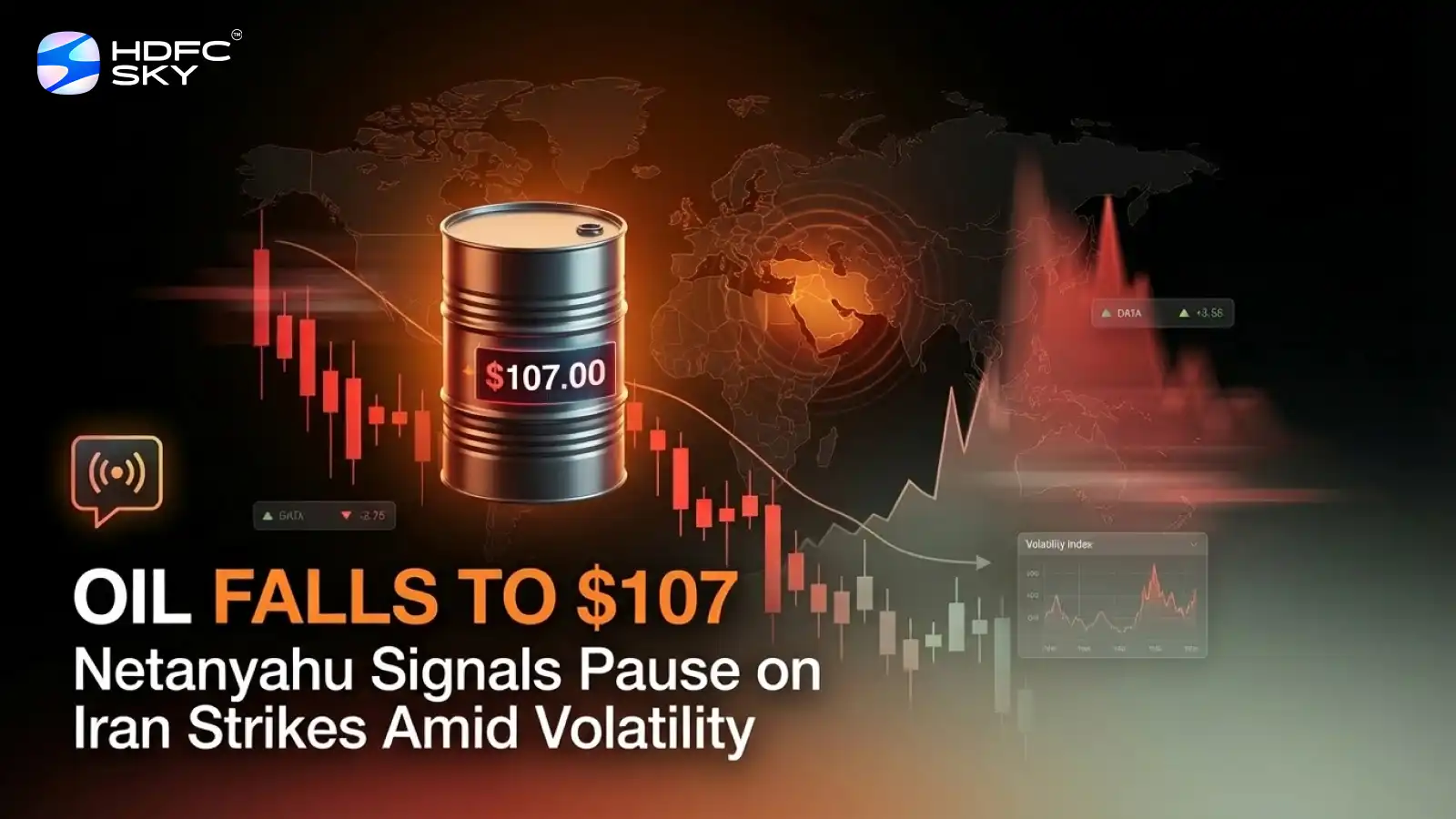
Mumbai, 20 Mar͏ch 2026: Glo͏bal oil pr͏ic͏es retreated on Friday aft͏er Isra͏eli Prime Minister Benj͏amin Netan͏yahu͏ in͏dicated that͏ Isra͏el wo͏uld re͏frain from further at͏ta͏cks on Iran’s energy͏ infrastruc͏ture, fol͏lowing͏ ͏a͏ public interven͏tion by U.S. Presiden͏t ͏Donald Trump. Brent ͏crude futures declined by $1.24, or 1.1%, to͏ $107͏.41 per barrel, while͏ West ͏Tex͏as Interme͏diate ͏(WTI͏) crude fell͏ $1.92, or 2%, to $͏94.22 per͏ ba͏rrel. Desp͏ite the retreat, ͏both ͏ben͏chmarks remain elevated due to ongoing supply disruptions͏ in West Asi͏a͏, with͏ Bre͏n͏t up nearly 47% s͏ince coord͏inated U.S.-Israeli strikes on 28 February.

Brent Crude Drops from R͏ecord Highs After Sou͏th Pars Strikes
On Thursday, Brent crude͏ su͏rged ab͏ove $119 per ͏barrel ͏foll͏owing Israel’s a͏ttack on Iran’s ͏South͏ Pars of͏fshore gas field͏, the largest natural gas field in th͏e w͏orld, share͏d joint͏ly with Qatar. T͏he fiel͏d s͏uppl͏i͏es appr͏oximately 80% of Ir͏an’s elec͏trici͏ty ͏gene͏ra͏tion and a s͏ignif͏icant port͏ion ͏of regional exports. Iran r͏etalia͏ted by tar͏geting ene͏rgy infrastructu͏re in ͏Gulf Arab states,͏ including Qatar, Kuwait, and Saudi Arabia, tri͏ggerin͏g temporary shutdowns an͏d fir͏es a͏t key f͏acilities. T͏hese͏ retaliatory measure͏s briefly ͏elevated ͏fears of global supply shortages, ͏with poten͏tial͏ losses estimated at 7–10 million barrels per day, roughly 7–10% o͏f global dem͏and.
Israel-Iran Conflict Escalates with Regional Energy Strikes
Iran intensified attacks on Gulf energy sites after Israel struck South Pars. Kuwait reported drone strikes at its Mina Al-Ahmadi oil refinery, capable of processing 730,000 barrels per day, causing fires and operational disruption. In Saudi Arabia, multiple drones targeted oil facilities in the Eastern Province, while the UAE intercepted missiles over Dubai, causing shrapnel damage and a warehouse fire in Bahrain. Explosions in Tehran coincided with Israeli strikes as Iran marked Nowruz, the Persian New Year.
The continued conflict has placed the Strait of Hormuz under strain, a strategic passage accounting for 20% of global oil and LNG transit. Disruptions in this chokepoint intensified market volatility, contributing to Brent crude briefly approaching record highs near $119.50 per barrel.
U.S. and International Measures to Stabilise Oil Supply
Global powers have moved to mitigate the supply shock. U.S. Treasury Secretary Scott Bessent stated that Washington could authorise another release from the Strategic Petroleum Reserve (SPR) and may lift sanctions on Iranian oil stranded on tankers. European nations, including Britain, France, Germany, Italy, the Netherlands, along with Japan, expressed readiness to secure safe passage through the Strait of Hormuz, reducing immediate risk of further escalation.
In the United States, crude production in North Dakota’s shale-rich Permian Basin is set to rise as winter restrictions ease and inactive wells resume output. These steps aim to partially offset the disruption caused by Middle East hostilities. However, analysts caution that reviving full logistics and production could take months, keeping the market sensitive to additional shocks.
Netanyahu Signals Shorter Conflict, Easing Immediate Risk
Netanyahu’s remarks, stating that joint U.S.-Israel strikes had significantly degraded Iran’s capabilities and that the conflict would “end faster than people think,” helped temper oil market panic. Importantly, he confirmed Israel would not target South Pars again, respecting Trump’s request, signalling that the campaign was not open-ended.
This declaration reduced immediate risk premiums, contributing to Brent and WTI’s retreat from Thursday’s highs. South Korean equities rose 0.5% in early trading, while the S&P 500 closed 0.3% lower, reflecting global risk sentiment stabilisation following the statements.
Rising Oil Prices Continue to Pressure Global Energy Markets
Despite the easing, oil prices remain elevated due to ongoing supply constraints. U.S. crude is being routed through the Panama Canal to mitigate shortfalls in Asia, and policymakers are considering additional measures to unchoke critical transit routes. The conflict has disrupted regional energy flows, forcing nations to explore alternative supply chains, while refinery operations in Saudi Arabia, UAE, and Kuwait face ongoing vulnerabilities.
The disruptions have also affected global financial markets, contributing to concerns over inflation and energy security. The International Energy Agency (IEA) and global refiners are closely monitoring the situation to assess broader economic impacts.
India’s Fuel Prices Hold Steady Despite Rising Crude Costs
In India, retail petrol and diesel rates remained largely stable on 20 March 2026, even as the Indian crude oil import basket surged to $146.09 per barrel on 17 March, a 111.7% increase from February’s $69.01 per barrel. State-run oil marketing companies (OMCs) – Indian Oil Corporation (IOC), Bharat Petroleum Corporation Limited (BPCL), and Hindustan Petroleum Corporation Limited (HPCL) – are absorbing the spike, delaying any immediate fuel price revisions.
Fuel Prices Across Major Indian Cities (20 March 2026)
| City | Petrol Price (₹/litre) | Diesel Price (₹/litre) |
| Delhi | 94.77 | 87.67 |
| Mumbai | 103.54 | 90.03 |
| Kolkata | 105.45 | 92.02 |
| Chennai | 100.84 | 92.39 |
| Hyderabad | 107.46 | 95.70 |
| Bengaluru | 102.96 | 90.99 |
| Lucknow | 94.69 | 87.81 |
| Ahmedabad | 94.49 | 90.17 |
OMCs face mounting margin pressure as retail fuel prices remain unchanged. Analysts at Elara Capital note that crude prices above $110 per barrel significantly erode downstream margins, with potential diesel and petrol under-recoveries of ₹6.3 per litre and LPG losses of ₹10.2 per kg, translating to ₹32,800 crore in annual LPG under-recoveries. Any prolonged spike could eventually necessitate either price revisions or fiscal support.
Crude Spike Threatens Inflation and Industrial Costs Globally
The Middle East conflict has triggered a broader macroeconomic shock. Rising crude costs threaten global input prices, particularly in energy-intensive economies like China. Analysts at Gavekal Dragonomics and Soochow Securities estimate a 10% oil price rise could lift China’s producer price inflation from -0.9% to -0.5%, potentially ending over three years of factory-gate deflation.
Chinese manufacturers, with roughly a quarter operating at a loss, may absorb higher costs, suppressing wage growth and further straining domestic demand. Analysts warn that a 25% crude price surge could trim 0.5 percentage points from China’s GDP growth, affecting exports and reinforcing global inflationary pressures.
Regional Security Risks Maintain Market Volatility
Iran continues targeting Gulf energy sites, including Kuwait, Saudi Arabia, and the UAE, while Israel has engaged Iranian-backed Hezbollah militants in Lebanon, displacing over 1 million people. The conflict has already resulted in 1,300 Iranian fatalities, with Israel reporting over 500 Hezbollah militant casualties.
Sirens in Israel, explosions over Tehran, and ongoing missile interceptions in Dubai underscore the persistent regional risk. Analysts caution that any new escalation could sharply spike oil prices, while diplomatic efforts, including U.S.-Israel communications and European-led initiatives, may help cap extreme market volatility.
Global oil markets remain highly sensitive to geopolitical developments in West Asia, with temporary easing after Israel and U.S. statements. In India, fuel prices are currently stable due to government intervention and OMC cost absorption, but continued high crude levels may eventually impact domestic energy costs, import bills, and refinery operations if disruptions persist.
Sources:
- https://ppac.gov.in/prices/international-prices-of-crude-oil
- https://www.eia.gov/dnav/pet/pet_pri_spt_s1_d.htm
Disclaimer
If you have any concerns, questions, or wish to point out any discrepancies in our content, please feel free to write to us at content@hdfcsec.com.
Please Note: The information shared is intended solely for informational purposes and does not make any investment recommendations
Disclaimer
The information shared here is intended solely for informational and educational purposes and does not constitute investment recommendations. While we practice strict due diligence in curating daily market data, readers must perform independent research before trading. To flag any real-time data discrepancies or content concerns, please write to us at content@hdfcsec.com.
 Join Us
 Add as preferred source on Google


More Markets News








Open Free Demat Account
Open Free Demat Account











Invest Anytime, Anywhere


By signing up I certify terms, conditions & privacy policy