Nifty 50
- TCS₹2,34293.60 (4.16%)
- ICICI Bank₹1,422.80-20.20 (-1.40%)
- Tech Mahindra₹1,640.9055.90 (3.53%)
- Shriram Finance₹1,086.90-14.10 (-1.28%)
- Infosys₹1,14433.20 (2.99%)
- ITC₹266-3.00 (-1.12%)
- HCL Technologies₹1,316.1034.10 (2.66%)
- UltraTech Cement₹11,589-128.00 (-1.09%)
- Wipro₹180.954.55 (2.58%)
- Asian Paints₹2,608.70-22.30 (-0.85%)
- Bajaj Auto₹11,910190.00 (1.62%)
- SBI Life Insurance ₹1,761.10-12.10 (-0.68%)
- Hindalco Industries₹1,037.4013.40 (1.31%)
- Eicher Motors₹8,059-41.00 (-0.51%)
- HDFC Bank₹720.309.30 (1.31%)
- Maruti Suzuki₹13,376-64.00 (-0.48%)
- Tata Motors PV₹319.403.40 (1.08%)
- Bajaj Finserv₹2,002-9.00 (-0.45%)
- Grasim Industries₹3,29032.00 (0.98%)
- InterGlobe Aviation₹5,166-23.00 (-0.44%)

- Offerings
- Tools & Platforms
Tools & Calculators
- Open API
- Calculators
- SIP Calculator
- CAGR Calculator
- Compound Interest Calculator
- FD Calculator
- RD Calculator
- EPF Calculator
- Retirement Calculator
- HDFC SIP Calculator
- Mutual Fund Return Calculator
- Lumpsum Calculator
- Step Up SIP Calculator
- ETF SIP Calculator
- Brokerage Calculator
- Equity Margin Calculator
- SWP Calculator
- EMI Calculator
- MTF Calculator
- Margin Pledge Calculator
- Markets
Stocks
F&O
Mutual Funds
- More
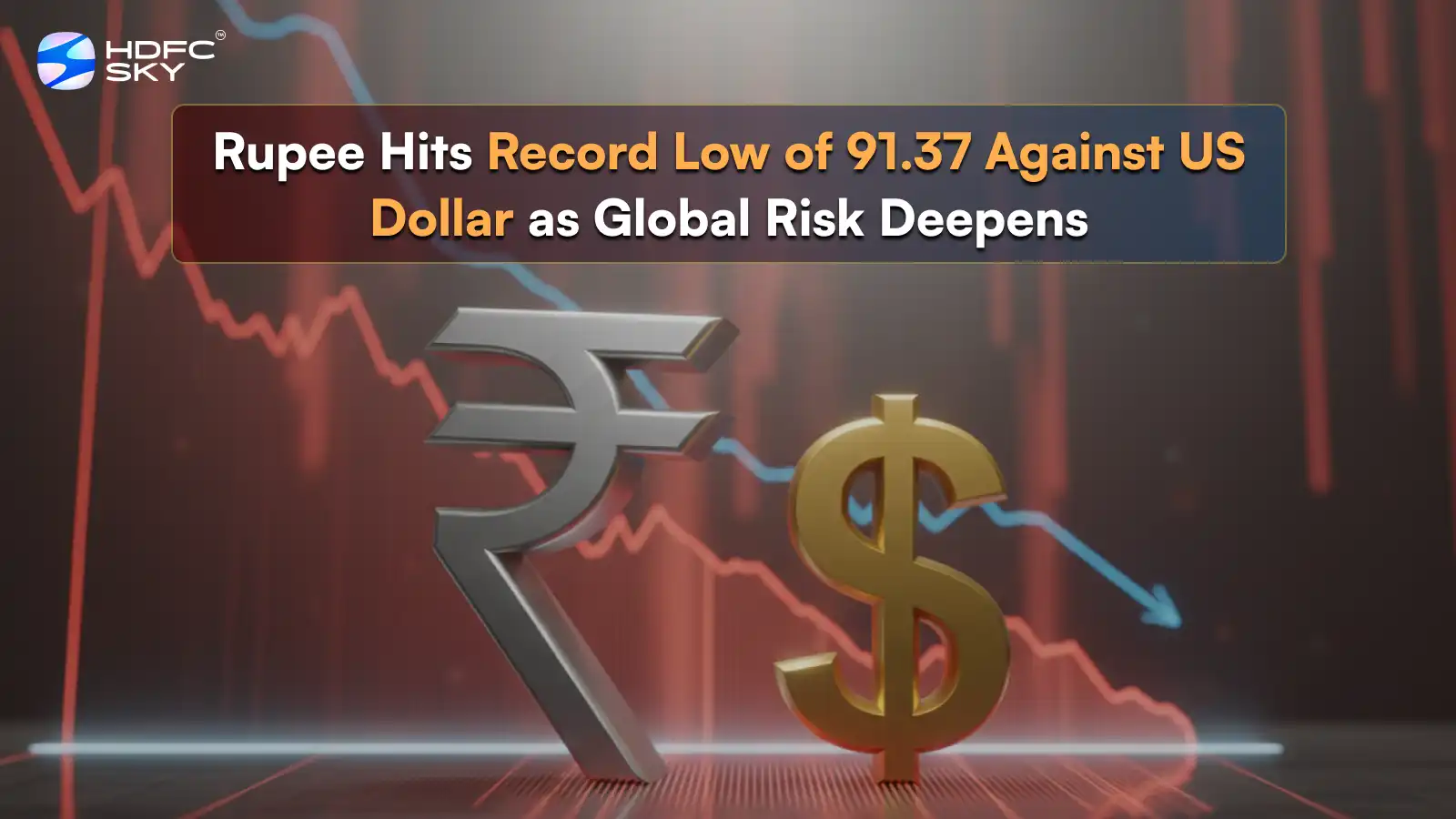
Rupee Hits Record Low of 91.37 Against US Dollar as Global Risk Aversion Deepens
Authored By Shishta Dutta | Published at: Jan 21, 2026 01:05 PM IST
Open Free Demat Account
Open Free Demat Account
Mumbai, 21 January 2026: The Indian rupee slid to a fresh all-time low against the US dollar on Wednesday, breaching the 91.37 mark during intra-day trade, as heightened global risk aversion linked to the Greenland dispute weighed heavily on emerging market currencies. Persistent foreign capital outflows and weakness in domestic equities further pressured the local unit despite intermittent support from the Reserve Bank of India (RBI).

Rupee Slides 40 Paise to 91.37 as Global Uncertainty Intensifies
The rupee depreciated 40 paise from its previous close to trade at 91.37 per US dollar in early trade at the interbank foreign exchange market. It opened the session at 91.05, briefly stabilised amid suspected central bank intervention, and then extended losses as risk-off sentiment dominated global markets. On Tuesday, the currency had already closed 7 paise lower at 90.97, then its weakest closing level on record.
Greenland Dispute and Trade War Rhetoric Weigh on Risk Appetite
Global sentiment deteriorated after renewed geopolitical tensions surrounding Greenland revived concerns of a broader US–Europe trade dispute. The return of protectionist rhetoric triggered caution across financial markets, compounding pressure on risk-sensitive currencies such as the rupee. Investors globally remained cautious as political developments added to existing macroeconomic uncertainties.
Wall Street Weakness and ‘Sell America’ Theme Add Pressure
US equities reflected the risk-off mood, with the S&P 500 Index falling nearly 2% overnight. US Treasury yields weakened, while the dollar index logged its sharpest fall in three weeks, signalling uncertainty over the outlook for US assets. This backdrop reduced support for emerging market currencies, including the Indian rupee, despite a softer dollar globally.
Asian Currencies Mixed as Dollar Index Slips to 98.59
Asian currencies traded with limited direction, caught between a weaker US dollar and declining risk appetite. The dollar index, which tracks the greenback against a basket of six major currencies, was down 0.05% at 98.59. Market participants noted that subdued follow-through reflected uncertainty rather than conviction-driven trades.
Japanese Bond Sell-Off Pushes Yields to Record Highs
Adding to global volatility, Japanese government bonds witnessed a sharp sell-off, driving yields to record highs amid fiscal concerns. The move unsettled regional markets and further dented sentiment across Asia, indirectly impacting the rupee and other emerging market currencies.
Equity Market Declines and ₹2,938 Crore FII Outflows Hurt Sentiment
Domestic equities opened sharply lower, mirroring global weakness. The Sensex fell 385.82 points to 81,794.65, while the Nifty declined 91.5 points to 25,141 in early trade. Foreign institutional investors offloaded ₹2,938.33 crore worth of equities on Tuesday, according to exchange data, intensifying pressure on the rupee through sustained capital outflows.
RBI Presence Limits Volatility Near Lifetime Lows
Market participants indicated that the RBI remained active in the foreign exchange market through much of the session to smooth excessive volatility. Despite these efforts, the rupee hovered close to its lifetime lows, having previously touched an intra-day record of 91.14 and a closing low of 90.93 on 16 December 2025.
Crude Oil Falls to $64.20, Offering Limited Relief
Brent crude, the global oil benchmark, declined 1.11% to $64.20 per barrel in futures trade. While lower oil prices typically ease pressure on India’s import bill, the positive impact was overshadowed by stronger global risk aversion and persistent financial market stress.
Rupee Trading Ranges Highlight Elevated Volatility
Currency market commentary during the session highlighted that a sustained move above 91.07 could expose the rupee to further weakness towards the 91.70-92.00 zone if global unease persists. On the downside, interim support was seen in the 90.30–90.50 range, indicating heightened two-way volatility under current conditions.
Indian Currency Remains Vulnerable Amid Global Crosscurrents
The rupee’s decline underscored the combined impact of geopolitical tensions, global market sell-offs, and domestic equity weakness. Even as the US dollar softened marginally, risk aversion dominated trading decisions, keeping pressure on the Indian currency.
Disclaimer: At HDFC SKY, we take utmost care and due diligence in curating and presenting news and market-related content. However, inadvertent errors or omissions may occasionally occur.
If you have any concerns, questions, or wish to point out any discrepancies in our content, please feel free to write to us at content@hdfcsec.com.
Please note that the information shared is intended solely for informational purposes and does not make any investment recommendations
 Join Us
 Add as preferred source on Google


More Business News








Open Free Demat Account
Open Free Demat Account







Invest Anytime, Anywhere


By signing up I certify terms, conditions & privacy policy