Nifty 50
- Dr. Reddy's Labs₹1,310.9081.40 (6.62%)
- Shriram Finance₹825-40.00 (-4.62%)
- JSW Steel₹1,26074.50 (6.28%)
- Tata Consumer ₹936.50-27.40 (-2.84%)
- BSE₹3,359128.20 (3.97%)
- Bajaj Finance₹918.70-10.25 (-1.10%)
- Adani Ports₹1,752.5049.80 (2.92%)
- HDFC Life Insurance ₹519-4.75 (-0.91%)
- Eternal₹325.558.15 (2.57%)
- HDFC Bank₹688.05-4.75 (-0.69%)
- Max Healthcare₹83520.00 (2.45%)
- Sun Pharmaceutical₹1,740-8.00 (-0.46%)
- Kotak Mahindra Bank₹440.7510.25 (2.38%)
- HCL Technologies₹1,417-5.20 (-0.37%)
- Grasim Industries₹2,95056.00 (1.94%)
- Tata Motors PV₹263.70-0.90 (-0.34%)
- Coal India₹4057.55 (1.90%)
- Mahindra & Mahindra₹2,853.10-8.10 (-0.28%)
- Hindalco Industries₹885.6515.80 (1.82%)
- Power Grid Corp₹247-0.40 (-0.16%)

- Offerings
- Tools & Platforms
Tools & Calculators
- Open API
- Calculators
- SIP Calculator
- CAGR Calculator
- Compound Interest Calculator
- FD Calculator
- RD Calculator
- EPF Calculator
- Retirement Calculator
- HDFC SIP Calculator
- Mutual Fund Return Calculator
- Lumpsum Calculator
- Step Up SIP Calculator
- ETF SIP Calculator
- Brokerage Calculator
- Equity Margin Calculator
- SWP Calculator
- EMI Calculator
- MTF Calculator
- Margin Pledge Calculator
- Algo Strategy
- Markets
Stocks
F&O
Mutual Funds
- More
Rupee͏ Surges 1.4% to 93.59 Against Dollar͏ After RBI Caps Bank Forex Positions
Authored By HDFC SKY | Published at: Mar 30, 2026 12:30 PM IST
Open Free Demat Account
Open Free Demat Account
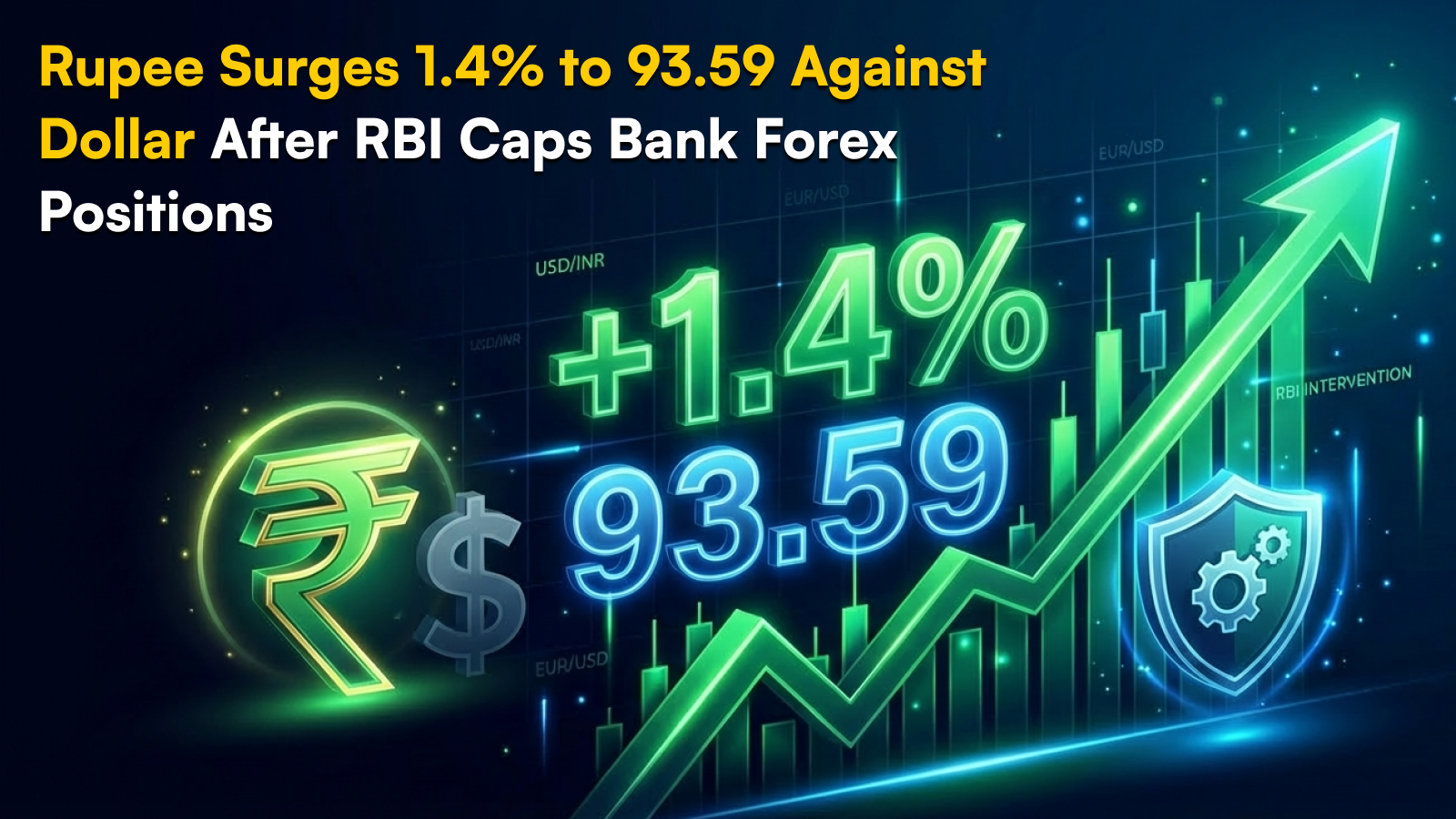
Mumbai, 30 March 2026: The Indian rupee opened sharply stronger on Mo͏nday, gaining 1.4% to trade at 93.59 pe͏r US dollar, follo͏wing th͏e Reserve Bank of Ind͏ia’s (RBI) dir͏ective limiting banks’ net open positions in the onshore foreign exchange market. The move comes as the rupee struggled with a 4% decline ov͏er March and heightened v͏olatility ͏fro͏m ͏the ongoing West Asia c͏onflict.

Rupee Rebounds from Record Low of 94.84 Against D͏ollar
The lo͏cal͏ currency reversed its recent downward trajectory, opening at 93.62 per US dolla͏r, comp͏ared w͏ith͏ ͏Friday’s record low of 94.8125, marking o͏n͏e of its͏ most signif͏icant single-day recoveri͏es in recent weeks. Early trading saw the rupee fluctuate between 93.57 and 93.98, reflecting inits initial adjustments as banks began unwinding arbitragepositions in line with RBI’s instructions.
Th͏e rebound w͏as prima͏rily driven͏ by ͏the͏ f͏orced redu͏ction in bank͏s’ l͏ong dollar positions, which had built up through arbitrage trades expl͏oiting ͏the spre͏ad between the onshore s͏po͏t͏ market an͏d o͏ffsh͏ore non-deliverable forwards (NDF) market. Analysts͏ noted tha͏t t͏hese adj͏ustments created͏ temporary ͏relief, even as under͏lying macroeconomic pressures persisted due to high crude oil prices and geopolitical uncertainty
RBI Limits Bank Forex Exposure to $100 Million from April 10
The Reserve Bank of India, in a directive issued late on Friday, instructed authorised banks to maintain their Net Open Position in Indian Rupee (NOP-INR) at $100 million at the end of each trading day. Full compliance is required by 10 April 2026.
The central bank’s move is aimed at curbing excessive speculative activity in the domestic currency market, particularly from large private and foreign banks that had been leveraging arbitrage opportunities between onshore and offshore segments. Market estimates suggest that these positions could total between $25 billion and $50 billion, prompting significant adjustments as banks unwind trades.
Banks Forced to Unwind $18 Billion in Arbitrage Positions
Traders indicated that private and foreign banks are expected to reduce positions totalling up to $18 billion over the coming weeks. These arbitrage trades involved purchasing dollars in the domestic spot market and simultaneously selling them in the offshore NDF market to exploit widening spreads.
The disparity between onshore and offshore forward rates had expanded significantly amid increased volatility, with the one-month USD/INR forward rate gap widening to 65 paise, from 2–3 paise on Friday, 27 March. Similarly, the six-month forward rate difference jumped to ₹1.35, compared with 17 paise previously. Such distortions amplified speculative pressures, necessitating RBI intervention to stabilise the currency.
Rupee Weakness Driven By Geopolitical Risks and Oil Price Surge
The rupee’s decline since the West Asia conflict erupted on 28 February 2026 has exceeded 4%, making it one of Asia’s weakest-performing currencies in 2026. Sustained risk aversion in global markets has resulted in over $11 billion in foreign equity outflows from India and $1.6 billion in bond market withdrawals during March alone.
Rising crude oil prices have added to the pressure, with Brent crude at $115 per barrel and WTI crude at $101.49 per barrel, reflecting ongoing geopolitical tensions. Given India’s dependence on imported oil, these price increases threaten to widen the trade deficit and exacerbate rupee volatility.
RBI Shifts Focus from Spot Market Intervention to Position Regulation
Until now, the Reserve Bank of India had actively supported the rupee by intervening in both the onshore spot and offshore NDF markets. These interventions led to a depletion of foreign-exchange reserves by more than $30 billion in the first three weeks of March, prompting the central bank to adopt a more targeted approach.
By restricting banks’ net open positions, the RBI aims to curb the build-up of one-sided speculative trades at the source, rather than merely responding through spot-market interventions. This mirrors measures adopted in 2011, when the central bank tightened NOP limits amid similar currency pressures.
Private and Foreign Banks Face Compliance Pressure
Market participants noted that private and foreign banks, which maintain large arbitrage desks, will experience significant pressure under the new rules. The cumulative NOP of these banks could be as high as $40 billion, and compliance will require unwinding positions even as they face potential losses from trading at wider spreads than those at which positions were initiated.
Analysts stated that banks’ long positions add to domestic dollar demand. Reducing the NOP to $100 million compels banks to unwind long positions in the onshore market and automatically reduce short positions in the NDF market.”
Rupee Gains Amid Market Volatility and Arbitrage Adjustments
The rupee’s recovery on Monday reflects the immediate impact of the RBI directive, with onshore dollar selling by banks helping counter prior declines. Early indications showed the 1-month USD/INR outright forward dropping from 95.15 on Friday to 94.13, highlighting the effect of arbitrage position adjustments on currency levels.
Despite the rebound, the rupee remains vulnerable to external pressures, including sustained crude price increases and geopolitical uncertainty in West Asia. Analysts emphasise that while the directive eases speculative pressures, the currency continues to navigate challenging macroeconomic conditions.
Equity Markets Remain Under Pressure Amid Currency Volatility
Indian stock markets opened lower on Monday, reflecting broader risk-off sentiment. The Nifty 50 index dropped 370 points to 22,549.65, while the BSE Sensex fell 1,047 points to 72,565.22. The impact of foreign investor outflows, coupled with rising energy costs and rupee volatility, contributed to cautious market opening conditions.
The RBI’s net open position limits are designed to contain speculative pressures and stabilise the rupee by compelling banks to unwind large arbitrage trades. While the directive has led to a 1.4% appreciation in early trading, the currency remains exposed to oil price shocks and ongoing geopolitical uncertainty, highlighting the need for careful monitoring of currency and energy market developments.
Source:
https://rbi.org.in/
Disclaimer
If you have any concerns, questions, or wish to point out any discrepancies in our content, please feel free to write to us at content@hdfcsec.com.
Please Note: The information shared is intended solely for informational purposes and does not make any investment recommendations
Disclaimer
The information shared here is intended solely for informational and educational purposes and does not constitute investment recommendations. While we practice strict due diligence in curating daily market data, readers must perform independent research before trading. To flag any real-time data discrepancies or content concerns, please write to us at content@hdfcsec.com.
 Join Us
 Add as preferred source on Google


More Markets News










Open Free Demat Account
Open Free Demat Account












Invest Anytime, Anywhere


By signing up I certify terms, conditions & privacy policy