Nifty 50
- Eternal₹317.4012.95 (4.25%)
- Shriram Finance₹865-35.90 (-3.98%)
- Apollo Hospitals₹7,730125.50 (1.65%)
- Adani Enterprises₹2,477-73.00 (-2.86%)
- ONGC₹227.502.50 (1.11%)
- JSW Steel₹1,185.50-34.50 (-2.83%)
- Asian Paints₹2,30722.20 (0.97%)
- Jio Financial ₹205.03-5.77 (-2.74%)
- TCS₹2,53023.10 (0.92%)
- Tata Steel₹167.67-4.66 (-2.70%)
- UltraTech Cement₹11,05092.00 (0.84%)
- Adani Ports₹1,702.70-47.30 (-2.70%)
- Maruti Suzuki₹11,23060.00 (0.54%)
- Tech Mahindra₹1,790-39.10 (-2.14%)
- Cipla₹1,3387.10 (0.53%)
- Tata Motors PV₹264.60-5.40 (-2.00%)
- Reliance Industries₹1,1905.50 (0.46%)
- Hindalco Industries₹869.85-15.75 (-1.78%)
- Axis Bank₹1,217.505.50 (0.45%)
- Trent₹2,727.50-48.30 (-1.74%)

- Offerings
- Tools & Platforms
Tools & Calculators
- Open API
- Calculators
- SIP Calculator
- CAGR Calculator
- Compound Interest Calculator
- FD Calculator
- RD Calculator
- EPF Calculator
- Retirement Calculator
- HDFC SIP Calculator
- Mutual Fund Return Calculator
- Lumpsum Calculator
- Step Up SIP Calculator
- ETF SIP Calculator
- Brokerage Calculator
- Equity Margin Calculator
- SWP Calculator
- EMI Calculator
- MTF Calculator
- Margin Pledge Calculator
- Algo Strategy
- Markets
Stocks
F&O
Mutual Funds
- More
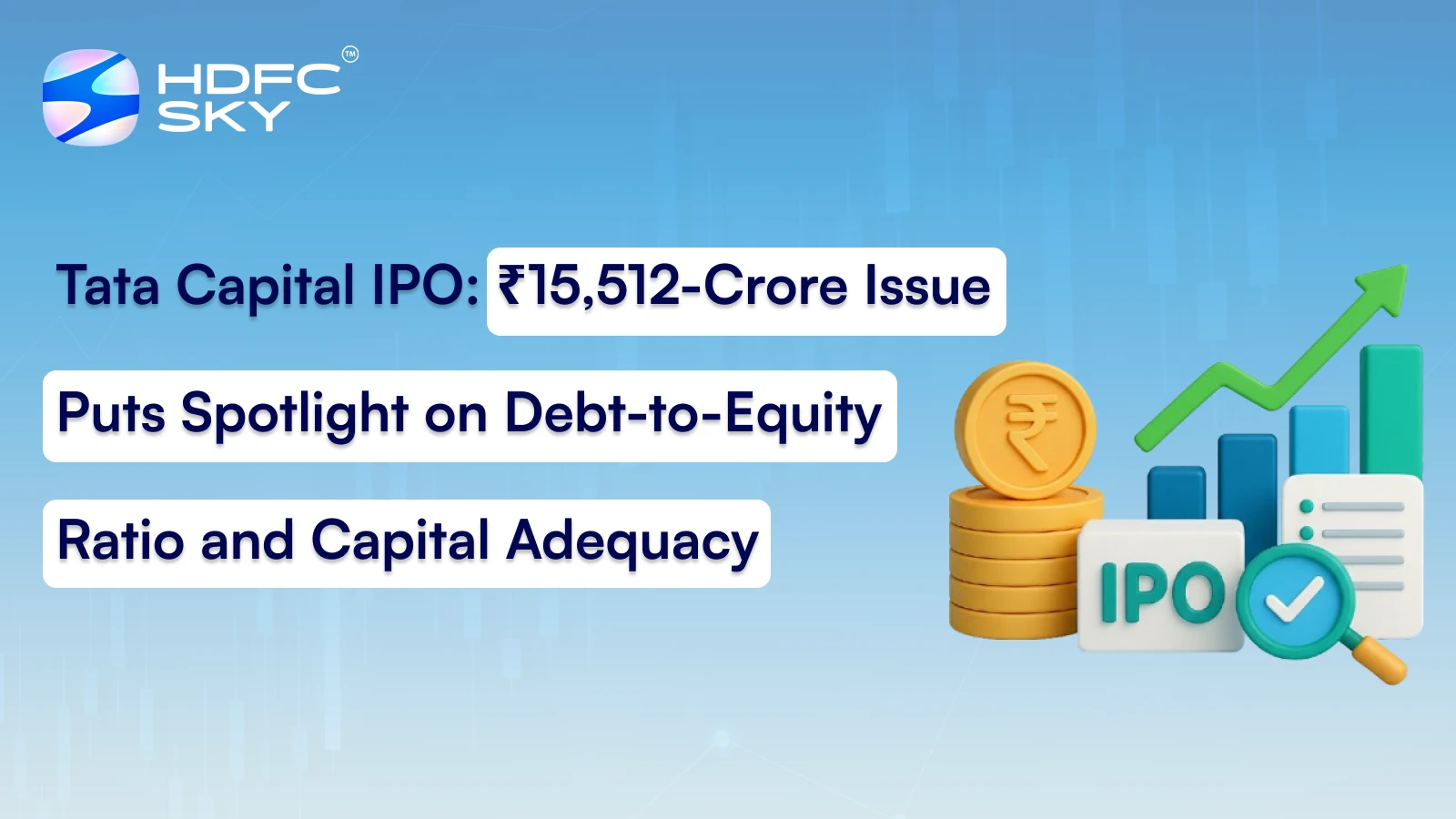
Tata Capital IPO: ₹15,512-C͏ror͏e I͏ssue Puts Spotlight on Debt-to-͏Equity͏ Ratio and͏ Capi͏tal Adequacy
Authored By Shishta Dutta | Last Modified: Jun 9, 2026 03:00 PM IST
Open Free Demat Account
Open Free Demat Account
Mumbai, 30 Septembe͏r 20͏25: Tata Capital Limited, the financial service͏s͏ arm of the Tata Group, is preparing for its ₹15,511.87 crore Initial Public Offering (IPO), which will be held between 6 and 8 October 2025. The IPO comprises a new iss͏ue of ₹6,846 crore along with an Offer for Sal͏e (OFS) of 8,665 crore, with a ͏p͏ric͏e ͏band fixed at ₹310-₹326 pe share

Tata Capital IPO High Debt-to-Equity Ratio in Focus
With a debt-to-equity ratio of 6.6x, Tata Capital shows too much reliance on borrowed money to drive loan book expansion. Total borrowings in FY25 exceeded ₹2.08 lakh crore, considerably greater than ₹1.61 lakh crore in FY24. This rise outpaced the company’s net worth, which rose to ₹32,587.82 crore from ₹23,540.19 crore during the same period.
While such leverage has enabled Tata Capital to strengthen its presence across consumer finance, SME lending, and corporate loans, it also places pressure on interest coverage ratios and repayment obligations.
Compared to peers like Bajaj Finance, which maintains a debt-to-equity ratio of around 3.8x, Tata Capital’s leverage signals higher funding costs and potential exposure to liquidity stress in a tightening credit environment. The ratio, the͏re͏fo͏re, becomes a key metric for assessing the company’s financial resilience as it scales further.
Tata Capital IPO Strengthening Capital Adequacy Through IPO Proceeds
The fresh issue of ₹6,846 crore is designed to directly augment Tier-I capital, which is central to improving the company’s capital adequacy ratio (CAR). NBFCs are required by the Reserve Bank of India (RBI) to maintain a minimum CAR of 15%, and while Tata Capital’s CAR currently stands close to regulatory thresholds, rapid growth in its loan portfolio has increased the urgency for fresh equity infusion.
By channeling IPO proceeds into capital buffers, Tata Capital aims to create a cushion against rising provisioning requirements and market shocks, particularly as RBI has mandated stricter rules on liquidity coverage, bad loan recognition, and systemic risk controls. In a sector expected to expand at 14–16% CAGR by FY28, stronger capital adequacy will not only ensure compliance but also provide the company with the flexibility to withstand cyclical downturns and competitive pressures.
This move signals a strategic recalibration from aggressive leverage-driven growth to more sustainable capital-supported expansion.
Tata Capital IPO Sector-Wide Implications of IPO Timing
Tata Capital IPO comes shortly after Tata Capital’s merger with Tata Motors Finance Limited (TMFL), which added scale but also increased leverage. This timing underscores the broader trend of NBFCs tapping equity markets to fortify balance sheets amid evolving regulatory demands. Anchor investors have already subscribed ₹4,641.83 crore on 3 October 2025, reflecting the scale and significance of the issue in reshaping the capital structure of one of India’s largest non-banking lenders.
The upcoming Tata Capital IPO illustrates how major NBFCs are addressing leverage pressures while aligning with stricter capital adequacy requirements. By directing fresh equity towards strengthening Tier-I capital, the company signals the growing importance of balance-sheet resilience in a sector balancing rapid credit growth with heightened regulatory scrutiny.
Disclaimer
At HDFC SKY*, we take utmost care and due diligence in curating and presenting news and market-related content. However, inadvertent errors or omissions may occasionally occur.
If you have any concerns, questions, or wish to point out any discrepancies in our content, please feel free to write to us at content@hdfcsec.com.
Please Note: The information shared is intended solely for informational purposes and does not make any investment recommendations.
HDFC SKY from HDFC Securities, one of most trusted trading platforms in India, has been recognized with the *Next-Gen Digi Content Awards 2025-26.
 Join Us
 Add as preferred source on Google


More IPO News





Open Free Demat Account
Open Free Demat Account











Invest Anytime, Anywhere


By signing up I certify terms, conditions & privacy policy