Nifty 50
- Tata Consumer ₹981.1044.60 (4.76%)
- Hindustan Unilever₹1,767.70-50.90 (-2.80%)
- Bharat Electronics₹3718.00 (2.20%)
- TCS₹2,480.60-54.40 (-2.15%)
- Bharti Airtel₹1,958.8041.30 (2.15%)
- Infosys₹1,141.10-24.90 (-2.14%)
- Trent₹2,80753.00 (1.92%)
- HCL Technologies₹1,400-17.00 (-1.20%)
- BSE₹3,423.6064.60 (1.92%)
- Grasim Industries₹2,916.50-33.50 (-1.14%)
- Maruti Suzuki₹11,411191.00 (1.70%)
- Asian Paints₹2,298.60-23.40 (-1.01%)
- Bajaj Auto₹10,226155.00 (1.54%)
- ONGC₹226.17-2.27 (-0.99%)
- Power Grid Corp₹250.803.80 (1.54%)
- ITC₹257.95-2.55 (-0.98%)
- Max Healthcare₹847.6512.65 (1.51%)
- Reliance Industries₹1,190.20-11.60 (-0.97%)
- Shriram Finance₹836.2511.25 (1.36%)
- Tech Mahindra₹1,778.80-16.20 (-0.90%)

- Offerings
- Tools & Platforms
Tools & Calculators
- Open API
- Calculators
- SIP Calculator
- CAGR Calculator
- Compound Interest Calculator
- FD Calculator
- RD Calculator
- EPF Calculator
- Retirement Calculator
- HDFC SIP Calculator
- Mutual Fund Return Calculator
- Lumpsum Calculator
- Step Up SIP Calculator
- ETF SIP Calculator
- Brokerage Calculator
- Equity Margin Calculator
- SWP Calculator
- EMI Calculator
- MTF Calculator
- Margin Pledge Calculator
- Algo Strategy
- Markets
Stocks
F&O
Mutual Funds
- More
Escalating Middle East Tensions, Stagflation Fears Grips Global Markets
Authored By Prime Research | Last Modified: Mar 19, 2026 10:07 AM IST

Open Free Demat Account
Open Free Demat Account
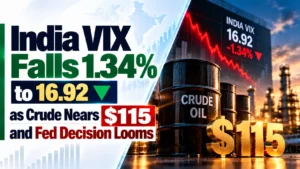
Crude Oil surged after Iran struck Middle East energy facilities in retaliation for an Israeli attack on South Pars gas field.
Iran declared Gulf energy assets “legitimate targets,” pushing Brent well past $110/bbl, WTI near to ~$100/bbl, and U.S. natural gas up ~5%.
Elevated risk premia threaten sustained imported inflation, wider current account deficits in energy importers like India, and cross-asset volatility.
Trump linked further Iran action to allies reopening the Strait of Hormuz, raising supply disruption risks.
A 60-day Jones Act waiver was announced to ease domestic fuel movement, though its global impact is limited.
Iranian missiles caused “extensive damage” at Qatar’s Ras Laffan Industrial City. Saudi Arabia intercepted four ballistic missiles targeting Riyadh and neutralized a drone attack on an eastern gas facility.
U.S. stock benchmarks closed at their lowest levels of 2026 on Wednesday after the Federal Reserve held interest rates steady. The Dow Jones Industrial Average plunged over 750 points, as investors digested the Fed’s revised inflation projections and hawkish tone. The S&P 500 and Nasdaq Composite fell 1.4% and 1.5% respectively, wiping out the week’s earlier gains.
Global equities extended their decline, with rising crude prices and a U.S. inflation reading adding further pressure.
The U.S. Federal Reserve held rates steady on Wednesday, projecting higher inflation, stable unemployment, and a single rate cut this year — an outlook Fed Chair Jerome Powell called subject to “unusually high uncertainty” amid the U.S.-Israeli war with Iran.
Following an 11-1 vote to maintain the benchmark rate in the 3.50%–3.75% range, Powell acknowledged that inflation progress has been slower than expected.
The Fed’s Summary of Economic Projections signalled just a quarter-point rate cut by year-end — with no indication of timing — while its year-end inflation forecast was revised up to 2.7% from 2.4% in December.
The Bank of Canada similarly held rates, with both central banks signalling vigilance against an energy-driven inflation resurgence.
US Treasury yields spiked, 10-year to 4.256%, 2-year to 3.741%, on a hot PPI print and hawkish Fed signals, sharpening stagflation concerns.
The Indian rupee hit a record low, breaching 92.50 amid thin dollar liquidity ahead of a bank holiday today. Aggressive importer demand triggered a sharp sell-off.
Indian markets are set to open sharply lower today, pressured by escalating tensions in West Asia and surging Brent crude prices amid supply disruption fears. The Fed’s hawkish stance in its latest meeting, indicating fewer rate cuts, adds to the global risk-off sentiment, dragging down equities.
The Nifty drew support from the gap band of 22,923–23,207 earlier this week, and that same zone is expected to remain relevant today as well.
A decisive break below 22,923 would signal a resumption of the downtrend.
Amid the escalating U.S.-Israel-Iran conflict, President Trump has directed Israel to halt further strikes on Iranian on the South Pars gas field. Any signs of de-escalation in the West Asian crisis could help cushion the impact on global equity markets.
Disclaimer
At HDFC SKY, we take utmost care and due diligence in curating and presenting news and market-related content. However, inadvertent errors or omissions may occasionally occur.
If you have any concerns, questions, or wish to point out any discrepancies in our content, please feel free to write to us at content@hdfcsec.com.
Please Note: The information shared is intended solely for informational purposes and does not make any investment recommendations
If you have any concerns, questions, or wish to point out any discrepancies in our content, please feel free to write to us at content@hdfcsec.com.
Please Note: The information shared is intended solely for informational purposes and does not make any investment recommendations
Disclaimer
The information shared here is intended solely for informational and educational purposes and does not constitute investment recommendations. While we practice strict due diligence in curating daily market data, readers must perform independent research before trading. To flag any real-time data discrepancies or content concerns, please write to us at content@hdfcsec.com.
 Join Us
 Add as preferred source on Google
Summarize with AI


More Markets News









Open Free Demat Account
Open Free Demat Account
Trending News


Similar News
View All ↗
Latest Articles
View MoreHistory of Visa: The Network Behind the World's Card Payments
Last Updated: Oct 27, 2026

Reading Probability Language in a Trade Idea
Last Updated: Oct 26, 2026

Why DMart’s Stock Has Always Looked So Expensive
Last Updated: Oct 26, 2026

Tired of Tips? Become an Independent F&O Trader
Last Updated: Oct 26, 2026

Call Triggered, Now What? Managing a Trade After Entry
Last Updated: Oct 26, 2026



Invest Anytime, Anywhere


By signing up I certify terms, conditions & privacy policy