Nifty 50
- Tata Consumer ₹989.0552.55 (5.61%)
- Cipla₹1,325.40-29.60 (-2.18%)
- BSE₹3,448.1089.10 (2.65%)
- Adani Enterprises₹2,454-54.00 (-2.15%)
- Bharti Airtel₹1,961.3043.80 (2.28%)
- Asian Paints₹2,279.90-42.10 (-1.81%)
- Power Grid Corp₹252.505.50 (2.23%)
- Grasim Industries₹2,897.90-52.10 (-1.77%)
- Bajaj Auto₹10,279208.00 (2.07%)
- Hindustan Unilever₹1,788-30.60 (-1.68%)
- Max Healthcare₹851.3516.35 (1.96%)
- TCS₹2,495.90-39.10 (-1.54%)
- Trent₹2,804.2050.20 (1.82%)
- ICICI Bank₹1,381.40-21.60 (-1.54%)
- Bharat Electronics₹3696.00 (1.65%)
- Coal India₹399.80-5.20 (-1.28%)
- Maruti Suzuki₹11,370150.00 (1.34%)
- ITC₹257.55-2.95 (-1.13%)
- Sun Pharmaceutical₹1,759.5019.50 (1.12%)
- HDFC Bank₹680.95-7.10 (-1.03%)

- Offerings
- Tools & Platforms
Tools & Calculators
- Open API
- Calculators
- SIP Calculator
- CAGR Calculator
- Compound Interest Calculator
- FD Calculator
- RD Calculator
- EPF Calculator
- Retirement Calculator
- HDFC SIP Calculator
- Mutual Fund Return Calculator
- Lumpsum Calculator
- Step Up SIP Calculator
- ETF SIP Calculator
- Brokerage Calculator
- Equity Margin Calculator
- SWP Calculator
- EMI Calculator
- MTF Calculator
- Margin Pledge Calculator
- Algo Strategy
- Markets
Stocks
F&O
Mutual Funds
- More
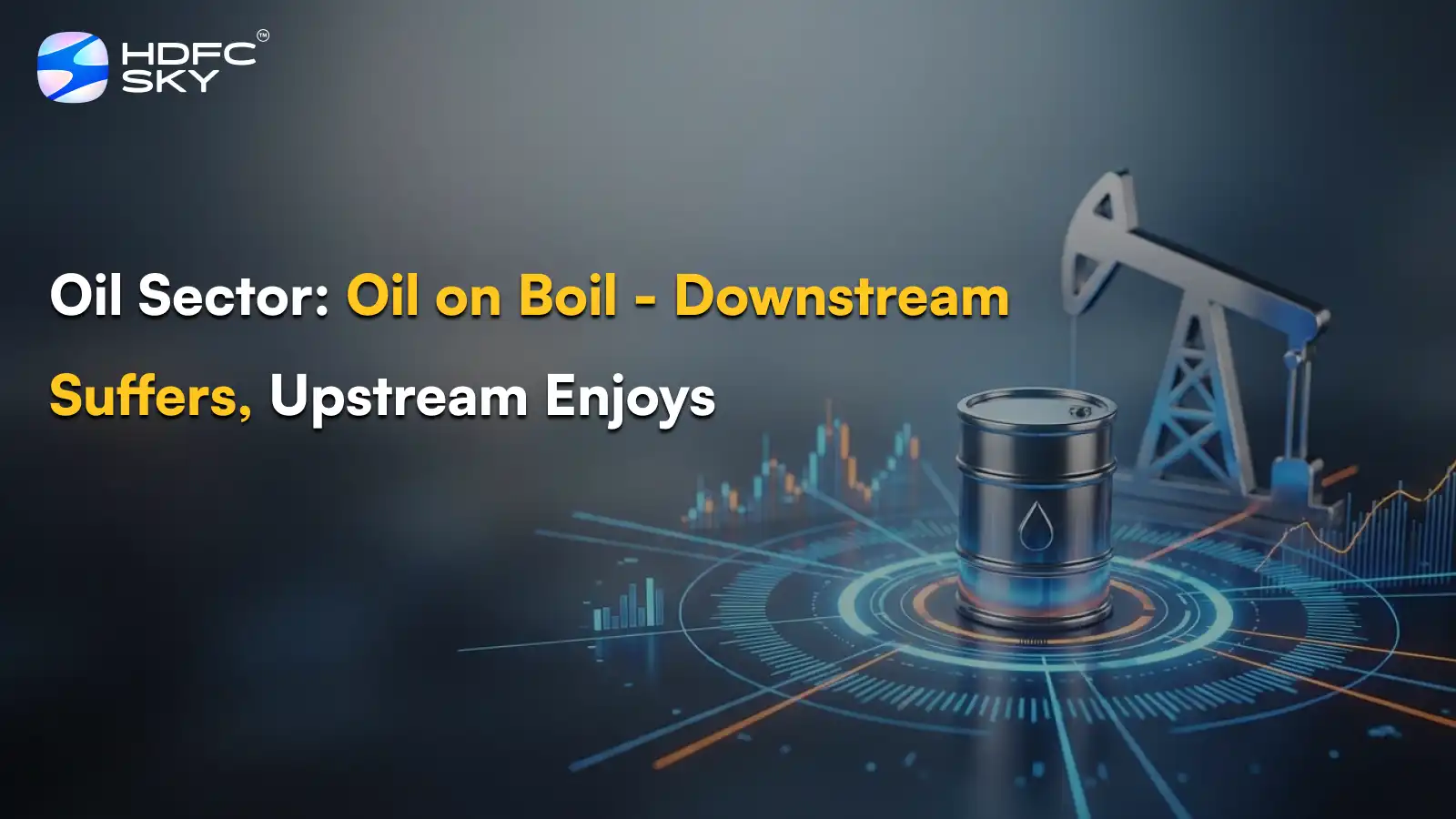
Oil Sector: Oil on Boil - Downstream Suffers, Upstream Enjoys
Authored By Prime Research | Last Modified: Mar 16, 2026 11:11 AM IST
Open Free Demat Account
Open Free Demat Account
The US-Israel vs Iran war has led to the closure of The Strait of Hormuz, production cut at various oil fields in Iraq, Saudi Arabia, and Kuwait, and the shutdown of Ras Laffan LNG liquefaction plant in Qatar and Ras Tanura refinery of Saudi Aramco. These developments have disrupted the well-oiled global supply chain of crude oil, resulting in Brent Crude Oil prices surging beyond USD 90/bbl, up from USD 73/bbl (on 27th February). Given the fact that India is dependent on crude oil imports to meet its fuel and energy requirements, the country is not insulated from the disruptions in the global oil market. Currently, more than 50% of India’s oil imports flow through the Strait of Hormuz. While Indian refiners face the challenge of meeting the country’s crude oil requirement amidst limited crude oil availability and sky rocketing transportation costs, city gas distribution companies are forced to deal with reduction in gas availability, high gas prices, and a depreciating rupee against the dollar. The upstream segment seems to be the only beneficiary as higher crude oil prices and weakening rupee should improve the oil and oil-linked gas realization of this segment.
OMCs’ integrated margins to decline: With the retail selling prices of transportation fuels (gasoline and diesel) remaining unchanged and sudden spike in the brent crude oil price, the integrated margin of OMCs is set to decline in the near term compared to the 9MFY26 reported margin ranging from INR 8/ltr to INR 12/ltr. However, higher crude oil prices will lead to inventory gains, which would provide some cushion to the reported margins in Q4FY26. Since the war began, gasoline and diesel cracks have increased to an average of USD 34 and USD 25.4 per barrel in first 10 days of March 2026 from an average of USD 20 and USD 6.6 per barrel recorded in Feb 2026 (+70%/+2.8x), resulting in significant GRM expansion. The Singapore Refining Margin, which averaged at USD 10.2/bbl in February 2026, increased by 91% to an average of USD 19.4/bbl. As per our calculations, for every USD 1/bbl increase in gross refining margin, the annual EPS of IOCL/BPCL/HPCL increases by 11/9/7%. This increase in the gross refining margin will compress the OMCs’ marketing margins. With integrated margin under pressure and share of refining margin in overall integrated margin increasing, companies with higher earnings sensitivity to marketing margins will be the most negatively impacted. For every INR 1/ltr decrease in marketing margin, IOCL/BPCL/HPCL’s FY27 EPS reduces by 21/20/24%. Given that IOCL has a lower marketing mix in the overall volume, it should fare better compared to peers like BPCL and HPCL in the near term.
Upstream to benefit: Elevated crude oil prices aid higher realization of oil and oil-linked gas for the upstream segment (the only caveat being that the government does not increase/impose any additional tax). For every USD 5/bbl increase in Brent crude oil price above USD 70/bbl, ONGC/Oil India’s standalone annual EPS goes up by 14/9%. We prefer Oil India over ONGC, given the former’s better growth in production volumes in comparison to ONGC’s declining production volume.
Change in estimates: For now, we maintain our estimates and recommendation for all the OMCs and upstream companies.
Disclaimer
If you have any concerns, questions, or wish to point out any discrepancies in our content, please feel free to write to us at content@hdfcsec.com.
Please Note: The information shared is intended solely for informational purposes and does not make any investment recommendations
Disclaimer
The information shared here is intended solely for informational and educational purposes and does not constitute investment recommendations. While we practice strict due diligence in curating daily market data, readers must perform independent research before trading. To flag any real-time data discrepancies or content concerns, please write to us at content@hdfcsec.com.
 Join Us
 Add as preferred source on Google


More Markets News









Open Free Demat Account
Open Free Demat Account












Invest Anytime, Anywhere


By signing up I certify terms, conditions & privacy policy