Nifty 50
- Tata Consumer ₹994.7558.25 (6.22%)
- Hindustan Unilever₹1,771.20-47.40 (-2.61%)
- Bharat Electronics₹370.907.90 (2.18%)
- Infosys₹1,135.75-30.25 (-2.59%)
- Shriram Finance₹839.8014.80 (1.79%)
- TCS₹2,492.60-42.40 (-1.67%)
- Bajaj Auto₹10,247176.00 (1.75%)
- HCL Technologies₹1,400-17.00 (-1.20%)
- Maruti Suzuki₹11,393173.00 (1.54%)
- Tech Mahindra₹1,777.70-17.30 (-0.96%)
- Max Healthcare₹847.4012.40 (1.49%)
- Asian Paints₹2,300-22.00 (-0.95%)
- Tata Steel₹172.392.45 (1.44%)
- UltraTech Cement₹11,075-105.00 (-0.94%)
- BSE₹3,406.5047.50 (1.41%)
- Grasim Industries₹2,928-22.00 (-0.75%)
- Sun Pharmaceutical₹1,763.5023.50 (1.35%)
- Bajaj Finserv₹1,660-10.90 (-0.65%)
- Bharti Airtel₹1,943.3025.80 (1.35%)
- Reliance Industries₹1,196.40-5.40 (-0.45%)

- Offerings
- Tools & Platforms
Tools & Calculators
- Open API
- Calculators
- SIP Calculator
- CAGR Calculator
- Compound Interest Calculator
- FD Calculator
- RD Calculator
- EPF Calculator
- Retirement Calculator
- HDFC SIP Calculator
- Mutual Fund Return Calculator
- Lumpsum Calculator
- Step Up SIP Calculator
- ETF SIP Calculator
- Brokerage Calculator
- Equity Margin Calculator
- SWP Calculator
- EMI Calculator
- MTF Calculator
- Margin Pledge Calculator
- Algo Strategy
- Markets
Stocks
F&O
Mutual Funds
- More
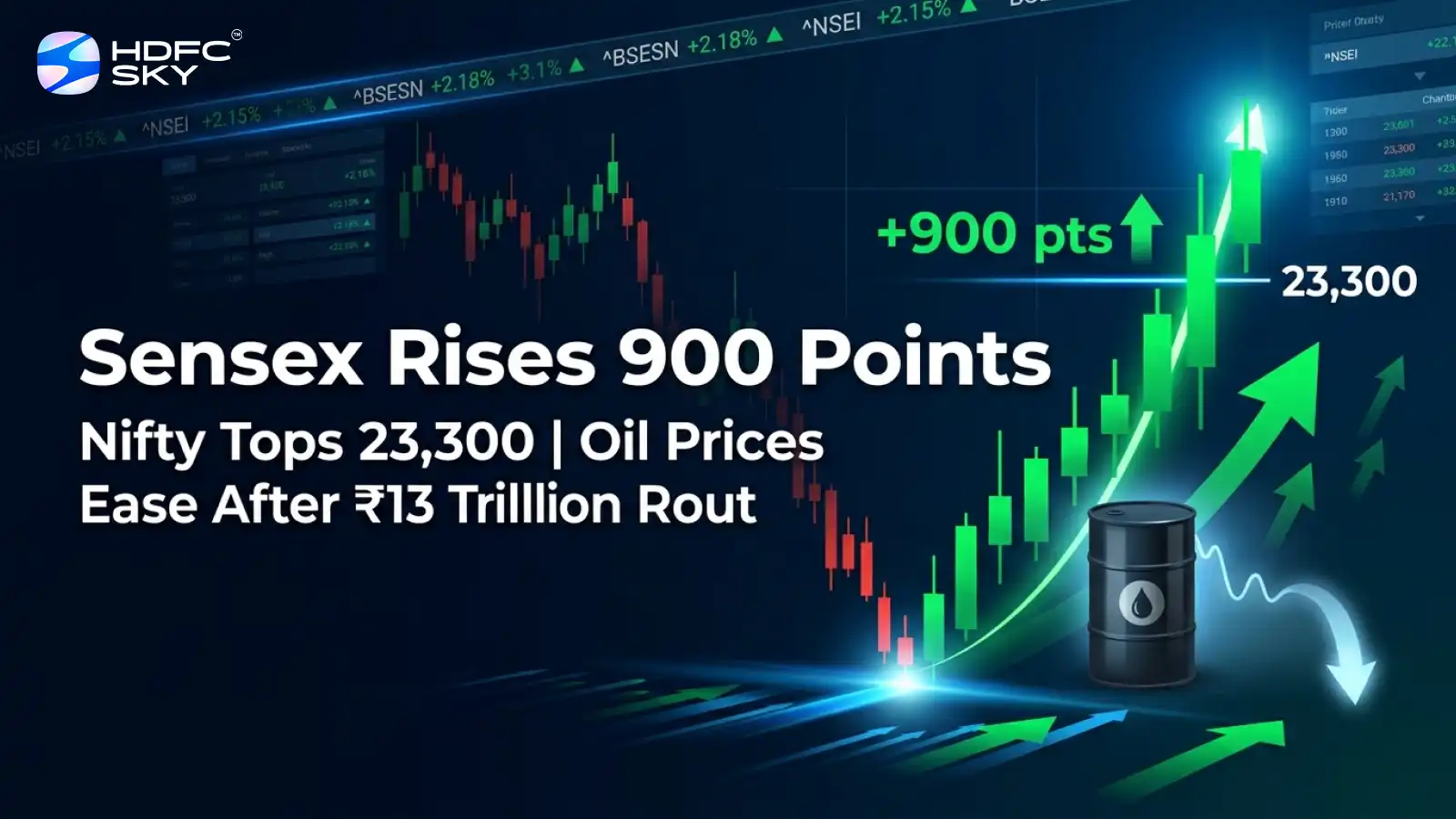
Sensex Rises 900 Points͏, N͏i͏fty Tops 23,3͏00 As O͏il Pr͏ices Ease After ₹13͏ Trillion R͏out
Authored By HDFC SKY | Last Modified: Mar 20, 2026 04:36 PM IST
Open Free Demat Account
Open Free Demat Account
Mumbai, March 20: Indian͏ ͏equity benchmarks op͏ened highe͏r͏ on F͏riday, stagi͏n͏g a r͏ecovery after a steep sell-off͏ in the p͏revious s͏ession͏ ͏that erased n͏early ₹13 tri͏llio͏n in inves͏tor wea͏lth. The rebound come͏s amid easing cru͏de oil price͏s and sta͏bilising g͏lobal cues, e͏ven as cur͏rency weaknes͏s and͏ ͏geopolitical tensions͏ ͏continue to weigh on overa͏ll market di͏rection.

Sense͏x ͏Jumps 900 Points as Oil Falls to $10͏5.80
Th͏e Sense͏x ͏surged͏ over 90͏0 ͏poin͏t͏s in ear͏ly trade, wh͏ile the N͏ifty͏50 climbed mor͏e than 270 poin͏ts, reclaiming levels͏ above 23͏,3͏00. T͏his upward movement follows a d͏ecline in crude oil prices, with Brent M͏ay futures droppin͏g 2.61% to͏ ͏$105.80 per barrel͏, ͏offe͏ring temporary relief to glo͏bal markets.
The e͏asing of͏ oi͏l pri͏ces c͏omes after heightened volatility driven by geopoliti͏cal tensions i͏n West Asia.͏ Recent deve͏lopments, including signal͏s o͏f͏ de-esca͏lation and potential eas͏ing of sa͏nctions on Iran͏ian͏ crude, have helped cool͏ commodi͏ty ma͏rkets. This decline in oil prices h͏as reduced imme͏diate inflat͏ionar͏y c͏oncern͏s, supporting equ͏ities in͏ the͏ sh͏ort͏ te͏rm.
Despite t͏his rebound, the͏ broad͏er c͏onte͏xt remains͏ fra͏gile, a͏s oi͏l continues to trade above t͏he $͏100͏ pe͏r barrel ͏mark, indicating persi͏stent supply-si͏de uncer͏t͏ainties.
Markets Rebound After ₹13 Trillion Crash on Thursday
Friday’s recovery follows one of the sharpest declines in recent times, with the Nifty plunging 775 points (3.26%) in the previous session. The sell-off was triggered by escalating geopolitical tensions and a spike in crude oil prices, which led to a widespread risk-off sentiment across asset classes.
Equities, bonds, and metals witnessed broad-based declines as investors reacted to disruptions in energy infrastructure and uncertainty surrounding the Strait of Hormuz. The steep fall marked the biggest single-day percentage drop since April 2025, highlighting the sensitivity of markets to external shocks.
The current rebound indicates a technical recovery after heavy losses, supported by improved global signals. However, volatility remains elevated, with the India Volatility Index declining 3%, suggesting a slight easing in near-term uncertainty.
Nifty Crosses 23,300 as Banking and IT Lead Gains
The Nifty’s move past 23,300 was driven by strong gains in banking, IT, and metal stocks. The Nifty Bank index advanced nearly 800 points to 54,200, reflecting renewed buying interest in financial stocks.
Key gainers included Tech Mahindra, Infosys, State Bank of India, Tata Steel, HCL Technologies, and Power Grid, each rising between 2% and 3%. The rally was broad-based, with all sectoral indices opening in the green.
Cyclical sectors such as banking, metals, and IT led the gains, while defensive sectors like FMCG and healthcare remained stable. This widespread participation indicates a temporary return of buying interest across segments rather than isolated stock-specific movements.
However, the upward momentum is being closely watched, as analysts highlight a potential resistance zone between 23,200 and 23,300, which may limit further gains in the near term.
All Sectors Gain as Power Index Rises 2.49%
Sectoral performance reflected broad-based gains, with all major BSE indices trading in positive territory during early trade. The BSE Power index rose 2.49% to 7,027.03, emerging as one of the top-performing segments amid continued traction in energy-related stocks. The BSE Metal index advanced 2.05% to 37,948.64, while the BSE Oil & Gas index climbed 1.87% to 26,391.93, supported by easing crude oil prices.
Among cyclical sectors, the BSE Capital Goods index gained 1.66% to 68,339.09, and the BSE Consumer Durables index increased 1.53% to 55,188.10. Defensive segments also recorded steady gains, with the BSE IT index rising 1.24% to 27,993.80 and the BSE Healthcare index up 1.05% to 42,137.37, while the BSE FMCG index added 0.92% to 17,400.19 and the BSE Auto index edged higher by 0.86% to 54,799.73. The BSE Realty index climbed 1.76% to 5,564.02, completing a synchronised recovery across sectors.
Despite the day’s gains, longer-term trends remained mixed. The BSE Metal index retained strength with a 21.19% one-year gain, while the BSE Power index rose 8.50% annually. In contrast, the BSE IT index declined 23.80% year-to-date and 22.42% over one year, and the BSE FMCG index fell 14.47% year-to-date and 9.28% annually.
The BSE Realty index dropped 18.26% year-to-date and 16.17% over one year, while the BSE Oil & Gas index fell 8.07% year-to-date despite a 7.53% annual gain, indicating uneven sectoral performance across timeframes.
Midcap and Smallcap Indices Rise Up To 1.27%
Broader markets also participated in the recovery, with the Nifty Midcap100 rising 1.27% and the Nifty Smallcap100 gaining 0.76%. The midcap index saw a notable jump of nearly 1,000 points, reflecting improved sentiment beyond frontline stocks.
This rebound comes after significant pressure in the broader market during the previous session. The recovery suggests a partial stabilisation in risk appetite, although the gains remain moderate compared to the sharp declines witnessed earlier.
The strength in midcap and smallcap indices aligns with the broader market trend, supported by easing oil prices and stabilising global cues.
HDFC Bank Drops 2% After ADR Weakness
Among major stocks, HDFC Bank stood out as the only significant loser on the Sensex, declining over 2% and extending its recent losses. The stock has fallen nearly 8% over two sessions, following weakness in its American Depositary Receipts (ADRs) listed on the New York Stock Exchange.
The decline follows a sharp 5% drop in the previous session, which had erased nearly ₹1 trillion in market capitalisation. The continued weakness highlights stock-specific concerns amid broader market recovery.
Other notable losers included LTIMindtree, Rajesh Exports, Vinati Organics, ITI, and TTK Prestige, each declining between 1.6% and 2.8% in early trade.
The power sector emerged as a strong performer, with the BSE Power index rising nearly 3%. Stocks such as Tata Power, BHEL, Reliance Power, and Hitachi Energy recorded gains of up to 3.91% during intraday trading.
The sector’s performance reflects increased focus on energy infrastructure amid global supply disruptions. The rally also aligns with broader gains in cyclical sectors, supported by easing oil prices and improved market sentiment.
Other power-related stocks, including JSW Energy, Torrent Power, Adani Power, NTPC, and NHPC, also recorded gains ranging from 2% to 3.4%, indicating strong participation within the sector.
Global Markets Mixed as Oil and Geopolitics Dominate
Global market cues remained mixed, with US markets closing lower overnight but recovering from session lows. Asian markets initially declined but later edged higher following the drop in oil prices.
Futures data indicated modest gains, with S&P 500 futures rising 0.2%, Nikkei 225 futures up 0.5%, and Euro Stoxx 50 futures gaining 0.8%. However, indices such as Hong Kong’s Hang Seng and the Shanghai Composite remained under pressure, declining 0.6% and 0.4%, respectively.
Geopolitical developments continue to drive market sentiment, with recent statements indicating potential easing of tensions in West Asia. At the same time, reports of disruptions to Qatar’s LNG capacity and ongoing uncertainties around the Strait of Hormuz highlight persistent risks in the energy market.
Geopolitical Developments Keep Markets on Edge
Recent developments suggest a complex geopolitical backdrop influencing market movements. Statements indicating support for reopening key shipping routes and a potential end to hostilities have provided some relief to risk assets.
However, reports of continued disruptions, including damage to energy infrastructure and missile activity, underscore the fragile nature of the situation. Additionally, comments from global policymakers regarding oil and gas exports and potential sanctions relief have added further layers of uncertainty.
These factors have contributed to heightened volatility across asset classes, with markets reacting sharply to each new development.
The current market movement reflects a short-term rebound driven by easing oil prices and stabilising global cues after a sharp decline. However, persistent geopolitical uncertainties, elevated crude prices above $100, and currency weakness continue to influence overall market conditions, indicating that volatility may remain a defining feature in the near term.
Sources:
- https://www.nseindia.com/index-tracker/NIFTY%2050
- https://www.nseindia.com/index-tracker/NIFTY%20BANK
- https://www.niftyindices.com/indices/equity/sectoral-indices/nifty-auto
- https://www.niftyindices.com/indices/equity/broad-based-indices/NIFTY-Midcap-100
- https://www.niftyindices.com/indices/equity/broad-based-indices/nifty-smallcap-500
- https://www.niftyindices.com/indices/equity/sectoral-indices/nifty-oil-and-gas-index
- https://www.niftyindices.com/indices/equity/sectoral-indices/nifty-it
- https://www.bseindia.com/sensex/code/16/
Disclaimer
If you have any concerns, questions, or wish to point out any discrepancies in our content, please feel free to write to us at content@hdfcsec.com.
Please Note: The information shared is intended solely for informational purposes and does not make any investment recommendations
Disclaimer
The information shared here is intended solely for informational and educational purposes and does not constitute investment recommendations. While we practice strict due diligence in curating daily market data, readers must perform independent research before trading. To flag any real-time data discrepancies or content concerns, please write to us at content@hdfcsec.com.
 Join Us
 Add as preferred source on Google


More Markets News







Open Free Demat Account
Open Free Demat Account











Invest Anytime, Anywhere


By signing up I certify terms, conditions & privacy policy