Nifty 50
- Infosys₹1,03540.90 (4.11%)
- Bajaj Auto₹10,045-829.00 (-7.62%)
- HDFC Life Insurance ₹534.2013.00 (2.49%)
- Maruti Suzuki₹11,386-581.00 (-4.86%)
- HDFC Bank₹721.2012.50 (1.76%)
- Shriram Finance₹945-37.70 (-3.84%)
- SBI Life Insurance ₹1,721.6025.20 (1.49%)
- Tata Steel₹178-6.30 (-3.42%)
- Max Healthcare₹940.9511.15 (1.20%)
- Adani Ports₹1,737.80-60.50 (-3.36%)
- TCS₹2,07524.40 (1.19%)
- Grasim Industries₹2,962-99.90 (-3.26%)
- HCL Technologies₹1,243.1013.10 (1.07%)
- Eicher Motors₹6,920-230.00 (-3.22%)
- Tata Consumer ₹9577.50 (0.79%)
- Mahindra & Mahindra₹2,860-90.00 (-3.05%)
- Tech Mahindra₹1,5339.00 (0.59%)
- Adani Enterprises₹2,816.80-86.60 (-2.98%)
- Kotak Mahindra Bank₹418.351.35 (0.32%)
- ITC₹255.90-6.85 (-2.61%)

- Offerings
- Tools & Platforms
Tools & Calculators
- Open API
- Calculators
- SIP Calculator
- CAGR Calculator
- Compound Interest Calculator
- FD Calculator
- RD Calculator
- EPF Calculator
- Retirement Calculator
- HDFC SIP Calculator
- Mutual Fund Return Calculator
- Lumpsum Calculator
- Step Up SIP Calculator
- ETF SIP Calculator
- Brokerage Calculator
- Equity Margin Calculator
- SWP Calculator
- EMI Calculator
- MTF Calculator
- Margin Pledge Calculator
- Algo Strategy
- Markets
Stocks
F&O
Mutual Funds
- More
Red Flags in IPO Subscription Scams That Most Retail Investors Ignore
By Aseem Shrivastava | Updated at: May 21, 2026 03:35 PM IST

Open Free Demat Account
Open Free Demat Account
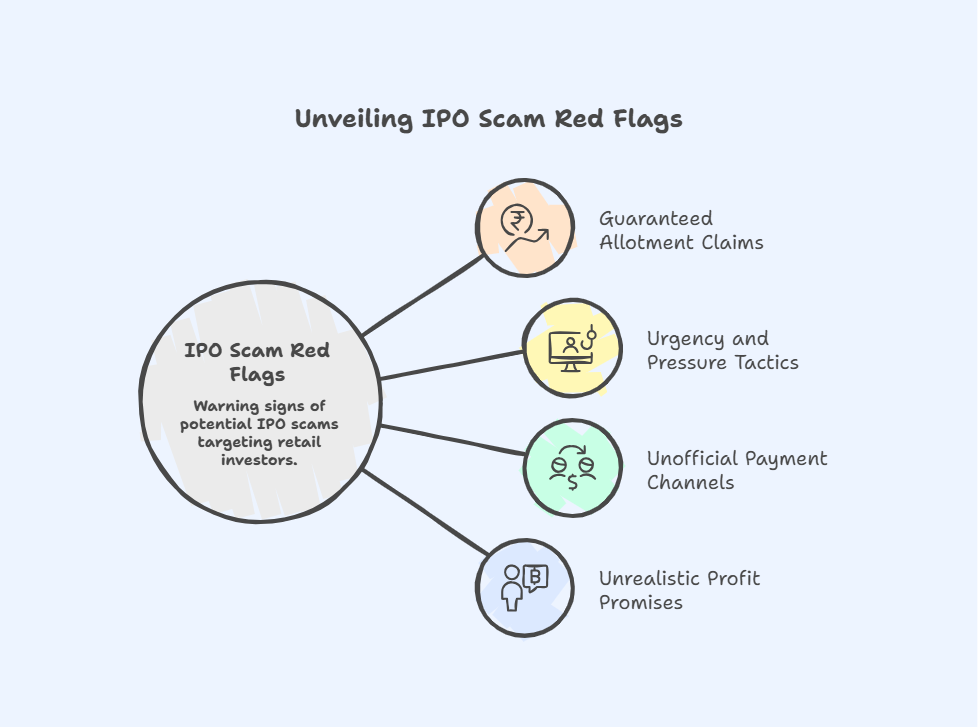
Initial Public Offerings (IPOs) often create excitement among retail investors. Social media hype and stories of quick listing gains push many people to apply without doing proper checks. Scammers understand this behaviour well and use it to exploit investors during IPO seasons. Here are some red flags of IPO scams that retail investors should never ignore.
Guaranteed Allotment Claims
No broker, agent, Telegram channel, or market operator can guarantee IPO allotment in a genuine public issue. IPO allotment follows a regulated process overseen by registrars and stock exchanges.
Scammers usually target investors with messages such as:
- 100% allotment assured
- Pay extra to secure shares
- Special quota available
- Guaranteed listing gains
These offers create urgency and push investors into transferring money outside official channels. If someone asks for additional money to secure IPO shares, it is a major red flag.
Fake UPI Mandates and Payment Links
Retail IPO applications today are largely processed through the ASBA, often using UPI-based mandate approvals. Fraudsters exploit this by sending fake payment requests or cloned UPI approval links. Many investors make the mistake of approving UPI mandates without carefully checking the details.
Before approving any IPO-related mandate:
- Verify the merchant or bank name
- Cross-check the amount
- Ensure the request matches the IPO application submitted through your broker or bank
- Confirm that funds are being blocked—not directly debited—from your account
- Approve mandates only through official banking or UPI applications
Also Read : How a “Guaranteed Returns” WhatsApp Group Scammed 300 Investors
Unregulated Telegram and WhatsApp Research Groups
IPO scams increasingly operate through social media communities. Telegram and WhatsApp groups claim to provide inside information about upcoming IPOs, anchor investor demand, or hidden listing gain opportunities. These claims are frequently misleading or entirely fabricated.
These groups usually follow a predictable pattern:
- Build trust with market commentary
- Share aggressive IPO recommendations
- Push investors toward specific brokers, payment links, or operators
- Manipulate sentiment using fake screenshots and fabricated profit claims
- Promote unofficial grey market premium (GMP) narratives as certainty
Many retail investors confuse social media popularity with credibility. A large subscriber count does not make a channel trustworthy.
Investors should verify whether any financial advisor or analyst is registered with SEBI before relying on investment recommendations.
Mindlessly Following Grey Market Premium (GMP) Hype
Discussions about grey-market premiums dominate every IPO cycle. While GMP can indicate market sentiment, it is not an official or regulated metric. Scammers misuse inflated GMP numbers to create artificial excitement around weak or risky IPOs. Hype-driven investing usually creates vulnerability, especially in overheated IPO markets.
Investment decisions should be based primarily on the company’s prospectus, business fundamentals, financial performance, and valuation—not unofficial grey-market signals.
Bottom Line
IPO scams thrive on speed, greed, and lack of verification. Most frauds succeed because investors act emotionally instead of following basic checks. Remember to use only authorized platforms and ignore guaranteed-return claims. Avoiding social media-driven pressure and carefully reading the company’s fundamentals also helps. Caution is often more valuable than speed. A missed IPO opportunity is far better than becoming the victim of a financial scam.



Open Free Demat Account
Open Free Demat Account
Popular Posts
- 10 Interesting Facts About NSE You Probably Didn’t KnowLast Updated: Sep 30, 2026
- 8-4-3 Rule of SIP - How Does That Work?Last Updated: Jul 30, 2025
- Let’s view more exciting Posts
Popular Post from Scam Shield by Sky
- How a “Guaranteed Returns” WhatsApp Group Scammed 300 InvestorsLast Updated: May 21, 2026
- Let's view more exciting Post!
Popular Post from Blogs
- “Bounce Back” Theme Gains Traction in 2026Last Updated: Apr 8, 2026
- 5 Takeaways for Tax Payers from the Budget 2025Last Updated: Jan 29, 2026
- Let’s view more exciting Posts


Invest Anytime, Anywhere


By signing up I certify terms, conditions & privacy policy