Nifty 50
- Infosys₹1,03540.90 (4.11%)
- Bajaj Auto₹10,045-829.00 (-7.62%)
- HDFC Life Insurance ₹534.2013.00 (2.49%)
- Maruti Suzuki₹11,386-581.00 (-4.86%)
- HDFC Bank₹721.2012.50 (1.76%)
- Shriram Finance₹945-37.70 (-3.84%)
- SBI Life Insurance ₹1,721.6025.20 (1.49%)
- Tata Steel₹178-6.30 (-3.42%)
- Max Healthcare₹940.9511.15 (1.20%)
- Adani Ports₹1,737.80-60.50 (-3.36%)
- TCS₹2,07524.40 (1.19%)
- Grasim Industries₹2,962-99.90 (-3.26%)
- HCL Technologies₹1,243.1013.10 (1.07%)
- Eicher Motors₹6,920-230.00 (-3.22%)
- Tata Consumer ₹9577.50 (0.79%)
- Mahindra & Mahindra₹2,860-90.00 (-3.05%)
- Tech Mahindra₹1,5339.00 (0.59%)
- Adani Enterprises₹2,816.80-86.60 (-2.98%)
- Kotak Mahindra Bank₹418.351.35 (0.32%)
- ITC₹255.90-6.85 (-2.61%)

- Offerings
- Tools & Platforms
Tools & Calculators
- Open API
- Calculators
- SIP Calculator
- CAGR Calculator
- Compound Interest Calculator
- FD Calculator
- RD Calculator
- EPF Calculator
- Retirement Calculator
- HDFC SIP Calculator
- Mutual Fund Return Calculator
- Lumpsum Calculator
- Step Up SIP Calculator
- ETF SIP Calculator
- Brokerage Calculator
- Equity Margin Calculator
- SWP Calculator
- EMI Calculator
- MTF Calculator
- Margin Pledge Calculator
- Algo Strategy
- Markets
Stocks
F&O
Mutual Funds
- More
What is Meant By Bottom-Of-The-Pyramid Customers?
By Ankur Chandra | Published at: May 20, 2025 01:23 PM IST
Open Free Demat Account
Open Free Demat Account
Bottom-of-the-pyramid customers refer to low-income customers, customers who are at the bottom of the income pyramid. The term was first coined by management guru C.K. Prahalad. Initially referred to the poorest two-thirds of the world’s population. A large part of this population lived on less than $2.15 per day. Today, the term is used to refer to a wider segment of low-income customers.
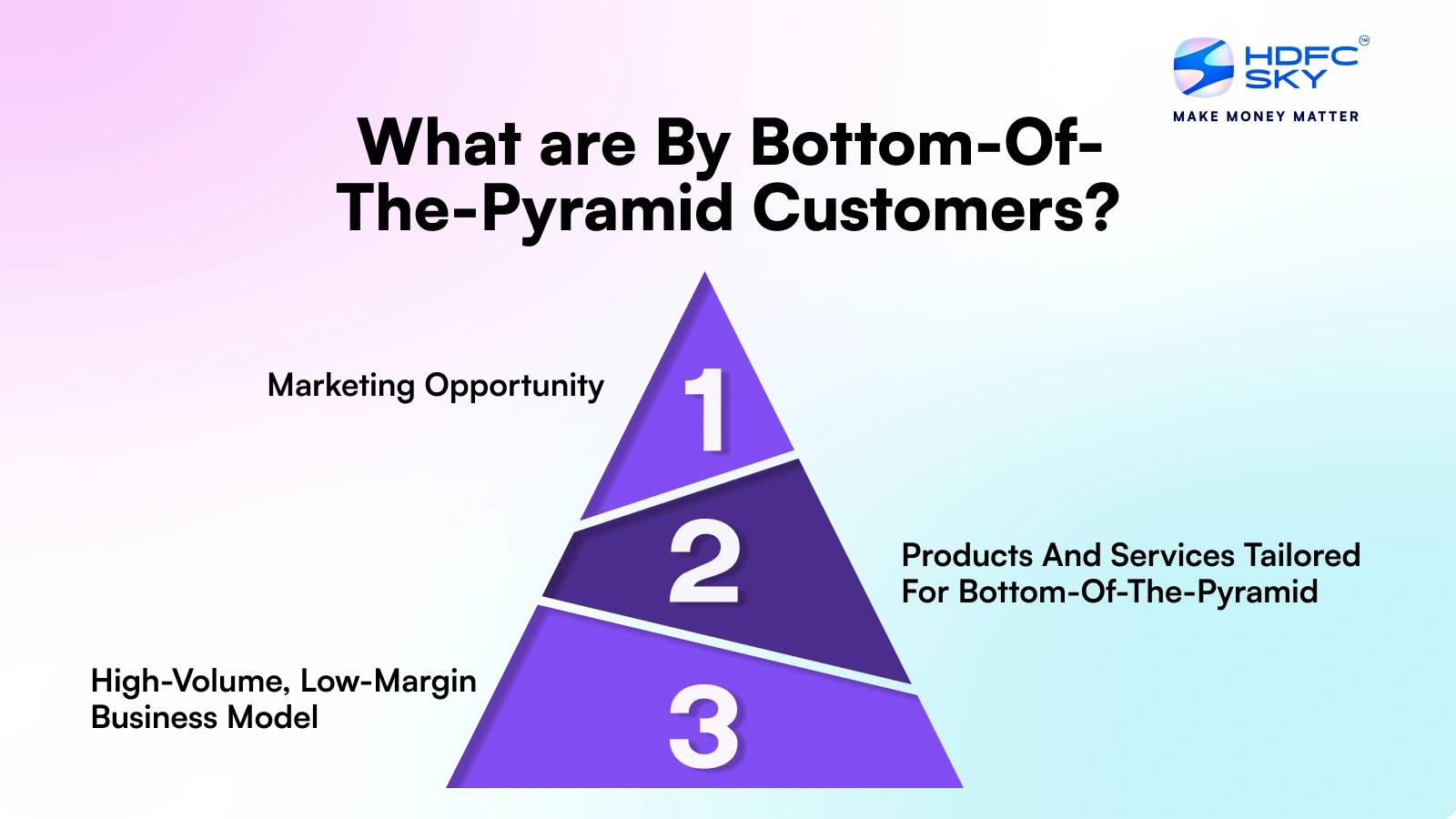
Bottom Of The Pyramid Customers Represent A Significant Marketing Opportunity
With the recognition of the bottom-of-the-pyramid customers, businesses have realised that these customers present a significant marketing opportunity for them. Before this, businesses focused solely on middle-class and affluent customers. In his book The Fortune at the Bottom of the Pyramid, C.K. Prahlad highlighted how companies could create value for themselves and their shareholders by developing products tailored for bottom-of-the-pyramid customers.
Products And Services Tailored For Bottom-Of-The-Pyramid Customers
One example of how a company can create products for bottom-of-the-pyramid customers is by offering small sachets of bottled versions of products like shampoos. A bottled shampoo may be unaffordable for low-income customers. But when the same shampoo comes in a small Re 1 or Rs 2 sachet, even a low-income customer can buy it. Many people from the low-income category generally do not have high liquidity and prefer buying products in small quantities to avoid paying a large amount upfront.
High-Volume, Low-Margin Business Model
Companies serving the bottom of the pyramid customers often adopt a high-volume, low-margin business model. This involves setting a low profit margin per unit of the product sold. This lowers the price of the product. The goal is to sell to a large customer base so that even with low per-unit profits, the overall revenue remains high. This kind of business model is apt for a country like India, where a large number of people fall in the bottom of the pyramid category or the low-income category.
Microfinance loans are another example of a product created for bottom-of-the-pyramid customers. These loans are given to groups of poor customers who do not have any collateral or security to offer. Many take these loans to meet their immediate liquidity crisis or to buy things that can support their livelihood.
Many discount brokers also target low-income customers by offering them their services at very low brokerage charges or fees. Some mutual funds allow customers to begin investing with as little as ₹100, making investment accessible even to low-income individuals.
The bottom-of-the-pyramid approach is also being implemented in the healthcare sector. Solutions like telemedicine are being actively promoted so as to reduce the cost of providing healthcare. This makes it more affordable for bottom-of-the-pyramid customers.
Fintech Has Made It Easier To Serve Bottom-Of-The-Pyramid Customers
Fintech has made it easier to serve bottom of the pyramid customers. Large-scale peer-to-peer lending is an example of how fintech has made it possible for people from lower income groups to take loans from those who have the money to lend and at reasonable rates of interest. Earlier, these poor people were heavily dependent on local money lenders for their financing needs. These money lenders often charge very high or usurious rates of interest on the loans that they give.
Conclusion
A lot of untapped opportunity still exists in the bottom of the pyramid customer segment. Companies and businesses can create more value for their shareholders and other stakeholders by designing products and services specially tailored for this particular segment.



Open Free Demat Account
Open Free Demat Account
Popular Posts
- 10 Interesting Facts About NSE You Probably Didn’t KnowLast Updated: Sep 30, 2026
- 8-4-3 Rule of SIP - How Does That Work?Last Updated: Jul 30, 2025
- Let’s view more exciting Posts
Popular Post from Share Market
- New Pre‑Open Rules Go Live on 7 September 2026Last Updated: Sep 4, 2026
- Trap Alert: How to Identify Common Market TrapsLast Updated: Apr 24, 2026
- When the King of Skies Encounters TurbulenceLast Updated: Jan 28, 2026
- HDFC Securities Partners with smallcase to Launch Model Portfolios on HDFC SKYLast Updated: Nov 28, 2025
- HDFC Securities Introduces SKY Signals on HDFC SKY to Strengthen Research-Driven Investments for Retail CustomersLast Updated: Nov 20, 2025
- Let's view more exciting Post!
Popular Post from Blogs
- “Bounce Back” Theme Gains Traction in 2026Last Updated: Apr 8, 2026
- 5 Takeaways for Tax Payers from the Budget 2025Last Updated: Jan 29, 2026
- Let’s view more exciting Posts


Invest Anytime, Anywhere


By signing up I certify terms, conditions & privacy policy