Nifty 50
- Trent₹2,906326.00 (12.64%)
- Coal India₹411.65-13.45 (-3.16%)
- BSE₹3,305125.40 (3.94%)
- Tech Mahindra₹1,504.50-31.40 (-2.04%)
- Kotak Mahindra Bank₹431.9015.90 (3.82%)
- Max Healthcare₹902.50-14.50 (-1.58%)
- Nestle₹1,341.4044.30 (3.42%)
- Tata Motors PV₹285.80-2.85 (-0.99%)
- Hindustan Unilever₹1,895.2056.80 (3.09%)
- UltraTech Cement₹10,750-100.00 (-0.92%)
- Jio Financial ₹217.905.90 (2.78%)
- Apollo Hospitals₹7,914.50-70.50 (-0.88%)
- Reliance Industries₹1,21831.60 (2.66%)
- ITC₹266.70-2.20 (-0.82%)
- Eternal₹3298.20 (2.56%)
- Bajaj Finance₹963.10-6.90 (-0.71%)
- Asian Paints₹2,424.2058.20 (2.46%)
- TCS₹2,100-14.40 (-0.68%)
- HDFC Life Insurance ₹543.9512.95 (2.44%)
- Titan Company₹4,550-30.00 (-0.66%)

- Offerings
- Tools & Platforms
Tools & Calculators
- Open API
- Calculators
- SIP Calculator
- CAGR Calculator
- Compound Interest Calculator
- FD Calculator
- RD Calculator
- EPF Calculator
- Retirement Calculator
- HDFC SIP Calculator
- Mutual Fund Return Calculator
- Lumpsum Calculator
- Step Up SIP Calculator
- ETF SIP Calculator
- Brokerage Calculator
- Equity Margin Calculator
- SWP Calculator
- EMI Calculator
- MTF Calculator
- Margin Pledge Calculator
- Algo Strategy
- Markets
Stocks
F&O
Mutual Funds
- More
Indian Gas Exchange IPO
TBA/ TBA shares
Minimum Investment
IPO Details
TBA
TBA
₹ TBA
TBA
₹ TBA to TBA
NSE, BSE
TBA
TBA
Open Free Demat Account
Open Free Demat Account
Indian Gas Exchange IPO Timeline
Bidding Start
TBA
Bidding Ends
TBA
Allotment Finalisation
TBA
Refund Initiation
TBA
Demat Transfer
TBA
Listing
TBA
About Indian Gas Exchange Limited
Incorporated in November 2019, Indian Gas Exchange Limited is India’s first and only authorized automated physical delivery-based natural gas trading exchange. Headquartered in Noida, Uttar Pradesh, the company operates an electronic trading platform for buying and selling natural gas, enabling transparent price discovery, efficient trading, and nationwide market access. As of July 17, 2026, physical delivery of gas traded on the exchange is facilitated through 19 delivery points across five of the six regional gas hubs in India. The company offers a diversified product portfolio comprising fixed-price contracts, spot contracts, forward contracts, index-linked contracts, special contracts, and small-scale LNG contracts. With cumulative traded volumes exceeding 240.84 million MMBtu as of March 31, 2026, Indian Gas Exchange has established itself as a central institution for organized gas trading in India.
Indian Gas Exchange Limited IPO Overview
Indian Gas Exchange Limited filed its Draft Red Herring Prospectus with SEBI on July 14, 2026, proposing a book-built IPO comprising entirely of an Offer for Sale of up to 16,710,000 equity shares by the promoter, Indian Energy Exchange Limited. As the issue is entirely an OFS, the IPO proceeds will go entirely to the selling shareholders, and the company will not receive any proceeds from the offer. Key IPO details such as dates, price bands, and lot size are yet to be announced. The equity shares are proposed to be listed on BSE and NSE. Axis Capital Ltd. and Motilal Oswal Investment Advisors are the book-running lead managers and Kfin Technologies Ltd. is the registrar of the issue. The pre-issue shareholding stands at 75,000,000 shares, with post-issue shareholding remaining at 75,000,000 shares. Promoter IEX holds a 47.28% stake in the company.
Indian Gas Exchange Limited Upcoming IPO Details
| Category | Details |
| Issue Type | Book Built Issue IPO |
| Total Issue Size | 16,710,000 equity shares |
| Fresh Issue | Nil (100% Offer for Sale) |
| Offer for Sale (OFS) | 16,710,000 equity shares (₹[●] million) |
| IPO Dates | TBA |
| Price Bands | TBA |
| Lot Size | TBA |
| Face Value | ₹10 per share |
| Listing Exchange | BSE, NSE |
| Shareholding pre-issue | 75,000,000 shares |
| Shareholding post-issue | 75,000,000 shares |
Indian Gas Exchange Limited IPO Lots
| Application | Lots | Shares | Amount |
| Retail (Min) | TBA | TBA | TBA |
| Retail (Max) | TBA | TBA | TBA |
| S-HNI (Min) | TBA | TBA | TBA |
| S-HNI (Max) | TBA | TBA | TBA |
| B-HNI (Min) | TBA | TBA | TBA |
Indian Gas Exchange Limited IPO Reservation
| Investor Category | Shares Offered |
| QIB Shares Offered | Not more than 50% of the Offer |
| Retail Shares Offered | Not less than 35% of the Offer |
| NII (HNI) Shares Offered | Not less than 15% of the Offer |
Indian Gas Exchange Limited IPO Valuation Overview
| KPI | Value |
| Earnings Per Share (EPS) – Basic | ₹5.68 |
| Earnings Per Share (EPS) – Diluted | ₹5.66 |
| Price/Earnings (P/E) Ratio | TBD |
| Return on Net Worth (RoNW) | 23.47% |
| Net Asset Value (NAV) | ₹23.87 per share |
| Return on Equity (RoE) | 25.72% |
| Return on Capital Employed (RoCE) | 31.71% |
| EBITDA Margin | 96.07% |
| PAT Margin | 68.88% |
| Debt to Equity Ratio | N/A (no debt) |
Objectives of the IPO Proceeds
- Being entirely an OFS issue, the IPO proceeds will entirely go to the selling shareholders, and the company will not use the proceeds for corporate purposes.
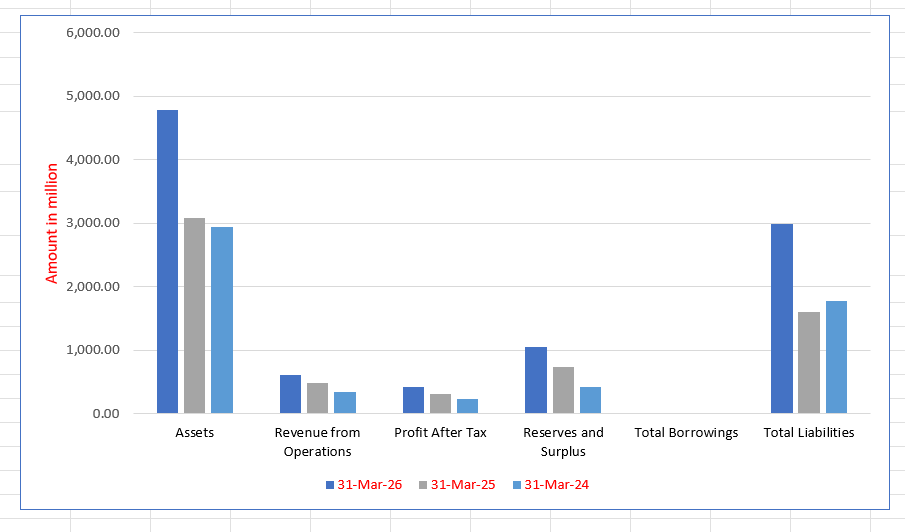
Indian Gas Exchange Limited Financials (in ₹ million)
| Particulars | 31 Mar 2026 | 31 Mar 2025 | 31 Mar 2024 |
| Assets | 4,777.29 | 3,080.18 | 2,945.75 |
| Revenue from Operations | 610.05 | 488.01 | 348.49 |
| Profit After Tax | 420.22 | 307.93 | 230.50 |
| Reserves and Surplus | 1,050.04 | 737.79 | 427.53 |
| Total Borrowings | Nil | Nil | Nil |
| Total Liabilities | 2,986.95 | 1,603.06 | 1,779.19 |
Financial Status of Indian Gas Exchange Limited
Indian Gas Exchange Limited IPO Strengths
1. India’s First and Only Authorized Gas Trading Exchange Creating a First-Mover Advantage
Indian Gas Exchange Limited is India’s first and only authorized national-level physical delivery-based gas trading exchange, providing an organized, transparent, and technology-enabled marketplace for trading natural gas. In December 2020, the company was granted authorization by the PNGRB to operate as an authorized gas exchange. Since commencement, the Exchange has witnessed significant growth in trading activity, with cumulative traded volumes exceeding 240.84 million MMBtu as of March 31, 2026. Total traded volume grew from 40.84 million MMBtu in Fiscal 2024 to 76.79 million MMBtu in Fiscal 2026, representing a CAGR of 37.12%. The company’s first-mover advantage positions it well to benefit from the expected structural shift from bilateral over-the-counter transactions towards organized exchange-based trading.
2. Transparent and Efficient Price Discovery Enabled by a Scalable Technology Platform
Indian Gas Exchange operates a fully electronic trading platform that enables participants to submit bids, execute trades, and manage transactions in a transparent and efficient manner. The proprietary technology architecture comprises ‘Trade Hub’ for real-time bid submission and trade execution, ‘Clear Hub’ for margin collection, clearing and settlement, and ‘Member Hub’ for post-trade data reporting. The platform integrates trading, clearing, and settlement systems supported by automated processes and real-time monitoring. The company’s information security management systems are ISO 27001:2022 certified, ensuring the integrity and availability of systems and data.
3. Pan-India Market Reach and Strong Stakeholder Connect Across the Natural Gas Ecosystem
Indian Gas Exchange enables geographically distributed trading and delivery of natural gas across key demand and supply centers in five regional gas hubs covering West, South, East, North, and Central India. As of the date of the DRHP, gas on the Exchange can be traded through 19 delivery points present across eight states. The company’s shareholders include IEX, NSE Investments Limited, ONGC, IOCL, Torrent Gas, and Adani Total Gas, who collectively represent multiple segments of the natural gas value chain. The number of registered participants grew from 303 in Fiscal 2024 to 360 in Fiscal 2026.
4. Multi-Contract Flexibility Driving a Financially Scalable, Operating Leverage-Led Business Model
Indian Gas Exchange offers a diversified product portfolio comprising eight fixed-price contracts and two index-linked contracts, enabling both short-term and medium-term trading. The mix of spot and forward contracts enables participants to manage both immediate and forward procurement requirements. As transaction volumes grow, the Exchange benefits from operating leverage, enabling revenue growth without a corresponding increase in operating costs. Revenue from operations grew from ₹348.49 million in Fiscal 2024 to ₹610.05 million in Fiscal 2026, while Adjusted EBITDA margin improved from 40.60% in Fiscal 2024 to 57.00% in Fiscal 2026.
5. Successfully Operating Under a Dedicated Regulatory Framework with Regular Policy Engagement
Indian Gas Exchange operates under a structured rule-based framework comprising exchange by-laws, market rules, and circulars, which define operational procedures, trading protocols, and the rights and obligations of participants. The Gas Exchange Regulations framework requires gas exchanges to maintain robust governance, surveillance, and risk management systems. The company actively engages with regulators and policy stakeholders to support the development of market-based mechanisms for natural gas trading and pricing in India. The existence of a dedicated regulatory framework for gas exchanges, together with early authorization under this framework, positions the company as a central institutional exchange for organized gas trading in India.
6. Strong Parentage with Existing Domain Experience in Energy Markets Through Promoter IEX
Indian Gas Exchange benefits from deep domain expertise in operating an energy trading exchange and energy markets through its promoter, IEX, which operates India’s largest electricity trading exchange with an 84.30% market share in terms of total electricity traded in Fiscal 2026. By leveraging IEX’s established technology, operational capabilities, and market understanding, the company is able to build and scale its Exchange using proven systems, processes, and governance frameworks. The company has entered into a consortium agreement with IEX to jointly bid for empanelment with the Directorate General of Hydrocarbons to facilitate e-auction of natural gas produced in India.
More About Indian Gas Exchange Limited
1. Company Overview
Indian Gas Exchange Limited, incorporated in November 2019, is India’s first and only authorized national-level physical delivery-based gas trading exchange. Headquartered in Noida, Uttar Pradesh, the company operates an electronic trading platform for buying and selling natural gas, enabling transparent price discovery, efficient trading, and nationwide market access. The company was granted authorization by the PNGRB in December 2020 to operate as an authorized gas exchange in accordance with the Gas Exchange Regulations.
2. Product Portfolio
The company offers a comprehensive range of standardized delivery-based gas contracts:
A. Fixed Price Contracts
Intra-day, day-ahead, daily, weekly, weekday, fortnightly, monthly, and balance-of-month contracts for short-term and planned gas procurement.
B. Spot Contracts
Intra-day, day-ahead, and daily contracts designed to meet immediate and near-term natural gas requirements.
C. Forward Contracts
Weekday, weekly, fortnightly, monthly, and balance-of-month contracts for medium-term procurement and price risk management.
D. Index-Linked Contracts
Three-month and six-month contracts linked to domestic and international gas and energy benchmarks, including GIXI, JKM®, WIM®, and Platts Dated Brent®.
E. Special Contracts
Customized fixed-price power contracts with weekly, fortnightly, and monthly tenors to meet sector-specific requirements.
F. Small Scale LNG Contracts
Spot and forward contracts for truck-delivered LNG, enabling gas access beyond the pipeline network.
3. Trading Infrastructure and Delivery Network
As of the date of the DRHP, physical delivery of gas traded on the Exchange is facilitated through 19 delivery points across five of the six regional gas hubs in India, covering West, South, East, North, and Central India. These delivery points are present across eight states, including key locations such as Dahej, Hazira, Bhadbhut, Chhara, Jaya, Suvali, Palanpur, and Ankot in Gujarat; Gadimoga, Mallavaram, and KG Basin in Andhra Pradesh; Mhaskal and Dabhol in Maharashtra; Shahdol in Madhya Pradesh; Bokaro and Jharia in Jharkhand; Dhamra in Odisha; Kochi in Kerala; and Barmer in Rajasthan.
4. Technology Platform
The company’s proprietary technology architecture comprises three integrated systems:
A. Trade Hub
Facilitates real-time bid submission, trade execution, and order matching.
B. Clear Hub
Enables margin collection, clearing and settlement, and delivery coordination.
C. Member Hub
Supports post-trade data reporting and participant interface requirements.
The company has also implemented enterprise resource planning capabilities through SAP systems, enabling automated billing, accounting, financial reporting, and reconciliation across the trading lifecycle. The IGX mobile application provides participants with access to market analytics, price trends, daily trade data, and gas consumption trends.
5. IGX Academy
The company has designed a digital learning platform called IGX Academy, designed to build market capacity and educate market participants on gas exchange regulations and fundamentals. As of March 31, 2026, the platform had 46 users who had already taken classes, and the company has issued a cumulative of 22 certifications.
6. Shareholding Structure
The company’s shareholders include IEX (promoter, 47.28% stake), NSE Investments Limited (24.75% stake), ONGC, IOCL, Torrent Gas, Adani Total Gas, and IGX ISOS Trust. These shareholders collectively represent multiple segments of the natural gas value chain, including upstream natural gas production, gas transmission and marketing, city gas distribution, and financial market infrastructure.
Industry Outlook
1. Indian Natural Gas Market Overview
India’s natural gas market is poised for significant growth, driven by the government’s focus on increasing the share of natural gas in the country’s primary energy basket from approximately 6% to 15% by 2030. India’s natural gas consumption is projected to grow by nearly 60% by 2030, reaching 297 million standard cubic metres per day (mmscmd), up from 188 mmscmd in FY24, according to a study by the Petroleum and Natural Gas Regulatory Board (PNGRB). Under the ‘Good-to-Go’ scenario, consumption may reach 496 mmscmd by 2040.
2. Growth Drivers and Sectoral Demand
Several key factors are driving this robust growth trajectory:
A. City Gas Distribution (CGD) Sector
The CGD segment is expected to be the anchor demand driver, contributing 50 mmscmd out of 110 mmscmd incremental demand by 2030. From a base of 37 mmscmd in FY24, CGD consumption is forecasted to grow 2.5–3.5 times by 2030. CGD consumption is projected to increase from approximately 14.90 BCM in Fiscal 2025 to approximately 31.75 BCM by 2030, representing a CAGR of approximately 16%.
B. Power Sector
Power sector consumption is projected to increase from approximately 7.96 BCM in Fiscal 2026 to approximately 13.03 BCM by 2030, representing a CAGR of approximately 13.11%.
C. LNG Imports
India is the world’s fourth-largest buyer of LNG. Top gas importer Petronet LNG forecasts imports rising to 28 million to 29 million metric tons in 2026 from about 25.5 million tons in 2025. India currently imports about 50% of its gas and is expected to double its LNG imports by 2030.
D. Regasification Capacity
India has 52.5 MMTPA of regasification capacity, currently operating at only about 50% utilization. In the next three to four years, India is expected to add another 20 million mt/year of regas capacity.
3. Exchange-Based Gas Trading Addressable Market
The Total Addressable Market for exchange-based gas trading is expected to grow at a CAGR of approximately 24.7% from Fiscal 2026 to Fiscal 2030, significantly higher than the projected growth in overall natural gas consumption of approximately 11.7%. The TAM is expected to increase from 16.4 BCM in Fiscal 2026 to 40.6 BCM by Fiscal 2030. The share of the TAM in India’s total gas consumption is expected to increase from approximately 24.53% in Fiscal 2026 to approximately 37.41% in Fiscal 2030.
4. Regulatory Reforms
A. Key regulatory reforms expected to drive market growth include:
B. Introduction of a market-friendly tariff framework, i.e., single unified tariff or entry-exit tariff
C. Inclusion of natural gas under the GST regime, expected to improve affordability
D. Proposed incorporation of an independent system operator to facilitate non-discriminatory access to pipeline infrastructure
E. Draft PNGRB (Access Code for Common Carrier or Contract Carrier Natural Gas Pipelines) Regulations, 2025 proposing transparent, flexible, and consumer-friendly capacity booking framework
F. NSE to launch India’s first domestic natural gas futures linked to IGX benchmark on July 27, 2026
How Will Indian Gas Exchange Limited Benefit
1. Indian Gas Exchange stands to benefit from India’s natural gas consumption projected to grow by nearly 60% to 297 mmscmd by 2030, significantly expanding the addressable market.
2. The TAM for exchange-based gas trading is expected to grow at a CAGR of approximately 24.7% from Fiscal 2026 to Fiscal 2030, providing substantial growth headroom.
3. With cumulative traded volumes growing at a CAGR of 37.12% to 76.79 million MMBtu in FY26, the Exchange is well-positioned to capture the structural shift from bilateral OTC transactions to exchange-based trading.
4. The launch of NSE’s natural gas futures linked to IGX’s benchmark on July 27, 2026 is expected to enhance market depth, liquidity, and attract a wider range of participants.
5. The company’s first-mover advantage as India’s only authorized gas exchange provides a significant competitive moat against potential new entrants.
6. Expansion into adjacent segments like LNG trading, petroleum products, renewable gas certificates, and hydrogen index opens new revenue streams and business opportunities.
7. The increasing participation from CGD, power, fertilizer, and industrial sectors is expected to drive higher trading volumes and revenue growth.
8. The company’s asset-light, technology-driven business model enables operating leverage with revenue growth without proportionate increases in operating costs.
Peer Group Comparison
| Name of Company | Revenue (₹ in million) | Face Value (₹) | P/E Ratio | Basic EPS (₹) | Diluted EPS (₹) | RoNW (%) | NAV (₹ ) |
| Indian Gas Exchange Limited | 610.05 | 10 | [●] | 5.68 | 5.66 | 23.47 | 23.87 |
| Peer Group | |||||||
| NSE Investments Limited | 139,817.00 | 2 | 64.51 | 32.24 | 32.24 | 22.49 | 143.16 |
| Multi Commodity Exchange of India Limited | 6,726.95 | 10 | 21.49 | 108.42 | 108.42 | 28.39 | 347.90 |
Key Strategies for Indian Gas Exchange Limited
1. Expand Trading Volumes and Liquidity Across the Exchange
Indian Gas Exchange intends to increase trading volumes on its Exchange by expanding participation among buyers, sellers, and intermediaries across the natural gas value chain. The company plans to expand delivery points in line with the growth of pipeline connectivity and gas infrastructure, particularly focusing on the North-East region. The company also intends to broaden its buyer base and increase sectoral participation, including enabling participation from the fertilizer sector and facilitating access for industries in areas covered by city gas distribution networks where exclusivity has expired.
2. Capitalize on Expected Growth in the Organized Market for Natural Gas
Indian Gas Exchange intends to capitalize on the expected growth in India’s natural gas market and the increasing shift towards organized, exchange-based trading. With India’s natural gas consumption projected to increase from 68.54 BCM in Fiscal 2026 to 108.39 BCM in Fiscal 2030, the company expects to increase its share of exchange-based trading volumes by leveraging its existing platform, participant base, delivery network, and product offerings. The company aims to leverage ongoing regulatory and policy initiatives aimed at enhancing market efficiency, improving infrastructure utilization, and facilitating exchange-based gas trading.
3. Expand Product Offerings
Indian Gas Exchange intends to expand its product portfolio to address the evolving procurement and trading requirements of participants. The company has already applied to the PNGRB for approval for commencement of trading in one-year and two-year contracts. The company also plans to introduce fixed price variants for all existing index-linked contracts and expand the availability of index-linked contracts that reference established global price indicators. Additionally, the company intends to expand product offerings to develop the renewable gas market, including Renewable Gas Certificates trading, subject to applicable regulatory approvals.
4. Develop New Gas Market Platforms and Adjacent Trading Segments
Indian Gas Exchange intends to expand its Exchange to support additional gas-related trading activities, including LNG trading at high seas, for which the company has submitted an application. The company also intends to introduce an RLNG terminal capacity booking platform, which would function as a digital system enabling gas consumers and traders to reserve or offer capacities at LNG regasification terminals. The company is also exploring trading in adjacent and emerging energy commodities, such as renewable gas certificates, compressed biogas, and petroleum products, and has filed an application for providing a platform for trading petroleum products.
5. Continue Regulatory and Policy Advocacy to Deepen the Natural Gas Market
Indian Gas Exchange intends to continue engaging with policymakers, regulators, industry associations, and other stakeholders to support the development of a transparent, competitive, and market-driven natural gas ecosystem in India. The company intends to continue advocating for reforms that facilitate wider market participation, improve infrastructure access, enhance transparency, and strengthen price discovery, including open and non-discriminatory access to gas infrastructure, incorporation of an independent system operator, market-friendly pipeline tariff charging framework, inclusion of natural gas under the GST regime, and implementation of gas release programs through exchange.
6. Leverage Partnerships to Develop Derivatives and Financial Market Integration
Indian Gas Exchange intends to collaborate with financial market institutions to explore the development of derivative products linked to its gas price benchmark, GIXI. The company has collaborated with NSE, pursuant to which NSE proposes to introduce exchange-traded derivatives based on natural gas traded and delivered on the Exchange. NSE has received approval from SEBI to launch Indian natural gas futures, with trading commencing on July 27, 2026. The development of such derivatives can support price risk management for participants and enhance market depth and liquidity by attracting a wider range of participants.
7. Invest in and Expand IGX Academy, the Digital Learning Platform
Indian Gas Exchange intends to further develop IGX Academy as a platform to build market awareness and enhance capabilities in exchange-based gas trading. The company plans to expand its content offerings to include more advanced and role-specific modules covering trading strategies, contract structures, and regulatory developments. The company also aims to introduce certification programs to support the development of a trained ecosystem of market participants and enhance the platform through interactive formats such as webinars, workshops, and simulation-based training tools.
SWOT Analysis of Indian Gas Exchange IPO
Strength and Opportunities
- India's first and only authorized gas trading exchange creating first-mover advantage
- Transparent price discovery enabled by scalable technology platform
- Pan-India market reach across 19 delivery points in 5 regional gas hubs
- Multi-contract flexibility driving operating leverage-led business model
- Strong parentage with IEX's domain expertise in energy exchanges
- India's natural gas consumption projected to rise 60% to 297 mmscmd by 2030
- TAM for exchange-based gas trading expected to grow at 24.7% CAGR through 2030
- NSE to launch natural gas futures linked to IGX benchmark starting July 27, 2026
- Government target to raise gas share in energy basket from 6% to 15% by 2030
- Expansion into adjacent segments like LNG trading, petroleum products, and hydrogen index
Risks and Threats
- Still nascent market with limited liquidity compared to mature exchanges
- Regulatory cap permitting only up to 10% of domestic production to be traded through exchanges
- Dependence on policy reforms for addressable market expansion
- Limited awareness and adoption of exchange-based gas trading among market participants
- Competition from bilateral over-the-counter transactions
- Price sensitivity of LNG demand affecting trading volumes
- Global LNG price volatility impacting market participation
- Infrastructure constraints in pipeline connectivity across regions
- Potential entry of new gas exchanges in the future
- Regulatory and policy uncertainty in the evolving gas market
Upcoming IPO News






Explore IPO Opportunities
Explore our comprehensive IPO pages to stay updated on the latest trends and insights.


How to apply IPO with HDFC SKY?
Follow these simple steps to apply for an IPO through HDFC SKY. Secure your investments and explore new opportunities with ease by accessing the IPOs available on the platform.
- 1Login to your HDFC SKY Account
- 2Select Issue
- 3Enter Number of Lots and your Price.
- 4Enter UPI ID
- 5Complete Transaction on Your UPI App
FAQs on Indian Gas Exchange IPO
How can I apply for Indian Gas Exchange Limited IPO?
What is the total issue size of Indian Gas Exchange IPO?
On which exchanges will Indian Gas Exchange shares be listed?
Who are the book-running lead managers for the IPO?
Why is this a 100% Offer for Sale IPO?


Invest Anytime, Anywhere


By signing up I certify terms, conditions & privacy policy