Nifty 50
- Dr. Reddy's Labs₹1,22120.00 (1.67%)
- Tata Motors PV₹281.75-8.70 (-3.00%)
- Infosys₹1,003.203.00 (0.30%)
- Adani Enterprises₹2,831.10-85.40 (-2.93%)
- HDFC Life Insurance ₹531.600.60 (0.11%)
- Jio Financial ₹220.50-6.50 (-2.86%)
- Power Grid Corp₹261.85-7.65 (-2.84%)
- L&T₹3,766.40-109.80 (-2.83%)
- ONGC₹230-5.86 (-2.48%)
- Adani Ports₹1,743.70-44.30 (-2.48%)
- Hindustan Unilever₹1,896-46.90 (-2.41%)
- Tata Consumer ₹960-23.20 (-2.36%)
- Reliance Industries₹1,197.60-28.40 (-2.32%)

- Offerings
- Tools & Platforms
Tools & Calculators
- Open API
- Calculators
- SIP Calculator
- CAGR Calculator
- Compound Interest Calculator
- FD Calculator
- RD Calculator
- EPF Calculator
- Retirement Calculator
- HDFC SIP Calculator
- Mutual Fund Return Calculator
- Lumpsum Calculator
- Step Up SIP Calculator
- ETF SIP Calculator
- Brokerage Calculator
- Equity Margin Calculator
- SWP Calculator
- EMI Calculator
- MTF Calculator
- Margin Pledge Calculator
- Algo Strategy
- Markets
Stocks
F&O
Mutual Funds
- More
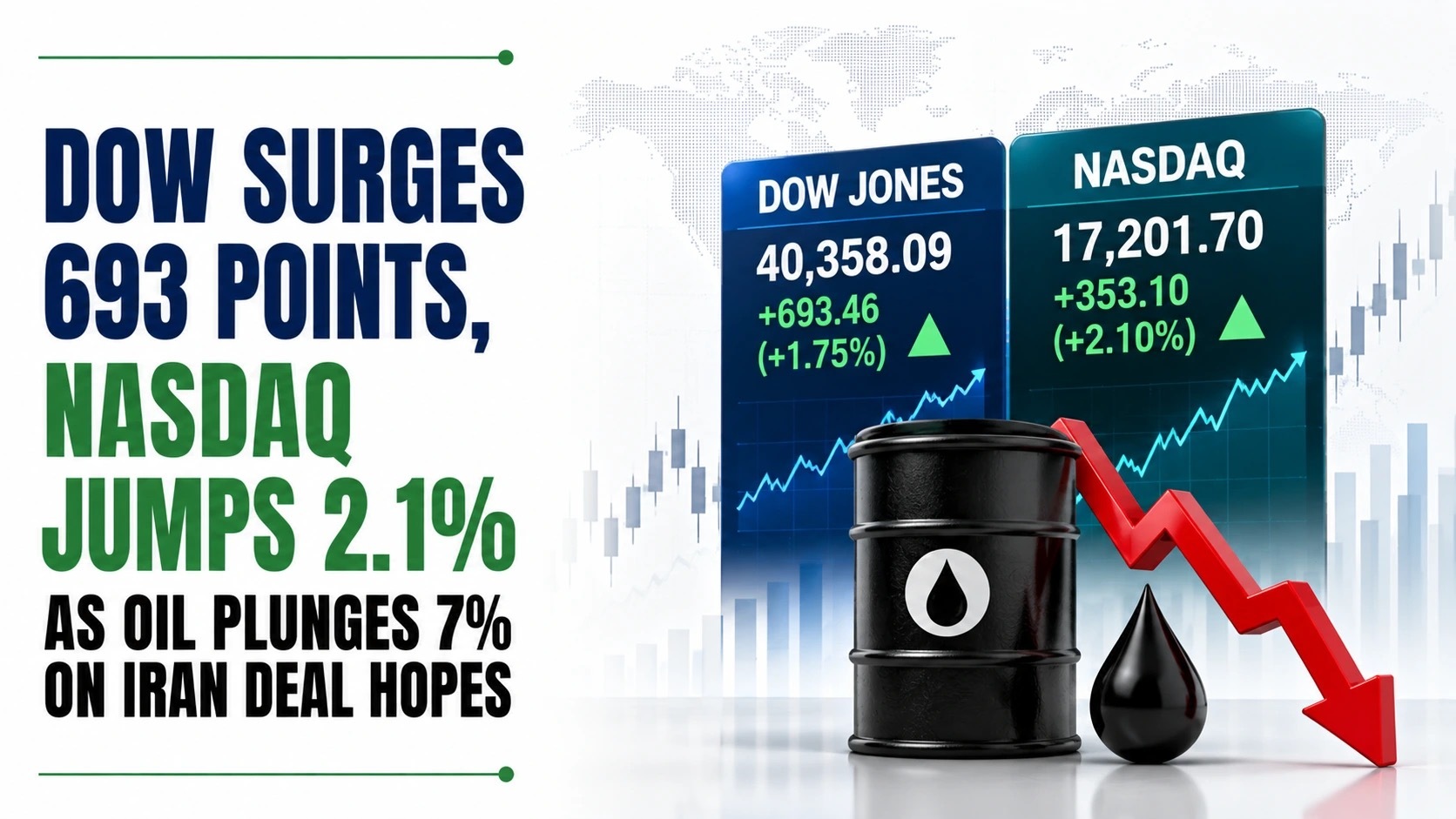
Dow Surges 693 Points, and Nasdaq Jumps 2.1% as Oil Plunges 7% on Iran Deal Hopes
Authored By HDFC SKY | Last Modified: Aug 4, 2026 09:50 AM IST
Open Free Demat Account
Open Free Demat Account
Mumbai, Aug 4: U.S. stock markets rallied sharply on Monday as signs of de-escalating tensions in the Middle East triggered a steep sell-off in crude oil prices, easing inflation fears and lifting investor sentiment across all major indices. The tech-heavy Nasdaq Composite led the charge with a 2.13% surge, while the Dow Jones Industrial Average added 693.38 points and the S&P 500 climbed 1.48%, as markets priced in a potential reopening of the Strait of Hormuz following President Donald Trump’s announcement that he had called off planned military strikes against Iran.
The rally marked a sharp recovery from July’s volatile performance, with investors returning to risk-on mode as geopolitical uncertainty temporarily receded. The Dow’s advance of 693.38 points, or 1.32%, brought the blue-chip index to 53,178.41, just shy of its record closing high of 53,055.91 set on July 6. The S&P 500 briefly traded above its previous record close of 7,609.78, touching an intraday high of 7,610.04, before settling at 7,600.50. The Nasdaq Composite surged 540.04 points, or 2.13%, to close at 25,913.90, outperforming the other major indices.
Oil Prices Tumble 7% to Three-Week Low After Trump Halts Iran Attack Plans
The primary catalyst for Monday’s market rally was the sharp decline in crude oil prices, which fell to their lowest level in three weeks following President Trump’s decision to cancel planned military strikes against Iran. Front-month Brent crude futures fell $6.35, or 7.0%, to settle at $83.77 per barrel, while U.S. West Texas Intermediate (WTI) crude dropped $4.33, or 5.1%, to $80.34 per barrel.
Trump announced over the weekend that he had called off the attack “subject to being able to rapidly make a DEAL” to reopen the Strait of Hormuz, adding that talks between Washington and Tehran would resume on Monday. The development eased immediate concerns about crude shipments through the Persian Gulf, a critical chokepoint for global oil supplies. However, the president also described Iran’s leadership as “unbelievably duplicitous,” cautioning that the situation remained fluid. The pullback in oil prices reduced fears that higher energy costs would add to inflation and force interest rates higher, providing a tailwind for equities.
Dow Jones Industrial Average Surges 693 Points as Boeing Leads Blue-Chip Rally
The Dow Jones Industrial Average climbed 693.38 points, or 1.32%, to close at 53,178.41, building on Friday’s gains and finishing just shy of its record closing high. The index opened at 52,759.06 and traded in a range of 52,759.06 to 53,230.08 during the session.
The blue-chip rally was broad-based, with 24 of the 30 components closing in positive territory. Boeing (BA) emerged as the top performer, soaring 7.92% after the Federal Aviation Administration granted long-awaited certification for its 737 Max 7 aircraft, ending nearly a decade of delays. Other significant contributors included Caterpillar (CAT), which gained 2.49%, and Home Depot (HD), up 2.43%. Conversely, Apple (AAPL) weighed on the index, declining 1.85% amid ongoing supply chain concerns. The rally was primarily driven by the sharp drop in oil prices, which alleviated concerns over rising input costs for industrial giants. The Dow was on track for a record closing high during the final hour of trading, with the index holding its gains as Treasury yields declined.
S&P 500 Hits Near-Record High on Broad-Based Rally Led by Communication Services
The benchmark S&P 500 advanced 110.78 points, or 1.48%, settling at 7,600.50, just 0.12% below its record closing high of 7,609.78. The index opened at 7,504.78 and touched an intraday high of 7,610.04, briefly surpassing its previous record.
Seven of the 11 sectors closed higher, with Communication Services leading the charge, surging nearly 5% as mega-cap tech giants rebounded. Meta Platforms (META) surged 6.01%, while Alphabet (GOOGL) climbed 4.90%, driving the sector’s outperformance. The Consumer Discretionary sector was the second-best performer, rising 2.5%, buoyed by Amazon (AMZN) which added 4.63% and reached a $3 trillion market capitalisation for the first time. The rally was underpinned by easing geopolitical tensions and a decline in Treasury yields, which fell as worries around inflation dimmed slightly. The S&P 500’s advance left it less than 0.5% below its record close, ending a 41-trading-day stretch without a record, the longest since a 53-session stretch that ended in April 2026.
Nasdaq Composite Jumps 2.1% as Tech Stocks Rebound and Amazon Hits $3 Trillion
The tech-heavy Nasdaq Composite outperformed the other major indices, surging 540.04 points, or 2.13%, to close at 25,913.90. The index opened at 25,452.66 and traded in a range of 25,420.35 to 25,967.44 during the session.
Large software and internet stocks supported the Nasdaq’s advance. Amazon (AMZN) rose 4.63% and reached a market value of $3 trillion for the first time, following its strong quarterly results last week. Microsoft (MSFT) climbed 4.94%, while Salesforce (CRM) and other cloud computing giants also advanced. The communications services and technology sectors were the driving force behind the market’s advance, with Meta Platforms (META) surging nearly 6% and Alphabet (GOOGL) climbing around 5%. However, Apple (AAPL) bucked the trend, falling 1.85% and making it the only Magnificent Seven member to end in the red. Apple’s shares dropped more than 7% last week after the technology giant reported weak guidance due to supply challenges. The Nasdaq’s three-day gain of approximately 6.1% put it on track for its largest three-day percentage advance since May 2025.
Russell 2000 Outperforms as Small-Caps Rally on Broad Market Strength
The Russell 2000, which tracks small-cap stocks, outperformed the major indices on Monday, rising 1.67% to close at 1,798.18. The index opened at 1,798.18 and traded in a range of 1,798.18 to 1,798.18 during the session. The small-cap rally reflected broad-based market strength, with advancing stocks outnumbering decliners by 1.89-to-1 on the New York Stock Exchange and 1.49-to-1 on the Nasdaq. The Russell 2000’s outperformance suggested that the rally extended beyond a small group of large technology companies, indicating improving market breadth.
S&P 100 Rallies 1.65% as Mega-Cap Tech Stocks Lead the Advance
The S&P 100, which tracks the largest 100 companies in the S&P 500, gained 61.01 points, or 1.65%, to close at 3,751.99. The index opened at 3,701.60 and traded in a range of 3,701.60 to 3,759.36 during the session. The S&P 100’s advance was driven by the same factors that lifted the broader market, with mega-cap technology and communication services stocks leading the charge. The index’s performance reflected the concentration of gains among the largest U.S. companies, which benefited from the decline in oil prices and easing geopolitical tensions.
Also Read: How to Invest in S&P 500 Stocks Through Index Funds
Dow Jones Composite, Transport and Utility Averages Show Mixed Performance
The Dow Jones Composite Average rose 176.68 points, or 1.06%, to close at 16,828.19, reflecting broad strength across the Dow’s components. The Dow Jones Transportation Average gained 191.89 points, or 0.91%, to close at 21,231.19, as airlines and transport companies benefited from the sharp decline in oil prices. However, the Dow Jones Utility Average bucked the trend, falling 1.78 points, or 0.16%, to close at 1,119.86, as the defensive sector lagged amid the broader risk-on rally. The utility sector’s decline reflected investors’ rotation out of defensive stocks and into growth-oriented sectors.
Philadelphia Semiconductor Index Rises 1.05% as Chip Stocks Recover
The Philadelphia Semiconductor Index (SOX) gained 119.28 points, or 1.05%, to close at 11,430.35, recovering from recent weakness. The index opened at 11,046.09 and traded in a range of 10,922.31 to 11,495.28 during the session. Semiconductor stocks moved higher as investors resumed buying in the AI trade, though the sector’s gains were more modest compared to the broader market. The SOX remains well below its 52-week high of 14,655.29, reflecting the sector’s volatility in recent months. Investors continued to assess whether rapid spending on artificial intelligence infrastructure will generate enough profit to support elevated chip-stock valuations.
NYSE Composite Index Advances 0.62% as Breadth Improves
The NYSE Composite Index rose 150.26 points, or 0.62%, to close at 24,257.81. The index opened at 24,107.54 and traded in a range of 24,107.54 to 24,259.63 during the session. The NYSE Composite’s advance reflected improving market breadth, with advancing stocks outnumbering decliners by a significant margin. The index’s performance was supported by the broad-based rally across sectors, with seven of the 11 S&P 500 sectors closing higher.
S&P MidCap 400 and SmallCap 600 Rally as Mid and Small-Caps Participate
The S&P MidCap 400 gained 41.18 points, or 1.10%, to close at 3,799.82, while the S&P SmallCap 600 rose 1.67% to close at 1,798.18. The mid-cap and small-cap indices‘ outperformance relative to the large-cap benchmarks suggested that the rally was broadening beyond the mega-cap technology stocks. The S&P MidCap 400 opened at 3,758.64 and traded in a range of 3,758.64 to 3,802.71 during the session. The participation of mid and small-cap stocks indicated improving investor confidence and a more sustainable market advance.
Volatility Indices Decline as Market Fears Ease
The CBOE Volatility Index (VIX), often referred to as Wall Street’s “fear gauge,“ fell 1.56% to close at 15.74. The VIX opened at 16.03 and traded in a range of 15.54 to 16.30 during the session. The decline in the VIX reflected easing market fears as geopolitical tensions subsided and oil prices dropped sharply. The VIX’s move below 16 indicated that investors were pricing in lower near-term volatility, consistent with the risk-on sentiment that drove Monday’s rally.
Communication Services Leads Sector Gains as Energy Stocks Lag
All 11 S&P 500 sectors traded, with seven closing higher. The Communication Services sector was the best performer, surging nearly 5%, driven by gains in Meta Platforms (META) and Alphabet (GOOGL). The Consumer Discretionary sector was the second-best performer, rising 2.5%, buoyed by Amazon (AMZN) and other retail-related stocks. The Technology sector also advanced, supported by gains in Microsoft (MSFT) and other software companies.
The Energy sector was the worst performer, declining as crude oil prices tumbled. Chevron (CVX) fell 1.95%, while Exxon Mobil (XOM) declined 0.24%, as lower oil prices weighed on energy company profits. President Trump criticised major oil companies for making “too much money“ amid high oil prices, adding pressure on the sector. The Healthcare sector also lagged, with Eli Lilly (LLY) falling 2.39% and AbbVie (ABBV) declining 2.44%. The Consumer Staples and Utilities sectors also underperformed, reflecting investors‘ rotation out of defensive stocks.
ISM Manufacturing PMI Hits 55.6, Highest Since May 2022
The Institute for Supply Management’s (ISM) Manufacturing Purchasing Managers’ Index (PMI) rose to 55.6 in July, up from 53.3 in June, reaching its highest level in more than four years. Readings above 50 indicate that manufacturing activity is expanding. The stronger-than-expected reading, which surpassed economists’ forecasts of 54.0, was driven by gains in new export orders, backlogs and imports.
New export orders rose 4.5 points to 53.0, while backlog orders increased 4.5 points to 55.0. Production jumped 6.3 points to 58.5, while employment climbed 3.1 points to 52.8, marking the first expansion in employment in 33 months. The prices index remained solidly in growth territory at 71.1, though it declined 1.9 points from June, indicating some easing in input cost pressures. The strong manufacturing data bolstered the economic outlook, though concerns about supply chain disruptions and price volatility persisted.
Treasury Yields Decline as Oil Prices Retreat and Inflation Fears Ease
U.S. Treasury yields declined on Monday as the sharp drop in oil prices eased concerns about rising inflation. The benchmark 10-year Treasury yield fell 5.52 basis points to 4.69%, retreating from Friday’s close at 4.747%, which was the highest level since January 2025. The 30-year bond yield declined 4.44 basis points to 5.2306%, after peaking at 5.2811% on Friday, the highest since 2007. The 2-year Treasury yield, which is more sensitive to Federal Reserve policy expectations, dropped 5.4 basis points as investors weighed the economic impact of elevated energy costs. The yield curve between 2-year and 10-year notes stood at 44 basis points.
The decline in yields provided support for equities by reducing borrowing costs and making future corporate earnings more valuable in current terms. Federal Reserve Bank of New York President John Williams said inflation should ease gradually if energy prices and tariffs have peaked, though he noted that the Fed could raise rates if inflation does not return toward its 2% target. The central bank held its benchmark rate between 3.5% and 3.75% at its latest meeting.
Gold Edges Lower as Dollar Weakens and Oil Declines
Gold prices edged lower on Monday as uncertainty over the war in the Middle East and concerns over rising inflation lingered, with markets also watching a slew of job reports this week to gauge the Federal Reserve’s policy path. Spot gold fell 0.3% to $4,029.84 per ounce, while U.S. gold futures for August delivery dropped 0.5% to $4,029.00. The precious metal posted its first monthly rise in five in July, rising about 1%.
The decline in gold prices came despite a weaker U.S. dollar, which typically supports gold. The US Dollar Index (DXY) was near flat at 99.91. The dollar weakened against the yen after the U.S. and Japan coordinated to support the latter after it hit a 40-year low against the greenback. Gold’s muted performance reflected competing forces, with the decline in oil prices reducing inflation fears while geopolitical uncertainty continued to provide some support for safe-haven assets.
The sharp decline in oil prices, triggered by diplomatic engagement between the U.S. and Iran, provided the primary catalyst for Monday’s broad-based market rally. The strong ISM manufacturing data reinforced the economic expansion narrative, while declining Treasury yields eased borrowing cost concerns. However, the on-again, off-again nature of U.S.-Iran diplomacy suggests that geopolitical risk remains elevated, and investors should monitor developments in the Middle East alongside this week’s employment data for further market direction
Source
- https://www.nasdaq.com/
- spglobal.com/spdji/en/indices/equity/sp-500/
- https://www.dowjones.com/
- https://www.spglobal.com/spdji/en/indices/equity/dow-jones-industrial-average/
- https://www.spglobal.com/spdji/en/indices/equity/sp-500/
- https://www.nasdaq.com/market-activity/index/comp
- https://www.nasdaq.com/market-activity/quotes/nasdaq-ndx-index
- https://www.spglobal.com/spdji/en/indices/equity/sp-100/
- https://www.lseg.com/en/ftse-russell/indices/russell-us
- https://www.nyse.com/index
- https://www.nyse.com/index
- https://www.spglobal.com/spdji/en/indices/equity/dow-jones-transportation-average/
- https://www.spglobal.com/spdji/en/indices/equity/dow-jones-utility-average/
- https://www.spglobal.com/spdji/en/indices/equity/dow-jones-composite-average/
- https://www.nasdaq.com/market-activity/index/sox
- https://www.cboe.com/tradable_products/vix/
Disclaimer
If you have any concerns, questions, or wish to point out any discrepancies in our content, please feel free to write to us at content@hdfcsec.com.
Please Note: The information shared is intended solely for informational purposes and does not make any investment recommendations
Disclaimer
At HDFC SKY*, we take utmost care and due diligence in curating and presenting news and market-related content. However, inadvertent errors or omissions may occasionally occur.
If you have any concerns, questions, or wish to point out any discrepancies in our content, please feel free to write to us at content@hdfcsec.com.
Please Note: The information shared is intended solely for informational purposes and does not make any investment recommendations.
HDFC SKY from HDFC Securities, one of most trusted trading platforms in India, has been recognized with the *Next-Gen Digi Content Awards 2025-26.
 Join Us
 Add as preferred source on Google


More International News





Open Free Demat Account
Open Free Demat Account












Invest Anytime, Anywhere


By signing up I certify terms, conditions & privacy policy