Nifty 50
- Cipla₹1,39916.00 (1.16%)
- HDFC Life Insurance ₹526.90-34.60 (-6.16%)
- ONGC₹2392.10 (0.89%)
- Bajaj Finance₹982-61.20 (-5.87%)
- NTPC₹326.600.60 (0.18%)
- Axis Bank₹1,186.50-56.70 (-4.56%)
- Bajaj Finserv₹1,762.30-84.20 (-4.56%)
- Adani Enterprises₹2,900-93.20 (-3.11%)
- InterGlobe Aviation₹4,890-138.50 (-2.75%)
- Trent₹2,700-74.00 (-2.67%)
- Nestle₹1,351-36.20 (-2.61%)
- Asian Paints₹2,392.70-62.30 (-2.54%)
- Reliance Industries₹1,219.20-28.80 (-2.31%)

- Offerings
- Tools & Platforms
Tools & Calculators
- Open API
- Calculators
- SIP Calculator
- CAGR Calculator
- Compound Interest Calculator
- FD Calculator
- RD Calculator
- EPF Calculator
- Retirement Calculator
- HDFC SIP Calculator
- Mutual Fund Return Calculator
- Lumpsum Calculator
- Step Up SIP Calculator
- ETF SIP Calculator
- Brokerage Calculator
- Equity Margin Calculator
- SWP Calculator
- EMI Calculator
- MTF Calculator
- Margin Pledge Calculator
- Algo Strategy
- Markets
Stocks
F&O
Mutual Funds
- More
India VIX Surges 22.9% as US Yields, Crude and Financial Stocks Drive Market Volatility
Authored By HDFC SKY | Last Modified: Sep 24, 2026 04:54 PM IST
Open Free Demat Account
Open Free Demat Account
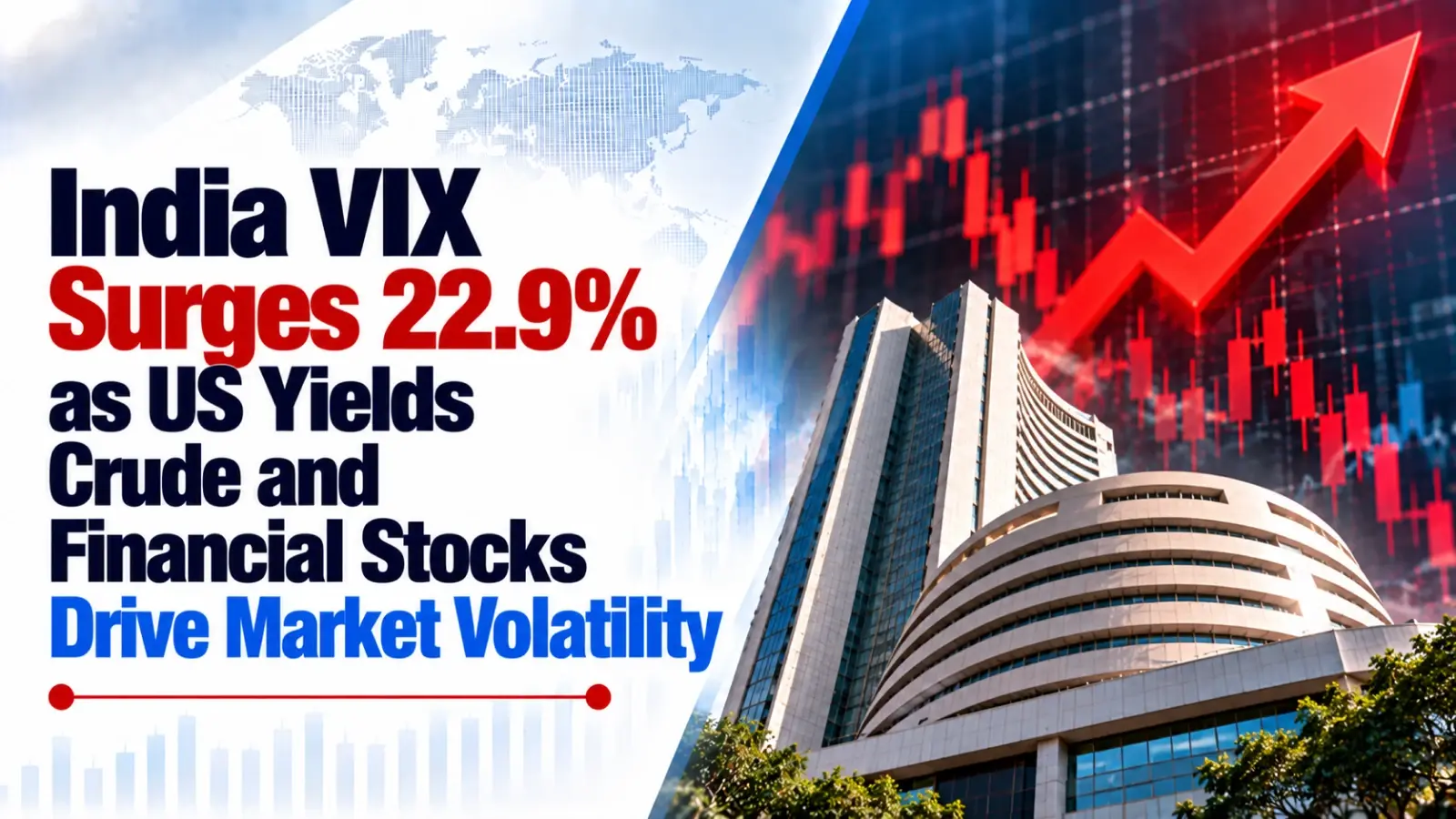
Mumbai, Sept 24: India VIX, the volatility gauge for the Indian equity market, jumped 2.37 points, or 22.9%, to 12.73 on Thursday, after opening at 10.34 against the previous close of 10.35. The index touched an intraday high of 13.21 and a low of 10.34, as rising US Treasury yields, crude oil above $100 a barrel, weak global markets and heavy selling across financial stocks increased market volatility.

India VIX Jumps 22.9% as Nifty Falls Below 23,100
The sharp rise in India VIX came alongside a broad decline in Indian equity benchmarks during Thursday’s session. The Nifty 50 moved below the 23,200 level during the afternoon, while the Sensex also came under heavy pressure. By around 2:15 pm, the Nifty was at 23,076.55, down 1.58%, while the Sensex stood at 73,673.50, down 1.54%.
The volatility index had entered Thursday from a relatively subdued level after falling about 6% in the previous session. Its previous close was 10.35, while the 52-week range stood between 8.72 and 28.90. The sharp intraday increase therefore marked a significant change from Wednesday’s calmer market conditions.
The move also followed a weaker global market backdrop. US equities had declined in the previous session, while Asian markets traded lower or mixed as markets assessed rising bond yields, oil prices and geopolitical developments.
US 10-Year Yield Crosses 5.1% and Raises Market Pressure
The rise in US Treasury yields was one of the key global developments behind Thursday’s market decline. The US 10-year Treasury yield moved above 5.1%, reaching its highest level since 2007, after stronger US business activity data increased expectations that monetary policy could remain restrictive for longer.
The stronger US economic activity reading reinforced expectations around higher US interest rates. This pushed Treasury yields higher and contributed to weakness across global equities before the Indian market opened.
The previous US session had already ended lower, with the Dow Jones Industrial Average down 0.68%, the S&P 500 down 0.75% and the Nasdaq Composite down 1.13%. The weaker overnight performance added to the negative global backdrop for Indian equities.
Brent Crude Rises Above $102 as Iran-US Tensions Return
Crude oil added another source of pressure during Thursday’s session. Brent crude traded around $102–103 a barrel, after gaining almost 4% in the previous session. The increase followed renewed uncertainty around US-Iran diplomatic developments.
For India, the movement in crude prices remains closely linked to inflation and the country’s import bill. Higher oil prices also affect corporate costs and the broader economic environment. The combination of crude above $100 and elevated US Treasury yields therefore formed an important part of the day’s global market backdrop.
The oil move also coincided with renewed geopolitical uncertainty surrounding the US-Iran situation, adding another factor to the market’s assessment of energy prices and global economic conditions.
Insurance Stocks Slide as Regulatory Proposals Hit Financial Shares
Domestic financial stocks faced significant selling pressure after regulatory proposals concerning insurance-sector commissions and distribution arrangements. Banks, insurers and insurance-related financial companies were among the stocks facing losses during the session.
The proposed changes relate to insurance distribution, including commission structures and payouts. Insurance distributors, digital insurance platforms and financial institutions with insurance-related fee income were among the areas affected by the market reaction.
By 12:25 pm, the Nifty 50 had fallen 1.10% to 23,188.75, while the Sensex had declined 1.08% to 74,016.46. At the same time, India VIX had risen 11.06% to 11.49, showing how volatility increased alongside the broader market decline.
Asian Markets Fall as Bond Yields Reach Multi-Year Highs
The weakness in Indian equities also came against a softer Asian market backdrop. Markets across the region assessed the sharp increase in global bond yields, geopolitical tensions and expectations around US-China discussions.
The MSCI gauge of Asian equities fell 0.4%, while Hong Kong’s Hang Seng declined 0.5% and the Shanghai Composite slipped 0.4% in morning trade. The weaker regional performance followed the decline in US equities and the rise in US Treasury yields.
This broader market weakness coincided with the domestic selling in financial stocks, creating multiple pressure points for Indian benchmark indices during the session.
Trump-Xi Meeting Adds Trade and Geopolitical Uncertainty
Another major event being monitored on 24 September was the meeting between US President Donald Trump and Chinese President Xi Jinping in Washington. Discussions were expected to cover trade, tariffs, Taiwan, Iran, artificial intelligence and China’s rare-earth position.
The US and China had also agreed to extend their trade truce until 10 January 2027, according to US Treasury Secretary Scott Bessent. The meeting therefore remained an important global event during the Indian trading session, although the day’s rise in India VIX was more directly associated with the movement in Treasury yields, crude prices and domestic financial stocks.
NSE Listing Adds a Major Domestic Market Event
Thursday also marked the listing of the National Stock Exchange of India (NSE) on the BSE. The NSE shares began trading at approximately ₹1,800, compared with the IPO price of ₹1,785, to close at ₹1818 with, with an intraday high of ₹ 1,878.
The listing was a major domestic market event, but the day’s broader rise in India VIX occurred alongside the decline in benchmark indices and the pressure from global and financial-sector developments. The NSE debut therefore remained a parallel market event rather than the primary factor behind the volatility index’s movement.
September Volatility Reverses After Wednesday’s 6% VIX Fall
The contrast between 23 September and 24 September highlights the change in market conditions over two sessions. On Wednesday, the Nifty 50 gained 0.50%, the Sensex rose 0.40%, and India VIX declined by roughly 6% to around 10.35.
On Thursday, India VIX rose to 12.73, marking a 22.9% increase, while the Nifty and Sensex moved sharply lower. The index’s September seasonality data also shows that India VIX has delivered positive returns in 9 of 18 years during September. Its maximum positive September change was 34.92% in 2018, while the maximum negative change was -26.10% in 2009.
Foreign flows provided a different backdrop. On 23 September, foreign portfolio investors bought approximately ₹1,617 crore of Indian equities, while domestic institutional investors bought about ₹2,341 crore. However, cumulative foreign portfolio investor selling during September stood at roughly ₹22,770 crore through 23 September.
India VIX Closes at 12.73 After Global And Domestic Pressure
India VIX ultimately ended the 24 September session at 12.73, up 2.37 points or 22.9% from 10.35. The index recorded a day’s range of 10.34–13.21, while the Nifty faced pressure from higher US Treasury yields, crude oil above $100, weaker global markets and losses across financial and insurance-related stocks.
The session therefore marked a sharp increase in the volatility index after the comparatively subdued reading recorded on 23 September.
India VIX closed at 12.73, up 22.9%, as higher US Treasury yields, Brent crude above $100, weaker global markets and domestic financial-sector selling coincided on 24 September. The index’s 10.34–13.21 range captured the sharp increase in volatility during a session marked by several domestic and global developments.
Source
- https://www.nseindia.com/reports-indices-historical-vix
Disclaimer
At HDFC SKY*, we take utmost care and due diligence in curating and presenting news and market-related content. However, inadvertent errors or omissions may occasionally occur.
If you have any concerns, questions, or wish to point out any discrepancies in our content, please feel free to write to us at content@hdfcsec.com.
Please Note: The information shared is intended solely for informational purposes and does not make any investment recommendations.
HDFC SKY from HDFC Securities, one of most trusted trading platforms in India, has been recognized with the *Next-Gen Digi Content Awards 2025-26.
 Join Us
 Add as preferred source on Google


More Business News








Open Free Demat Account
Open Free Demat Account











Invest Anytime, Anywhere


By signing up I certify terms, conditions & privacy policy