Nifty 50
- Eternal₹317.4012.95 (4.25%)
- Shriram Finance₹865-35.90 (-3.98%)
- Apollo Hospitals₹7,730125.50 (1.65%)
- Adani Enterprises₹2,477-73.00 (-2.86%)
- ONGC₹227.502.50 (1.11%)
- JSW Steel₹1,185.50-34.50 (-2.83%)
- Asian Paints₹2,30722.20 (0.97%)
- Jio Financial ₹205.03-5.77 (-2.74%)
- TCS₹2,53023.10 (0.92%)
- Tata Steel₹167.67-4.66 (-2.70%)
- UltraTech Cement₹11,05092.00 (0.84%)
- Adani Ports₹1,702.70-47.30 (-2.70%)
- Maruti Suzuki₹11,23060.00 (0.54%)
- Tech Mahindra₹1,790-39.10 (-2.14%)
- Cipla₹1,3387.10 (0.53%)
- Tata Motors PV₹264.60-5.40 (-2.00%)
- Reliance Industries₹1,1905.50 (0.46%)
- Hindalco Industries₹869.85-15.75 (-1.78%)
- Axis Bank₹1,217.505.50 (0.45%)
- Trent₹2,727.50-48.30 (-1.74%)

- Offerings
- Tools & Platforms
Tools & Calculators
- Open API
- Calculators
- SIP Calculator
- CAGR Calculator
- Compound Interest Calculator
- FD Calculator
- RD Calculator
- EPF Calculator
- Retirement Calculator
- HDFC SIP Calculator
- Mutual Fund Return Calculator
- Lumpsum Calculator
- Step Up SIP Calculator
- ETF SIP Calculator
- Brokerage Calculator
- Equity Margin Calculator
- SWP Calculator
- EMI Calculator
- MTF Calculator
- Margin Pledge Calculator
- Algo Strategy
- Markets
Stocks
F&O
Mutual Funds
- More
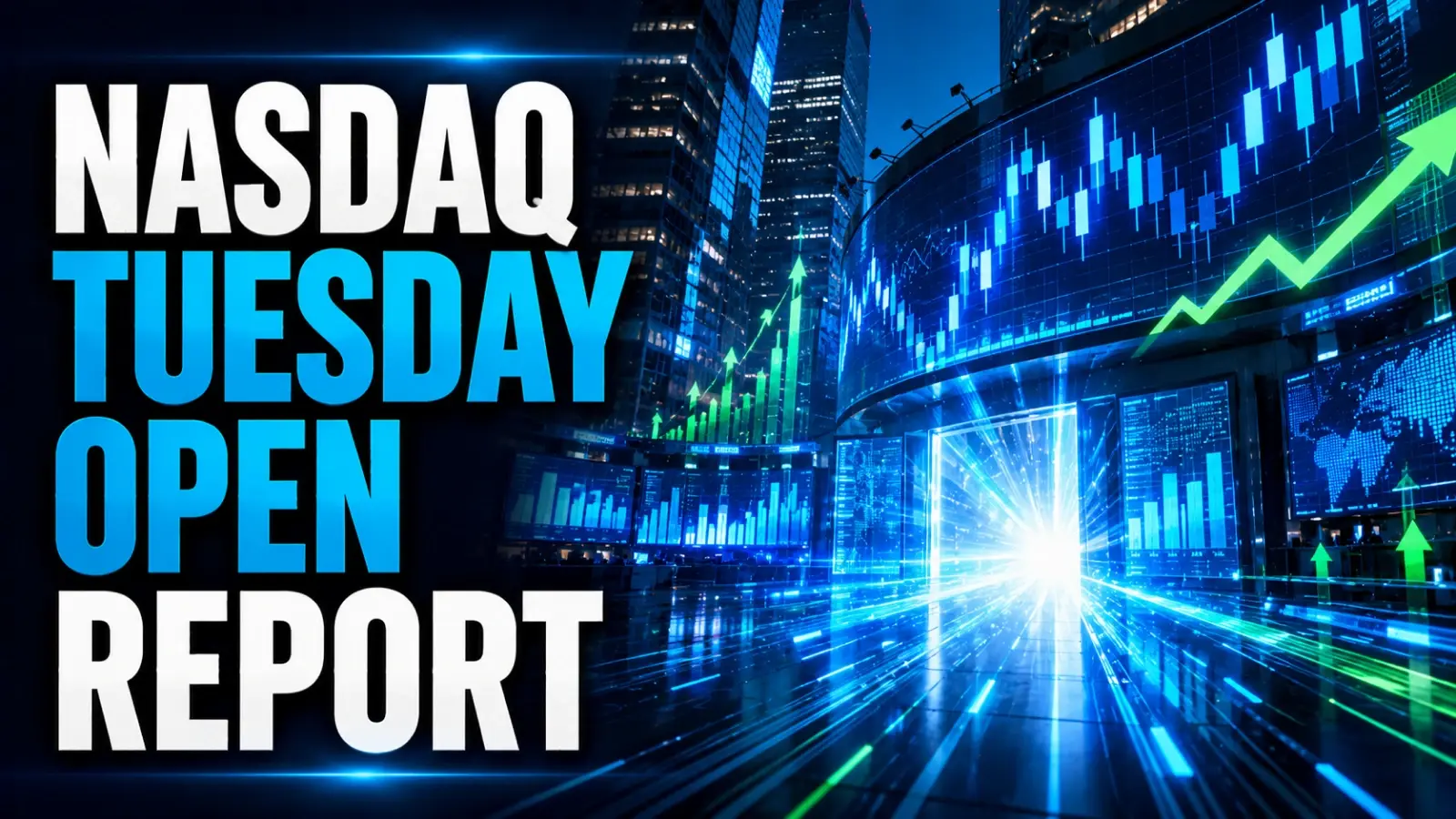
Nasdaq Composite Rebounds 0.30% to 26,455 as Markets Await First Fed Decision Under Chair Kevin Warsh
Authored By HDFC SKY | Last Modified: Jun 18, 2026 09:31 AM IST
Open Free Demat Account
Open Free Demat Account
Mumba June 17: The tech-heavy Nasdaq Composite advanced in early trading on Wednesday as investors positioned themselves ahead of the Federal Reserve’s first monetary policy decision under newly confirmed Chairman Kevin Warsh. The index climbed 78.77 points, or 0.30%, to 26,455.12 during the morning session, recovering some ground after Tuesday’s sharp sell-off that saw the benchmark decline over 1%.
The broader market presented a mixed picture at the opening bell. The Dow Jones Industrial Average opened at 51,889, reflecting a 0.42% gain, while the S&P 500 commenced trading at 7,555.42, remaining relatively flat.
Simultaneously, the Nasdaq Composite opened marginally lower at 26,493.82 before reversing course to trade in positive territory. The index later edged 0.3% higher to 26,767.60 during the morning session, largely driven by the continued rally in SpaceX.
The Dow Jones also reached a fresh all-time intraday record, climbing approximately 180 points (0.4%) to extend its record-breaking run.

Tech Stocks Recover After Tuesday’s Semiconductor Sell-Off
The technology sector showed signs of resilience following a turbulent Tuesday session that saw chipmakers bear the brunt of selling pressure. Semiconductor stocks, which had dragged the Nasdaq lower by approximately 1.15% in the previous session, rebounded strongly in pre-market and early trading.
Leading the recovery were major chip manufacturers including Broadcom, Micron Technology, Advanced Micro Devices and Intel, all of which recorded gains between 1.5% and 3.5% in pre-market activity. The Philadelphia Semiconductor Index showed broad-based strength, with Applied Materials climbing 3.38%, Intel rising 3.2%, and Lam Research advancing 3.02% ahead of the opening bell. The recovery was further underscored by the Nasdaq 100 heatmap, which showed Applied Materials (AMAT) soaring 8.14%, Lam Research (LRCX) gaining 5.83%, and ASML Holding (ASML) advancing 5.21% during the session.
The rebound comes after chip stocks experienced significant pressure on Tuesday, with AMD dropping over 7%, Broadcom declining 4%, and Nvidia losing more than 2%. Analysts attributed the recovery to bargain hunting and renewed optimism around artificial intelligence infrastructure spending, which continues to drive demand for semiconductor equipment and memory solutions.
Federal Reserve Takes Centre Stage as Warsh Chairs First FOMC Meeting
All eyes remained fixed on the Federal Reserve as the central bank convened its June 16-17 Federal Open Market Committee meeting, marking the first policy gathering under Chairman Kevin Warsh. Warsh, confirmed by the Senate in May with a 54-45 vote, succeeds Jerome Powell as the 17th chair of the Federal Reserve. A former Fed governor who served from 2006 to 2011, Warsh previously acted as the Federal Reserve’s representative to the Group of Twenty and as the Board’s emissary to emerging and advanced economies in Asia. He began his career at Morgan Stanley, rising to Executive Director of Mergers and Acquisitions, and holds degrees from Stanford University and Harvard Law School.
Policymakers were widely expected to maintain the federal funds rate in the 3.50% to 3.75% range at the conclusion of the meeting. Markets had priced in a near-certainty of no change, shifting investor focus instead to Warsh’s post-meeting press conference scheduled for 2.30 PM ET.
Inflation and Geopolitical Tensions Complicate Rate Outlook
The Federal Reserve’s decision to keep interest rates unchanged came amid persistent inflationary pressures, with May’s Consumer Price Index rising 4.2% year-over-year, marking a third consecutive monthly increase. Higher energy prices, driven by disruptions linked to the US-Iran conflict and the closure of the Strait of Hormuz, have been a key contributor to inflation.
Analysts expect the Fed to maintain a cautious, hawkish stance, with some forecasting rates will remain unchanged through 2026 before modest cuts begin in 2027. Markets currently see a moderate chance of at least one rate cut before year-end. Investors also closely monitored the meeting as the first under Chair Kevin Warsh, seeking clues about future policy direction and communication practices.
Also Read: How to Invest in the US Stocks From India?
US-Iran Peace Deal Offers Oil Relief but Uncertainty Persists
Geopolitical developments helped ease inflation concerns as the US and Iran reportedly reached a framework agreement to end their conflict. The proposed deal would allow Iran to resume oil and petrochemical exports through US waivers, while frozen Iranian assets would be released gradually under phased sanctions relief.
It also includes a $300 billion investment fund to support long-term economic cooperation. The US would lift its blockade of Iranian ports, and Iran would restore maritime traffic through the Strait of Hormuz. Despite a planned signing ceremony on 19 June, President Donald Trump warned the agreement was not yet final. Meanwhile, oil prices fell for a fifth straight session, with Brent and WTI crude declining sharply, easing inflation expectations and supporting equity markets.
Extreme Movers and Broad Pre-Market Activity Highlight Market Volatility
The pre-market session witnessed extraordinary volatility across various stocks, with several names posting triple-digit percentage swings. According to pre-market scans, the top gainers included TBLAW, which surged 200%, followed by SLBT climbing 166.97%, and OBAI advancing 107.63%. Conversely, the top losers saw sharp declines, with GDC (GD Culture Group) plunging 73.26%, CIIT dropping 70.14%,and MYPSW falling 66.67%.
Among the most active advanced stocks during the early trading session, EHGO led the pack with a staggering 299.62% gain, followed by SNBR rising 146.49%, and ICCM advancing 136.15%. Other notable gainers included CLWT up 84.09%, SVAQW gaining 81.64%, and DAICW rising 79.63%. These extreme moves underscore the heightened speculative activity and rapid rotations occurring within the broader market landscape.
Goldman Sachs Identifies Capex Supercycle as AI Spending Surges
Goldman Sachs believes the global economy is entering a major capital expenditure supercycle, driven by rising demand for investment across industries. A significant portion of this spending is focused on AI infrastructure, with major technology companies expected to invest more than $600 billion in 2026 alone.
Beyond AI, governments are increasing expenditure on defence, energy security, and supply chain resilience amid shifting geopolitical dynamics and deglobalisation trends. Goldman argues that businesses are moving toward more capital-intensive growth models, leading to structurally higher costs and investment needs. This environment is expected to be characterised by higher inflation, interest rates, debt levels, and long-term growth opportunities..
SpaceX Continues Record-Breaking Run After Historic IPO
SpaceX (NASDAQ: SPCX) continued to dominate market attention, with shares rising approximately 2% in pre-market trading, poised to extend a post-IPO rally that has seen the Elon Musk-led rocket company eclipse Amazon in market value in just three days of trading. The company priced its IPO at $135 per share on 12 June 2026, raising $75 billion in what became the largest initial public offering in history. Underwriters exercised their greenshoe option on 15 June, lifting total proceeds to $85.7 billion.
SPCX ended Tuesday’s session up 4.83% at $201.80, giving SpaceX an implied market capitalisation of approximately $2.65 trillion, about $8 billion above Amazon.com‘s valuation. The stock briefly touched an intraday peak of $225.64, pushing its implied market value above $3 trillion and leapfrogging both Amazon and Microsoft simultaneously.
SpaceX operates the Starlink satellite internet service and a fleet of reusable rockets, and acquired Elon Musk’s AI venture xAI in February, adding xAI’s data centers, its Grok AI models, and ownership of the social platform X to its portfolio. The company’s 2025 financials showed revenue of $18.7 billion alongside a net loss approaching $5 billion, while first-quarter capital spending more than doubled year-over-year, hitting $10.1 billion compared with $4.1 billion in the same stretch of 2025.
Retail Sales Surge 0.9% in May, Exceeding Expectations
Economic data released Wednesday provided further evidence of consumer resilience, with the Commerce Department reporting that retail sales rose 0.9% in May, significantly exceeding the Dow Jones consensus forecast of 0.5%. The increase more than doubled the revised 0.4% gain recorded in April.
Gas station receipts jumped 3.4% amid soaring energy prices tied to the Iran war. However, gains were spread across other sectors, including miscellaneous retail (2.3%), online stores (1.5%), motor vehicles parts and dealers (1.2%), and furniture and home furnishings (1%). The only major category to post a decline was electronics and appliances, which saw a 0.5% decrease.
In addition to topping the forecast, the sales increase was faster than the inflation increase of 0.5% as measured by the Consumer Price Index, suggesting real consumer spending growth remained positive. The data underscored the resilience of the US consumer despite higher interest rates and ongoing geopolitical uncertainties.
Semiconductors Lead Sector Rotation as Banks Gain Ground
A notable theme of the morning session was the rotation out of technology and into financial stocks, driven by the hot inflation data and expectations of higher-for-longer interest rates. The chipmaker sector declined approximately 5.92% in early trading, while the broader technology sector fell 2.79%.
Conversely, the financial and banking sector gained 1.48%, with JPMorgan posting the largest single-stock gain in the sector at 3.68%. This sector rotation reflected the classic market response to rising rates, as banks benefit from wider net interest margins while expensive technology stocks face valuation pressure.
Among individual semiconductor names, Intel rose approximately 2% as part of a broader comeback among chip stocks. The move came on the heels of the company starting production of its most-advanced chip node known as 18A-P, a step that moves the company closer to securing a potential agreement to produce chips for Apple devices. Alongside Intel, ASML advanced 5%, while the Invesco PHLX Semiconductor ETF gained more than 2%.
Also Read: Understanding US Stock Market Timings
Market Outlook and Key Levels to Monitor
The Nasdaq Composite remained approximately 2.7% below its record closing high, with technical analysts noting that the index continued to hold above important support levels. Traders were watching the 28,000 area as the next major upside target, while key support levels were identified around 26,350 to 25,400.
The 10-year Treasury yield remained steady at 4.43% as traders widely expected the Fed to hold interest rates steady. Gold traded near $4,329.66 per ounce, while silver was at $70.12 per ounce. Wall Street strategists remained optimistic, with analysts at Wells Fargo raising their 2026 year-end S&P 500 target to 7,950, citing stronger earnings expectations and easing macroeconomic risks.
The Nasdaq’s rebound reflects optimism ahead of the Fed’s policy decision, with investors focused on AI and semiconductor stocks. Inflation concerns and developments in the US-Iran peace process remain key risks, while traders watch critical support and resistance levels.
Source
- https://www.nasdaq.com/
Disclaimer
If you have any concerns, questions, or wish to point out any discrepancies in our content, please feel free to write to us at content@hdfcsec.com.
Please Note: The information shared is intended solely for informational purposes and does not make any investment recommendations
Disclaimer
At HDFC SKY*, we take utmost care and due diligence in curating and presenting news and market-related content. However, inadvertent errors or omissions may occasionally occur.
If you have any concerns, questions, or wish to point out any discrepancies in our content, please feel free to write to us at content@hdfcsec.com.
Please Note: The information shared is intended solely for informational purposes and does not make any investment recommendations.
HDFC SKY from HDFC Securities, one of most trusted trading platforms in India, has been recognized with the *Next-Gen Digi Content Awards 2025-26.
 Join Us
 Add as preferred source on Google


More International News




Open Free Demat Account
Open Free Demat Account








Invest Anytime, Anywhere


By signing up I certify terms, conditions & privacy policy