Nifty 50
- HCL Technologies₹1,290.9067.90 (5.55%)
- Max Healthcare₹849.75-16.20 (-1.87%)
- TCS₹2,230.40105.40 (4.96%)
- Maruti Suzuki₹11,174-141.00 (-1.25%)
- Tech Mahindra₹1,522.7051.70 (3.51%)
- NTPC₹307.35-2.65 (-0.85%)
- Infosys₹1,038.7518.75 (1.84%)
- Tata Motors PV₹282.30-2.15 (-0.76%)
- Hindustan Unilever₹1,853.8033.10 (1.82%)
- InterGlobe Aviation₹4,767-28.00 (-0.58%)
- Bajaj Auto₹10,182148.00 (1.47%)
- Eicher Motors₹7,081.50-37.50 (-0.53%)
- Adani Enterprises₹2,66838.00 (1.44%)
- Power Grid Corp₹247.90-1.10 (-0.44%)
- Grasim Industries₹2,898.5040.50 (1.42%)
- Reliance Industries₹1,154.50-4.40 (-0.38%)
- Bajaj Finserv₹1,742.9023.00 (1.34%)
- Bharti Airtel₹1,773.10-5.60 (-0.31%)
- Hindalco Industries₹892.359.85 (1.12%)
- JSW Steel₹1,169.50-3.50 (-0.30%)

- Offerings
- Tools & Platforms
Tools & Calculators
- Open API
- Calculators
- SIP Calculator
- CAGR Calculator
- Compound Interest Calculator
- FD Calculator
- RD Calculator
- EPF Calculator
- Retirement Calculator
- HDFC SIP Calculator
- Mutual Fund Return Calculator
- Lumpsum Calculator
- Step Up SIP Calculator
- ETF SIP Calculator
- Brokerage Calculator
- Equity Margin Calculator
- SWP Calculator
- EMI Calculator
- MTF Calculator
- Margin Pledge Calculator
- Algo Strategy
- Markets
Stocks
F&O
Mutual Funds
- More
SpaceX IPO: Shares Jump 19% to $161 on Nasdaq Debut After Record $75 Billion Fundraise
Authored By HDFC SKY | Published at: Jun 13, 2026 01:03 PM IST
Open Free Demat Account
Open Free Demat Account
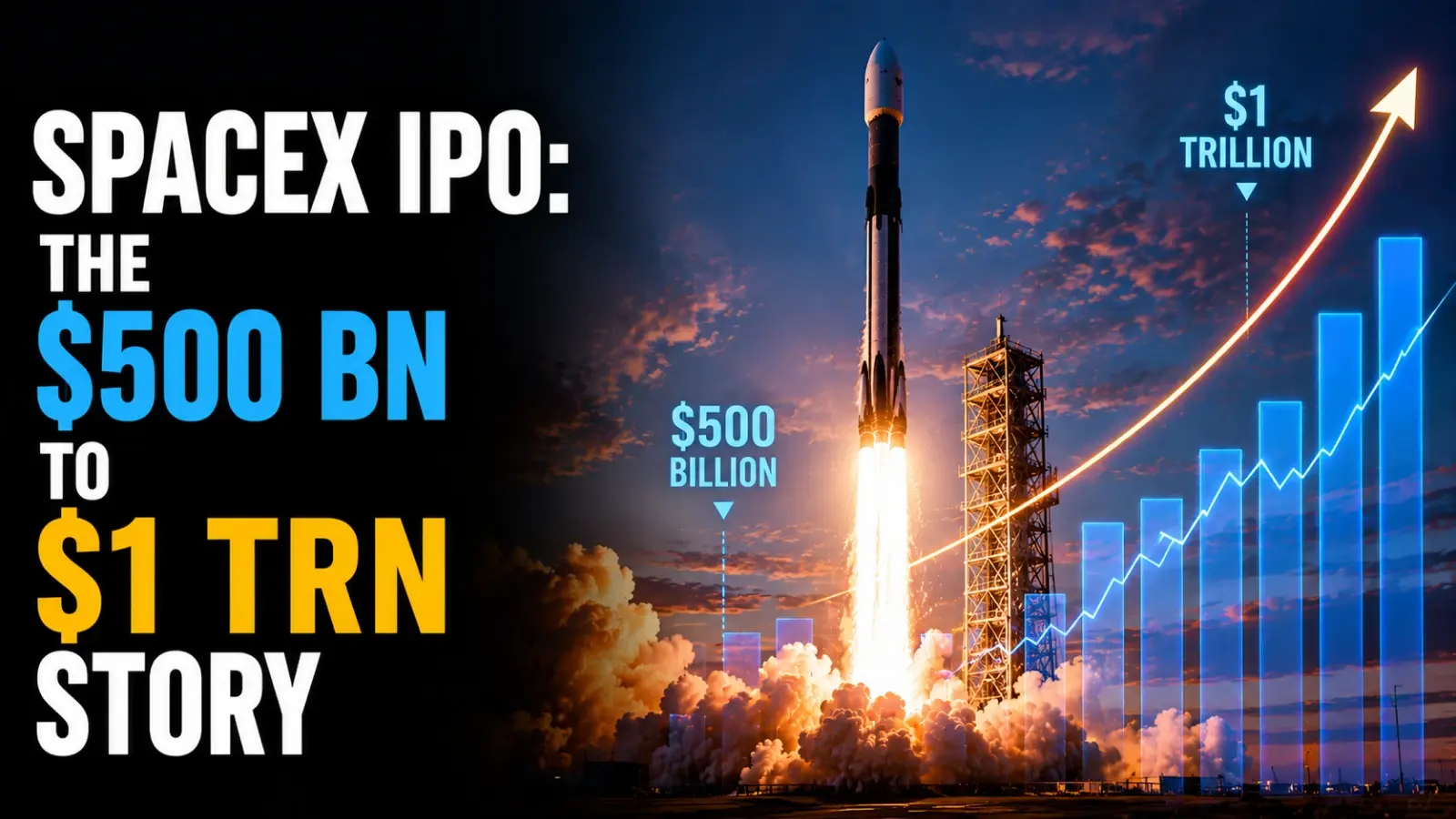
Mumbai, June 13: SpaceX made its highly-awaited debut listing on the Nasdaq stock exchange, closing at $160.95 against an opening price of $150 and IPO price of $135 on Friday. With an offering worth $75 billion, raised from the sale of 555.6 million shares, the listing is not only the largest Initial Public Offering ever but also breaks the record held by Saudi Aramco at $29.4 billion in 2019.
The company, trading under ticker symbol SPCX, succeeded in achieving a market capitalisation of about $2.1 trillion before the closing bell, thus placing itself in the list of the six biggest publicly traded companies in the US. Over 510 million shares were traded during the day, worth roughly $84 billion in trading activity. The listing makes Elon Musk the first trillionaire on paper, with his stock holdings in SpaceX and Tesla estimated at about $1.03 trillion in value.
Elon Musk Becomes World’s First Trillionaire with $750 Billion SpaceX Stake
The major trigger that has fuelled the recent spike in historic valuation is Musk’s ownership in SpaceX, which stands at 42 per cent. According to information from the company’s S-1 filing, the CEO had 849 million Class A shares along with 5.57 billion Class B shares prior to the offering. This translates to a value of approximately $750 billion at the offer price of $150 per share.
Also Read: SpaceX’s $1.8-Trillion Nasdaq Debut Puts Indian Space Stocks in the Spotlight
When added to his Tesla stake, which Bloomberg estimates at approximately $280 billion, Musk’s total net worth crossed the $1 trillion threshold. His wealth now exceeds the entire economic output of nations such as Poland or Switzerland, according to economic comparisons cited in market reports. The Bloomberg Billionaires Index officially recorded Musk’s net worth at $1.11 trillion following the close of trading. Musk holds $53.8 billion in SpaceX options in addition to his direct shareholding, while his Tesla options are valued at $116.4 billion.
SpaceX Nasdaq Debut Lifts Valuation to $2.1 Trillion Despite $4.94 Billion Net Loss in 2025
A critical examination of the company’s financial foundation reveals significant challenges underlying the market enthusiasm. SpaceX reported a net loss of $4.94 billion for the full year 2025, according to its IPO prospectus.
The company carries an accumulated deficit of $41.3 billion since its founding in 2002. For the first quarter of 2026, the company posted a further loss of $4.28 billion, bringing total losses between early 2025 and March 2026 to $8.7 billion.
Annual revenue for 2025 stood at $18.67 billion, a figure substantially lower than other technology companies with comparable valuations. The company’s primary revenue generator is the Starlink satellite internet division, which represents the only profitable segment of the business. SpaceX acquired Musk’s artificial intelligence startup xAI in February 2026, integrating the Grok AI models, associated data centres, and the social network X into its corporate structure. The company has outlined plans to expand its satellite network and construct artificial intelligence data centres in space.
Retail Investors Receive 20 Per Cent IPO Allocation as Shares Trade Between $150 and $176 on Day One
The trading dynamics on Friday demonstrated unusual patterns for a listing of this magnitude. Shares opened late in the morning at $150 and reached an intraday high of $176.50 before settling at $160.95 at the closing bell.
The stock spent much of the session trading between 15 per cent and 30 per cent above Thursday’s offering price. Retail investors received approximately 20 per cent of the IPO allocation, significantly above the typical norm for large offerings. Some participants celebrated allocations of just a single share, reflecting the intense demand among individual investors.
The offering was nearly four times oversubscribed, drawing over $350 billion in demand from institutional and retail buyers combined. The IPO valued the company at approximately $1.77 trillion at the offering price, which expanded to $2.1 trillion by market close. In after-hours trading, shares continued to climb, rising an additional 3.67 per cent to $166.85, adding roughly another $80 billion to the market capitalisation.
Antonio Gracias and Valor Equity Partners Secure $75 Billion Windfall From 2006 Investment
The IPO has generated substantial wealth for early backers who supported SpaceX when the company’s survival was uncertain. Antonio Gracias, a longtime member of Musk’s inner circle and founder of Valor Equity Partners, holds more than 500 million SpaceX shares through investment vehicles affiliated with his private equity firm.
This position represents roughly 7.3 per cent of SpaceX’s Class A stock and was valued at upwards of $75 billion at Friday’s opening price, making it one of the largest single fortunes ever generated by a venture investor.
Also Read: How to Invest in the US Stocks From India?
Gracias told CNBC shortly before shares began trading that he intended to hold his stake “as long as possible.” Valor Equity Partners made its first investment in SpaceX in 2006, when the company was still struggling to achieve a successful orbital launch. The firm’s limited partners are the primary beneficiaries of the gains, according to a post Gracias published on X following the release of the S-1 filing.
Google Turns $900 Million Investment Into $132 Billion as SpaceX Becomes Seventh Most Valuable Global Company
In 2015, Google invested approximately $900 million in SpaceX for a stake of around 7.64 per cent. That position was valued at roughly $12 billion at the time of investment based on contemporaneous private market valuations. By the first hour of trading on Friday, Google’s stake had grown to $132 billion, representing one of the most profitable venture investments ever recorded.
The search giant’s SpaceX payday could be followed by an even larger return later this year, as Google holds approximately 14 per cent of Anthropic, which is preparing for a major IPO of its own.
Other prominent winners include Luke Nosek, a PayPal veteran who led the first institutional venture investment into SpaceX in 2008 while at Founders Fund. Nosek holds nearly 33 million Class A shares directly and through his family office, Nosek Capital, a stake worth approximately $5 billion at the opening price.
Gwynne Shotwell and Bret Johnsen Join Ranks of Billionaires From Two Decades of Service
Long-serving executives have also reaped substantial rewards from the public listing. Gwynne Shotwell, who joined SpaceX in 2002 and has served as president and chief operating officer for nearly two decades, holds a stake valued at close to $2 billion at the IPO’s opening price.
This places her among America’s wealthiest self-made women, just behind Sheryl Sandberg at $2.4 billion and Taylor Swift at $2 billion. Shotwell has been widely credited with holding the organisation together as Musk divided his attention across
Tesla, government efficiency initiatives, and X. Bret Johnsen, who joined SpaceX as chief financial officer in 2011, holds a stake worth approximately $1.4 billion at the opening price. Johnsen spent years raising billions in private funding to finance the company’s ambitious engineering projects before steering the organisation through its transition to public markets.
Ira Ehrenpreis, a venture capitalist and former Tesla board member who built his firm DBL Partners around values-driven investing, saw his SpaceX stake reach roughly $205 million at debut.
Analysts Warn of Lock-Up Expiry as $200 Billion to $300 Billion in Employee Shares Could Hit Market in August
Market observers have pointed to a significant liquidity event approaching in the coming months. Lock-up agreements restricting employee share sales begin expiring in August 2026, which could release an estimated $200 billion to $300 billion worth of SpaceX shares onto the market.
This figure represents between two and four times the size of the IPO itself. By comparison, passive fund demand from index inclusion is estimated at roughly $30 billion, creating a substantial supply-demand imbalance. A study by the University of Florida analysing 44 years of every IPO in the United States showed that IPOs underperform the market over three years from listing day onwards, with the only market-beating strategy being to obtain an allocation in the IPO itself and sell on day one.
A separate study by Truist examining the 30 largest technology IPOs found that all 30 experienced a significant drawdown in year one, with a median maximum drawdown of 54 per cent.
Goldman Sachs and Morgan Stanley Earn $100 Million Each as Underwriters as SpaceX Joins Nasdaq-100 Fast Entry Rule
The investment banks that facilitated the public listing have earned substantial fees from the transaction. The top players, Goldman Sachs and Morgan Stanley, will each take home approximately $100 million in underwriting fees.
Bank of America, Citigroup, and JPMorgan Chase will each receive about $75 million in fees, bringing total investment banking compensation to $500 million. In April, the New York Times reported that Musk required Wall Street firms to purchase subscriptions to his Grok AI chatbot if they wanted to participate as underwriters. Nasdaq’s new “fast entry” rule facilitated SpaceX’s inclusion into the Nasdaq-100 index substantially sooner than would have been possible under previous regulations.
Bloomberg Intelligence estimates this could generate roughly $20 billion in demand from passive funds tracking the index. The IPO values the company at approximately 109 to 116 times trailing revenue, an extraordinary multiple even by hyperscaler standards.
SpaceX Projects $28.5 Trillion Total Addressable Market as Company Loses Money on AI Operations
The company’s valuation rests heavily on optimistic projections about future market opportunities. SpaceX estimates its total addressable market at $28.5 trillion, a figure just a few trillion dollars shy of United States gross domestic product. A substantial portion of this projected market comes from the company’s artificial intelligence business, which to date has been a money-losing operation.
NYU valuation expert Aswath Damodaran has described SpaceX’s TAM as one that “borders on fantasy.” The company admits in its own prospectus that many of its initiatives “involve significant technical complexity, unproven technologies or technologies that do not exist, and such initiatives may not achieve commercial viability.”
Despite these warnings, the company has outlined plans to put over 100,000 satellites in orbit for communications and to construct artificial intelligence data centres in space. The company’s mission statement, as published in the IPO prospectus, is: “To build the systems and technologies necessary to make life multiplanetary, to understand the true nature of the universe and to extend the light of consciousness to the stars.”
Other Space and Satellite Companies Fall Sharply as SpaceX Sucks Liquidity From Magnificent Seven Stocks
The ripple effects of the SpaceX debut were felt across related sectors. Shares of other space and satellite businesses fell sharply, reversing gains recorded after SpaceX filed for its IPO in April. Market data showed signs that investors had been selling shares of major technology companies, including Amazon, Apple, Meta, Microsoft, and even Tesla, in order to purchase SpaceX shares. Samuel Kerr, who leads equity capital markets research for Mergermarket, told the BBC there had been noticeable selling in large technology companies as SpaceX was marketing and pricing its IPO.
“That would indicate investors were selling out of liquid tech exposure, like the Mag 7 names, to make room for SpaceX,” Kerr said. On Friday, shares of Tesla, Microsoft, Apple and Amazon dipped slightly, while Meta, Alphabet and Nvidia remained relatively flat.
SpaceX’s market capitalisation of $2.1 trillion now exceeds that of many established technology giants, placing it behind only Apple, Microsoft, Nvidia, Amazon, and Alphabet among United States publicly traded companies.
Oxfam Calls Trillionaire Milestone a ‘Dark Day for Global Democracy’ as Protesters Gather at Times Square
The wealth concentration represented by the IPO has drawn sharp criticism from advocacy groups. According to the UK-based anti-poverty charity Oxfam, Musk’s wealth now exceeds that of the poorest 3.8 billion people in the world combined, representing 46 per cent of the global population.
Oxfam’s analysis indicates that Musk’s wealth grew by over $550 billion over the past year, equivalent to an average rate of over $1 million per minute. The charity stated that a 10 per cent tax on Musk’s wealth could lift 800 million people above the extreme poverty line. “A trillionaire is not a sign of a healthy economy – it is a sign that extraordinary wealth and power are being concentrated in the hands of a tiny few while millions of people struggle to afford the basics,” said Jean Mclean, Chief Influencing Officer at Oxfam GB.
Protesters staged an anti-Musk demonstration in New York City’s Times Square ahead of the listing, with one inflatable balloon depicting Musk featuring the words “SpaceX’s Grok makes AI child porn” across its chest.
Company Continues to Lose Money as Starship Rocket Remains Untested for Orbital Flights
Despite the market enthusiasm, SpaceX’s core technological ambitions face significant hurdles. The company’s Starship rocket, on which its Mars colonization dreams depend, has undergone only around a dozen test flights, none of which have been an orbital flight around Earth. Musk’s stated plan calls for uncrewed Starships to head for Mars sometime between 2026 and 2028, with crews to follow later.
Few independent experts believe a 2026 Mars mission is credible, given that the rocket is still being tested. On the positive side, SpaceX launches the large majority of objects reaching orbit, has re-flown its Falcon 9 boosters dozens of times each, and maintains a success rate above 99 per cent.
This has created a genuine revolution in cheap, reliable access to low-Earth orbit. The company stated in its IPO prospectus that it is unsure whether its lunar economy initiatives will ever succeed, explicitly warning that many initiatives involve technologies that do not currently exist.
SpaceX shares closed the first trading session at $160.95, representing a 19 per cent premium to the IPO price of $135. Trading volume exceeded 510 million shares, with $84 billion changing hands. The company’s market capitalisation stands at $2.1 trillion. Lock-up agreements expire in August 2026, potentially releasing $200 billion to $300 billion in employee-owned shares onto the market. The company reported a $4.94 billion net loss for 2025 and carries an accumulated deficit of $41.3 billion.
Source
-
https://www.nasdaq.com/
Disclaimer
If you have any concerns, questions, or wish to point out any discrepancies in our content, please feel free to write to us at content@hdfcsec.com.
Please Note: The information shared is intended solely for informational purposes and does not make any investment recommendations
Disclaimer
At HDFC SKY*, we take utmost care and due diligence in curating and presenting news and market-related content. However, inadvertent errors or omissions may occasionally occur.
If you have any concerns, questions, or wish to point out any discrepancies in our content, please feel free to write to us at content@hdfcsec.com.
Please Note: The information shared is intended solely for informational purposes and does not make any investment recommendations.
HDFC SKY from HDFC Securities, one of most trusted trading platforms in India, has been recognized with the *Next-Gen Digi Content Awards 2025-26.
 Join Us
 Add as preferred source on Google


More Business News




Open Free Demat Account
Open Free Demat Account







Invest Anytime, Anywhere


By signing up I certify terms, conditions & privacy policy