Nifty 50
- Tata Consumer ₹1,00063.50 (6.78%)
- Asian Paints₹2,277-45.00 (-1.94%)
- Bharti Airtel₹1,978.8061.30 (3.20%)
- Coal India₹398-7.00 (-1.73%)
- Bajaj Auto₹10,390319.00 (3.17%)
- Grasim Industries₹2,900.80-49.20 (-1.67%)
- BSE₹3,441.1082.10 (2.44%)
- SBI₹945.10-15.70 (-1.63%)
- Trent₹2,820.6066.60 (2.42%)
- TCS₹2,496.90-38.10 (-1.50%)
- Maruti Suzuki₹11,450230.00 (2.05%)
- Adani Enterprises₹2,474.10-33.90 (-1.35%)
- Power Grid Corp₹251.754.75 (1.92%)
- Axis Bank₹1,205.70-14.30 (-1.17%)
- Eternal₹3315.45 (1.67%)
- ICICI Bank₹1,386.90-16.10 (-1.15%)
- Max Healthcare₹847.9012.90 (1.54%)
- HDFC Bank₹680.20-7.85 (-1.14%)
- Bharat Electronics₹368.155.15 (1.42%)
- HDFC Life Insurance ₹513.60-5.40 (-1.04%)

- Offerings
- Tools & Platforms
Tools & Calculators
- Open API
- Calculators
- SIP Calculator
- CAGR Calculator
- Compound Interest Calculator
- FD Calculator
- RD Calculator
- EPF Calculator
- Retirement Calculator
- HDFC SIP Calculator
- Mutual Fund Return Calculator
- Lumpsum Calculator
- Step Up SIP Calculator
- ETF SIP Calculator
- Brokerage Calculator
- Equity Margin Calculator
- SWP Calculator
- EMI Calculator
- MTF Calculator
- Margin Pledge Calculator
- Algo Strategy
- Markets
Stocks
F&O
Mutual Funds
- More
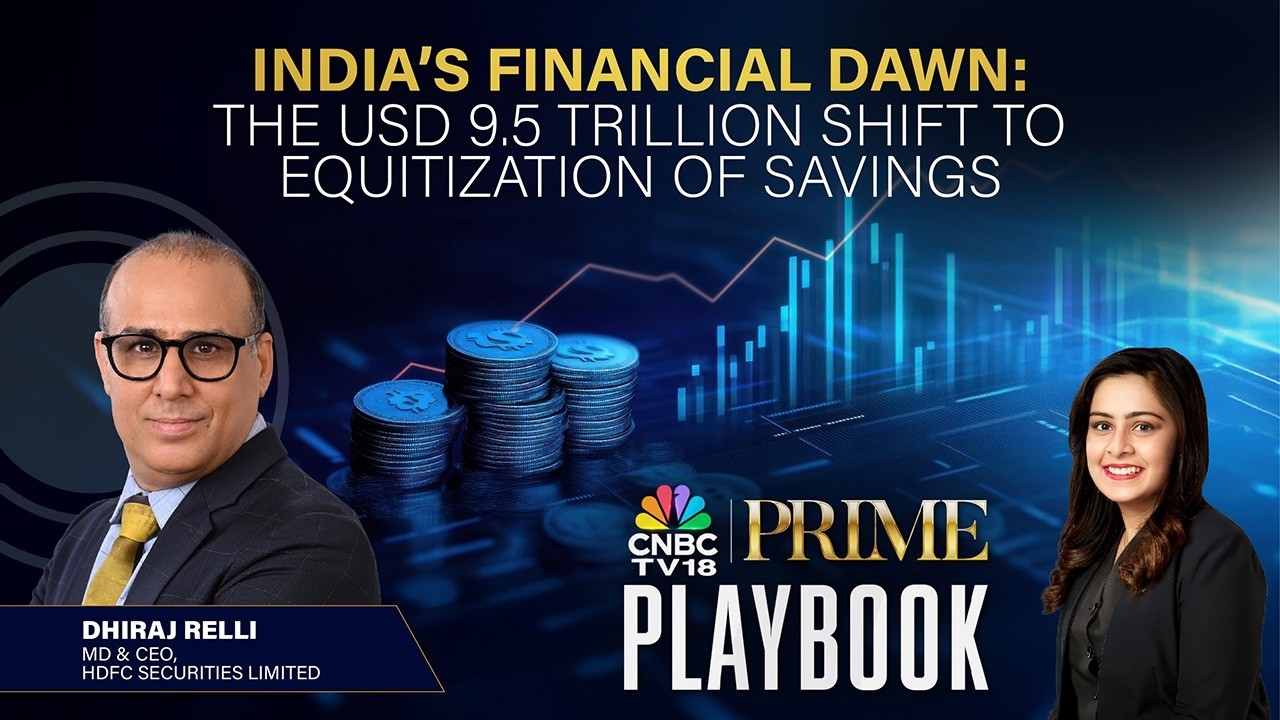
Ease of investing has been the single biggest change in India’s capital markets over the past decade: HDFC Securities MD & CEO, Dhiraj Relli
By Dhiraj Relli | Published at: Mar 11, 2026 05:59 PM IST
Open Free Demat Account
Open Free Demat Account
Mumbai, March 11: The greatest transformation in Indian capital markets over the last decade has been the ease of investing with complete elimination of cumbersome paperwork in favour of fully digital onboarding, according to HDFC Securities, Managing Director and CEO, Dhiraj Relli.
the capital markets had changed in the manner of how Indians invested.
“Earlier, we used to onboard customers with 38 or 40 signatures and large forms,” Relli said on CNBC TV18 Prime Playbook show. “Today, it’s just a six-to-seven-minute journey for a customer to complete the process digitally, with no paperwork and no intervention from a broking entity.”
The digitisation of investing, he added, has helped democratise financial services in India and accelerated a structural shift in household savings from physical assets such as gold and real estate to financial instruments like equities and mutual funds.
Democratisation of Financial Services
Relli said the transformation of India’s investment landscape has been driven not only by technology but also by a behavioural shift among investors.
“For a long time, Indian investors struggled to navigate volatility,” he said. “Even a small market correction would make them uncomfortable.” But over the last decade, rising aspirations, changing return expectations, and greater financial awareness have made investors more resilient.
He noted that markets today face event risks such as geopolitical tensions—including the ongoing conflict between Iran and the United States—but Indian investors appear far less shaken than before.
“There has been a pivot in behaviour,” Relli said. “Investors are no longer perturbed by volatility or short-term market shocks.” He credited regulators, financial institutions, and the media ecosystem for expanding access to financial information, enabling broader participation in capital markets.
“Twenty-five years ago, only institutional investors and ultra-high-net-worth individuals had access to market information,” he said. “Today, information is available to everyone—from small investors to large institutions.”
SIP Boom and the Financialisation of Savings
The growing popularity of systematic investment plans (SIPs) reflects this structural shift. According to Relli, monthly SIP inflows have surged dramatically over the past few years.
“SIP inflows have moved from about ₹8,000 crore in March 2020 to over ₹31,000 crore in January 2026,” he said. The number of SIP accounts has also expanded rapidly, with over 10 crore accounts now investing an average of around ₹3,000 per month. If the current trajectory continues, Relli expects the SIP ecosystem to reach unprecedented levels.
“We have been growing the SIP book at around 24% annually,” he said. “At this rate, we could see monthly SIP flows touching ₹1 lakh crore by around 2030.” At the same time, India’s mutual fund industry is approaching a major milestone, with assets under management nearing ₹100 lakh crore. Relli said the financialisation of savings remains in its early stages. Currently, only about 20% of household financial savings are allocated to equities or mutual funds. This share could rise to 33% by 2033, he said.
Gold ETFs and the Rise of Financial Assets
Another major trend reshaping the investment landscape is the move from physical to financial versions of traditional assets. Earlier, investors typically bought gold in the form of jewellery or bullion. Today, many are shifting to financial products such as gold exchange-traded funds (ETFs).
“We saw about ₹24,000 crore flowing into gold ETFs,” Relli said, adding that these inflows even exceeded net SIP investments during certain periods.
“This is the financialisation of savings,” he said. “People are moving from physical assets into financial instruments across asset classes.”
Within this broader shift, equities are gaining traction because of their higher return potential. “The financialisation of savings and equitisation of savings will continue and accelerate,” Relli said.
However, he cautioned that prolonged market downturns could temporarily slow investor enthusiasm. “If markets remain in a prolonged down cycle, some investors could lose confidence and SIP inflows might moderate,” he said. Still, he believes investors are becoming more disciplined and may view corrections as buying opportunities.
Equitisation of Savings in Smaller Cities
The expansion of investing is not limited to major urban centres. Smaller towns and cities are emerging as key drivers of India’s investment boom.
Data shows that investments from B30 cities, beyond the top 30 urban centres, are growing faster than those from metro areas.
“B30 cities are growing at a 30% CAGR, compared with 20% growth in the top 30 cities,” Relli said. He attributed this rise to greater financial literacy, wider access to market information, and the influence of digital platforms and financial media. “Media, social platforms, and influencers
have played an important role in democratising investing,” he said, while acknowledging that some unregistered advisors have also contributed to misinformation.
Long-Term Investors vs Short-Term Traders
While participation in capital markets is expanding, Relli acknowledged that speculative trading—especially in derivatives—has also increased. India has become the world’s largest derivatives trading market, reflecting a strong appetite for short-term gains. “Investors have gravitated toward speculative activities, which also reflects the tendency to try and make quick money,” he said. However, regulators such as Securities and Exchange Board of India (SEBI) have taken steps to curb excessive speculation. Relli believes that despite the attention given to speculative trading, a deeper structural shift toward long-term investing is underway. India’s mutual fund industry, with assets of about ₹81 lakh crore, is largely owned by individual investors. “Nearly 60% of mutual fund assets belong to individuals,” he said. “That tells you people are investing for the long term.”
He also expects retirement planning and long-term wealth creation to gain momentum as India’s demographic profile evolves.
Passive Funds, NFOs, and India’s Growth Story
Looking ahead, Relli said investors should prioritise asset allocation rather than chasing the latest investment trends. “Investors should first look at their time horizon, risk appetite, and return expectations,” he said. For many investors, balanced advantage funds, large-cap mutual funds, and multi-asset strategies may be more suitable than high-risk thematic funds or new fund offers (NFOs).
While passive funds are gaining popularity globally, Relli said India still offers ample opportunities for active fund managers to generate returns.
“With more than 2,900 companies listed on exchanges, there are still significant alpha opportunities beyond the major indices,” he said. Nonetheless, passive investing is expected to grow steadily as the market matures.
India’s Long-Term Investment Story
Despite global uncertainties and periodic market volatility, Relli remains optimistic about India’s economic trajectory. India’s economy is projected to grow steadily, potentially becoming the world’s third-largest economy by 2030 with a GDP of about $7.3 trillion.
“As the country’s per capita income rises, more households will start allocating a portion of their savings to financial assets,” he said. India’s savings rate is already close to 29%, above the global average, suggesting substantial room for growth in financial investments.
Over time, Relli expects investors to adopt more structured financial planning rather than making ad-hoc investment decisions. “The investment process is critical—discovery, decision, execution, monitoring, and review,” he said.
His advice to investors: Remain patient and focus on long-term goals.
“Investors should have patience in planning and impatience in implementation,” Relli said, summing up the discipline needed to navigate India’s evolving investment landscape.


Open Free Demat Account
Open Free Demat Account
Popular Posts
- 10 Interesting Facts About NSE You Probably Didn’t KnowLast Updated: Sep 30, 2026
- 8-4-3 Rule of SIP - How Does That Work?Last Updated: Jul 30, 2025
- Let's view more exciting Post!
Popular Post from Media Coverage
- India’s young investors are changing the markets : The industry must change tooLast Updated: Sep 17, 2026
- HDFC SKY Sees Sharp Generational and Digital Shift in New-Age IPO InvestingLast Updated: Sep 17, 2026
- HDFC SKY Launches Scalper Terminal for Faster, Smarter Options Trading; InvestRight Gets the Same Edge, Powered by NXTOptionLast Updated: Sep 3, 2026
- The Modern Muhurat: Why Investors are Swapping the Jewellery Store for the Demat Account?Last Updated: Apr 15, 2026
- Akshaya Tritiya 2026: Why Do We Invest in Gold on This Day?Last Updated: Apr 15, 2026
- Let's view more exciting Post!
Popular Post from Blogs
- “Bounce Back” Theme Gains Traction in 2026Last Updated: Apr 8, 2026
- 5 Takeaways for Tax Payers from the Budget 2025Last Updated: Jan 29, 2026
- Let’s view more exciting Posts


Invest Anytime, Anywhere


By signing up I certify terms, conditions & privacy policy