Nifty 50
- Trent₹2,906326.00 (12.64%)
- Coal India₹411.65-13.45 (-3.16%)
- BSE₹3,305125.40 (3.94%)
- Tech Mahindra₹1,504.50-31.40 (-2.04%)
- Kotak Mahindra Bank₹431.9015.90 (3.82%)
- Max Healthcare₹902.50-14.50 (-1.58%)
- Nestle₹1,341.4044.30 (3.42%)
- Tata Motors PV₹285.80-2.85 (-0.99%)
- Hindustan Unilever₹1,895.2056.80 (3.09%)
- UltraTech Cement₹10,750-100.00 (-0.92%)
- Jio Financial ₹217.905.90 (2.78%)
- Apollo Hospitals₹7,914.50-70.50 (-0.88%)
- Reliance Industries₹1,21831.60 (2.66%)
- ITC₹266.70-2.20 (-0.82%)
- Eternal₹3298.20 (2.56%)
- Bajaj Finance₹963.10-6.90 (-0.71%)
- Asian Paints₹2,424.2058.20 (2.46%)
- TCS₹2,100-14.40 (-0.68%)
- HDFC Life Insurance ₹543.9512.95 (2.44%)
- Titan Company₹4,550-30.00 (-0.66%)

- Offerings
- Tools & Platforms
Tools & Calculators
- Open API
- Calculators
- SIP Calculator
- CAGR Calculator
- Compound Interest Calculator
- FD Calculator
- RD Calculator
- EPF Calculator
- Retirement Calculator
- HDFC SIP Calculator
- Mutual Fund Return Calculator
- Lumpsum Calculator
- Step Up SIP Calculator
- ETF SIP Calculator
- Brokerage Calculator
- Equity Margin Calculator
- SWP Calculator
- EMI Calculator
- MTF Calculator
- Margin Pledge Calculator
- Algo Strategy
- Markets
Stocks
F&O
Mutual Funds
- More
Steamhouse India IPO
To be Announced
Minimum Investment
IPO Details
TBA
TBA
TBA
TBA
TBA
NSE, BSE
TBA
TBA
Open Free Demat Account
Open Free Demat Account
Steamhouse India IPO Timeline
Bidding Start
TBA
Bidding Ends
TBA
Allotment Finalisation
TBA
Refund Initiation
TBA
Demat Transfer
TBA
Listing
TBA
About Steamhouse India Limited
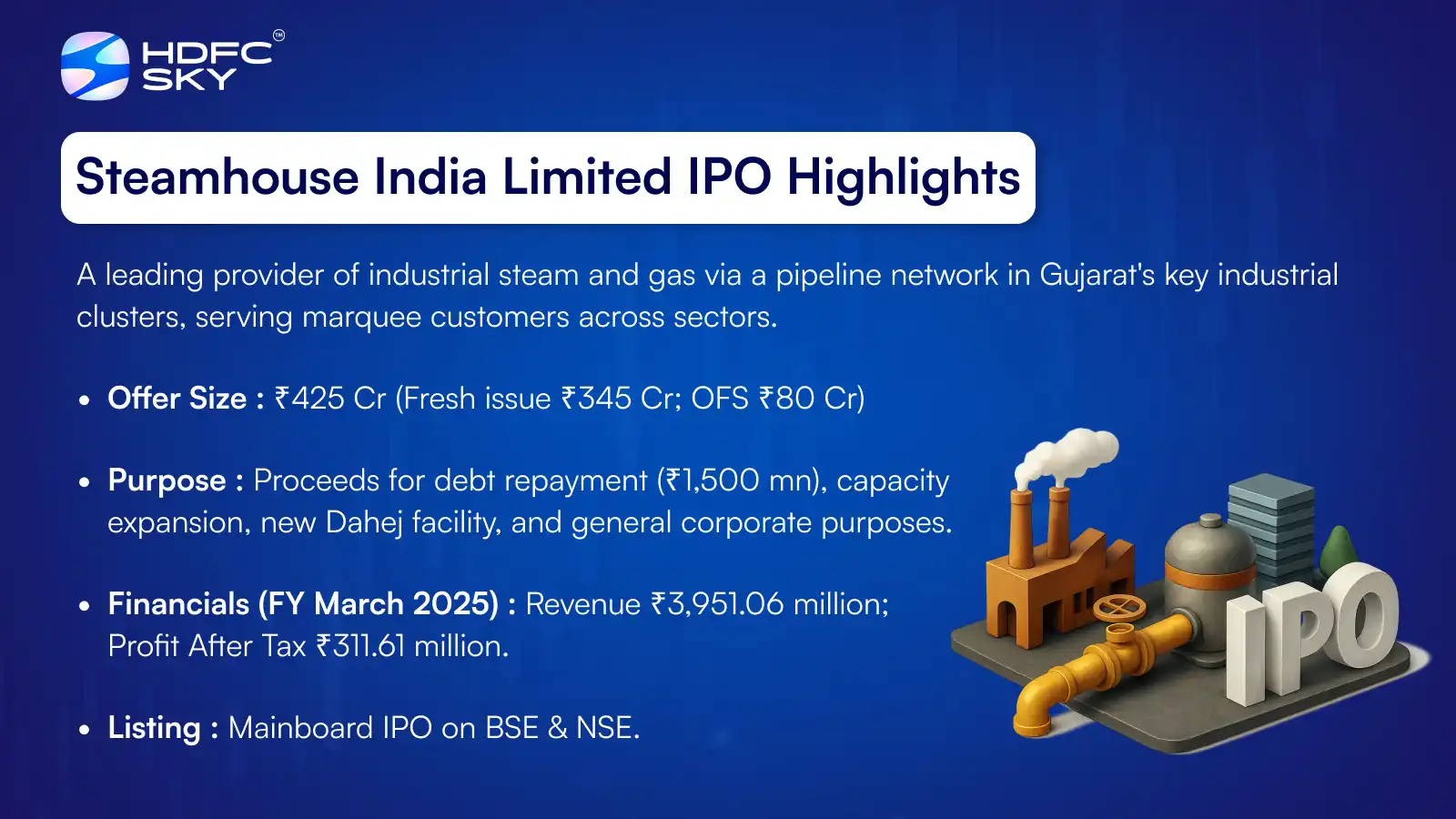
Steamhouse India Limited is a leading industrial steam and gas supplier based in Surat, Gujarat. Incorporated in 2015, the company operates an extensive pipeline network of over 56 km across key industrial hubs like Sachin, Vapi, Ankleshwar, and Panoli. With a combined steam capacity of 345 tonnes per hour from its seven boilers, it serves a diverse marquee clientele across pharmaceuticals, chemicals, textiles, and agrochemicals. The company commenced nitrogen gas supply in 2025, marking its expansion into comprehensive industrial gas solutions, and focuses on energy-efficient, eco-conscious steam generation.
Steamhouse India Limited IPO Overview
The Steamhouse India Limited IPO is a book-built public offering of ₹425 crores, comprising a fresh issue of up to ₹345 crores and an Offer for Sale (OFS) of up to ₹80 crores by selling shareholders. The proceeds from the fresh issue are earmarked for debt repayment, funding capital expenditure for capacity expansion at Ankleshwar and Panoli facilities, setting up a new facility in Dahej SEZ, and general corporate purposes. With a strategic presence in Gujarat’s industrial corridors and a proven community boiler model, the IPO aims to strengthen the company’s balance sheet and finance its growth trajectory in the rapidly expanding industrial gas and steam market in India.
Steamhouse India Limited Upcoming IPO Details
| Category | Details |
| Issue Type | Book Built Issue IPO |
| Total Issue Size | Up to ₹425.00 Crores |
| Fresh Issue | Up to ₹345.00 Crores |
| Offer for Sale (OFS) | Up to ₹80.00 Crores |
| IPO Dates | TBA |
| Price Bands | TBA |
| Lot Size | TBA |
| Face Value | ₹2 per share |
| Listing Exchange | BSE, NSE |
| Shareholding pre-issue | 22,59,76,750 shares |
| Shareholding post-issue | TBA |
Steamhouse India IPO Lots
| Application | Lots | Shares | Amount |
| Retail (Min) | TBA | TBA | TBA |
| Retail (Max) | TBA | TBA | TBA |
| S-HNI (Min) | TBA | TBA | TBA |
| S-HNI (Max) | TBA | TBA | TBA |
| B-HNI (Min) | TBA | TBA | TBA |
Steamhouse India Limited IPO Reservation
| Investor Category | Shares Offered |
| QIB Shares Offered | Not more than 50% of the Offer |
| Retail Shares Offered | Not less than 35% of the Offer |
| NII (HNI) Shares Offered | Not less than 15% of the Offer |
Steamhouse India Limited IPO Valuation Overview
| KPI | Value |
| Earnings Per Share (EPS) | ₹1.38 |
| Price/Earnings (P/E) Ratio | TBD |
| Return on Net Worth (RoNW) | 23.79% |
| Net Asset Value (NAV) | ₹5.80 per share |
| Return on Equity (RoE) | 23.53% |
| Return on Capital Employed (RoCE) | 17.20% |
| EBITDA Margin | 17.54% |
| PAT Margin | 7.82% |
| Debt to Equity Ratio | 1.63 |
*LTM: Last Twelve Months up to September 30, 2025
Objectives of the IPO Proceeds
The Net Proceeds from the Fresh Issue are intended to be utilised as per the details provided in the table below:
| Particulars | Amount (in ₹ million) |
| Repayment or prepayment of certain outstanding borrowings | 1,500.00 |
| Funding capital expenditure for capacity expansion (Ankleshwar & Panoli) | 708.98 |
| Funding capital expenditure for new facility in Dahej SEZ | 373.80 |
| General corporate purposes* | [●] |
*Note: *To be determined upon finalisation of the Offer Price and updated in the Prospectus prior to filing with the RoC. The amount utilised for general corporate purposes shall not exceed 25% of the Gross Proceeds.
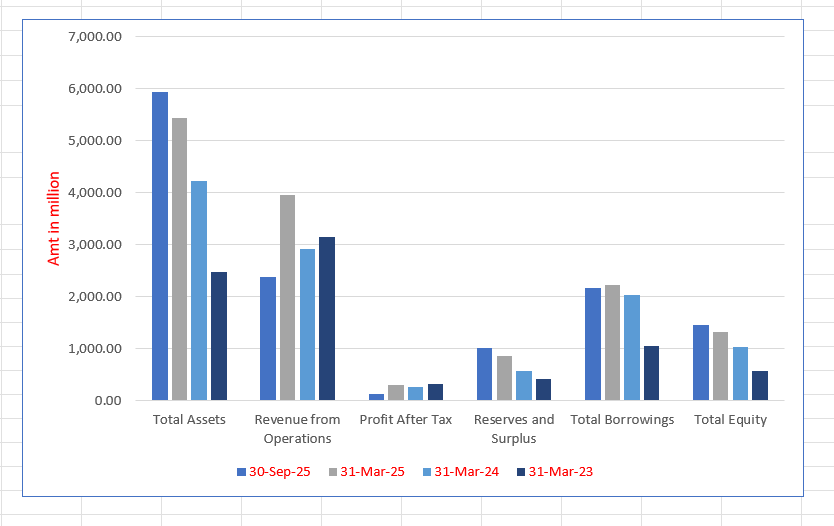
Steamhouse India Limited Financials (in ₹ million)
| Particulars | 30 Sep 2025 | 31 Mar 2025 | 31 Mar 2024 | 31 Mar 2023 |
| Total Assets | 5,943.77 | 5,436.68 | 4,223.06 | 2,470.84 |
| Revenue from Operations | 2,384.17 | 3,951.06 | 2,917.10 | 3,155.39 |
| Profit After Tax | 130.85 | 311.61 | 271.86 | 333.99 |
| Reserves and Surplus | 1,015.67 | 872.49 | 583.49 | 418.42 |
| Total Borrowings | 2,165.97 | 2,229.47 | 2,027.06 | 1,059.41 |
| Total Equity | 1,467.62 | 1,324.45 | 1,035.45 | 568.42 |
SWOT Analysis of Steamhouse India IPO
Strength and Opportunities
- Leading market position in industrial steam supply within Gujarat's key clusters.
- Strategically located facilities near ports and customer clusters reducing logistics costs.
- Extensive and owned pipeline network creating high entry barriers.
- Marquee and diversified customer base with long-term contracts ensuring revenue visibility.
- Successful foray into nitrogen gas supply via pipeline, a unique model in India.
- Strong operational expertise and experienced promoter with deep industry knowledge.
- Clear strategy for capacity expansion and geographical diversification outside Gujarat.
- Focus on eco-friendly solutions like waste-to-energy and non-fossil fuels aligning with sustainability trends.
- Favorable industry outlook driven by 'Make in India' and the shift from captive to outsourced utilities.
- Opportunity to leverage the asset-light 'purchase and distribution' model for faster growth.
Risks and Threats
- High dependency on coal as the primary fuel source for steam generation.
- Significant debt burden leading to high finance costs and leveraged balance sheet.
- Customer concentration risk with revenue dependency on specific industrial sectors.
- Operational and regulatory risks associated with environmental compliance and emissions.
- Intense competition from large industrial gas players and captive boiler users.
- Vulnerability to fluctuations in imported coal prices and foreign exchange rates.
- Execution risks related to timely completion of planned expansion projects.
- Dependence on the economic health and capex cycles of user industries like chemicals and textiles.
- Potential supply chain disruptions affecting fuel availability or pipeline integrity.
- Regulatory changes in environmental norms could increase operational costs.

Explore IPO Opportunities
Explore our comprehensive IPO pages to stay updated on the latest trends and insights.


About Steamhouse India Limited
Steamhouse India Limited IPO Strengths
Leading Market Position with High Entry Barriers
Steamhouse India Limited has established a leading position in providing energy-efficient industrial steam solutions within key industrial clusters of Gujarat. Its extensive, owned pipeline network spanning over 56 kilometers represents a significant physical and contractual barrier to entry for competitors. This infrastructure, coupled with long-term agreements with customers for right-of-way, creates a sustainable competitive moat and ensures stable revenue streams from its operational hubs.
Strategic Location of Facilities
The company’s facilities are strategically located near major Indian ports (within 45-50 km) and within dense industrial customer clusters like Ankleshwar, Panoli, and Vapi. This proximity significantly reduces the landed cost of imported coal, a key raw material, by minimizing transportation expenses. Furthermore, being close to customers reduces pipeline length for distribution, enhancing operational efficiency and cost-effectiveness, which is a critical advantage in the utility business.
Marquee and Diversified Customer Base
Steamhouse boasts a marquee customer base including reputed names like Aether Industries and Anupam Rasayan, spread across more than eight sectors such as pharmaceuticals, chemicals, and textiles. This diversification mitigates sector-specific risks. The company enjoys long-term relationships with high customer retention rates (96.64% in H1 FY26), driven by the value proposition of reliable, cost-effective, and eco-friendly steam supply compared to maintaining captive boilers.
Track Record of Eco-Friendly Solutions
The company has a demonstrated commitment to sustainability by promoting the shift from individual captive boilers to centralized community boilers, which lowers overall emissions. It employs techniques like sprinkling hydrated lime on coal to reduce SOx emissions and has initiated a waste-to-energy unit using plastic and textile waste as fuel. This focus on reducing the carbon footprint aligns with global environmental trends and regulatory push, enhancing its appeal to environmentally conscious customers.
Experienced Promoter and Management Team
Steamhouse is led by its promoter, Vishal Sanwarprasad Budhia, who has extensive experience in the community boiler industry and related infrastructure like Common Effluent Treatment Plants (CETPs). He is supported by a seasoned management team with expertise in operations, projects, and finance. This collective industry knowledge enables the company to effectively manage operations, anticipate market trends, and execute its growth strategies.
More About Steamhouse India Limited
Steamhouse India Limited, incorporated in 2015, has rapidly evolved into a significant player in India’s industrial utilities space. The company’s core business involves generating steam at centralized community boiler facilities and distributing it through a proprietary pipeline network to multiple industrial customers within a cluster.
Business Model and Operations
- Asset-Owned Model: The company owns, operates, and maintains seven boiler facilities with a combined steam capacity of 345 Tonnes Per Hour (TPH), translating to an annual installed capacity of approximately 2.2 million tonnes.
- Pipeline Network: As of November 2025, it owns and operates an extensive pipeline system of 56,236 meters, connecting its plants directly to customers’ premises, ensuring uninterrupted supply.
- Fuel Sourcing: Primarily uses imported coal, leveraging its proximity to ports for cost efficiency. It is progressively integrating non-fossil fuels like industrial waste and agro-waste into its energy mix.
Expansion and Diversification
Steamhouse commenced its nitrogen generation and distribution business in February 2025 from its Ankleshwar facility, marking a strategic diversification. Unlike the typical cylinder-based supply, it uses a pipeline network for nitrogen distribution, a unique model in India. The company is also actively exploring ‘purchase and distribution’ arrangements, an asset-light model to scale operations.
Financial and Operational Metrics
The company has demonstrated consistent growth in revenue, which increased from ₹2,917.10 million in FY24 to ₹3,951.06 million in FY25. It serves over 170 customers, with a strong presence in high-growth sectors. Operational efficiency is reflected in key metrics like an EBITDA margin of 17.54% and a Return on Equity of 23.53% for the period ending September 2025.
Future Outlook
With a clear strategy for capacity expansion, geographical diversification beyond Gujarat, and a focus on sustainable fuel sources, Steamhouse is poised to capitalize on the structural shift from captive to outsourced industrial utilities in India. The IPO will provide the necessary capital to reduce debt and fund this growth agenda.
Industry Outlook
Indian Industrial Gases and Steam Market: A Robust Growth Trajectory
The Indian industrial gases and steam market is on a strong growth path, driven by the expansion of the manufacturing sector under initiatives like ‘Make in India’ and ‘Atmanirbhar Bharat’. The market is expected to witness a healthy CAGR, propelled by demand from key end-user industries such as pharmaceuticals, chemicals, metals, textiles, and food processing.
Key Growth Drivers:
- Manufacturing Sector Expansion: Government policies are boosting domestic manufacturing, increasing the need for essential utilities like steam and industrial gases (oxygen, nitrogen, hydrogen).
- Shift from Captive to Outsourced Generation: Industries are increasingly outsourcing their steam and gas requirements to specialized players like Steamhouse to avoid high capital expenditure (CAPEX), achieve better fuel efficiency, ensure regulatory compliance, and focus on their core competencies.
- Environmental Regulations: Stricter environmental norms are making it costly and complex for small and medium enterprises to operate individual, often inefficient, captive boilers. Centralized community boilers offer better emission control and compliance.
- Growth in End-User Industries: Sectors like specialty chemicals, pharmaceuticals, and agrochemicals—which are core customers for Steamhouse—are themselves experiencing significant growth, directly fueling demand for reliable steam and gas supply.
Focus on Steam and On-site Gas Supply
Within this broad market, the demand for outsourced steam is particularly high in chemical clusters and industrial zones. The value proposition of lower cost, reliability, and environmental benefits is compelling. Furthermore, the market for on-site and pipeline-supplied gases (like nitrogen) is growing as it offers purity, consistency, and safety advantages over cylinder-based supply.
The Indian market presents a significant opportunity for players with an asset-heavy, pipeline-connected model, as it ensures customer stickiness and creates high entry barriers, exactly the model pioneered by Steamhouse India Limited in its operational regions.
How Will Steamhouse India Limited Benefit
- Benefit from the strong tailwinds of the ‘Make in India’ initiative, which is driving capital expenditure and expansion in the manufacturing sector, directly increasing demand for its steam and gas services.
- Capitalize on the accelerating trend of industries outsourcing their utility needs to reduce upfront capital investment and operational complexity, leveraging its established community boiler model as a preferred solution.
- Expand its addressable market by entering new industrial clusters and regions outside Gujarat, using the IPO proceeds to fund new facilities and reduce geographical concentration risk.
- Strengthen its competitive position against both captive boiler users and other gas players by offering a unique, pipeline-based nitrogen supply model, enhancing customer stickiness and operational margins.
- Improve financial metrics and reduce interest costs by utilizing a significant portion of the IPO proceeds (₹1,500 million) to repay high-cost debt, leading to a healthier balance sheet.
- Leverage the growing regulatory push for cleaner industrial processes by promoting its eco-friendly solutions, including waste-to-energy projects, making it a partner of choice for sustainability-focused customers.
- Enhance its capacity and service offering through planned CAPEX in existing and new facilities (Ankleshwar Phase 3, Panoli Phase 2, Dahej SEZ), allowing it to serve more customers and increase revenue per cluster.
- Tap into the growth of its key customer segments, such as pharmaceuticals and specialty chemicals, which are on a high-growth trajectory in India, ensuring consistent and growing demand for its utilities.
Peer Group Comparison
| Name of Company | Face Value (₹) | Revenue, (₹ million) | Basic EPS (₹) | NAV (₹) | P/E | ROE |
| Steamhouse India Limited | 2 | 3,951.06 | 1.38 | 5.80 | NA* | 23.53 |
| Peer Group | ||||||
| Linde India Limited | 10 | 24,853.76 | 53.33 | 447.91 | 111.88 | 11.91 |
| Ellenbarrie Industrial Gases Limited | 2 | 3,124.83 | 6.36 | 37.68 | 61.67 | 16.88 |
Key Strategies for Steamhouse India Limited
Capacity and Geographical Expansion
Steamhouse India Limited plans to expand its capacity by setting up new facilities both within and outside Gujarat. This includes planned projects in Jhagadia, Dahej SEZ, Tarapur, and Pirana (Ahmedabad). The strategy aims to increase steam distribution capacity from 345 TPH to 675 TPH, servicing a broader customer base, reducing regional dependency, and improving market penetration and business resilience.
Diversification of Business Offerings
The company intends to diversify beyond steam by expanding its nitrogen supply business and exploring new industrial gases like hydrogen and carbon dioxide. It also pursues hybrid models, such as purchasing steam from third parties for distribution. This diversification strategy allows Steamhouse to respond flexibly to market demands, offer comprehensive solutions, and tap into adjacent growth markets within the industrial utilities sector.
Enhancing Operational Efficiency
Steamhouse focuses on improving operational efficiency and reducing expenses through initiatives like installing turbines for co-generation, using drones for pipeline mapping, and implementing variable frequency drives. Cost-control measures include bulk coal purchasing and reusing bed material. These efforts are aimed at maintaining a low-cost base, optimizing resource use, and enhancing overall competitiveness in a cost-sensitive market.
Debt Profile Improvement
A key strategy involves improving the company’s debt profile by utilizing a significant portion (₹1,500 million) of the IPO proceeds to repay or prepay outstanding borrowings. This action is expected to reduce debt-servicing costs, achieve a more favorable debt-to-equity ratio, and free up internal accruals. A stronger balance sheet will provide greater financial flexibility to fund future growth investments and withstand economic cycles.
Reducing Carbon Footprint
Steamhouse is committed to reducing its carbon footprint by increasing the use of non-fossil fuel sources like industrial waste, agro-waste, and refuse-derived fuel. Projects in Nandesari (Phase 2), Vapi (Phase 3), and Pirana are designed for such fuels. This strategy aligns with environmental regulations, meets the sustainability goals of customers, and may open avenues for benefits under India’s evolving carbon credit trading scheme.
How to apply IPO with HDFC SKY?
Follow these simple steps to apply for an IPO through HDFC SKY. Secure your investments and explore new opportunities with ease by accessing the IPOs available on the platform.
- 1Login to your HDFC SKY Account
- 2Select Issue
- 3Enter Number of Lots and your Price.
- 4Enter UPI ID
- 5Complete Transaction on Your UPI App
FAQs On Steamhouse India Limited IPO
How can I apply for Steamhouse India Limited IPO?
What is the issue size of the Steamhouse India IPO?
What will the company use the IPO proceeds for?
Where will Steamhouse India Limited shares be listed?
Who are the book-running lead managers for this IPO?


Invest Anytime, Anywhere


By signing up I certify terms, conditions & privacy policy