Nifty 50
- ITC₹263.757.85 (3.07%)
- HCL Technologies₹1,205.20-37.90 (-3.05%)
- Tata Motors PV₹287.207.80 (2.79%)
- Asian Paints₹2,353-54.00 (-2.24%)
- Bajaj Finance₹974.5526.25 (2.77%)
- HDFC Bank₹705.80-15.40 (-2.14%)
- BSE₹3,11468.00 (2.23%)
- Max Healthcare₹922.25-18.70 (-1.99%)
- Shriram Finance₹963.6018.60 (1.97%)
- Infosys₹1,016.30-18.70 (-1.81%)
- NTPC₹320.105.00 (1.59%)
- HDFC Life Insurance ₹526.95-7.25 (-1.36%)
- Titan Company₹4,584.1068.40 (1.51%)
- Apollo Hospitals₹8,048.50-85.00 (-1.05%)
- Bharti Airtel₹1,764.4023.30 (1.34%)
- Bharat Electronics₹379.20-3.90 (-1.02%)
- UltraTech Cement₹10,851141.00 (1.32%)
- Cipla₹1,332.20-11.80 (-0.88%)
- TCS₹2,099.6024.60 (1.19%)
- Kotak Mahindra Bank₹415.40-2.95 (-0.71%)

- Offerings
- Tools & Platforms
Tools & Calculators
- Open API
- Calculators
- SIP Calculator
- CAGR Calculator
- Compound Interest Calculator
- FD Calculator
- RD Calculator
- EPF Calculator
- Retirement Calculator
- HDFC SIP Calculator
- Mutual Fund Return Calculator
- Lumpsum Calculator
- Step Up SIP Calculator
- ETF SIP Calculator
- Brokerage Calculator
- Equity Margin Calculator
- SWP Calculator
- EMI Calculator
- MTF Calculator
- Margin Pledge Calculator
- Algo Strategy
- Markets
Stocks
F&O
Mutual Funds
- More
Oil Prices Today, October 5, 2026: Brent Falls 0.8% To $101 Per Barrel As Middle East Supply Rises, G7 Stock Release Eases Concerns
Authored By HDFC SKY | Last Modified: Oct 5, 2026 10:42 AM IST

Open Free Demat Account
Open Free Demat Account
Mumbai, October 5: Oil prices fell on Monday as rising crude exports from the Middle East and a planned release of oil stocks by Group of Seven nations helped ease concerns over supply disruptions, even as fresh attacks on Saudi energy infrastructure added to geopolitical risks. Brent crude futures fell 0.8% to $101.5 a barrel, while US West Texas Intermediate crude declined 1.2% to $90 a barrel.
The decline came after crude prices had initially climbed following claims by Yemen’s Iran-backed Houthi group that it had launched ballistic missiles and drones at Saudi Aramco facilities in Riyadh and the Khurais area. The attacks raised fresh concerns over production in Saudi Arabia, the world’s biggest oil exporter, and added another layer of risk to an already disrupted Middle Eastern energy market.

Houthi Attacks Raise Supply Risks
The Houthis said the strikes were carried out in response to around 50 Saudi-led air and missile attacks in Yemen over a 12-hour period. Saudi Arabia has not confirmed the Houthi claims regarding the Aramco facilities.
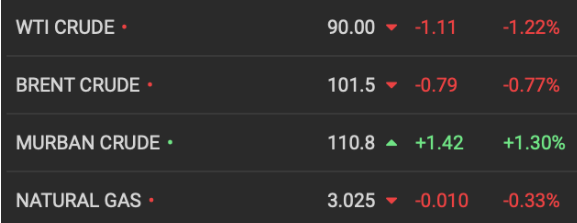
Both contracts fell as supply concerns eased amid conflict. Source: oilprice.com
The attacks came as Yemen’s Saudi-backed, internationally recognised government announced a major military campaign to recapture territory controlled by the Iran-backed Houthis. The escalation threatens to widen the conflict around key energy and shipping routes at a time when the broader Middle East remains highly volatile.
The Houthis have also gained control of the strategic Bab el-Mandeb Strait, a major shipping route connecting the Red Sea with the Gulf of Aden. Any further disruption to shipping through the region could add to transportation costs and increase the risk premium embedded in crude prices.
Middle East Oil Exports Rise
Despite the latest attacks, physical oil flows have shown signs of improvement. Middle Eastern crude exports rose above pre-war levels on four of the seven days in the final week of September, according to shipping data, even as vessels came under attack while passing through the Strait of Hormuz.
The increase in exports has helped counter some of the market’s immediate supply concerns. Saudi Arabia has also resumed crude loadings at Yanbu on the Red Sea after its East-West Pipeline restarted following a drone attack.
Saudi Aramco has additionally been using ship-to-ship transfers outside the Strait of Hormuz to maintain crude flows. The improvement in shipments suggests that producers are finding alternative ways to keep barrels moving despite the disruption to traditional export routes.
G7 To Release 100 Million Barrels
Adding to the supply outlook, G7 countries agreed to release 100 million barrels of crude and diesel from emergency reserves. The countries also pledged to refrain from imposing energy export restrictions, a move aimed at preventing further tightening of global supplies.
The planned release has taken some immediate supply pressure out of the market. With additional barrels expected from strategic reserves at a time when Middle Eastern exports are recovering, traders have been less inclined to push crude prices higher solely on geopolitical concerns.
However, the supply situation remains fragile. The conflict has disrupted production and export infrastructure across the region, while shipping costs have surged because of longer and less efficient routes.
Aramco Cuts Asian Oil Prices
Saudi Aramco has also unexpectedly cut its November crude prices for Asian buyers to six-year lows, signalling an effort to protect market share despite elevated transportation costs.
The company lowered the official selling price of Arab Light crude for Asia by $3 a barrel to a discount of $5 to the Oman-Dubai benchmark average. The reduction was wider than expected and marked the steepest discount since June 2020.
Aramco also cut the prices of its heavier grades, Arab Medium and Arab Heavy, by $5 a barrel for Asian buyers. The move is aimed partly at offsetting sharply higher freight costs. The cost of hiring a very large crude carrier capable of carrying about 2 million barrels from the Gulf to China had risen to around $1.2 million a day, compared with roughly $80,000 a year earlier.
OPEC+ Keeps November Output Targets Unchanged
Meanwhile, OPEC+ agreed to keep its November oil production targets unchanged, in line with expectations that the group is unlikely to make major changes to output policy before next year.
The conflict has also delayed a review of members’ production capacity that is important for determining 2027 quotas. Disruptions to projects across the Middle East have made it harder to assess how much additional crude producers will be able to bring to the market.
Although exports through the Strait of Hormuz have started to improve, OPEC+ producers are still pumping well below their pre-war levels. As a result, the oil market remains tight despite the recent improvement in supply flows.
Oil Prices Outlook
Brent crude remains above the $100-a-barrel mark, highlighting the substantial geopolitical premium still embedded in prices. For now, rising Middle Eastern exports and the G7’s planned stock release are helping to contain gains, but further attacks on oil infrastructure or commercial shipping could quickly revive supply fears.
The direction of crude prices is therefore likely to remain closely tied to developments around the Strait of Hormuz, Saudi energy facilities and the wider conflict involving Iran, Saudi Arabia and the Houthis.
Source
- oilprice.com
Disclaimer
At HDFC SKY*, we take utmost care and due diligence in curating and presenting news and market-related content. However, inadvertent errors or omissions may occasionally occur.
If you have any concerns, questions, or wish to point out any discrepancies in our content, please feel free to write to us at content@hdfcsec.com.
Please Note: The information shared is intended solely for informational purposes and does not make any investment recommendations.
HDFC SKY from HDFC Securities, one of most trusted trading platforms in India, has been recognized with the *Next-Gen Digi Content Awards 2025-26.
 Join Us
 Add as preferred source on Google


More Business News









Open Free Demat Account
Open Free Demat Account











Invest Anytime, Anywhere


By signing up I certify terms, conditions & privacy policy