Nifty 50
- Eternal₹335.909.05 (2.77%)
- Bharti Airtel₹1,830.20-63.10 (-3.33%)
- HCL Technologies₹1,28131.70 (2.54%)
- Adani Ports₹1,787.10-36.90 (-2.02%)
- ITC₹2674.70 (1.79%)
- Bajaj Finance₹1,021.30-19.00 (-1.83%)
- Sun Pharmaceutical₹1,868.9031.60 (1.72%)
- Power Grid Corp₹266.10-4.20 (-1.55%)
- Reliance Industries₹1,247.4021.00 (1.71%)
- Adani Enterprises₹2,975-45.00 (-1.49%)
- Max Healthcare₹1,066.6017.30 (1.65%)
- Wipro₹164.55-2.28 (-1.37%)
- Titan Company₹4,87576.50 (1.59%)
- Grasim Industries₹3,166-43.20 (-1.35%)
- HDFC Life Insurance ₹559.408.45 (1.53%)
- Infosys₹1,038.50-12.90 (-1.23%)
- SBI Life Insurance ₹1,75625.00 (1.44%)
- Tata Steel₹183.40-2.14 (-1.15%)
- Tech Mahindra₹1,558.5021.40 (1.39%)
- Tata Motors PV₹301.65-2.15 (-0.71%)

- Offerings
- Tools & Platforms
Tools & Calculators
- Open API
- Calculators
- SIP Calculator
- CAGR Calculator
- Compound Interest Calculator
- FD Calculator
- RD Calculator
- EPF Calculator
- Retirement Calculator
- HDFC SIP Calculator
- Mutual Fund Return Calculator
- Lumpsum Calculator
- Step Up SIP Calculator
- ETF SIP Calculator
- Brokerage Calculator
- Equity Margin Calculator
- SWP Calculator
- EMI Calculator
- MTF Calculator
- Margin Pledge Calculator
- Algo Strategy
- Markets
Stocks
F&O
Mutual Funds
- More
Import Restriction on PVC Resin Set to Reshape Cost Structures Across Domestic Value Chain
Authored By HDFC SKY | Last Modified: Jul 29, 2026 04:33 PM IST
Open Free Demat Account
Open Free Demat Account
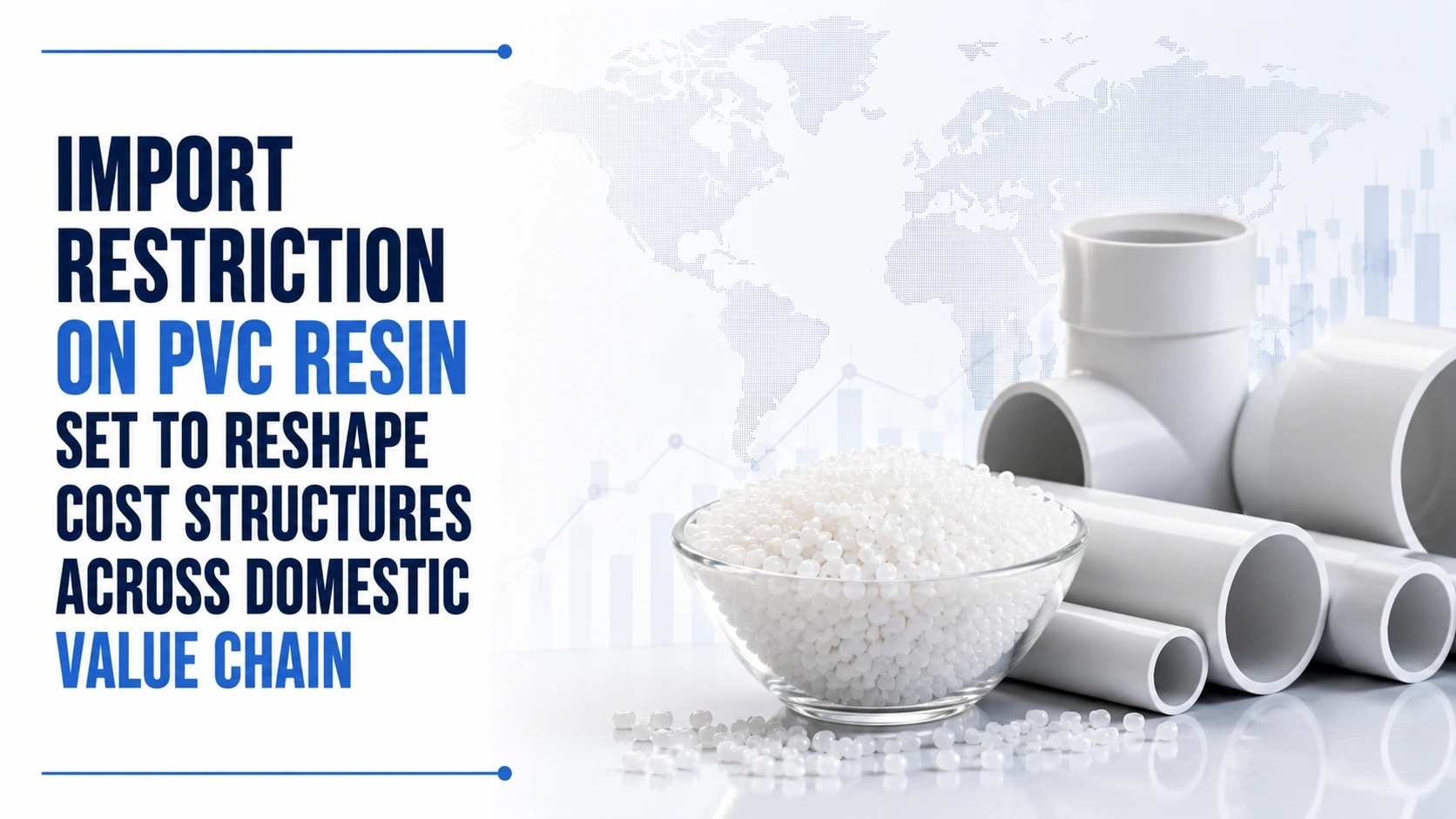
New Delhi, Jul 29: The Directorate General of Foreign Trade (DGFT)’s decision to impose a minimum import price of USD 0.766 per kg on Suspension Grade PVC (S-PVC) resin for six months is expected to have a cascading impact across India’s plastics manufacturing ecosystem, with domestic resin producers likely to benefit from firmer pricing power even as downstream converters face the prospect of higher input costs, according to think tank Global Trade Research Initiative (GTRI).
Since India imports roughly 64 per cent of its S-PVC resin requirement and virtually every major supplier — China, Japan, Taiwan, South Korea and others — ships below the new threshold, the restriction effectively pulls almost the entire existing import trade into the licensed category. Analysts expect this to push up domestic PVC prices even though the overall import volume is unlikely to fall meaningfully, given the scale of India’s dependence on overseas supply.

Likely Positive Impact on Domestic PVC Resin Producers
- Chemplast Sanmar: As one of India’s larger integrated PVC resin manufacturers, the company stands to gain from reduced competition from cheap imports and potential pricing headroom in the domestic market.
- Finolex Industries: A leading domestic PVC resin and pipe manufacturer; the resin business could see margin support from firmer domestic prices, even as its pipe-making arm faces some offsetting cost pressure.
- DCW Ltd: A smaller domestic PVC producer that could see improved realisations if import-linked pricing pressure eases.
- Grasim Industries: Through its chlor-alkali and chemicals business, the company has exposure to the PVC value chain and could benefit from a more supportive pricing environment for domestic resin.
Likely Negative or Mixed Impact on Downstream Converters and Pipe Manufacturers
- Astral Ltd: A major consumer of PVC resin for pipes and fittings; higher input costs could pressure margins unless the company passes on costs or has adequate domestic sourcing tie-ups.
- Supreme Industries: With PVC pipes forming a meaningful part of its product portfolio, elevated resin costs could weigh on profitability in the near term.
- Prince Pipes and Fittings: Similarly exposed to resin cost inflation as a downstream pipe manufacturer reliant on both domestic and imported PVC.
- Kisan Mouldings: A smaller PVC pipe and fittings player that could see cost pressure flow through to margins given its scale disadvantage relative to larger peers.
Broader Industry Considerations
- The notification affects a raw material used extensively in pipes, fittings, cables, and a wide range of plastic products, meaning cost pass-through could eventually touch construction, infrastructure and agriculture-linked demand for PVC piping.
- With customs duty on S-PVC imports at 8.25 per cent (7.5 per cent Basic Customs Duty plus 0.75 per cent Social Welfare Surcharge), the new minimum import price effectively translates into a landed cost floor of about USD 0.87 per kg after IGST, according to GTRI.
- Since annual PVC resin consumption stands at around 4.7 million metric tonnes, with S-PVC accounting for roughly 4.5 MMT of that demand, any sustained increase in domestic prices could have an outsized effect on overall input costs across the plastics manufacturing sector.
- Market participants will be watching whether domestic producers use the pricing headroom to expand capacity, or whether converters absorb higher costs and pass them on to end consumers of pipes, fittings and other PVC-based products.
The measure is set to remain in force for six months, after which the DGFT is expected to review its impact on both domestic pricing and the broader import dependency that continues to define India’s PVC resin market.
Source
- PTI
Disclaimer
If you have any concerns, questions, or wish to point out any discrepancies in our content, please feel free to write to us at content@hdfcsec.com.
Please Note: The information shared is intended solely for informational purposes and does not make any investment recommendations
Disclaimer
At HDFC SKY*, we take utmost care and due diligence in curating and presenting news and market-related content. However, inadvertent errors or omissions may occasionally occur.
If you have any concerns, questions, or wish to point out any discrepancies in our content, please feel free to write to us at content@hdfcsec.com.
Please Note: The information shared is intended solely for informational purposes and does not make any investment recommendations.
HDFC SKY from HDFC Securities, one of most trusted trading platforms in India, has been recognized with the *Next-Gen Digi Content Awards 2025-26.
 Join Us
 Add as preferred source on Google


Open Free Demat Account
Open Free Demat Account
-











Invest Anytime, Anywhere


By signing up I certify terms, conditions & privacy policy