Nifty 50
- Axis Bank₹1,222.4035.90 (3.03%)
- Max Healthcare₹1,015.50-30.50 (-2.92%)
- Asian Paints₹2,44451.30 (2.14%)
- Tata Motors PV₹290.20-4.80 (-1.63%)
- Mahindra & Mahindra₹3,03552.30 (1.75%)
- Infosys₹1,000.20-14.30 (-1.41%)
- Bajaj Finance₹996.9014.90 (1.52%)
- ONGC₹235.86-3.14 (-1.31%)
- HCL Technologies₹1,25814.40 (1.16%)
- Trent₹2,665.10-34.90 (-1.29%)
- InterGlobe Aviation₹4,94555.00 (1.12%)
- Kotak Mahindra Bank₹401.80-3.20 (-0.79%)
- Power Grid Corp₹269.052.65 (0.99%)
- Bharti Airtel₹1,785.40-10.40 (-0.58%)
- Coal India₹426.104.10 (0.97%)
- Hindalco Industries₹976.70-5.30 (-0.54%)
- HDFC Bank₹735.606.70 (0.92%)
- ICICI Bank₹1,327.70-6.80 (-0.51%)
- UltraTech Cement₹11,156100.00 (0.90%)
- SBI Life Insurance ₹1,746.70-8.30 (-0.47%)

- Offerings
- Tools & Platforms
Tools & Calculators
- Open API
- Calculators
- SIP Calculator
- CAGR Calculator
- Compound Interest Calculator
- FD Calculator
- RD Calculator
- EPF Calculator
- Retirement Calculator
- HDFC SIP Calculator
- Mutual Fund Return Calculator
- Lumpsum Calculator
- Step Up SIP Calculator
- ETF SIP Calculator
- Brokerage Calculator
- Equity Margin Calculator
- SWP Calculator
- EMI Calculator
- MTF Calculator
- Margin Pledge Calculator
- Algo Strategy
- Markets
Stocks
F&O
Mutual Funds
- More
Former Infosys CEO Vishal Sikka Launches Hang Ten Systems: Here is How It Will Impact Indian Tech Stocks
Authored By HDFC SKY | Last Modified: Jun 29, 2026 09:45 AM IST
Open Free Demat Account
Open Free Demat Account
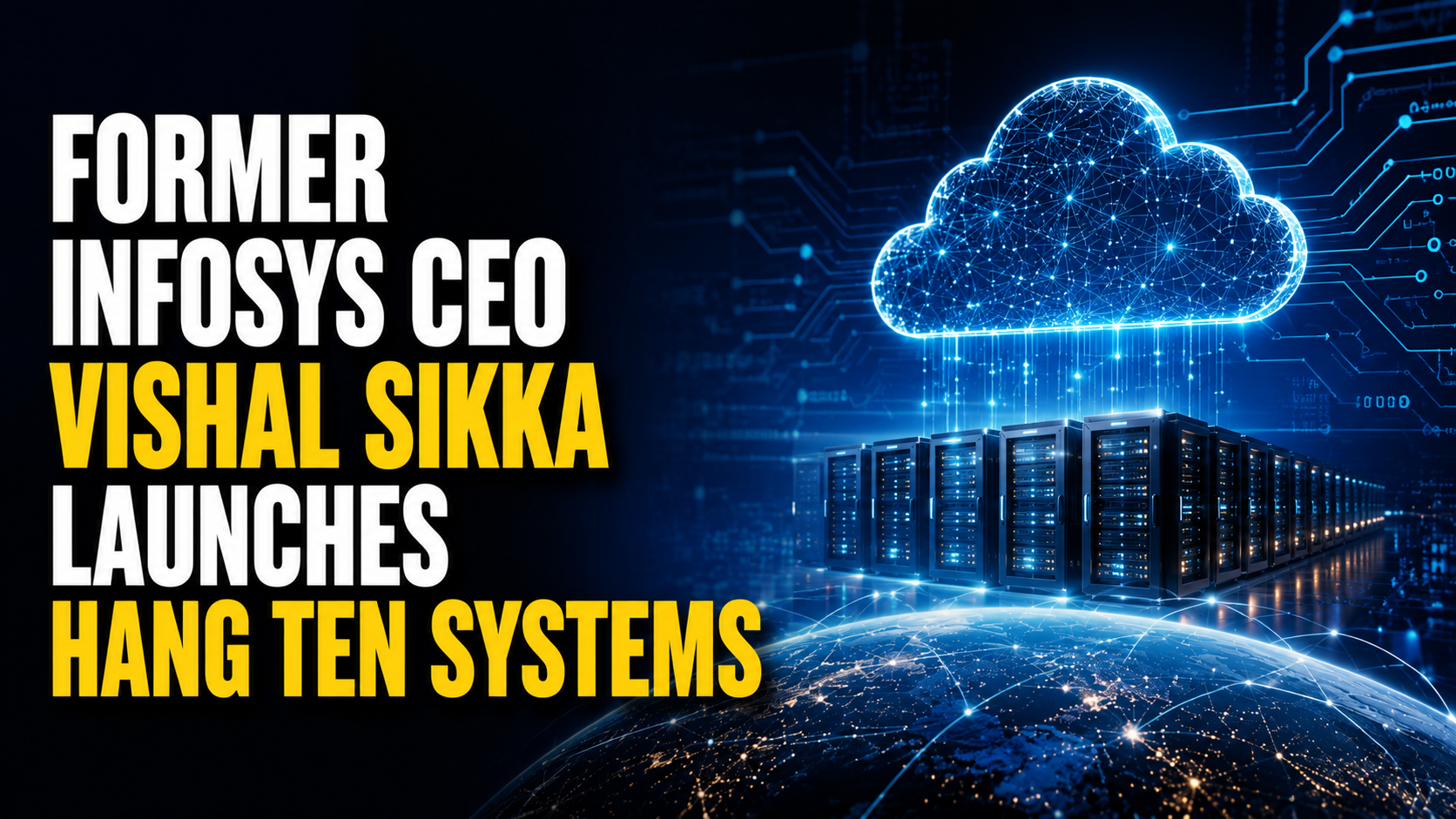
Mumbai, June 27: Former Infosys CEO Vishal Sikka has launched Hang Ten Systems, raising a $32 million seed round led by Mayfield, with a strategic investment from Aramco Ventures, positioning the Bay Area startup as an enterprise AI services company built around agentic code generation, reusable AI skills, and domain expertise — a direct structural challenge to the outsourcing model that built India’s IT industry.
Here is what it means for Indian markets:
1. Large-cap IT stocks face fresh valuation pressure
This is the most immediate and direct impact. Indian IT services stocks have been trading under pressure this year as investors try to work out how much of their revenue is exposed to AI tools that can automate coding, testing, documentation, and support work. Hang Ten’s launch sharpens that anxiety considerably – because this is not a generic AI vendor making abstract claims. Sikka ran Infosys. He understands its billing model, its client relationships, and precisely where its revenue is most vulnerable. Traditional services scale linearly with headcount, Mayfield noted, and Hang Ten’s entire pitch is that AI breaks that equation. For Infosys, TCS, Wipro, and HCL Tech — all of which still derive the majority of revenue from labour-arbitrage-driven outsourcing – this narrative, coming from someone with insider credibility, could trigger another round of institutional selling and multiple compression on the Nifty IT index, which is already down nearly 30% over the past year.
2. Mid-cap IT and niche IT stocks face existential re-rating
While the Indian tech industry has achieved great success with its Software-as-a-Service model over the years, there are fears that this model could be entirely replaced by AI. Hang Ten Systems appears to be an AI-native alternative, focused on assisting clients through AI-driven code generation featuring agent capabilities, reusable skill libraries, and specialised engineering talent. Mid-cap IT firms are more vulnerable than the large-caps because they lack the balance sheet depth to absorb a prolonged transition and are more heavily concentrated in the application maintenance and custom development work that Hang Ten is directly targeting. Stocks like Mphasis, Coforge, and LTIMindtree, already navigating deal cycle uncertainty — could see sharper de-rating as the market prices in faster-than-expected disruption of their core business model.
3. Indian AI-native and SaaS-adjacent stocks could see a sentiment lift
Not all the impact is negative. Analysts at Jefferies argued earlier this year that IT services may be among the first sectors to face meaningful AI disruption, while Infosys chairman Nandan Nilekani said AI could expand the industry’s addressable market, with Infosys projecting AI-first services could represent a $300 billion to $400 billion market by 2030. Indian companies already pivoting toward AI-native delivery, embedded software, and digital engineering, Tata Elxsi, Newgen Software, Kellton Tech, stand to benefit as the market rewards businesses positioned on the right side of this disruption. Hang Ten’s launch validates the AI-services thesis and could attract fresh institutional attention toward Indian listed peers with credible AI portfolios.
4. IT staffing and workforce-linked stocks face structural headwinds
Hang Ten Systems is hiring across delivery, engineering, sales, and leadership and plans to expand across multiple locations globally to meet enterprise demand, with the early crew including executives who have worked with Sikka for years across SAP, Infosys, and his previous enterprise AI startup, VianAI. The startup’s model explicitly bets against headcount-driven scaling, which is the foundation of India’s IT staffing industry. If Hang Ten’s AI-native model gains enterprise traction — demonstrated already through early clients Siemens Gamesa and Fresenius — it signals structurally lower demand for traditional bench-based IT manpower, putting sustained pressure on staffing companies whose revenues are tied to billing hours and placement volumes rather than AI productivity gains.
Disclaimer
If you have any concerns, questions, or wish to point out any discrepancies in our content, please feel free to write to us at content@hdfcsec.com.
Please Note: The information shared is intended solely for informational purposes and does not make any investment recommendations
Disclaimer
At HDFC SKY*, we take utmost care and due diligence in curating and presenting news and market-related content. However, inadvertent errors or omissions may occasionally occur.
If you have any concerns, questions, or wish to point out any discrepancies in our content, please feel free to write to us at content@hdfcsec.com.
Please Note: The information shared is intended solely for informational purposes and does not make any investment recommendations.
HDFC SKY from HDFC Securities, one of most trusted trading platforms in India, has been recognized with the *Next-Gen Digi Content Awards 2025-26.
 Join Us
 Add as preferred source on Google


More INFY News







Open Free Demat Account
Open Free Demat Account
₹1,000.20







Invest Anytime, Anywhere


By signing up I certify terms, conditions & privacy policy