Nifty 50
- Coal India₹42813.30 (3.21%)
- Tata Consumer ₹984.10-16.50 (-1.65%)
- Eternal₹3426.10 (1.82%)
- Nestle₹1,363.90-21.10 (-1.52%)
- InterGlobe Aviation₹5,03089.00 (1.80%)
- Bajaj Finserv₹1,823.40-26.40 (-1.43%)
- Titan Company₹4,928.5053.50 (1.10%)
- Bajaj Finance₹1,008.80-12.50 (-1.22%)
- Dr. Reddy's Labs₹1,21112.70 (1.06%)
- Sun Pharmaceutical₹1,846.40-22.50 (-1.20%)
- Wipro₹1661.45 (0.88%)
- Grasim Industries₹3,128.20-37.80 (-1.19%)
- Tata Steel₹184.971.57 (0.86%)
- Trent₹2,782.90-32.60 (-1.16%)
- Adani Enterprises₹2,99722.00 (0.74%)
- Eicher Motors₹7,427-85.50 (-1.14%)
- Adani Ports₹1,7957.90 (0.44%)
- TCS₹2,105-23.70 (-1.11%)
- NTPC₹327.801.40 (0.43%)
- Apollo Hospitals₹8,822.50-89.50 (-1.00%)

- Offerings
- Tools & Platforms
Tools & Calculators
- Open API
- Calculators
- SIP Calculator
- CAGR Calculator
- Compound Interest Calculator
- FD Calculator
- RD Calculator
- EPF Calculator
- Retirement Calculator
- HDFC SIP Calculator
- Mutual Fund Return Calculator
- Lumpsum Calculator
- Step Up SIP Calculator
- ETF SIP Calculator
- Brokerage Calculator
- Equity Margin Calculator
- SWP Calculator
- EMI Calculator
- MTF Calculator
- Margin Pledge Calculator
- Algo Strategy
- Markets
Stocks
F&O
Mutual Funds
- More
Nifty and Sensex Post Weekly Gains Amid RBI Policy and CAS Rollout, Despite Friday's Financial-Led Selloff
Authored By HDFC SKY | Last Modified: Aug 10, 2026 10:02 AM IST
Open Free Demat Account
Open Free Demat Account
Mumbai, Aug 8: Indian equity benchmarks concluded the trading week on a subdued note on Friday, as elevated crude oil prices and a sharp selloff in heavyweight financial stocks pared gains. A
However, the benchmarks managed to secure their second consecutive weekly advance, supported by a sharp decline in crude oil prices earlier in the week and sustained foreign institutional investor (FII) inflows. The week was marked by significant events, including the Reserve Bank of India’s (RBI) Monetary Policy Committee (MPC) decision, the introduction of a new Closing Auction Session (CAS) for derivatives-linked stocks, and a heavy deluge of corporate earnings from index heavyweights.
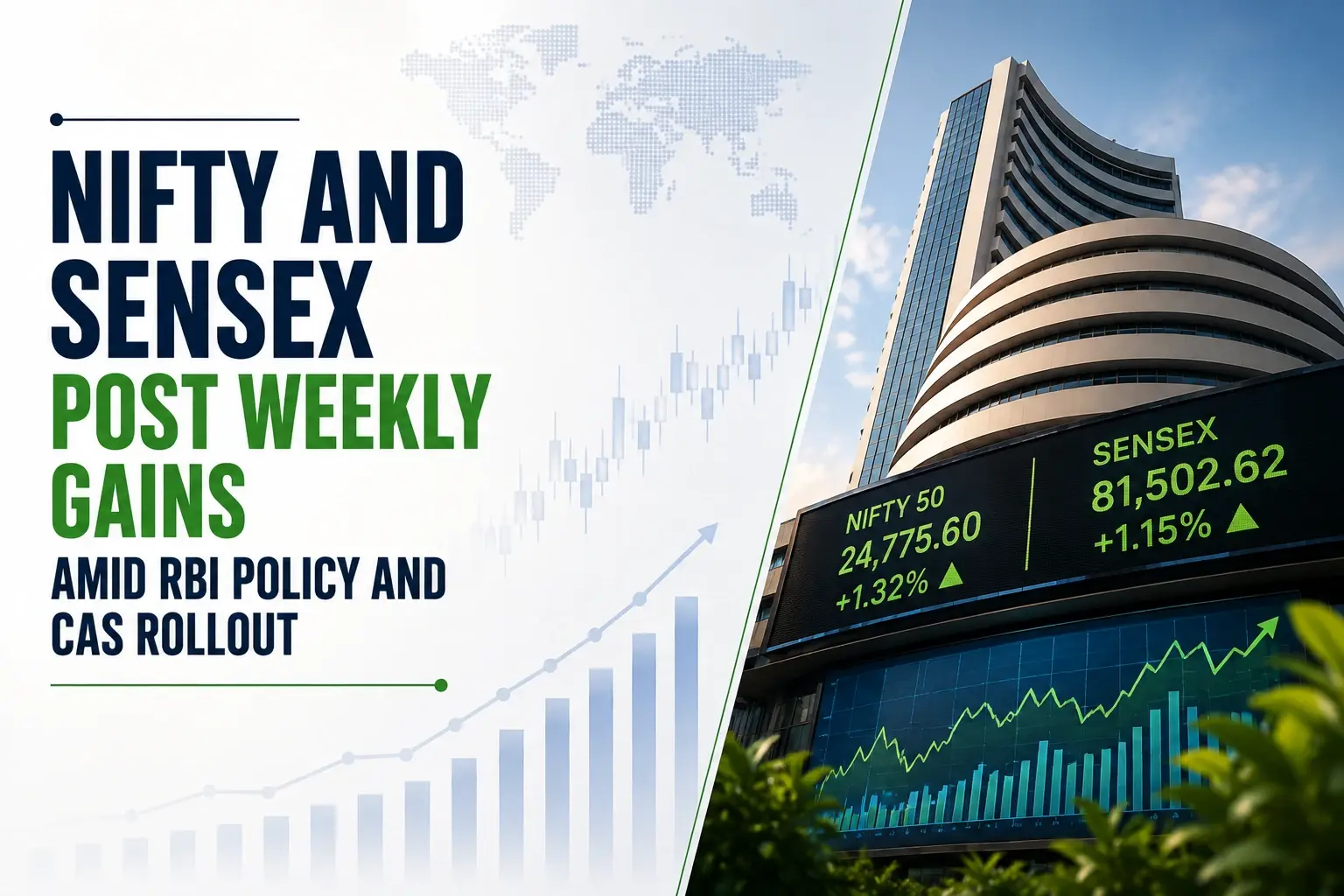
The BSE Sensex settled at 78,499.17, declining 455.59 points or 0.58% on Friday, while the NSE Nifty50 closed at 24,570.65, down 65.35 points or 0.27%. Despite this end-of-week pullback, the Sensex recorded a weekly gain of approximately 0.5% and the Nifty advanced by about 0.8%.

Sensex and Nifty Snap Gains as Financial Stocks and Oil Prices Weigh
The final trading session of the week saw benchmarks snap a two-day winning streak as the Nifty failed to hold the 24,600 level. The market’s decline was predominantly driven by financial stocks, with the Nifty Bank index plunging 317 points to settle at 57,746. Elevated crude oil prices remained a persistent headwind; Brent crude traded around $83.55 a barrel, while WTI crude gained 1.1% to $78.17. The India VIX, a gauge of market volatility, edged up 1.91% to 11.98.
The primary trigger for Friday’s fall was the RBI’s draft proposal to ban revolving credit facilities by Non-Banking Financial Companies (NBFCs), which triggered a massive selloff in NBFC stocks. This was compounded by concerns over rising crude oil prices, as uncertainty persisted over the full restoration of shipping through the Strait of Hormuz.
The benchmark indices ended the week in positive territory, but Friday’s correction highlighted the market’s vulnerability to external factors like oil price movements and domestic regulatory proposals affecting the financial sector.
Midcap and Smallcap Indices Show Resilience, Outperform Benchmarks
While frontline indices experienced volatility, the broader market demonstrated remarkable strength. The BSE 150 MidCap Index rose 0.73% , and the BSE 250 SmallCap Index added 1.32% on Monday alone. For the week, broader markets significantly outperformed their large-cap peers, with the small-cap index rising 2.7% and the mid-cap index advancing 0.9%.
This rally in broader markets was fueled by a sharp drop in Brent crude oil prices earlier in the week amid easing geopolitical tensions in the Middle East, which boosted overall market sentiment.
Continued FII inflows and broad-based buying across sectors further supported the mid and small-cap segments. The outperformance of midcap and smallcap indices signals strong investor confidence in the broader economic recovery and a “risk-on” sentiment among market participants.
The broader markets ended the week on a mixed note, with the Nifty Midcap 100 rising 0.22%, while the Nifty Smallcap 100 slipped 0.06%. Among sectoral indices, Nifty Financial Services, Consumer Durables, Chemicals, and Realty witnessed heavy selling, while auto, IT, and metal stocks ended in the green.
Weekly Top Gainers and Losers: Grasim and TCS Lead Gains; Bajaj Finance and Apollo Hospitals Among Losers
The Nifty50 pack witnessed significant divergence in weekly performance, with Grasim Industries emerging as the top gainer, closing 5.13% higher on Monday alone. Tata Consultancy Services (TCS) followed closely with a 4.57% gain, while InterGlobe Aviation rose 4.43%, Infosys climbed 4.42%, and Shriram Finance advanced 4.16%. On the losing side, Apollo Hospitals Enterprise declined 1.53%, Sun Pharmaceutical Industries fell 1.36%, Maruti Suzuki slipped 0.59%, Oil & Natural Gas Corporation (ONGC) dropped 0.22%, and Tech Mahindra edged lower by 0.14%.
Earnings announcements and sectoral rotations shaped the weekly performance. Grasim Industries gained on the back of strong cement demand and a positive outlook for its chemicals business. TCS and Infosys benefited from a weaker rupee and a strong deal pipeline in the IT sector. InterGlobe Aviation continued its rally on robust air traffic growth and improved yields. Shriram Finance saw buying interest following strong quarterly results and improved asset quality.
On the losing side, Apollo Hospitals came under pressure as investors booked profits after a strong run-up. Sun Pharma declined amid concerns over pricing pressures in the US market. Maruti Suzuki slipped despite reporting strong volume growth, as margin concerns weighed on sentiment. ONGC traded lower following a decline in global crude oil prices, which impacted revenue prospects for the state-owned explorer.
Midcap and Smallcap Weekly Performance: Jubilant Foodworks and APL Apollo Tubes Lead Gains
The broader markets witnessed significant action during the week, with midcap and smallcap indices outperforming their large-cap peers. The NIFTY Midcap 100 index surged 1.21% on Monday, supported by strong buying interest in select counters. Jubilant Foodworks led the midcap pack with a 7.24% gain, followed by APL Apollo Tubes rising 6.71%, National Aluminium Company climbing 5.41%, Godfrey Phillips India advancing 5.32%, and LG Electronics India gaining 5.27%. On the losing side, Steel Authority of India Limited (SAIL) fell 2.38%, BSE declined 1.95%, MCX dropped 1.86%, Exide Industries slipped 1.73%, and Aurobindo Pharma lost 1.61%. The NIFTY Smallcap index increased by 249.70 points or 1.29% on Monday.
The midcap rally was driven by strong earnings performances and sector-specific tailwinds. Jubilant Foodworks gained on the back of robust demand and store expansion plans. APL Apollo Tubes benefitted from strong steel demand and margin improvement. National Aluminium Company rose following a surge in aluminium prices globally. Godfrey Phillips India saw buying interest after reporting strong quarterly numbers. LG Electronics India gained on expectations of strong festive season demand.
However, the midcap space witnessed some profit-booking towards the end of the week. Blue Star fell 5.65% after reporting a 15.26% decline in consolidated net profit to ₹102.5 crore for the June quarter. BSE declined 2.82% on profit-booking after a strong run-up. Jubilant
Foodworks dropped 2.47% as investors locked in gains. Hero MotoCorp lost 2.45% despite reporting strong revenue growth, as profit declined due to a high base effect. Mahindra & Mahindra Financial Services slipped 2.45% amid concerns over asset quality. On the gaining side, Kalyan Jewellers India rose 5%, Bharat Dynamics gained 4.76%, and Cochin Shipyard advanced 4.56%, driven by strong order books and positive sectoral outlook.
RBI MPC Keeps Repo Rate Unchanged at 5.25%, Maintains Neutral Stance
The Reserve Bank of India’s Monetary Policy Committee held its 62nd meeting from August 3 to 5, 2026, under the chairmanship of Governor Sanjay Malhotra. The MPC voted unanimously to keep the policy repo rate under the liquidity adjustment facility (LAF) unchanged at 5.25%. Consequently, the standing deposit facility (SDF) rate remains at 5.00%, and the marginal standing facility (MSF) rate and the Bank Rate remain at 5.50%. The MPC also decided to continue with the neutral stance.
The rate decision was widely anticipated by the market and provided a stable policy backdrop for equity markets. The RBI raised its FY27 real GDP growth projection by 10 basis points to 6.7%, indicating confidence in the resilience of the Indian economy despite global headwinds. The central bank noted that high-frequency indicators point to a healthy start to the year, supported by manufacturing, services, consumption, investment and exports.
However, renewed tensions in West Asia, volatility in international financial markets and weather-related shocks pose downside risks to growth. The RBI also lowered its FY27 CPI inflation projection, though it noted that CPI inflation increased to 4.4% in June after remaining below target for 16 consecutive months.
Closing Auction Session Debuts Successfully for F&O Stocks
Effective August 3, 2026, the Closing Auction Session (CAS) was introduced for stocks in the Futures and Options (F&O) segment, revising market closing timings while keeping the opening time unchanged. Continuous trading in F&O stocks now ends at 3:15 pm, followed by the closing auction session, while non-F&O stocks continue to trade until 3:30 pm. Trading in index and stock futures and options concludes at 3:40 pm.
The new mechanism is aimed at enhancing price discovery for the official closing price, reducing end-of-day volatility, and facilitating transparent execution of large institutional orders. The CAS mechanism triggered sharp swings at the close and reduced retail participation in derivatives, according to market experts. The divergence between the Nifty and Sensex on Monday was partly attributed to the new closing price mechanism.
Nifty Q1 Earnings Surge as Banks, Metals, and Technology Lead the Charge
The first-quarter earnings season for FY27 concluded on a robust note, with Nifty companies delivering a stronger-than-expected performance. According to domestic brokerage Motilal Oswal Financial Services (MOFSL), the overall earnings performance was stronger than expected, supported by robust showings from banks, metals, technology, and auto companies.
The earnings beat provides a constructive backdrop for the market, reinforcing confidence in the underlying strength of corporate India. The earnings growth was driven by strong performances in the banking, metals, and technology sectors. Companies have retained volumes despite price hikes, signalling resilient demand, while strong domestic flows and improving foreign investor sentiment leave little reason for a sharp market sell-off.
SBI Beats Estimates with 10% Profit Growth; Hindalco Reports Record Profit
State Bank of India (SBI) reported a 10.23% year-on-year rise in standalone net profit to ₹21,121 crore for the June 2026 quarter, surpassing market estimates, driven by robust loan growth. Net Interest Income (NII) increased 14.88% to ₹46,992 crore, supported by an 18.63% rise in advances. However, non-interest income declined 9.07% to ₹15,923 crore, mainly due to lower treasury and forex income. SBI’s Net Interest Margin (NIM) stood at 2.86%, while the stock gained over 1% following the results.
Hindalco Industries posted a record consolidated net profit of ₹7,013 crore, a staggering 75% year-on-year surge, significantly surpassing the Bloomberg consensus estimate of ₹5,614 crore. Revenue from operations climbed 32% to ₹84,825 crore. The stock gained 2.6% on the results announcement.
Titan Company reported a consolidated net profit of ₹1,777 crore, up 63% year-on-year, beating estimates. Total income rose 40% to ₹20,753 crore, driven by strong jewellery demand. However, the stock ended 0.82% lower at ₹4,943.
Bharti Airtel Reports 37% Profit Jump; Revenue Surges 18%
Bharti Airtel Ltd, India’s second-largest telecom operator, reported June-quarter revenue that beat analyst estimates but missed profit expectations, as robust growth in its premium mobile, enterprise, home broadband and Africa businesses was partly offset by higher depreciation and tax expenses and a one-time ₹353 crore charge at its Africa unit.
Consolidated revenue from operations rose 18.4% year-on-year (y-o-y) to ₹58,539 crore, above Bloomberg’s estimate of ₹56,896 crore, while net profit increased 37.3% to ₹8,167 crore, but fell short of the ₹8,699 crore consensus estimate.
The Gurugram-based company’s EBITDA (earnings before interest, tax, depreciation and amortization) rose 19.3% y-o-y to ₹33,599 crore, beating estimates of ₹32,510 crore, which the company attributed to higher revenue growth.
Shares of Bharti Airtel ended 0.8% lower at ₹1,955.10 on the National Stock Exchange (NSE) on Tuesday, while the benchmark Nifty 50 fell 0.64%. The results were announced after market hours.
Britannia Industries Misses Estimates Despite 14% Profit Growth
Biscuits maker Britannia Industries Ltd reported a consolidated net profit of ₹591.4 crore for Q1 FY27, up 13.6% from ₹520.1 crore in the corresponding period last year. Revenue from operations increased 8.2% year-on-year to ₹5,000 crore from ₹4,622.2 crore in Q1 FY26. EBITDA rose 11% to ₹840 crore, compared with ₹757 crore in the year-ago quarter.
The company’s net profit was below the CNBC-TV18 poll estimate of ₹606 crore, while revenue was marginally above the poll expectation of ₹4,994 crore. EBITDA margin stood at 16.8% in Q1 FY27, compared with 16.4% in the corresponding period last year, but below the poll estimate of 17.4%. The company cited the West Asia conflict, leading to a steep increase in the cost of fuel and shipment charges across domestic and international businesses.
Despite these challenges, the company delivered healthy volume and value growth while gaining ground against competition. Shares of Britannia ended at ₹5,430.00, down 0.26% on the BSE.
Hero MotoCorp Revenue Jumps 36%, Godrej Consumer Sales Rise 19%, While Bajaj Finance Slumps 5.8% on RBI Proposal
Hero MotoCorp reported a 36% year-on-year increase in revenue from operations to ₹12,999 crore for the June 2026 quarter. The country’s largest two-wheeler maker posted 29% year-on-year increase in standalone net profit at Rs 1,454 crore for the first quarter ended June 30, 2026. However, consolidated net profit declined 16.86% to ₹1,418 crore due to a high base effect from a one-time gain in the previous year.
Godrej Consumer Products reported a 19% year-on-year increase in consolidated revenue from operations to ₹4,225 crore for the quarter ended June 2026, supported by 9% underlying volume growth. Consolidated net profit rose 11% to ₹505 crore, while EBITDA increased 14%. On a standalone basis, revenue grew 12% to ₹2,535 crore, with EBITDA and PAT at ₹548 crore and ₹363 crore, respectively. The company’s board also declared an interim dividend of ₹5 per equity share for FY27, with August 13 fixed as the record date and payment scheduled on or before September 5.
Despite the earnings beat, its shares fell 3% on profit-booking and margin concerns. Meanwhile, financial stocks came under heavy pressure after the RBI proposed banning revolving credit facilities for NBFCs.
Bajaj Finance shares plunged 5.8% on August 7 after the Reserve Bank of India (RBI) released draft guidelines proposing that NBFCs should no longer offer revolving credit facilities, permitting only term loans where repaid principal does not restore the available credit limit. The proposed norms triggered a broad sell-off in NBFC stocks, with Tata Capital also declining sharply, as investors assessed the potential impact on lending models, customer acquisition, and future profitability.
KKR’s $1.5 Billion Medicover India Buy Leads Wave of M&A Deals Across Healthcare, Technology and Manufacturing
KKR’s $1.5 billion (approximately ₹14,250 crore) acquisition of Medicover India’s hospital business led a series of strategic mergers, acquisitions, and joint ventures announced across healthcare, technology, hospitality, and electronics, underscoring strong investor confidence in India’s long-term growth sectors.
The landmark transaction gives KKR control of a network of 24 multi-specialty hospitals with around 4,800 beds, over 1,900 doctors, and more than 80 clinical specialties across South and West India, significantly expanding its healthcare footprint in the country.
Agile Robots, an AI robotics company and supplier to Foxconn and Tata Electronics, acquired a majority stake in Bengaluru-based XNG Automation to expand local production of automation solutions. XNG, which employs around 200 people, specialises in factory automation and machine vision. The acquisition combines Agile Robots’ AI-powered robotics with XNG’s integration expertise, strengthening intelligent manufacturing capabilities and supporting India’s growing electronics and industrial automation ecosystem.
Meanwhile, Lumina Datamatics completed the acquisition of the remaining 20% stake in TNQTech, making the publishing technology company its wholly owned subsidiary. The move is expected to strengthen Lumina’s digital publishing and content technology offerings.
The Competition Commission of India (CCI) also approved the merger involving InterGlobe and Accor, clearing the way for the companies to expand their hospitality business in India.
In electronics manufacturing, Rashi Peripherals announced a joint venture with Japan’s Restar Corporation, under which Restar will acquire a 26% stake in Rashi’s subsidiary. The partnership, which will begin operations in October 2026, boosted Rashi Peripherals’ shares by over 3%.
Separately, Dixon Technologies gained more than 4% after Vivo Mobile India received government approval for their manufacturing joint venture, in which Dixon will hold a 51% stake. The venture is expected to strengthen domestic smartphone manufacturing and support India’s electronics production ecosystem.
LEAP India Launches ₹2,480 Crore IPO as Strong Listings and Fresh Issues Keep Primary Market Active
India’s primary market remained active with new public issues and strong listing performances across sectors. LEAP India, backed by global investment firm KKR, launched its ₹2,480 crore IPO on August 7, with a price band of ₹151–159 per share. The issue comprises a ₹480 crore fresh issue and a ₹2,000 crore offer for sale (OFS). Ahead of the IPO, the company raised ₹743.6 crore from 32 anchor investors. The IPO will remain open until August 11, with the stock expected to list on August 14.
Recent listings also received a strong market response. MV Electrosystems debuted at ₹520, a 22% premium over its issue price of ₹425, after its ₹290 crore IPO was subscribed 188.85 times, reflecting robust investor demand across institutional, retail, and non-institutional categories.
Similarly, Juniper Green Energy listed at ₹245, an 8.9% premium to its issue price of ₹225. The ₹1,800 crore IPO was subscribed 8.38 times, taking the renewable energy company’s market capitalisation to nearly ₹13,800 crore on debut. The company had earlier raised ₹539.4 crore from anchor investors.
Meanwhile, Technocraft Ventures opened its ₹251.88 crore IPO for subscription on August 7, with the issue set to close on August 11. The IPO comprises a fresh issue of ₹201.51 crore and an offer for sale (OFS) worth ₹50.37 crore. The share allotment is expected on August 12, while the company’s shares are tentatively scheduled to list on the NSE and BSE on August 14, 2026.
SIS Limited Announces ₹106 Crore Share Buyback
SIS Limited approved its fifth share buyback since listing, with the board fixing the maximum buyback price at ₹478.5 per share, a 10% premium to the previous closing price of ₹435.
Alongside the announcement, the company reported Q1 FY27 consolidated revenue of ₹4,600 crore and net profit of ₹100 crore, according to the source alert. The buyback is aimed at returning capital to shareholders, while the reported ₹106 crore buyback size and quarterly financial figures remain subject to confirmation through official exchange filings.
Corporate Actions: Jio Financial, Indus Towers Announce Dividend Record Dates
Several companies announced key corporate actions during the week. Jio Financial Services fixed August 10 as the record date for its final dividend of ₹0.60 per share. Indus Towers declared a dividend of ₹14 per share. Maruti Suzuki India announced a final dividend of ₹140 per share. Lumax Industries declared a final dividend of ₹55 per share, with the record date on August 6.
Dividend announcements are crucial for income-seeking investors and reflect the companies’ healthy financial positions. These announcements often lead to buying interest in the stock ahead of the record date, as investors seek to qualify for the dividend payout.
Paytm Witnesses Major Block Deal; SAIF Partners and Elevation Capital Offload Stake
Indian equity markets witnessed a major block deal in One 97 Communications, the parent company of Paytm. SAIF Partners and Elevation Capital V offloaded a 2.33% equity stake, comprising 1.49 crore shares.
FII and DII Flows: Domestic Institutions Continue to Offset Foreign Outflows
Foreign institutional investors returned as net buyers on August 7, purchasing shares worth ₹480.24 crore, while domestic institutional investors also remained net buyers, investing ₹235.56 crore. However, despite intermittent buying over the past week, FIIs remain net sellers for the year, having withdrawn around ₹3.39 lakh crore from Indian equities on a year-to-date basis. In contrast, DIIs have invested nearly ₹4.98 lakh crore, continuing to offset foreign outflows and provide support to domestic markets.
On August 4, FIIs bought equities worth ₹15,630.45 crore and sold shares worth ₹13,183.98 crore, resulting in a net inflow of ₹2,446.47 crore. On August 5, FIIs sold equities worth ₹943.42 crore, while DIIs were net buyers to the tune of ₹2,883.17 crore. On August 6, DIIs were net buyers to the tune of ₹4,013.60 crore.
Despite large-cap volatility, broader markets remained resilient, supported by strong earnings and domestic inflows. RBI’s NBFC proposal, geopolitical tensions, and crude oil prices influenced sentiment, while active IPOs and major healthcare and technology acquisitions reflected continued confidence in India’s long-term growth prospects.
Source
- https://www.nseindia.com/index-tracker/NIFTY%2050
- https://www.nseindia.com/index-tracker/NIFTY%20BANK
- https://www.niftyindices.com/indices/equity/sectoral-indices/nifty-auto
- https://www.niftyindices.com/indices/equity/broad-based-indices/NIFTY-Midcap-100
- https://www.niftyindices.com/indices/equity/broad-based-indices/nifty-smallcap-500
- https://www.niftyindices.com/indices/equity/sectoral-indices/nifty-oil-and-gas-index
- https://www.niftyindices.com/indices/equity/sectoral-indices/nifty-it
- https://www.bseindia.com/sensex/code/16/
- https://www.nseindia.com/
Disclaimer
If you have any concerns, questions, or wish to point out any discrepancies in our content, please feel free to write to us at content@hdfcsec.com.
Please Note: The information shared is intended solely for informational purposes and does not make any investment recommendations
Disclaimer
At HDFC SKY*, we take utmost care and due diligence in curating and presenting news and market-related content. However, inadvertent errors or omissions may occasionally occur.
If you have any concerns, questions, or wish to point out any discrepancies in our content, please feel free to write to us at content@hdfcsec.com.
Please Note: The information shared is intended solely for informational purposes and does not make any investment recommendations.
HDFC SKY from HDFC Securities, one of most trusted trading platforms in India, has been recognized with the *Next-Gen Digi Content Awards 2025-26.
 Join Us
 Add as preferred source on Google


More PAYTM News








Open Free Demat Account
Open Free Demat Account
₹1,814.40











Invest Anytime, Anywhere


By signing up I certify terms, conditions & privacy policy