Nifty 50
- Dr. Reddy's Labs₹1,229.4032.40 (2.71%)
- Apollo Hospitals₹7,775-252.50 (-3.15%)
- Bajaj Auto₹10,034256.00 (2.62%)
- ITC₹257.90-8.10 (-3.05%)
- Tata Motors PV₹284.454.55 (1.63%)
- Tech Mahindra₹1,471-43.10 (-2.85%)
- Bharat Electronics₹373.905.75 (1.56%)
- L&T₹3,627.50-75.80 (-2.05%)
- BSE₹3,330.2043.00 (1.31%)
- Max Healthcare₹865.95-17.85 (-2.02%)
- Cipla₹1,317.4016.40 (1.26%)
- Hindalco Industries₹882.50-17.85 (-1.98%)
- Eicher Motors₹7,11969.00 (0.98%)
- Hindustan Unilever₹1,820.70-36.00 (-1.94%)
- Mahindra & Mahindra₹2,81316.80 (0.60%)
- SBI₹941-18.10 (-1.89%)
- Kotak Mahindra Bank₹443.402.40 (0.54%)
- Coal India₹404.80-6.75 (-1.64%)
- HCL Technologies₹1,2236.30 (0.52%)
- Bharti Airtel₹1,778.70-26.40 (-1.46%)

- Offerings
- Tools & Platforms
Tools & Calculators
- Open API
- Calculators
- SIP Calculator
- CAGR Calculator
- Compound Interest Calculator
- FD Calculator
- RD Calculator
- EPF Calculator
- Retirement Calculator
- HDFC SIP Calculator
- Mutual Fund Return Calculator
- Lumpsum Calculator
- Step Up SIP Calculator
- ETF SIP Calculator
- Brokerage Calculator
- Equity Margin Calculator
- SWP Calculator
- EMI Calculator
- MTF Calculator
- Margin Pledge Calculator
- Algo Strategy
- Markets
Stocks
F&O
Mutual Funds
- More
Global Energy Transition Readiness Dips, India Among Top Gainers: WEF
Authored By PTI | Published at: Jun 18, 2026 03:11 PM IST
Open Free Demat Account
Open Free Demat Account
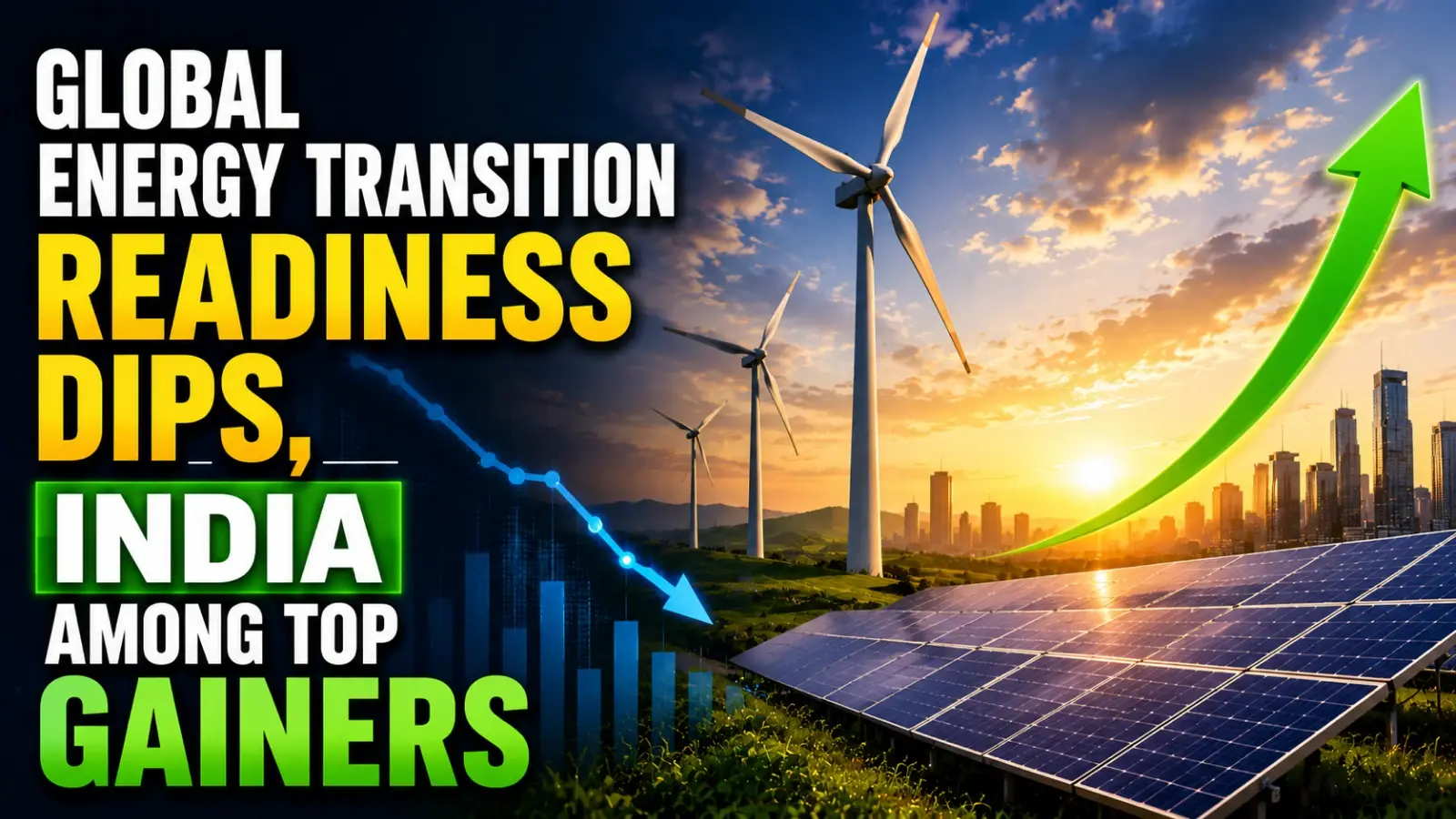
New Delhi: Global energy transition readiness has declined for the first time in more than a decade amid a surge in geopolitical risks, but India has registered one of the strongest improvements, a new report showed on Thursday.
Sweden, Finland and Denmark retained their top three positions globally on the World Economic Forum’s Energy Transition Index 2026, while India advanced two places to rank 70th.
“India was one of the strongest improvers globally in the Energy Transition Index 2026, recording one of the largest gains in transition readiness and strengthening its position as a key player in the next phase of the global energy transition,” the WEF said.
It attributed India’s improvement to stronger energy transition readiness and broad-based system gains, driven by a sharp rise in infrastructure, alongside improvements in equity, sustainability and financial investment.
The proportion of low-carbon jobs increased by 24 per cent in India in 2024, as renewable energy jobs reached 1.3 million (up 25 per cent over 2023), with hydropower being the largest employment source.
The report also underlined scaling renewable capacity, grid expansion and green hydrogen under its infrastructure-led clean-energy strategy as key focus areas for India.
Globally, the WEF said, the energy landscape is becoming more fragmented and security-driven, as countries rebalance sustainability, affordability and resilience priorities.
Despite record clean energy investment in 2025, global momentum slowed as transition readiness declined for the first time in more than a decade, it said.
It highlighted the disruption in the Strait of Hormuz having exposed vulnerabilities in energy systems already strained by rising demand, infrastructure bottlenecks and concentrated clean-energy investment.
The report, developed in collaboration with Accenture, found that the global energy transition — defined as progress toward more sustainable, equitable and secure energy systems — has stalled despite record global investment of USD 3.3 trillion, including USD 2.3 trillion in clean energy.
The research pointed to a growing disconnect between capital deployment and transition readiness, which declined for the first time in over a decade, suggesting that investment alone is no longer enough to sustain momentum.
The Energy Transition Index (ETI) benchmarks the performance of national energy systems across three core dimensions — security, sustainability and equity — and the readiness of the enabling environment to support the transition.
Nordic countries continued to lead the ETI rankings, while Singapore was among the biggest climbers, rising 10 places to 42nd on the Index, driven by new regulation and stronger political commitment.
Advanced economies held 14 of the top 20 positions, but progress was uneven and largely stalled, with overall average scores rising by just 0.2 per cent year-on-year.
India improved its score by 1.9 per cent.
Six G20 economies ranked among the top 20 — Germany (9th), France (10th), the United Kingdom (11th), China (14th), Brazil (17th) and the United States (19th).
“Among major economies, China continued to scale clean energy investment at record levels, India recorded one of the strongest gains in transition readiness, while the United States maintained strong energy security performance despite slipping modestly overall,” it said.
Global electricity demand grew by 3 per cent driven by electrification, cooling, digital infrastructure and AI, and was seen as emerging as a defining constraint on the transition.
Emerging economies accounted for around 80 per cent of demand growth but continued to face higher financing costs and infrastructure gaps.
The Energy Transition Index, being published for 16 years, uses 44 indicators across 120 countries to provide a data-driven assessment of both current energy system performance and readiness for the future.
(Disclaimer: Except for the headline, this article has not been edited by HDFC Sky editorial team and is auto-generated from PTI feed.)
Disclaimer
If you have any concerns, questions, or wish to point out any discrepancies in our content, please feel free to write to us at content@hdfcsec.com.
Please Note: The information shared is intended solely for informational purposes and does not make any investment recommendations
Disclaimer
At HDFC SKY*, we take utmost care and due diligence in curating and presenting news and market-related content. However, inadvertent errors or omissions may occasionally occur.
If you have any concerns, questions, or wish to point out any discrepancies in our content, please feel free to write to us at content@hdfcsec.com.
Please Note: The information shared is intended solely for informational purposes and does not make any investment recommendations.
HDFC SKY from HDFC Securities, one of most trusted trading platforms in India, has been recognized with the *Next-Gen Digi Content Awards 2025-26.
 Join Us
 Add as preferred source on Google


More Business News








Open Free Demat Account
Open Free Demat Account











Invest Anytime, Anywhere


By signing up I certify terms, conditions & privacy policy