Nifty 50
- Dr. Reddy's Labs₹1,229.4032.40 (2.71%)
- Apollo Hospitals₹7,775-252.50 (-3.15%)
- Bajaj Auto₹10,034256.00 (2.62%)
- ITC₹257.90-8.10 (-3.05%)
- Tata Motors PV₹284.454.55 (1.63%)
- Tech Mahindra₹1,471-43.10 (-2.85%)
- Bharat Electronics₹373.905.75 (1.56%)
- L&T₹3,627.50-75.80 (-2.05%)
- BSE₹3,330.2043.00 (1.31%)
- Max Healthcare₹865.95-17.85 (-2.02%)
- Cipla₹1,317.4016.40 (1.26%)
- Hindalco Industries₹882.50-17.85 (-1.98%)
- Eicher Motors₹7,11969.00 (0.98%)
- Hindustan Unilever₹1,820.70-36.00 (-1.94%)
- Mahindra & Mahindra₹2,81316.80 (0.60%)
- SBI₹941-18.10 (-1.89%)
- Kotak Mahindra Bank₹443.402.40 (0.54%)
- Coal India₹404.80-6.75 (-1.64%)
- HCL Technologies₹1,2236.30 (0.52%)
- Bharti Airtel₹1,778.70-26.40 (-1.46%)

- Offerings
- Tools & Platforms
Tools & Calculators
- Open API
- Calculators
- SIP Calculator
- CAGR Calculator
- Compound Interest Calculator
- FD Calculator
- RD Calculator
- EPF Calculator
- Retirement Calculator
- HDFC SIP Calculator
- Mutual Fund Return Calculator
- Lumpsum Calculator
- Step Up SIP Calculator
- ETF SIP Calculator
- Brokerage Calculator
- Equity Margin Calculator
- SWP Calculator
- EMI Calculator
- MTF Calculator
- Margin Pledge Calculator
- Algo Strategy
- Markets
Stocks
F&O
Mutual Funds
- More
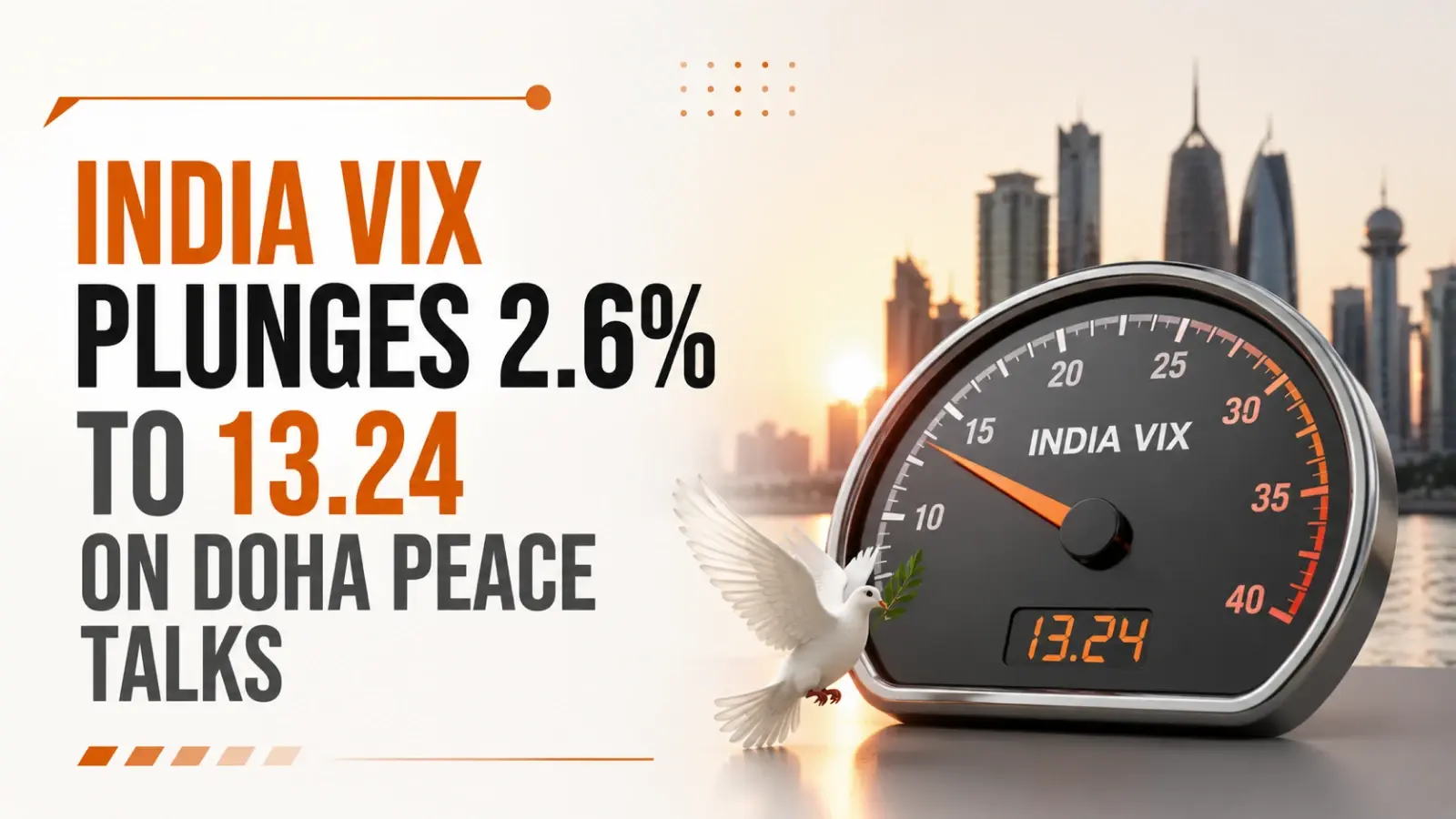
India VIX Plunges 2.6% to 13.24 on Doha Peace Talks, Oil Price Crash; Market Sentiment Turns Bullish
Authored By HDFC SKY | Last Modified: Jul 2, 2026 03:35 PM IST
Open Free Demat Account
Open Free Demat Account
Mumbai, July 2: India VIX, witnessed a sharp decline of approximately 2.6% during the opening session on Thursday, settling at 13.24 as positive global cues and a significant drop in crude oil prices bolstered investor confidence. The “fear index” touched an intraday low of 12.89 during the session, continuing its downward trajectory from the previous day’s close of 13.60 on 1 July, as traders scaled back hedging positions amid improving macroeconomic indicators.
The cooling of volatility comes on the back of a broad-based rally in domestic equity markets, with the benchmark Sensex surging over 400 points to trade above 77,300, while the Nifty 50 reclaimed the 24,100 mark. The GIFT Nifty, trading on the Gujarat International Finance Tec-City exchange, advanced 148.5 points (0.62%) to reach 24,192.50, indicating sustained bullish momentum in the futures market.

US-Iran Peace Talks and Oil Price Slide Drive Volatility Collapse
The most significant catalyst behind the India VIX decline was the positive progress in the US-Iran indirect peace talks held in Doha, Qatar, where negotiators from both nations discussed crucial issues including maritime traffic through the Strait of Hormuz and the unfreezing of Iranian funds. Qatar officially confirmed that the dialogue had yielded “positive progress,” with the talks concluding on Wednesday.
US President Donald Trump commented on the developments, stating that shipping through the Strait of Hormuz had reached record levels and predicting further declines in oil prices. Consequently, Brent crude futures fell to approximately $70–$71 per barrel, marking the third consecutive day of decline. The sharp drop in oil prices directly eased concerns about inflationary pressures and corporate input costs across sectors, driving a risk-on sentiment across global and domestic markets.
Technical Factors and F&O Expiry Premium Dissipation
Market analysts attributed the decline in India VIX to the natural roll-off of the risk premium built up ahead of the June futures and options (F&O) contract expiry on 1 July. Traders had aggressively hedged positions against expiry-related volatility in the preceding sessions, which pushed the India VIX higher. With the expiry now behind the market, this premium has dissipated, contributing to the index’s natural downward correction.
The Nifty Put-Call Ratio (PCR) rose from 1.02 to 1.13, reflecting the prevailing bullish sentiment among market participants. A higher PCR indicates that more put options are being written relative to call options, typically suggesting optimism about future price movements.
IT Sector Leads the Charge with Nearly 3% Surge
Nifty IT emerged as the top-performing sectoral index, surging nearly 3% after four consecutive sessions of losses, as investors returned to the beaten-down technology space despite mixed cues from global tech markets. Key gainers included Infosys, which advanced approximately 3%; HCLTech, which jumped nearly 3.4%; TCS, which rose around 2.6%; and Tech Mahindra, which gained nearly 2%.
The recovery in the IT sector, coupled with the decline in oil prices, contributed significantly to the broader market strength. Nifty Realty and Nifty Metal also gained nearly 1% each, while 1,818 stocks advanced on the National Stock Exchange against 586 declines, indicating broad-based participation across market capitalisations.
Domestic Investors Counter FII Outflows Amid Broader Rally
Foreign institutional investors (FIIs) remained net sellers on Thursday, offloading equities worth ₹1,140 crore in the cash segment. However, domestic institutional investors (DIIs) stepped in aggressively, recording net purchases of ₹3,159 crore, providing a strong counterbalance to foreign outflows and supporting the overall market resilience.
The Indian rupee strengthened considerably, opening 0.34% higher at 94.9275 against the US dollar, reflecting the positive sentiment stemming from lower oil prices and improved risk appetite among investors. Broader markets also participated in the rally, with Nifty Midcap 100 and Nifty Smallcap 100 gaining approximately 0.3% each.
Geopolitical Risks and Crude Volatility Remain Key Watch Factors
The India VIX, also known as the National Stock Exchange’s Volatility Index, measures the market’s expectation of volatility over the near term based on the prices of Nifty options. Despite the current cooling, analysts remain cautious about external risks that could reverse the favourable sentiment.
Earlier this year, the index had witnessed dramatic spikes, including a surge above 27 levels in March 2026 during the escalation of West Asia tensions, and several double-digit percentage moves in June due to geopolitical uncertainty and IT sector selling. Market experts note that while a VIX near 13 reflects moderate confidence, any unexpected developments, including geopolitical escalations, sharp moves in crude oil prices, or major central bank announcements, can quickly reverse sentiment.
Outlook: Sustained Low VIX May Support Gradual Equity Gains
The current India VIX reading of 13.24 suggests traders expect relatively stable market conditions over the next 30 days, with the index having declined more than 3% on 1 July before the opening of 2 July. Analysts believe that a sustained low VIX could allow markets to continue their gradual upward trend, provided macroeconomic conditions remain stable and no unforeseen global events emerge.
The index has now retraced significantly from its 52-week high of 28.90, although it remains above the 52-week low of 8.72. The technical rating for the day remains neutral, with classic pivot levels indicating immediate resistance at 13.82 and support at 12.90.
Seasonality analysis data shows that in 15 out of 18 years, India VIX has given negative returns in July, with an average negative change of -8.47% during the month. The maximum negative change recorded was -24.22% in July 2022, while the maximum positive change stood at 7.39% in July 2011.
The sharp retreat in India VIX below the 14-level signals reduced demand for protective options, with the index settling at 13.24 amid improved global cues and falling crude prices. Traders are closely monitoring US-Iran negotiations, oil price movements, and domestic institutional buying patterns for further directional cues. The put-call ratio of 1.13 and the IT sector’s rebound of nearly 3% suggest a favourable risk environment, though geopolitical unpredictability warrants continued vigilance.
Source
- https://www.nseindia.com/reports-indices-historical-vix
Disclaimer
If you have any concerns, questions, or wish to point out any discrepancies in our content, please feel free to write to us at content@hdfcsec.com.
Please Note: The information shared is intended solely for informational purposes and does not make any investment recommendations
Disclaimer
At HDFC SKY*, we take utmost care and due diligence in curating and presenting news and market-related content. However, inadvertent errors or omissions may occasionally occur.
If you have any concerns, questions, or wish to point out any discrepancies in our content, please feel free to write to us at content@hdfcsec.com.
Please Note: The information shared is intended solely for informational purposes and does not make any investment recommendations.
HDFC SKY from HDFC Securities, one of most trusted trading platforms in India, has been recognized with the *Next-Gen Digi Content Awards 2025-26.
 Join Us
 Add as preferred source on Google


More Business News









Open Free Demat Account
Open Free Demat Account











Invest Anytime, Anywhere


By signing up I certify terms, conditions & privacy policy