Nifty 50
- Eternal₹317.4012.95 (4.25%)
- Shriram Finance₹865-35.90 (-3.98%)
- Apollo Hospitals₹7,730125.50 (1.65%)
- Adani Enterprises₹2,477-73.00 (-2.86%)
- ONGC₹227.502.50 (1.11%)
- JSW Steel₹1,185.50-34.50 (-2.83%)
- Asian Paints₹2,30722.20 (0.97%)
- Jio Financial ₹205.03-5.77 (-2.74%)
- TCS₹2,53023.10 (0.92%)
- Tata Steel₹167.67-4.66 (-2.70%)
- UltraTech Cement₹11,05092.00 (0.84%)
- Adani Ports₹1,702.70-47.30 (-2.70%)
- Maruti Suzuki₹11,23060.00 (0.54%)
- Tech Mahindra₹1,790-39.10 (-2.14%)
- Cipla₹1,3387.10 (0.53%)
- Tata Motors PV₹264.60-5.40 (-2.00%)
- Reliance Industries₹1,1905.50 (0.46%)
- Hindalco Industries₹869.85-15.75 (-1.78%)
- Axis Bank₹1,217.505.50 (0.45%)
- Trent₹2,727.50-48.30 (-1.74%)

- Offerings
- Tools & Platforms
Tools & Calculators
- Open API
- Calculators
- SIP Calculator
- CAGR Calculator
- Compound Interest Calculator
- FD Calculator
- RD Calculator
- EPF Calculator
- Retirement Calculator
- HDFC SIP Calculator
- Mutual Fund Return Calculator
- Lumpsum Calculator
- Step Up SIP Calculator
- ETF SIP Calculator
- Brokerage Calculator
- Equity Margin Calculator
- SWP Calculator
- EMI Calculator
- MTF Calculator
- Margin Pledge Calculator
- Algo Strategy
- Markets
Stocks
F&O
Mutual Funds
- More
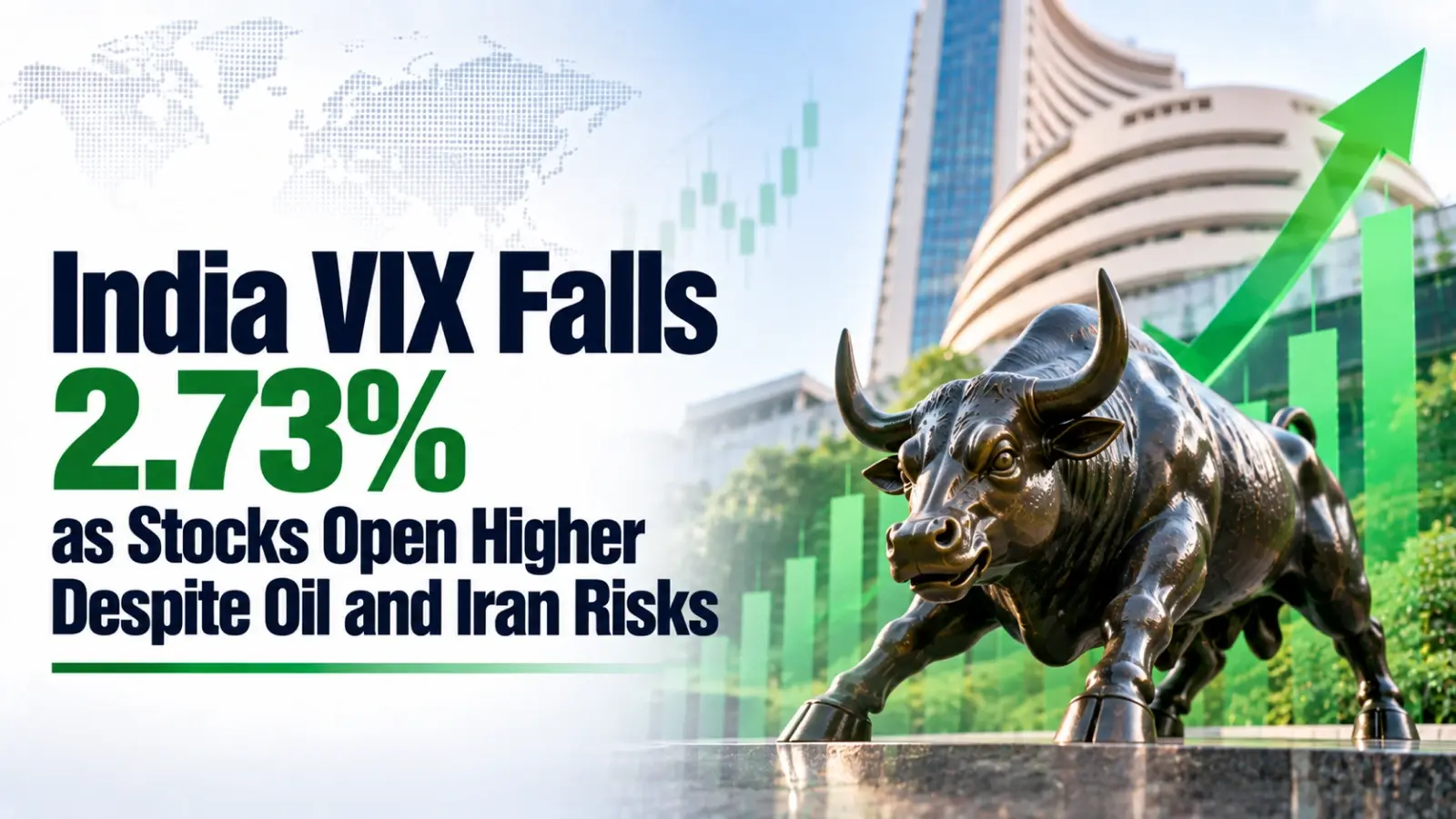
India VIX Falls 2.73% as Stocks Open Higher Despite Oil and Iran Risks
Authored By HDFC SKY | Last Modified: Sep 4, 2026 10:54 AM IST
Open Free Demat Account
Open Free Demat Account
Mumbai, Sept 4: India VIX declined 0.31 points, or 2.73%, to 11.02 by around 10:09 IST on Friday, after opening at 11.34, unchanged from the previous close. The volatility index touched an early high of 11.33 and a low of 10.85, as firmer Indian equities and improved global rate expectations outweighed pressure from elevated crude prices and renewed US-Iran tensions.

India VIX Slides to 10.85 as Indian Equities Stabilise
The opening move in India VIX came as Indian benchmark indices started the session on a firmer footing. GIFT Nifty had indicated a positive opening, with September 4 futures around 24,023–24,049, while Asian equities were broadly higher. By the early session, the Nifty 50 was above 23,900, with the Sensex also trading higher.
India VIX is derived from Nifty option prices and reflects expectations of near-term market volatility. The index opened at 11.34 before declining towards 10.85–11.01 during the early session. The move indicated that immediate volatility expectations were lower even as several external risks remained active.
The index’s 52-week range stands at 8.72–28.90, while its technical rating remains NEUTRAL. For Friday, the Classic pivot levels show resistance at 11.70, 12.07 and 12.54, with the pivot point at 11.23 and support levels at 10.86, 10.39 and 10.02.
Asian Stocks Rise as Fed Rate Concerns Ease
Global market conditions also supported the early decline in India VIX. Asian shares advanced on Friday as the immediate concern around another US rate increase eased. Japan’s Nikkei gained about 0.8%, while the dollar weakened after Federal Reserve Governor Christopher Waller adopted a stance that reduced immediate concerns about another US rate hike.
The softer global rate outlook came alongside easing US Treasury yields and a weaker dollar. These developments provided a more supportive backdrop for Asian equities as Indian markets opened. The combination of firmer regional markets and reduced immediate rate pressure therefore formed an important part of Friday’s opening environment.
US Jobs Data Keeps Volatility Risk Alive Ahead Of Release
The US August employment report remained a major event risk for global markets on Friday, although the data had not been released when Indian trading began. The report is being watched for its potential influence on expectations surrounding the Federal Reserve’s next interest-rate decision.
A stronger-than-expected employment report could raise expectations of tighter US monetary policy, while also affecting Treasury yields, the dollar and emerging-market currencies. A weak report could instead intensify concerns about economic growth. With neither outcome known at the Indian opening, the market was dealing with event uncertainty rather than an actual payrolls surprise.
Brent Near $96 Limits India VIX Decline
Crude oil remained the strongest counterweight to the softer volatility reading. Brent crude was around $96 a barrel on Friday morning, while WTI crude stood near $92. Brent had gained more than 7% for the week, while WTI had risen almost 10%.
The sharp rise in oil prices remained significant for India because higher crude prices can increase the country’s import bill, pressure the rupee, raise inflation risks, affect corporate margins and complicate monetary-policy expectations. These factors continued to keep an element of macroeconomic risk in the market despite the lower India VIX reading.
US-Iran Conflict Keeps Oil and Geopolitical Risks Elevated
Renewed US-Iran hostilities continued to add a geopolitical risk premium to markets. Escalation in the Middle East has increased concerns over disruption to regional energy supplies, while reported attacks involving commercial shipping have heightened focus on the Strait of Hormuz.
The latest US attacks reportedly caused casualties, while Iranian attacks on commercial shipping added to concerns surrounding energy and shipping routes. US officials have also indicated that Washington does not intend to negotiate while Iran continues attacks on commercial shipping.
The developments have contributed to the sharp rise in crude prices and remain an important source of uncertainty for Indian markets. Despite this backdrop, the opening session did not produce a corresponding surge in India VIX.
RBI Intervention Supports Rupee at ₹94.46 Per Dollar
Currency-market developments provided another supportive factor for the early session. The Reserve Bank of India intervened in the foreign-exchange market by selling US dollars to support the rupee amid pressure from elevated crude prices.
The rupee opened at approximately ₹94.46 per US dollar, slightly stronger than Thursday’s ₹94.4850. The currency’s opening stability came despite the pressure created by higher oil prices.
The intervention was significant because crude-related pressure on the rupee represents one of the channels through which higher energy costs can affect Indian financial markets. The relatively stronger opening of the rupee therefore accompanied the lower India VIX reading.
$136 Billion Inflows Provide Additional Rupee Support
Capital inflows also provided support to the domestic currency. Recent inflows through special schemes have exceeded $136 billion, while aggressive dollar sales by the Reserve Bank of India have also contributed to the rupee’s recent strength.
The combination of capital inflows and central-bank intervention came at a time when higher crude prices were increasing pressure on India’s external position. The currency therefore avoided a substantially weaker opening on Friday, adding to the more stable domestic market backdrop.
SEBI Reviews Derivatives Settlement After New Closing Session
The Securities and Exchange Board of India (SEBI) is also reviewing the methodology used to determine derivatives settlement prices following the introduction of the Closing Auction Session (CAS). A consultation paper is expected to follow.
The CAS mechanism, introduced in August, has prompted concerns involving expiry-day price formation, derivatives settlement prices, closing volatility, liquidity and hedging. Questions have also emerged over possible differences between cash-market closing prices and derivatives pricing.
The regulatory review represents an important development for the derivatives market, although it was not the principal factor behind Friday morning’s decline in India VIX.
September Seasonality Shows 10 Negative Years Out of 18
Historical September data also provides context for the index. India VIX has recorded negative returns in 10 out of 18 years during September. The month has seen a maximum positive change of 34.92% in 2018, with the average positive change at 19.02%. The maximum negative change was -26.10% in 2009, while the average negative change stood at -9.06%.
The average change for September is 3.42%. These figures form the index’s historical seasonality profile for the month.
Thursday’s FII Selling Remains a Carry-Over Risk
Foreign institutional investors sold approximately ₹2,345.87 crore of Indian equities on Thursday, while domestic institutional investors purchased around ₹4,977.46 crore. Since these transactions occurred on 3 September, they are not new events on Friday, but remain part of the market positioning carried into the opening session.
Thursday’s market had also ended weaker, with the Nifty 50 at 23,873.45, down 0.17%, while the Sensex closed at 76,152.86, lower by 417.49 points, or 0.55%. Friday’s firmer opening therefore followed four consecutive weaker sessions.
India VIX At 11.01 Reflects Lower Immediate Volatility
By around 10:07 IST, India VIX stood at approximately 11.01, about 2.9% below the previous close of 11.34, after moving between 10.85 and 11.34 during the early session.
The opening pattern showed a flat start followed by a decline in volatility expectations. Firmer Indian equities, stronger Asian markets, softer US rate expectations, a weaker dollar and rupee support coincided with the move lower. At the same time, Brent near $96, US-Iran tensions and the pending US employment report continued to keep significant external risks active.
India VIX fell 2.73% to 11.02 in the early session as firmer Indian equities and supportive global rate and currency conditions outweighed persistent risks from $96 Brent crude, US-Iran tensions and the pending US jobs report. The index remained within its 10.85–11.34 intraday range, with its technical trend rated NEUTRAL.
Source
- https://www.nseindia.com/reports-indices-historical-vix
Disclaimer
If you have any concerns, questions, or wish to point out any discrepancies in our content, please feel free to write to us at content@hdfcsec.com.
Please Note: The information shared is intended solely for informational purposes and does not make any investment recommendations
HDFC SKY, one of India’s most trusted trading platforms, has been recognized with the Next-Gen Digi Content Awards 2025–26.
Disclaimer
At HDFC SKY*, we take utmost care and due diligence in curating and presenting news and market-related content. However, inadvertent errors or omissions may occasionally occur.
If you have any concerns, questions, or wish to point out any discrepancies in our content, please feel free to write to us at content@hdfcsec.com.
Please Note: The information shared is intended solely for informational purposes and does not make any investment recommendations.
HDFC SKY from HDFC Securities, one of most trusted trading platforms in India, has been recognized with the *Next-Gen Digi Content Awards 2025-26.
 Join Us
 Add as preferred source on Google


More Business News








Open Free Demat Account
Open Free Demat Account










Invest Anytime, Anywhere


By signing up I certify terms, conditions & privacy policy