Nifty 50
- HCL Technologies₹1,30784.00 (6.87%)
- Kotak Mahindra Bank₹438.20-5.20 (-1.17%)
- TCS₹2,242.60117.60 (5.53%)
- Max Healthcare₹857.20-8.75 (-1.01%)
- Tech Mahindra₹1,52251.00 (3.47%)
- Maruti Suzuki₹11,213-102.00 (-0.90%)
- Hindustan Unilever₹1,878.6057.90 (3.18%)
- Eternal₹320.25-2.75 (-0.85%)
- Bajaj Auto₹10,328294.00 (2.93%)
- HDFC Life Insurance ₹555.10-4.15 (-0.74%)
- Infosys₹1,048.6528.65 (2.81%)
- InterGlobe Aviation₹4,767.30-27.70 (-0.58%)
- Bajaj Finance₹975.7518.50 (1.93%)
- Power Grid Corp₹247.75-1.25 (-0.50%)
- Grasim Industries₹2,906.5048.50 (1.70%)
- Tata Motors PV₹283.20-1.25 (-0.44%)
- Bajaj Finserv₹1,748.5028.60 (1.66%)
- Nestle₹1,320.20-4.50 (-0.34%)
- Trent₹2,956.5043.50 (1.49%)
- Adani Ports₹1,748.40-5.60 (-0.32%)

- Offerings
- Tools & Platforms
Tools & Calculators
- Open API
- Calculators
- SIP Calculator
- CAGR Calculator
- Compound Interest Calculator
- FD Calculator
- RD Calculator
- EPF Calculator
- Retirement Calculator
- HDFC SIP Calculator
- Mutual Fund Return Calculator
- Lumpsum Calculator
- Step Up SIP Calculator
- ETF SIP Calculator
- Brokerage Calculator
- Equity Margin Calculator
- SWP Calculator
- EMI Calculator
- MTF Calculator
- Margin Pledge Calculator
- Algo Strategy
- Markets
Stocks
F&O
Mutual Funds
- More
India VIX Falls 6.81% to 15.87 After Volatility Spike Triggered by West Asia Tension
Authored By HDFC SKY | Last Modified: Jun 9, 2026 12:09 PM IST
Open Free Demat Account
Open Free Demat Account
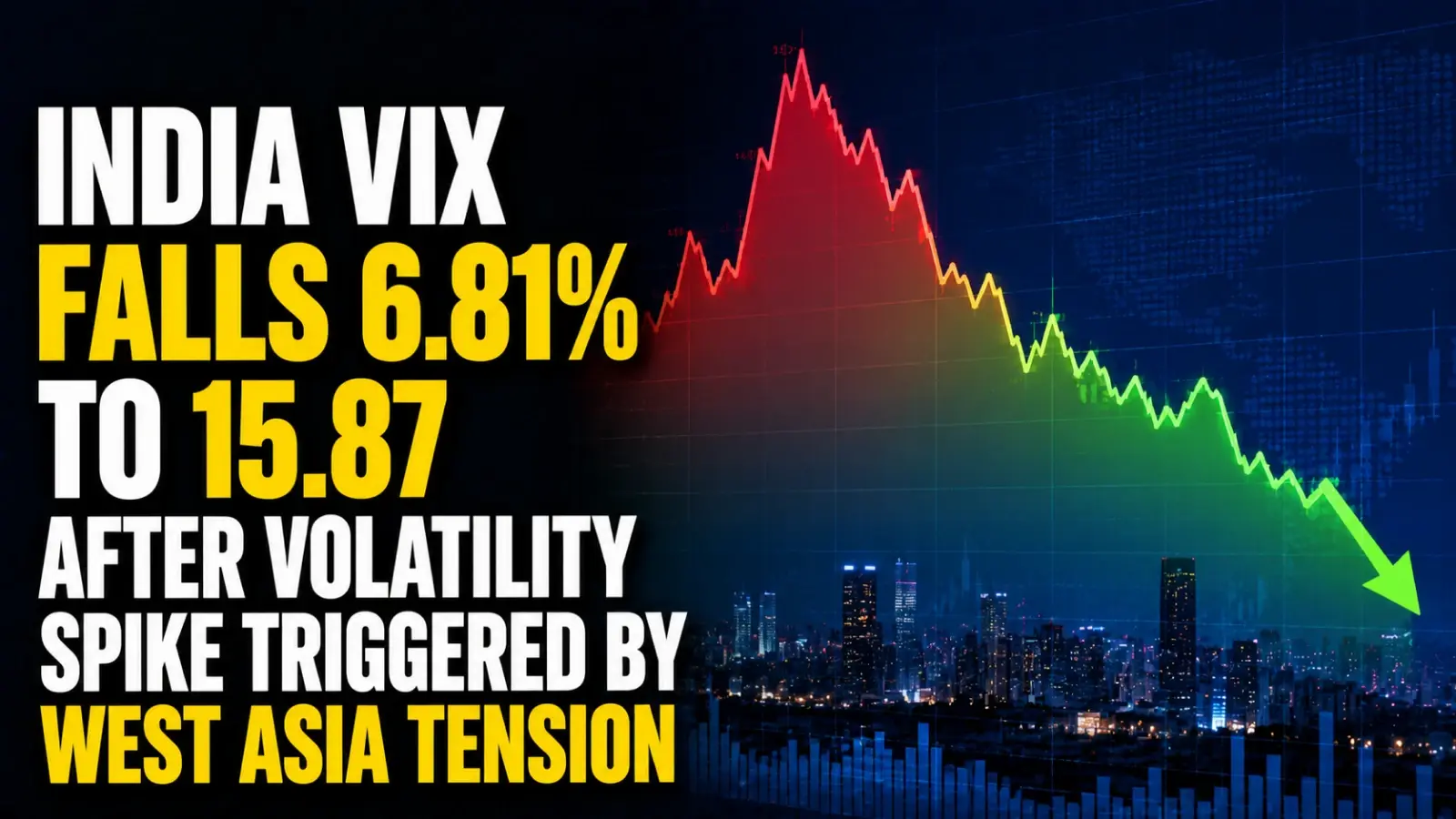
Mumbai, June 9: The India VIX, which is widely followed as an indicator of expected market volatility, declined by 6.81% to 15.87 on Tuesday during the early trading session after having surged sharply in the preceding session. In the previous trading day of June 8, the index closed at 17.03, representing an increase of about 7.85% from the earlier close of 15.79 amid geopolitical developments in West Asia and weakness across global markets.
The India VIX was seen trading at 15.87, falling by 1.16 points from its last close of 17.03. It started the session at 17.02, reached a high of 17.02, and marked a low of 15.79 during the session. Although it fell significantly on Tuesday in early trade, the level remained well above those registered earlier in the month.

India VIX Drops to 15.87 After Closing at 17.03
The latest movement came after India VX had recorded one of its strongest single-day gains in recent weeks. On June 8, 2026, the index moved from 15.79 to 17.03, indicating a sharp rise in expected market volatility. The historical trading data indicates that volatility index moved up by 1.24 points or 7.87% during the session, with the day’s trading range extending from 15.79 to 18.44.
The decline on Tuesday represents a little moderation from the gains made the previous day. However, the index is trading above the levels seen in the first week of June.
West Asia Developments Push Volatility Expectations Higher
The recent rise in India VIX coincided with renewed geopolitical tensions in West Asia. Reports of escalating conflict in the region contributed to a broad risk-off environment across financial markets, leading to increased uncertainty and higher volatility expectations.
Market reports indicated that concerns surrounding developments in the Middle East weighed on equities and currency markets. The volatility index responded sharply during this period as traders adjusted expectations for potential market fluctuations.
Also Read: Understanding India VIX: What 15 vs 25 Means for Your Portfolio Risk in Plain Language
The increase in volatility was reflected across major benchmarks, with Indian equities witnessing notable declines during the same period.
Sensex Falls 719 Points as Market Uncertainty Intensifies
The broader market witnessed significant pressure alongside the jump in India VIX. The BSE Sensex declined by 719 points, while the Nifty 50 fell 244 points, or 1.04%, to close at 23,123.
The decline was broad-based, with all sectoral indices ending the session in negative territory. Weakness was not limited to frontline stocks, as broader market indices also registered losses. The Nifty Midcap 100 declined 1.40%, while the Nifty Smallcap 100 fell 1.92%.
The simultaneous rise in India VIX and decline in benchmark indices highlighted the heightened uncertainty prevailing across the market during the session.
Foreign Outflows and Global Rebalancing Add Pressure
Alongside geopolitical concerns, global portfolio adjustments also emerged as a key development influencing market conditions. International investors continued repositioning portfolios amid changing global risk dynamics.
Foreign Institutional Investors (FIIs) remained net sellers for the seventh consecutive session, with reported equity sales of approximately ₹5,555 crore on Monday. The continued outflows coincided with broader weakness across several global markets and contributed to increased caution in domestic trading activity.
At the same time, reports highlighted portfolio shifts away from certain technology-driven investments globally, adding to volatility across international equity markets.
Five-Day Data Shows Sharp Swings In Volatility
Trading data from 2 June 2026 to 8 June 2026 illustrates the fluctuations witnessed in India VIX during the period.
On 2 June, the index closed at 15.36, down 7.15% from the previous session. It recovered on 3 June, rising 6.02% to 16.28. The index then declined 2.38% on 4 June and slipped another 0.60% on 5 June, closing at 15.79.
Also Read: What is India VIX Index?
The trend reversed sharply on 8 June, when India VIX advanced 7.87% to 17.03, recording the largest move during the observed period. The data reflects a market environment characterised by rapid shifts in volatility expectations over a short timeframe.
India VIX Remains Above Key Historical Levels
India VIX currently trades well above its 52-week low of 8.72, while remaining below its 52-week high of 28.90. The index has delivered a year-to-date return of 67.51%, underlining the significant increase in volatility expectations witnessed during 2026.
Technical indicators currently assign a Neutral trend rating to the index. Daily pivot calculations place the primary pivot point at 17.08, with immediate support levels at 15.73, 14.42, and 13.07, while resistance levels are identified at 18.39, 19.74, and 21.05.
These levels are derived from the previous trading session’s price range and are updated daily.
June History Shows Average Decline of 6.47%
Historical seasonality data indicates that June has generally been a challenging month for India VIX. Over the past 18 years, the index has recorded negative returns in 11 years during June.
The month has delivered an average change of -6.47%. The strongest positive June performance was recorded in 2011, when the index rose 9.45%, while the sharpest decline occurred in 2024, when it fell 43.90%.
Average positive June returns stand at 5.58%, while average negative returns are -14.13%, highlighting the wide range of outcomes historically observed during the month.
Volatility Gauge Continues to Reflect Market Uncertainty
India VIX remains one of the most closely watched indicators for measuring expected near-term market fluctuations. The recent move from 15.79 to 17.03, followed by a pullback to 15.87 on 9 June, reflects rapidly changing expectations amid geopolitical developments, global portfolio adjustments, foreign fund outflows, and broader weakness across equity markets.
The index’s performance over recent sessions underscores the extent to which external developments can influence volatility expectations, even as benchmark indices continue to navigate a challenging market environment.
India VIX declined to 15.87 on 9 June 2026 after surging to 17.03 in the previous session, reflecting changing volatility expectations amid West Asia tensions, foreign fund outflows and global market weakness. The index remains significantly above its 52-week low and has gained 67.51% year-to-date, while June seasonality data continues to indicate historically mixed volatility trends.
Source
- https://www.nseindia.com/reports-indices-historical-vix
Disclaimer
If you have any concerns, questions, or wish to point out any discrepancies in our content, please feel free to write to us at content@hdfcsec.com.
Please Note: The information shared is intended solely for informational purposes and does not make any investment recommendations
Disclaimer
At HDFC SKY*, we take utmost care and due diligence in curating and presenting news and market-related content. However, inadvertent errors or omissions may occasionally occur.
If you have any concerns, questions, or wish to point out any discrepancies in our content, please feel free to write to us at content@hdfcsec.com.
Please Note: The information shared is intended solely for informational purposes and does not make any investment recommendations.
HDFC SKY from HDFC Securities, one of most trusted trading platforms in India, has been recognized with the *Next-Gen Digi Content Awards 2025-26.
 Join Us
 Add as preferred source on Google


More Business News










Open Free Demat Account
Open Free Demat Account












Invest Anytime, Anywhere


By signing up I certify terms, conditions & privacy policy