Nifty 50
- Dr. Reddy's Labs₹1,229.4032.40 (2.71%)
- Apollo Hospitals₹7,775-252.50 (-3.15%)
- Bajaj Auto₹10,034256.00 (2.62%)
- ITC₹257.90-8.10 (-3.05%)
- Tata Motors PV₹284.454.55 (1.63%)
- Tech Mahindra₹1,471-43.10 (-2.85%)
- Bharat Electronics₹373.905.75 (1.56%)
- L&T₹3,627.50-75.80 (-2.05%)
- BSE₹3,330.2043.00 (1.31%)
- Max Healthcare₹865.95-17.85 (-2.02%)
- Cipla₹1,317.4016.40 (1.26%)
- Hindalco Industries₹882.50-17.85 (-1.98%)
- Eicher Motors₹7,11969.00 (0.98%)
- Hindustan Unilever₹1,820.70-36.00 (-1.94%)
- Mahindra & Mahindra₹2,81316.80 (0.60%)
- SBI₹941-18.10 (-1.89%)
- Kotak Mahindra Bank₹443.402.40 (0.54%)
- Coal India₹404.80-6.75 (-1.64%)
- HCL Technologies₹1,2236.30 (0.52%)
- Bharti Airtel₹1,778.70-26.40 (-1.46%)

- Offerings
- Tools & Platforms
Tools & Calculators
- Open API
- Calculators
- SIP Calculator
- CAGR Calculator
- Compound Interest Calculator
- FD Calculator
- RD Calculator
- EPF Calculator
- Retirement Calculator
- HDFC SIP Calculator
- Mutual Fund Return Calculator
- Lumpsum Calculator
- Step Up SIP Calculator
- ETF SIP Calculator
- Brokerage Calculator
- Equity Margin Calculator
- SWP Calculator
- EMI Calculator
- MTF Calculator
- Margin Pledge Calculator
- Algo Strategy
- Markets
Stocks
F&O
Mutual Funds
- More
India VIX Falls 6.14% To 12.55 As Geopolitical Fears Ease and Q1 Earnings Shift Market Focus
Authored By HDFC SKY | Last Modified: Jul 10, 2026 12:31 PM IST
Open Free Demat Account
Open Free Demat Account
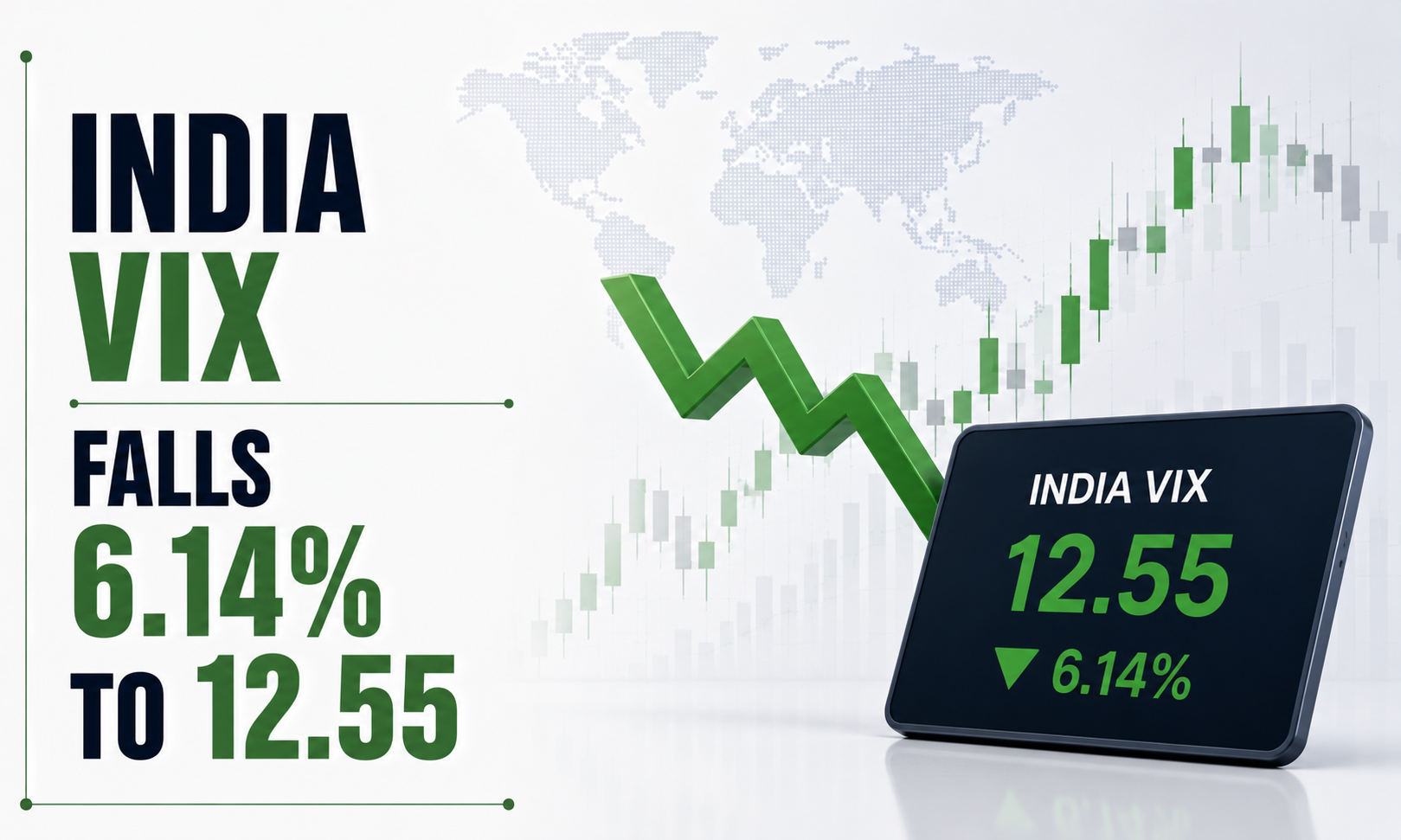
Mumbai, July 10: India’s volatility gauge, India VIX, declined 6.14% to 12.55 during the opening session on 10 July 2026, extending its retreat after the sharp spike recorded earlier this week. As of 09:57 IST, the index was trading within a 12.12–13.36 intraday range after opening at 13.36, reflecting a partial unwinding of the elevated volatility witnessed on 8 July.
While the decline indicates that immediate market turbulence has moderated, the index remains above the unusually low levels seen at the beginning of the week, keeping market participants focused on corporate earnings, global developments and crude oil prices.

India VIX Opens Lower After Sharp Weekly Swings
India VIX opened at 13.36, the same as its previous close, before slipping to 12.55, down 0.82 points or 6.14% during the morning session. The index touched an intraday high of 13.36 and a low of 12.12, while remaining well within its 52-week range of 8.72 to 28.90.
Despite the latest decline, the volatility index has delivered 32.28% year-to-date returns, highlighting that volatility levels remain significantly higher than those recorded earlier this year. Technical indicators continue to classify the broader trend as Neutral, with daily pivot levels placing resistance at 14.34, 15.32 and 15.96, while support is identified at 12.72, 12.08 and 11.10.
Wednesday’s 26% Spike Followed Broad Market Sell-Off
The latest movement follows one of the sharpest single-session jumps in India VIX this year. On 8 July, the volatility index surged approximately 26%, climbing to 14.68 as Indian equities witnessed widespread selling. During that session, the Sensex declined 1,677 points (2.15%) to 76,504, while the Nifty 50 dropped 516.65 points (2.12%) to 23,882. The sharp decline across benchmark indices coincided with more than ₹8 lakh crore being wiped off overall investor wealth, alongside broad-based weakness across banking, financial services, fast-moving consumer goods and oil & gas stocks.
The spike in volatility came after renewed geopolitical developments involving the United States and Iran, including the termination of a ceasefire arrangement, withdrawal from a memorandum of understanding, subsequent military action around the Strait of Hormuz, and retaliatory measures involving United States assets in the Gulf region. These developments heightened uncertainty surrounding global energy supplies and increased demand for downside protection in the derivatives market.
Recovery on July 9 Reduced Volatility Premium
By 9 July, Indian equity markets staged a measured recovery, leading to a decline in the volatility index. The Sensex gained 238 points (0.31%) to close at 76,742, while the Nifty 50 advanced 80.75 points (0.34%) to settle at 23,963. During the same session, India VIX corrected by around 9%, closing near 13.36, as a portion of the volatility premium built during the previous day’s sell-off unwound.
Broader markets also outperformed, with both the Nifty Midcap 100 and Nifty Smallcap 100 indices rising by more than 1%. The recovery followed improved buying interest in heavyweight information technology stocks after the release of quarterly earnings, alongside the absence of fresh geopolitical developments during Thursday’s trading session.
Q1 Earnings and Global Cues Drive Today’s Session
Attention has shifted towards the beginning of the first-quarter FY27 earnings season, which has become one of the primary factors influencing market activity. Tata Consultancy Services (TCS) reported net profit of ₹13,349 crore, representing 4.6% year-on-year growth, while revenue increased 13.9% year-on-year to ₹72,275 crore.
The quarterly performance has set the tone for upcoming earnings announcements, with market participants closely monitoring management commentary relating to deal wins, margins and future business conditions across the information technology sector.
Global market developments have also provided supportive cues. Gift Nifty traded around 24,104, indicating a premium of roughly 105 points over the previous Nifty futures close. Overnight, United States markets ended higher, with the Nasdaq advancing 1.30%, while several Asian markets also recorded gains, including South Korea’s Kospi, which rose 3.27%.
Geopolitical Risks and Crude Oil Stay In Focus
Although volatility has moderated compared with Wednesday’s spike, geopolitical developments continue to remain closely monitored. Concerns regarding global energy supplies had intensified earlier in the week following renewed tensions involving the United States and Iran, contributing to higher crude oil prices and increasing uncertainty across financial markets.
Higher crude oil prices remain particularly significant because India is a major crude oil importer. Sustained increases in energy prices can influence inflation expectations, corporate costs, fiscal balances and the current account position, making crude oil movements an important variable for overall market volatility. Alongside geopolitical developments, market participants are also tracking foreign institutional investor activity, global equity performance, weekly derivatives positioning and additional corporate earnings announcements.
Technical Levels Keep Volatility Trend Neutral
Technical indicators continue to suggest a Neutral trend for India VIX despite this week’s sharp movements. Analysts note that volatility has eased from recent highs but remains above the subdued levels recorded before Wednesday’s sell-off. Current technical levels identify resistance around 12.21, 12.61 and 12.86, while support is seen near 11.56.
Seasonality data also indicates that July has historically been a weak month for the volatility index. Over the past 18 years, India VIX has recorded negative returns in 15 July trading periods. The month has historically delivered an average decline of 8.57%, with the largest positive change of 7.39% recorded in 2011 and the largest negative movement of 24.22% recorded in 2022.
India VIX remained lower during the opening session on 10 July 2026, extending its decline after the sharp volatility witnessed earlier this week. Market activity is currently being shaped by the ongoing Q1 FY27 earnings season, geopolitical developments, crude oil prices, global market performance and derivatives positioning, while the volatility index continues to trade within a Neutral technical trend.
Source
- https://www.nseindia.com/reports-indices-historical-vix
Disclaimer
If you have any concerns, questions, or wish to point out any discrepancies in our content, please feel free to write to us at content@hdfcsec.com.
Please Note: The information shared is intended solely for informational purposes and does not make any investment recommendations
Disclaimer
At HDFC SKY*, we take utmost care and due diligence in curating and presenting news and market-related content. However, inadvertent errors or omissions may occasionally occur.
If you have any concerns, questions, or wish to point out any discrepancies in our content, please feel free to write to us at content@hdfcsec.com.
Please Note: The information shared is intended solely for informational purposes and does not make any investment recommendations.
HDFC SKY from HDFC Securities, one of most trusted trading platforms in India, has been recognized with the *Next-Gen Digi Content Awards 2025-26.
 Join Us
 Add as preferred source on Google


More Business News










Open Free Demat Account
Open Free Demat Account












Invest Anytime, Anywhere


By signing up I certify terms, conditions & privacy policy