Nifty 50
- Trent₹2,900320.00 (12.40%)
- Coal India₹411.20-13.90 (-3.27%)
- BSE₹3,301121.40 (3.82%)
- Tech Mahindra₹1,499-36.90 (-2.40%)
- Kotak Mahindra Bank₹430.9514.95 (3.59%)
- Max Healthcare₹902.90-14.10 (-1.54%)
- Nestle₹1,338.5041.40 (3.19%)
- ITC₹265.35-3.55 (-1.32%)
- Hindustan Unilever₹1,890.5052.10 (2.83%)
- Apollo Hospitals₹7,885-100.00 (-1.25%)
- Jio Financial ₹217.805.80 (2.74%)
- Infosys₹1,009.10-11.40 (-1.12%)
- SBI Life Insurance ₹1,75444.50 (2.60%)
- Bajaj Finance₹960-10.00 (-1.03%)
- Reliance Industries₹1,21629.60 (2.49%)
- UltraTech Cement₹10,740-110.00 (-1.01%)
- Eternal₹328.808.00 (2.49%)
- TCS₹2,094-20.40 (-0.96%)
- InterGlobe Aviation₹5,048113.00 (2.29%)
- Tata Motors PV₹286.10-2.55 (-0.88%)

- Offerings
- Tools & Platforms
Tools & Calculators
- Open API
- Calculators
- SIP Calculator
- CAGR Calculator
- Compound Interest Calculator
- FD Calculator
- RD Calculator
- EPF Calculator
- Retirement Calculator
- HDFC SIP Calculator
- Mutual Fund Return Calculator
- Lumpsum Calculator
- Step Up SIP Calculator
- ETF SIP Calculator
- Brokerage Calculator
- Equity Margin Calculator
- SWP Calculator
- EMI Calculator
- MTF Calculator
- Margin Pledge Calculator
- Algo Strategy
- Markets
Stocks
F&O
Mutual Funds
- More
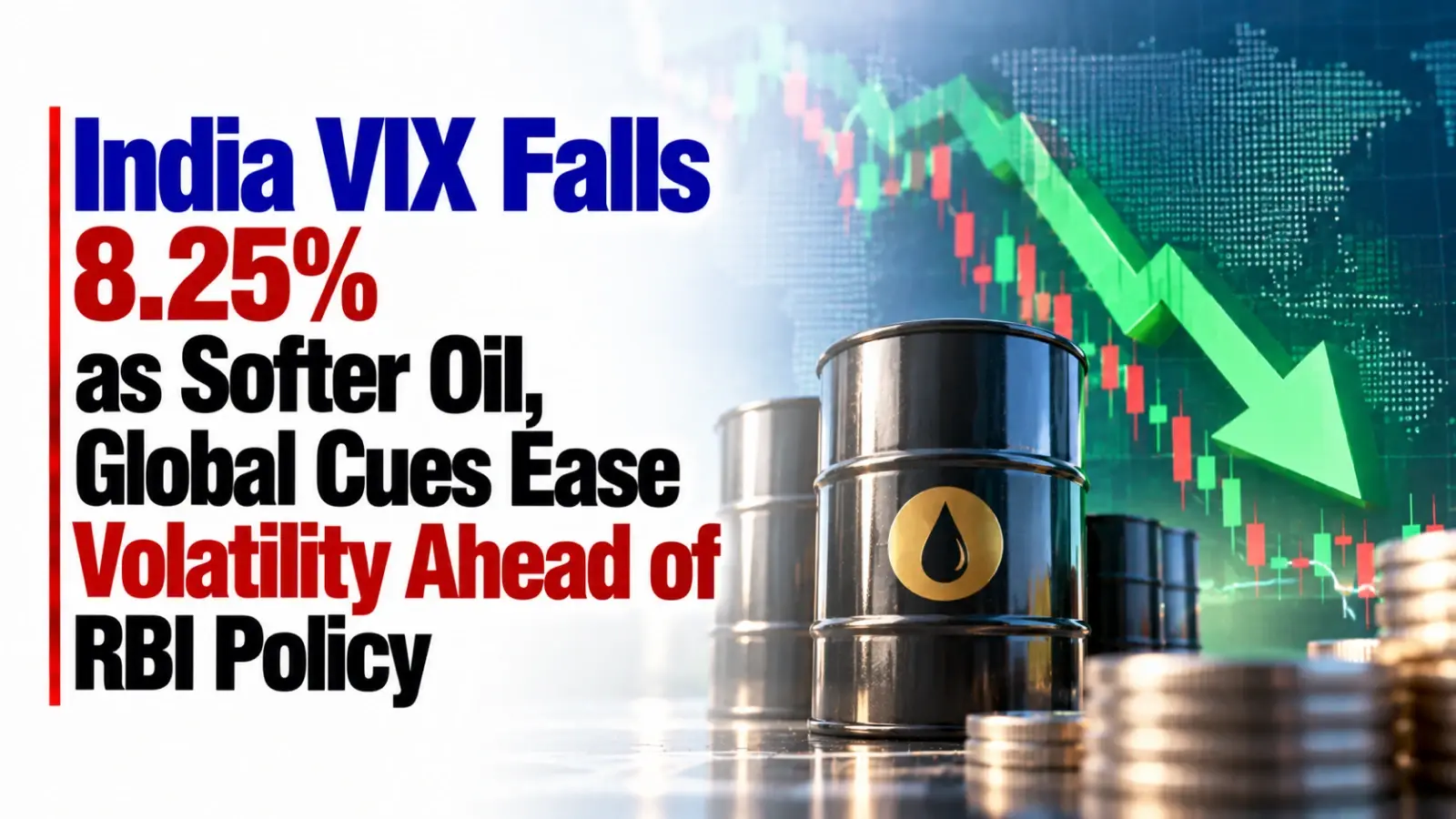
India VIX Falls 8.25% as Softer Oil, Global Cues Ease Volatility Ahead of RBI Policy
Authored By HDFC SKY | Published at: Oct 6, 2026 04:05 PM IST
Open Free Demat Account
Open Free Demat Account
Mumbai, Oct 6: Market volatility eased sharply on Tuesday as the India VIX fell 8.25% to 13.56, helped by softer crude oil prices, gains in global equities and a broad-based rise in domestic stocks. The volatility index had closed at 14.78 in the previous session.
India VIX opened at 14.77 and moved in a range of 13.52 to 14.77 during the day, before settling near its intraday lows. The decline suggests that some of the immediate nervousness in the market has eased, although investors continue to keep a close watch on several macroeconomic risks.
The Reserve Bank of India’s policy decision, due on October 7, remains a key event for investors. Weakness in the rupee, continued selling by foreign investors, elevated US Treasury yields and ongoing geopolitical concerns are also likely to influence market sentiment in the near term.

India VIX Slips as Market Sentiment Improves
The fall in India VIX came alongside gains in Indian equities, with investors finding some comfort in the improvement in global risk appetite and lower crude oil prices.
At 13.56, the index remains comfortably below its 52-week high of 28.90, although it is still above its 52-week low of 8.72. On a year-to-date basis, India VIX has gained 42.72%.
For Tuesday’s session, the index carried a Neutral technical rating. The pivot point stood at 14.54, while the key resistance levels were placed at 15.59, 16.40 and 17.45. On the downside, support was seen at 13.73, followed by 12.68 and 11.87.
The move below the 14-mark, however, indicates that traders were pricing in relatively lower near-term volatility compared with the previous session.
Global Markets Provide a Boost to Risk Appetite
A stronger global market backdrop also helped support sentiment in Indian equities. US stocks ended higher in the previous session, with technology shares leading the gains. The Nasdaq also closed at a record high, reflecting continued strength in the technology segment.
Asian markets largely followed the positive trend on Tuesday. Japan’s Nikkei rose around 0.7%, while the MSCI Asia-Pacific index excluding Japan also moved higher.
The improved global mood, along with positive signals from GIFT Nifty, gave domestic markets a firmer start. Softer crude oil prices added another layer of support, particularly given India’s sensitivity to movements in global oil prices.
Together, these factors helped pull India VIX lower from its opening level of 14.77 and kept volatility subdued through much of the session.
RBI Policy Decision Remains the Next Major Trigger
Despite Tuesday’s decline, investors are unlikely to completely let their guard down ahead of the RBI’s policy announcement on October 7.
Markets will closely watch the central bank’s assessment of inflation, growth, liquidity and external risks, as well as any signals on the future direction of monetary policy.
For now, the fall in India VIX points to a reduction in immediate market anxiety. Whether that calm persists will depend largely on the RBI’s policy signals, global bond yields, crude oil prices and foreign investor flows in the sessions ahead.
Crude Near $100 Eases Pressure on India’s Risk Indicators
Crude oil prices moved lower during the session, providing relief to an important source of pressure for the Indian economy. Brent crude fell to around $99.49 a barrel, while West Texas Intermediate declined to approximately $88.43. The move followed stronger Middle Eastern exports and the release of emergency stockpile measures by the Group of Seven.
The G7 agreed to release 100 million barrels from emergency reserves, reducing immediate concerns over a severe global supply shortage. At the same time, Middle Eastern crude exports recovered despite continuing geopolitical risks. Softer oil prices eased concerns surrounding India’s import bill, inflation, the current account, corporate margins, the rupee and monetary policy.
Middle East Risks Persist Despite Improving Oil Supplies
The decline in crude prices did not remove geopolitical risks from the market. Security concerns continued around the Middle East, including risks involving shipping near the Strait of Hormuz and attacks involving Saudi Arabia and Iran-backed Houthi forces.
The market therefore faced two contrasting developments during the session. Improving Middle Eastern oil flows and the G7 reserve release reduced immediate supply concerns, while the continuing conflict and shipping risks kept a geopolitical risk premium in place. This limited the extent to which volatility concerns could ease despite lower crude prices.
High US Treasury Yields Keep Currency Risks in Focus
Elevated US Treasury yields remained a counterweight to the improvement in global equity sentiment. The US 10-year Treasury yield reached 5.3493%, its highest level since 2002, while the 30-year yield was around 5.70%, keeping pressure on emerging-market currencies and financial conditions.
At the same time, expectations of an October US Federal Reserve rate hike declined sharply. Market pricing for an October hike fell to approximately 23% from 71% a week earlier. Lower expectations for aggressive monetary tightening supported global risk assets, although the exceptionally high Treasury yields continued to provide a source of pressure for emerging markets.
Rupee Near ₹96.43 Adds a Fresh Volatility Counterweight
The Indian rupee weakened to around ₹96.43 per US dollar, its weakest level in more than two months and close to its May record low of approximately ₹96.96. Foreign portfolio outflows, elevated US yields and dollar strength contributed to the currency pressure.
The combination of crude oil near $100 and the rupee near ₹96.4 per dollar kept concerns over imported inflation and India’s external balance in focus. The Reserve Bank of India was also believed to have intervened in the foreign exchange market, with state-run banks seen offering dollars and the central bank reportedly using dollar-rupee sell-buy swaps to drain excess liquidity.
FII Selling Persists as Domestic Buying Absorbs Pressure
Foreign portfolio investors continued to sell Indian equities during the session, with available data showing selling of approximately ₹4,699 crore. Domestic institutional investors, meanwhile, bought around ₹5,182 crore.
The difference between foreign selling and domestic institutional buying provided an important counterbalance during the session. Domestic purchases helped absorb part of the foreign selling pressure, while the continued foreign outflows remained a source of caution for the rupee, liquidity and overall market conditions.
RBI Policy Decision Keeps Event Risk Elevated
The Reserve Bank of India’s monetary policy decision scheduled for 7 October remained a major domestic event ahead of the close. Market expectations were increasingly tilted towards a 25-basis-point rate hike, which would take the repo rate from 5.25% to 5.50%. Nearly 60% of economists surveyed expected such a move.
The policy decision is also significant for its assessment of inflation, growth, liquidity and the rupee, particularly against the backdrop of crude oil prices and currency weakness. Consequently, Tuesday’s decline in India VIX occurred despite a significant domestic policy event remaining only one day away.
Bank Gains and Trent’s 23% Revenue Growth Support Markets
Domestic corporate developments also supported the broader market. Kotak Mahindra Bank reported strong growth in advances and deposits, while Axis Bank reported substantial year-on-year growth. Axis Bank gained around 1.4%, while Kotak Mahindra Bank rose approximately 3.8% during the session.
Trent was another major contributor after indicating approximately 23% year-on-year growth in standalone September-quarter revenue. The stock rose around 10% during morning trading. Godrej Consumer Products also received support from a positive second-quarter outlook, adding to the broader domestic market strength.
Broad Sector Gains Reinforce The Volatility Decline
Market breadth remained supportive during the session, with 13 of 16 major sectoral indices advancing in morning trade. Small- and mid-cap indices also recorded gains, while financials and banks were among the stronger areas.
The wider participation accompanied the decline in India VIX, with gains extending beyond a narrow group of stocks. This broader market performance coincided with the improvement in global cues and softer crude prices, helping India’s volatility gauge move lower during the session.
European Fiscal Stress and Dollar Strength Remain Risks
European political and fiscal developments remained an additional source of global uncertainty. The euro stayed near a 17-month low, while French government bonds faced pressure amid concerns over fiscal consolidation. Spain also faced additional political uncertainty following Prime Minister Pedro Sánchez’s decision to call a snap election.
These developments contributed to dollar strength, which remained relevant for emerging-market currencies including the rupee. The combination of European fiscal concerns, elevated US yields and domestic currency weakness therefore continued to provide a counterweight to the factors pushing India VIX lower.
October History Shows Mixed India VIX Volatility
India VIX has recorded positive returns in 9 of 18 years during October. Historical seasonality data shows October’s maximum positive change at 26.73% in 2020, with the average positive change at 10.72%. The maximum negative change was -30.99% in 2013, while the average negative change was -13.66%. Overall, the average October change stands at -1.47%, highlighting the mixed historical pattern for the volatility index.
India VIX closed at 13.56, down 8.25%, as softer crude, stronger global equities and domestic market breadth outweighed concerns from rupee weakness, foreign outflows, high US yields and Middle East risks. The 7 October RBI policy decision remains the key scheduled domestic event following Tuesday’s volatility decline.
Source
- https://www.nseindia.com/reports-indices-historical-vix
Disclaimer
At HDFC SKY*, we take utmost care and due diligence in curating and presenting news and market-related content. However, inadvertent errors or omissions may occasionally occur.
If you have any concerns, questions, or wish to point out any discrepancies in our content, please feel free to write to us at content@hdfcsec.com.
Please Note: The information shared is intended solely for informational purposes and does not make any investment recommendations.
HDFC SKY from HDFC Securities, one of most trusted trading platforms in India, has been recognized with the *Next-Gen Digi Content Awards 2025-26.
 Join Us
 Add as preferred source on Google


More Business News








Open Free Demat Account
Open Free Demat Account












Invest Anytime, Anywhere


By signing up I certify terms, conditions & privacy policy