Nifty 50
- Eternal₹317.4012.95 (4.25%)
- Shriram Finance₹865-35.90 (-3.98%)
- Apollo Hospitals₹7,730125.50 (1.65%)
- Adani Enterprises₹2,477-73.00 (-2.86%)
- ONGC₹227.502.50 (1.11%)
- JSW Steel₹1,185.50-34.50 (-2.83%)
- Asian Paints₹2,30722.20 (0.97%)
- Jio Financial ₹205.03-5.77 (-2.74%)
- TCS₹2,53023.10 (0.92%)
- Tata Steel₹167.67-4.66 (-2.70%)
- UltraTech Cement₹11,05092.00 (0.84%)
- Adani Ports₹1,702.70-47.30 (-2.70%)
- Maruti Suzuki₹11,23060.00 (0.54%)
- Tech Mahindra₹1,790-39.10 (-2.14%)
- Cipla₹1,3387.10 (0.53%)
- Tata Motors PV₹264.60-5.40 (-2.00%)
- Reliance Industries₹1,1905.50 (0.46%)
- Hindalco Industries₹869.85-15.75 (-1.78%)
- Axis Bank₹1,217.505.50 (0.45%)
- Trent₹2,727.50-48.30 (-1.74%)

- Offerings
- Tools & Platforms
Tools & Calculators
- Open API
- Calculators
- SIP Calculator
- CAGR Calculator
- Compound Interest Calculator
- FD Calculator
- RD Calculator
- EPF Calculator
- Retirement Calculator
- HDFC SIP Calculator
- Mutual Fund Return Calculator
- Lumpsum Calculator
- Step Up SIP Calculator
- ETF SIP Calculator
- Brokerage Calculator
- Equity Margin Calculator
- SWP Calculator
- EMI Calculator
- MTF Calculator
- Margin Pledge Calculator
- Algo Strategy
- Markets
Stocks
F&O
Mutual Funds
- More
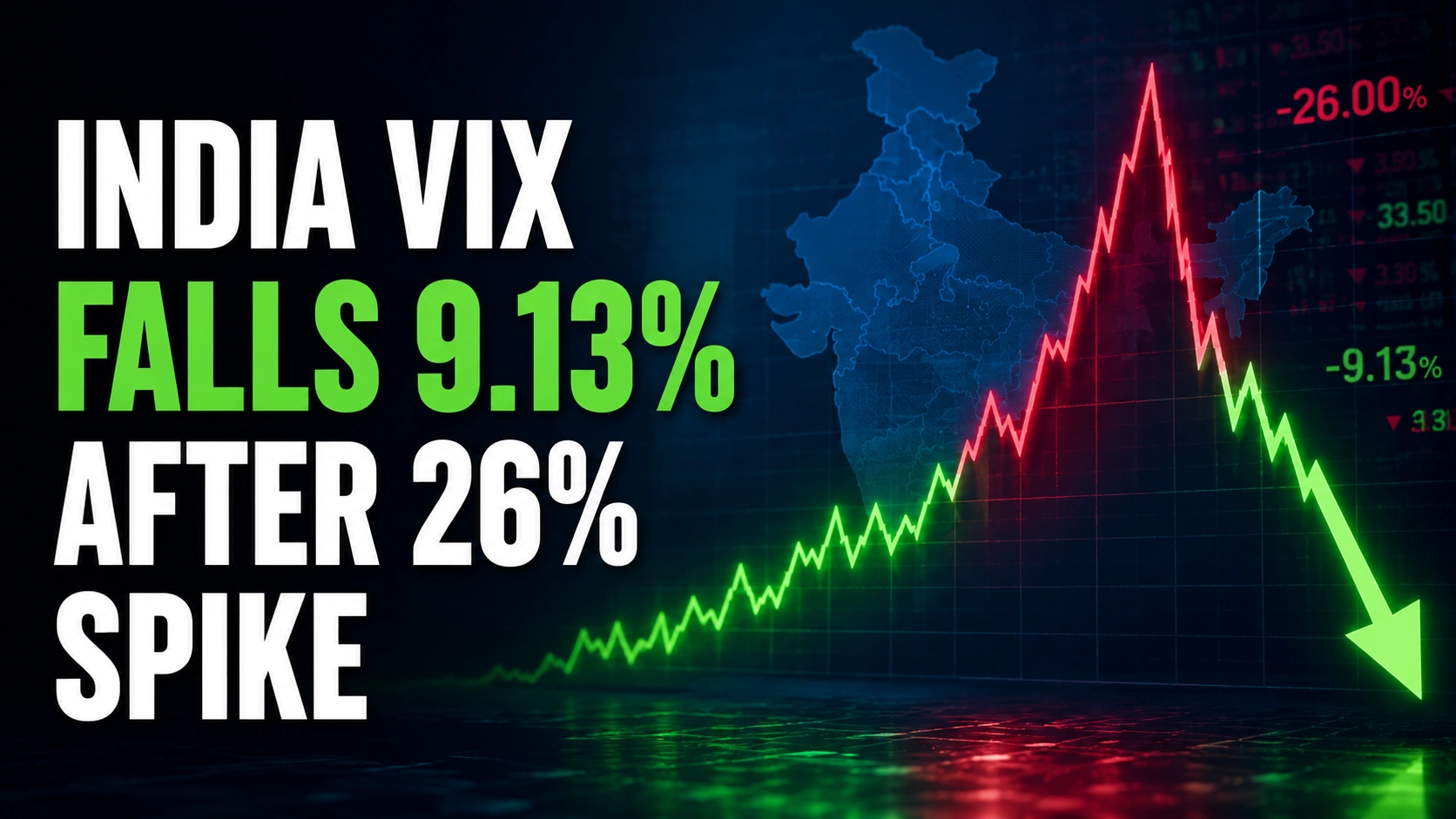
India VIX Falls 9.13% After 26% Spike as Sensex and Nifty Recover in Early Trade Amid Easing Volatility
Authored By HDFC SKY | Published at: Jul 9, 2026 10:52 AM IST
Open Free Demat Account
Open Free Demat Account
Mumbai, July 9: India VIX retreated during Thursday’s opening session after recording its sharpest single-day jump in more than a year in the previous trading session, signalling that market volatility eased slightly even as geopolitical risks and elevated crude oil prices continued to dominate trading sentiment.
As of 10:15 IST, the volatility index was trading at 13.34, down 1.34 points (9.13%) from its previous close of 14.68, after moving within an intraday range of 13.31 to 14.68. Despite the decline, India VIX remained well above the levels seen earlier this week following Wednesday’s broad-based sell-off across Indian equities.

India VIX Slides 9.13% After Wednesday’s 26% Volatility Surge
The decline in India VIX on 9 July followed a dramatic rise during the previous session, when the volatility gauge surged 26.01% to close at 14.68, marking its biggest single-day increase in around 16 months.
The index had climbed from a previous close of 11.65, touched an intraday high of 15.15-15.16, and briefly moved above 14.5 after beginning the week near a five-month low of around 11.70 on 7 July.
Thursday’s pullback indicated that the extreme volatility witnessed a day earlier moderated during the opening session, although the index continued to trade significantly above the calmer 9-12 range that had prevailed in recent weeks. The India VIX maintained a Neutral technical rating, with the day’s classical pivot point at 13.72, immediate support at 12.29, and first resistance at 16.12.
Sensex Rebounds Above 77,000 as Volatility Cools
Indian benchmark indices opened higher on Thursday after suffering one of their sharpest declines in recent months during Wednesday’s session. The Nifty 50 opened 0.43% higher at 23,986.80, while the Sensex began the day 0.41% higher at 76,832.34.
The recovery strengthened during early trade, with the Sensex rising 516.15 points (0.67%) to 77,019.75, while the Nifty 50 gained 139.90 points (0.59%) to 24,021.95. Reports also indicated that the benchmark indices later extended gains, with the Sensex advancing by more than 550 points and the Nifty moving back above 24,050 as volatility eased from Wednesday’s elevated levels.
Broader market participation also improved. Around 15 of the 16 major sectoral indices traded in positive territory during early trade, while the Nifty Midcap 100 and Nifty Smallcap 100 outperformed the benchmarks by gaining around 1% each.
US-Iran Tensions and Oil Rally Drove Wednesday’s Market Shock
The sharp increase in India VIX during the previous session coincided with heightened geopolitical tensions involving the United States and Iran, which intensified concerns over global energy supplies and broader financial markets.
Fresh military developments in the Middle East, including renewed conflict around the Strait of Hormuz, raised fears over potential disruptions to global shipping routes. The developments also pushed Brent crude prices up by 6.24%, rising US$4.63 to around US$78.79 per barrel, while other reports showed Brent trading close to US$78 per barrel during Thursday’s session.
The rise in crude prices added to concerns surrounding imported inflation, India’s trade balance and overall market stability, contributing to a sharp increase in demand for hedging instruments linked to equity markets.
Sharp Equity Sell-Off Lifted Options Hedging Activity
Wednesday witnessed one of the steepest market declines since late March, resulting in a broad-based fall across sectors and a significant increase in implied market volatility.
The Sensex plunged 1,677.12 points (2.15%) to close at 76,503.60, while the Nifty 50 declined 516.65 points (2.12%) to finish at 23,882.05. Market breadth weakened considerably, with 3,186 stocks declining against only 1,093 advancing on the BSE.
The broad market weakness also erased nearly ₹8 lakh crore in market capitalisation during the session. Sectoral indices finished lower across the board, with PSU Banks declining 2.72%, while financial services and fast-moving consumer goods stocks also recorded notable losses.
The sharp decline in equities coincided with increased demand for protective put options. Since India VIX is calculated using implied volatility derived from Nifty options, stronger hedging activity pushed the volatility index sharply higher during Wednesday’s session.
Technology Stocks Lag Despite Wider Market Recovery
Although most sectors recovered during Thursday’s opening trade, the technology sector remained under pressure.
The Nifty IT index declined around 1.5%, with major information technology companies including Infosys, Tata Consultancy Services (TCS), HCL Tech, and Tech Mahindra falling by up to 2% during early trade. In contrast, the Nifty Consumer Durables and Realty indices emerged among the strongest performers, each advancing by as much as 2%.
Market reports also highlighted that selective value buying contributed to the broader recovery, while reduced demand for protective hedges coincided with the easing in India VIX.
Technical Levels Remain in Focus After Volatile Sessions
Market participants continued monitoring key technical levels for the Nifty 50 following Wednesday’s sharp correction.
Immediate support was placed between 23,780 and 23,828, broadly aligning with the 50-day Exponential Moving Average (DEMA), while a broader support zone was identified between 23,645 and 23,800. On the upside, immediate resistance remained between 24,020 and 24,050, with the next major resistance zone placed between 24,150 and 24,300.
Reports noted that the benchmark index had moved below its earlier 24,000-24,150 support cluster during Wednesday’s sell-off, placing greater focus on these technical zones as markets stabilised during Thursday’s session.
July Seasonality Continues to Show Historically Weak Trend
Historical data continues to indicate that July has generally been a weaker month for India VIX. The volatility index has recorded negative monthly returns in 15 of the last 18 years, with an average monthly decline of 8.20%. The strongest positive July move remains 7.39% recorded in 2011, while the largest July decline was 24.22% in 2022. Despite Thursday’s decline, India VIX has delivered 40.61% year-to-date returns and remains well above its 52-week low of 8.72, while still below its 52-week high of 28.90.
India VIX eased during Thursday’s opening session after Wednesday’s sharp volatility spike, while benchmark indices recovered part of their previous losses. However, the volatility index remained above recent trading levels, with geopolitical developments, crude oil prices, technical market levels and the ongoing quarterly earnings season continuing to remain key market factors being closely monitored.
Source:
- https://www.nseindia.com/reports-indices-historical-vix
Disclaimer
If you have any concerns, questions, or wish to point out any discrepancies in our content, please feel free to write to us at content@hdfcsec.com.
Please Note: The information shared is intended solely for informational purposes and does not make any investment recommendations
Disclaimer
At HDFC SKY*, we take utmost care and due diligence in curating and presenting news and market-related content. However, inadvertent errors or omissions may occasionally occur.
If you have any concerns, questions, or wish to point out any discrepancies in our content, please feel free to write to us at content@hdfcsec.com.
Please Note: The information shared is intended solely for informational purposes and does not make any investment recommendations.
HDFC SKY from HDFC Securities, one of most trusted trading platforms in India, has been recognized with the *Next-Gen Digi Content Awards 2025-26.
 Join Us
 Add as preferred source on Google


More Markets News










Open Free Demat Account
Open Free Demat Account










Invest Anytime, Anywhere


By signing up I certify terms, conditions & privacy policy