Nifty 50
- Apollo Hospitals₹8,027.50361.50 (4.72%)
- BSE₹3,287.20-47.60 (-1.43%)
- ITC₹26611.00 (4.31%)
- Reliance Industries₹1,170.30-7.70 (-0.65%)
- Eicher Motors₹7,050282.50 (4.17%)
- JSW Steel₹1,168-7.20 (-0.61%)
- TCS₹2,15680.00 (3.85%)
- Cipla₹1,301-5.80 (-0.44%)
- HCL Technologies₹1,216.7039.80 (3.38%)
- Adani Ports₹1,76153.00 (3.10%)
- Infosys₹1,023.4026.40 (2.65%)
- Shriram Finance₹940.4523.20 (2.53%)
- Tata Motors PV₹279.906.90 (2.53%)
- UltraTech Cement₹10,675249.00 (2.39%)

- Offerings
- Tools & Platforms
Tools & Calculators
- Open API
- Calculators
- SIP Calculator
- CAGR Calculator
- Compound Interest Calculator
- FD Calculator
- RD Calculator
- EPF Calculator
- Retirement Calculator
- HDFC SIP Calculator
- Mutual Fund Return Calculator
- Lumpsum Calculator
- Step Up SIP Calculator
- ETF SIP Calculator
- Brokerage Calculator
- Equity Margin Calculator
- SWP Calculator
- EMI Calculator
- MTF Calculator
- Margin Pledge Calculator
- Algo Strategy
- Markets
Stocks
F&O
Mutual Funds
- More
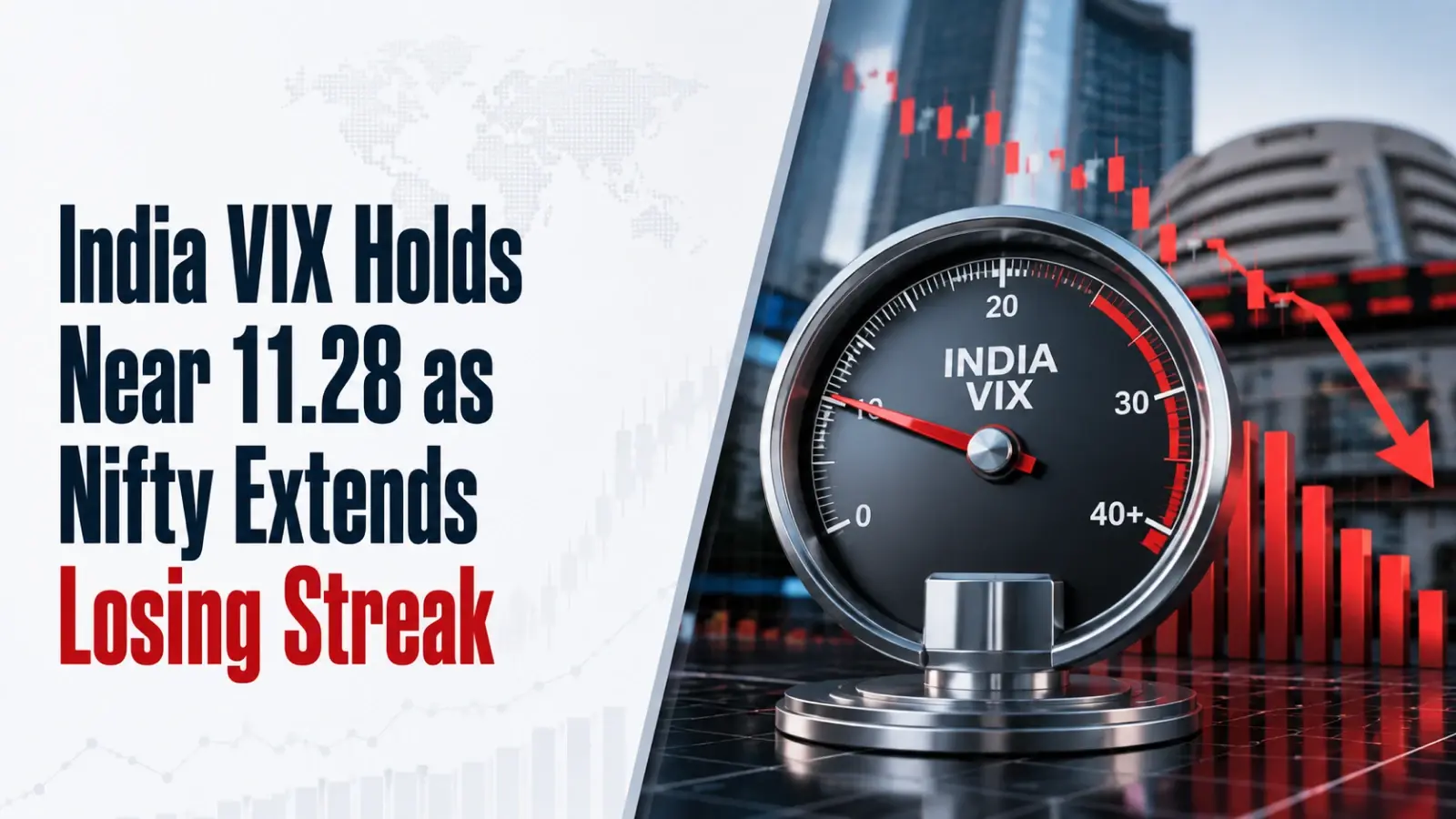
India VIX Holds Near 11.28 as Nifty Extends Losing Streak
Authored By HDFC SKY | Last Modified: Aug 19, 2026 04:36 PM IST
Open Free Demat Account
Open Free Demat Account
Mumbai, Aug 19: India VIX remained contained during Wednesday’s closing session despite continued weakness in Indian equities, Brent crude approaching $92 a barrel, elevated global bond yields and persistent US-Iran tensions. At 3:35 PM IST, India VIX stood at 11.28, down 0.11 points or 0.97%, after moving between 10.06 and 11.72 during the day. The volatility gauge opened at 11.38, compared with the previous close of 11.39.

India VIX at 11.28 Shows Contained Volatility at Close
India VIX remained around the 11–12 range through most of Wednesday’s session, even as benchmark indices continued to decline. The gauge touched an intraday high of 11.72 and a low of 10.06. At 2:54 PM, it was at 11.4475, up 0.50%, while HDFC Sky reported India VIX at 11.46 at 10:14 AM, up 0.53% from the previous close.
The closing-session movement was therefore modest rather than a sharp rise in implied volatility. This was significant because the Nifty was extending its losing streak and remained below the psychologically important 24,100 level. The equity-market weakness created conditions for greater demand for downside protection, but India VIX did not record a major spike.
Nifty Down 0.35% as Seventh Losing Session Continues
The Nifty remained under pressure into the closing session after declining for six consecutive sessions before Wednesday. At 11:30 AM, the index was at 24,056.05, down 99.35 points or 0.41%, while the Sensex stood at 76,889.84, lower by 345.62 points or 0.45%.
Later, the Nifty remained below 24,100 and close to the day’s lows. Reuters subsequently reported the Nifty at 24,070.65, down 0.35%, while the Sensex was at 76,991.33, down 0.32%.
The continued weakness in the benchmark indices supported some upward pressure on implied volatility. However, the relatively small India VIX movement indicated that the equity decline was not accompanied by a comparable surge in expected near-term volatility.
Brent Near $92 Keeps Pressure on Closing-Session Risk
Brent crude was among the key external factors influencing the market into the closing session. The benchmark moved towards $92 a barrel, extending gains for a fourth consecutive session. Another market feed placed Brent at around $92.22, up approximately 1.32% on the day.
The rise was linked to continuing uncertainty around the Strait of Hormuz and the lack of progress in US-Iran negotiations. The higher oil price added pressure to the broader Indian market environment and remained an important factor behind the cautious tone during the closing session.
US-Iran Tensions Sustain Geopolitical Risk into Close
Geopolitical uncertainty remained closely linked to the oil-market move. Market participants continued to monitor the US-Iran conflict, the absence of a clear diplomatic breakthrough and the possibility of disruption to oil shipments through the Strait of Hormuz.
The elevated geopolitical risk contributed to higher crude prices and added pressure to Indian equities. However, the India VIX reading near 11.28 at 3:35 PM showed that this risk did not translate into a sharp volatility increase by the end of the session.
Higher Global Bond Yields Add To Equity-Market Pressure
Higher global bond yields also weighed on Indian equities during Wednesday’s session. Renewed crude strength and sharply higher global bond yields kept the domestic market near its lows during afternoon trading.
The combination of higher yields, rising crude and weak global cues created a challenging backdrop for the closing session. Before India’s market opened, US equities had weakened, Asian markets were mixed to weak, crude prices were rising and geopolitical uncertainty remained elevated. Data also highlighted rising crude, higher yields and weakness in Asian technology and semiconductor shares as factors affecting the Indian market.
Rupee at ₹95.725 Remains a Contained Volatility Factor
The rupee traded around ₹95.725 per US dollar on Wednesday. Reuters reported that continued Reserve Bank of India intervention helped keep the currency relatively stable despite elevated oil prices, global bond-market selling and pressure on emerging-market currencies.
One-month implied volatility for the rupee fell below 4%, its lowest level since January. This meant currency volatility did not create an additional major shock alongside the weakness in Indian equities during the closing session.
FII And DII Buying Offsets Part of the Market Pressure
Institutional flows provided a counterweight to the negative macroeconomic backdrop. The latest available data, referring to 18 August, showed foreign institutional investors as net buyers of ₹1,652 crore, while domestic institutional investors were net buyers of ₹2,579 crore.
The flow data provided some liquidity support despite the weakness in the benchmark indices. The combination of continued institutional buying and contained currency volatility formed part of the backdrop in which India VIX remained relatively stable instead of recording a sharp closing-session increase.
Broad Market Weakness Keeps Downside Protection in Focus
The weakness was not limited to the headline indices. At 11:30 AM, BSE recorded 1,654 advances, 2,267 declines and 259 unchanged stocks, showing negative market breadth.
Data showed declines across healthcare, chemicals and cement stocks, while IT shares were among the areas trading in positive territory. Further it showed the Nifty 50 around 24,048, Nifty Bank around 57,205, Nifty Midcap 100 around 63,358 and Nifty Next 50 around 73,836.
The broad market weakness kept downside protection relevant, although the India VIX response remained limited.
India VIX At 11.39 Entered the Session After Six Nifty Falls
The closing-session reading also needs to be viewed against Wednesday’s starting conditions. On 18 August, India VIX closed at 11.39, while the Nifty fell for a sixth consecutive session to 24,154.90, down 132.75 points or 0.55%. The Sensex declined 492.70 points or 0.63% to 77,235.46.
This meant the market entered 19 August with persistent benchmark weakness but relatively low implied volatility. That pattern continued through Wednesday’s closing session, with India VIX ending at 11.28 despite another decline in the Nifty.
CAS Runs 3:15–3:35 PM as SEBI Warns Against Manipulation
The Closing Auction Session (CAS) was another important feature of Wednesday’s closing phase. The new mechanism, introduced from 3 August, operates from 3:15 PM to 3:35 PM for eligible F&O-linked stocks and involves reference-price determination, order entry and final matching.
At around 2:47 PM, Securities and Exchange Board of India (SEBI) Chairman Tuhin Kanta Pandey warned that the regulator would take immediate action against attempts to manipulate the new closing auction mechanism.
The warning came shortly before the CAS began and placed additional regulatory focus on the closing process. However, there is no reliable evidence in the supplied data establishing that the SEBI statement caused India VIX to rise or fall.
CAS Volume Concerns Add a Market-Structure Risk
Concerns surrounding the new closing mechanism have also extended to market volumes and derivatives activity. Kotak Neo reported that BSE shares had fallen more than 9% during August as new trading rules weighed on volumes and options turnover.
The issue is relevant to India VIX because the volatility index is calculated using Nifty options prices. Changes in options participation and liquidity can therefore form part of the market environment surrounding volatility pricing.
Wednesday’s data, however, did not show a visible volatility spike associated with CAS. India VIX had traded as high as 11.72 during the day before remaining around 11.45 shortly before the closing phase and standing at 11.28 at 3:35 PM.
India VIX’s 18-Year August Pattern Shows 10.19% Average Change
Seasonality data also provides context for the August closing session. India VIX has recorded positive returns in 12 of the past 18 Augusts. The month recorded a maximum positive change of 68.84% in 2015, while its maximum negative change was 11.26% in 2016.
The average positive change for August was 18.10%, the average negative change was -5.65%, and the overall average change was 10.19%. These figures describe the historical August pattern and do not determine Wednesday’s closing movement.
India VIX Ends 0.97% Lower Despite Multiple Market Pressures
India VIX’s closing-session performance therefore presented a clear contrast with the broader market backdrop. The gauge stood at 11.28, down 0.97%, after moving within a 10.06–11.72 intraday range.
The Nifty remained below 24,100 during the session, crude approached $92, US-Iran tensions remained unresolved, global bond yields were elevated and market breadth was negative. At the same time, rupee implied volatility remained below 4%, institutional flows were positive in the latest available data and India VIX remained at a relatively low absolute level.
The closing data consequently showed that equity-market weakness and higher macroeconomic risks did not translate into a comparable increase in India VIX by the end of the session.
India VIX ended the 19 August 2026 session at 11.28, down 0.97%, despite continued Nifty weakness, Brent crude near $92, elevated global yields and geopolitical uncertainty. The 3:15–3:35 PM CAS also remained under regulatory focus after SEBI’s warning, but the supplied data does not establish a direct impact on India VIX.
Disclaimer
If you have any concerns, questions, or wish to point out any discrepancies in our content, please feel free to write to us at content@hdfcsec.com.
Please Note: The information shared is intended solely for informational purposes and does not make any investment recommendations
HDFC SKY, one of India’s most trusted trading platforms, has been recognized with the Next-Gen Digi Content Awards 2025–26.
Disclaimer
At HDFC SKY*, we take utmost care and due diligence in curating and presenting news and market-related content. However, inadvertent errors or omissions may occasionally occur.
If you have any concerns, questions, or wish to point out any discrepancies in our content, please feel free to write to us at content@hdfcsec.com.
Please Note: The information shared is intended solely for informational purposes and does not make any investment recommendations.
HDFC SKY from HDFC Securities, one of most trusted trading platforms in India, has been recognized with the *Next-Gen Digi Content Awards 2025-26.
 Join Us
 Add as preferred source on Google


More Business News






Open Free Demat Account
Open Free Demat Account











Invest Anytime, Anywhere


By signing up I certify terms, conditions & privacy policy