Nifty 50
- Apollo Hospitals₹8,027.50361.50 (4.72%)
- BSE₹3,287.20-47.60 (-1.43%)
- ITC₹26611.00 (4.31%)
- Reliance Industries₹1,170.30-7.70 (-0.65%)
- Eicher Motors₹7,050282.50 (4.17%)
- JSW Steel₹1,168-7.20 (-0.61%)
- TCS₹2,15680.00 (3.85%)
- Cipla₹1,301-5.80 (-0.44%)
- HCL Technologies₹1,216.7039.80 (3.38%)
- Adani Ports₹1,76153.00 (3.10%)
- Infosys₹1,023.4026.40 (2.65%)
- Shriram Finance₹940.4523.20 (2.53%)
- Tata Motors PV₹279.906.90 (2.53%)
- UltraTech Cement₹10,675249.00 (2.39%)

- Offerings
- Tools & Platforms
Tools & Calculators
- Open API
- Calculators
- SIP Calculator
- CAGR Calculator
- Compound Interest Calculator
- FD Calculator
- RD Calculator
- EPF Calculator
- Retirement Calculator
- HDFC SIP Calculator
- Mutual Fund Return Calculator
- Lumpsum Calculator
- Step Up SIP Calculator
- ETF SIP Calculator
- Brokerage Calculator
- Equity Margin Calculator
- SWP Calculator
- EMI Calculator
- MTF Calculator
- Margin Pledge Calculator
- Algo Strategy
- Markets
Stocks
F&O
Mutual Funds
- More
Closing Auction Session: A Step-by-Step Guide to How the New Closing Price Mechanism Works
Authored By HDFC SKY | Last Modified: Aug 19, 2026 01:44 PM IST
Open Free Demat Account
Open Free Demat Account
Mumbai: The way closing prices are determined for certain stocks in India’s equity cash market has changed with the introduction of the Closing Auction Session (CAS). Effective August 3, 2026, CAS applies initially to stocks in the equity cash segment on which derivative contracts are available. The new mechanism is being implemented in a phased manner.
Under the earlier mechanism, the closing price of a stock was determined using the Volume Weighted Average Price (VWAP) of trades executed during the last 30 minutes of the Continuous Trading Session (CTS). Under the new mechanism, eligible stocks have a separate auction after regular trading ends at 3:15 p.m.
The CAS brings eligible buy and sell orders together in a single pool. The exchange then uses an equilibrium-price mechanism to discover the closing price. In simple terms, the process looks at the available buying and selling interest and determines the price at which the maximum possible quantity can be matched.
The objective is to provide a fair and transparent closing price. The closing price is important because it can be used for activities such as derivatives settlement, index computation and mutual fund Net Asset Value (NAV) determination. It can also help passive funds transact closer to the closing price and reduce tracking error.

What Is the Closing Auction Session?

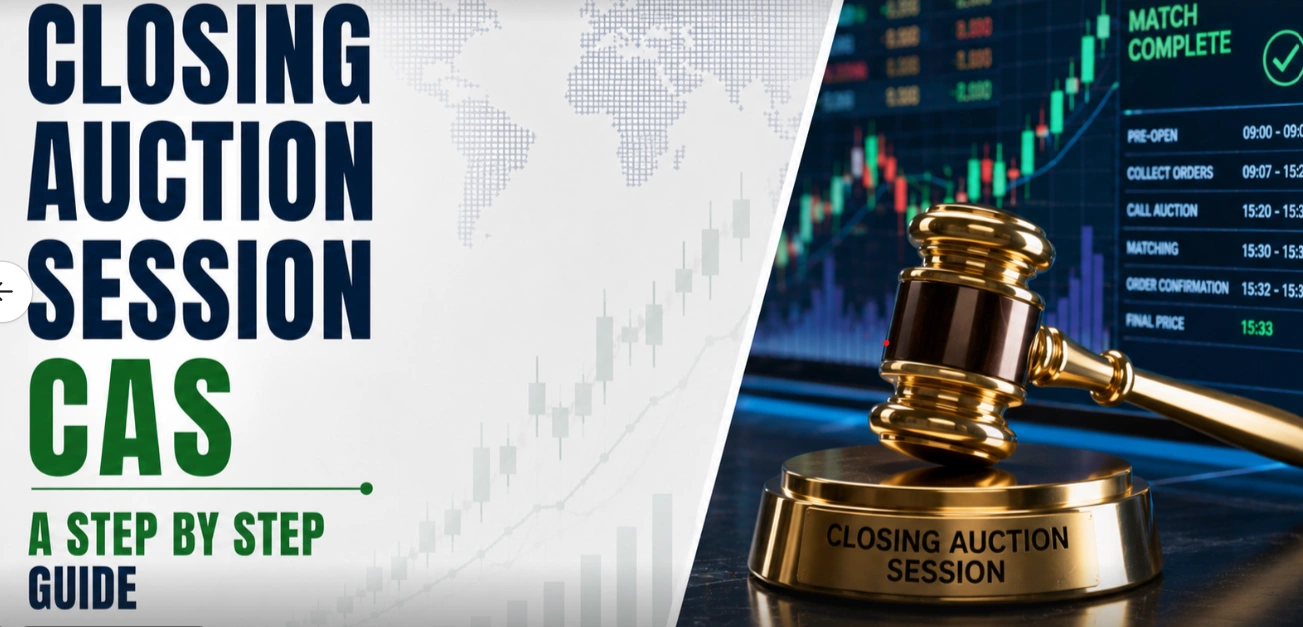
The Closing Auction Session (CAS) is a separate 20-minute trading session used to determine the closing price of eligible stocks in the equity cash segment.
The session runs from 3:15 p.m. to 3:35 p.m. on trading days. Initially, CAS applies to stocks in the cash segment on which derivative contracts are available. For other securities, the closing price continues to be determined using the VWAP of trades executed during the last 30 minutes of the Continuous Trading Session.
The main difference is therefore how the closing price is discovered. Under the earlier mechanism, the closing price was based on the VWAP of trades executed during the final 30 minutes of continuous trading.
Under CAS, the exchange conducts a separate auction. During this auction, eligible buy and sell orders are collected and matched. The closing price is then determined through the equilibrium-price mechanism.
Why Has the Closing Price Mechanism Changed?
A stock’s closing price is more than just the price at which trading ends for the day. It is used as a reference for several market-related activities.
For example, the closing price can be used as a reference for derivatives settlement, index computation and mutual fund NAV determination.
SEBI introduced CAS to create a more transparent closing-price discovery process. The auction brings market interest together into a single pool of liquidity. This can help improve the efficiency of execution, particularly for larger orders.
The mechanism also provides equal and transparent access to different categories of investors. The aim is for the closing price to better reflect the collective buying and selling interest available at the end of the trading day.
For passive funds, the closing price can also be important because such funds may need to transact at or around the closing price. A transparent closing-price mechanism can therefore help reduce tracking error.
How Does the Closing Auction Session Work?
The CAS is conducted over 20 minutes from 3:15 p.m. to 3:35 p.m. The session is divided into four stages:
- 3:15 p.m. to 3:20 p.m. — Reference price calculation and transition from CTS to CAS
- 3:20 p.m. to 3:25 p.m. — Order entry for limit and market orders
- 3:25 p.m. to approximately 3:30 p.m. — Order entry for limit orders, followed by random closure
- 3:30 p.m. to 3:35 p.m. — Order matching
Let’s understand each stage step by step.
Step 1: Reference Price Is Determined — 3:15 p.m. to 3:20 p.m.
 The first five minutes of CAS are used for reference price calculation and the transition from the Continuous Trading Session to the Closing Auction Session.
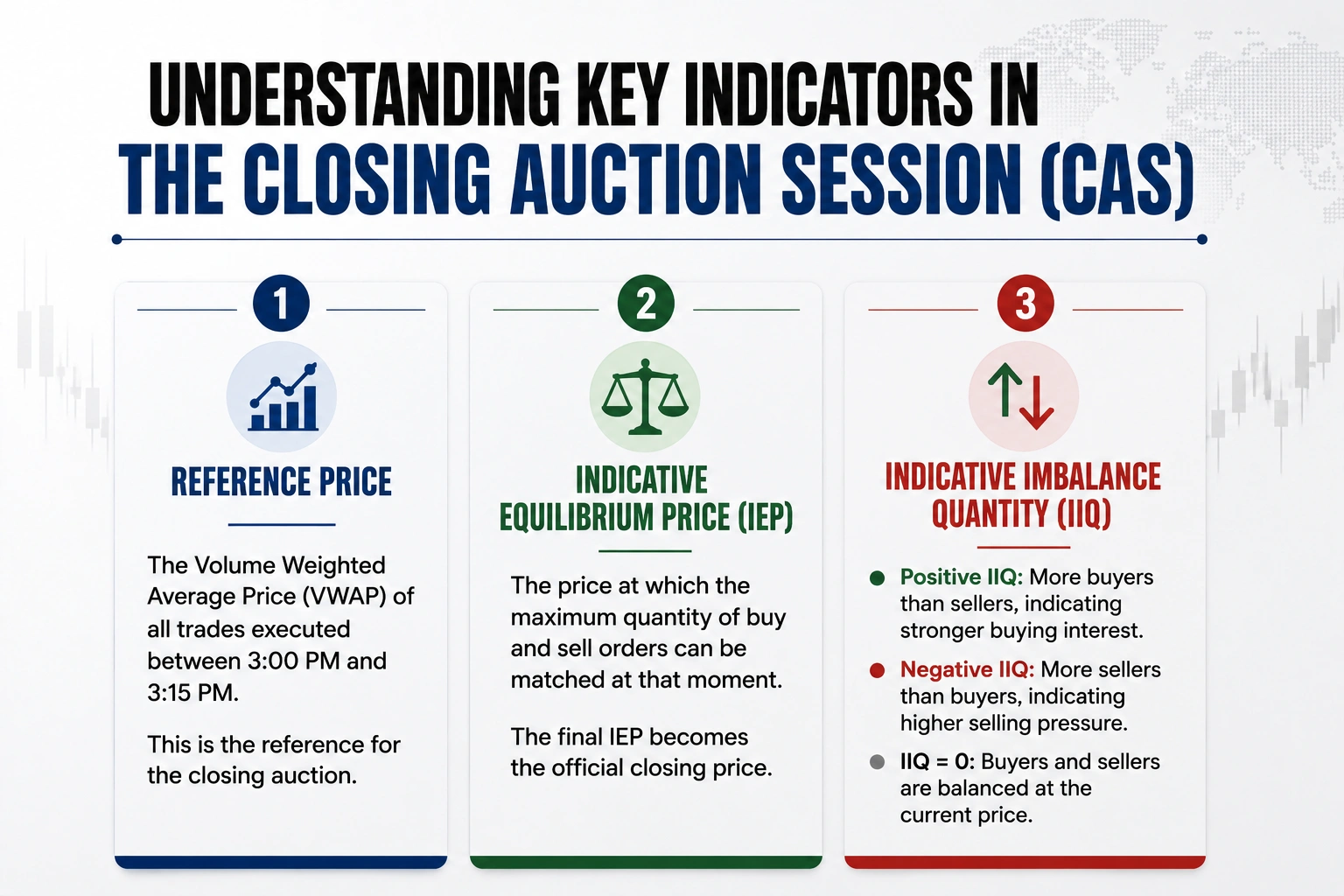
The Reference Price is the starting price used for the CAS. It is generally calculated using the Volume Weighted Average Price (VWAP) of trades executed in the stock between 3:00 p.m. and 3:15 p.m.
VWAP means the average trading price of a stock after taking the quantity traded at each price into account. Therefore, prices at which larger quantities were traded have a greater influence on the VWAP.
Example: Calculating the Reference Price
Suppose a stock trades at different prices between 3:00 p.m. and 3:15 p.m. Assume the VWAP of all eligible trades during this period works out to ₹100. The reference price for the CAS would therefore be:
Reference Price = ₹100
This reference price is then used to determine the applicable price band during the auction.
What If There Is No Trade Between 3:00 p.m. and 3:15 p.m.?
SEBI has also specified a process for determining the reference price when there are no trades during the 3:00 p.m. to 3:15 p.m. period.
If no trade is executed in the stock between 3:00 p.m. and 3:15 p.m., the Last Traded Price (LTP) of the stock during the day is taken as the reference price. The Last Traded Price means the price at which the most recent trade in the stock was executed.
For example, suppose a stock last traded at ₹250 at 2:45 p.m. and there were no further trades between 3:00 p.m. and 3:15 p.m. In this situation:
Reference Price = ₹250
If there has been no trade during the entire trading day, the closing price of the previous trading day is used as the reference price.In the case of a corporate action, the previous day’s closing price is adjusted as applicable, or the relevant base price is used.
This ensures that the CAS can still operate even when there is insufficient trading activity during the 3:00 p.m. to 3:15 p.m. period.
Step 2: Limit and Market Orders Can Be Entered — 3:20 p.m. to 3:25 p.m.
The next five minutes are the first order-entry period of CAS. During this period, investors can enter both limit orders and market orders. A limit order is an order to buy or sell a stock at a specified price or a better price.
For example, a buy limit order at ₹100 means the investor is willing to buy the stock at ₹100 or a lower price. A market order, on the other hand, is an order to buy or sell at the price available in the market, subject to the rules of the auction.
Both limit orders and market orders are considered when calculating the equilibrium price.
Example: Orders Entered During CAS
Suppose the reference price of a stock is ₹100.
During the first order-entry period, investors enter the following orders:
- Buy 5,000 shares at ₹99
- Buy 3,000 shares at ₹100
- Buy 2,000 shares at ₹101
- Sell 4,000 shares at ₹100
- Sell 3,000 shares at ₹101
- Sell 2,000 shares at ₹102
The exchange considers the available buy and sell interest when determining the equilibrium price.
The purpose is to identify the price at which the maximum possible quantity can be matched.
Step 3: Only Limit Orders Can Be Entered – 3:25 p.m. to Random Close
The next stage begins at 3:25 p.m. During this period, the order-entry process continues, but only limit orders can be entered. Market orders cannot be modified or cancelled during this period.
Another important feature of CAS is the random closure of the order-entry session. The order-entry session closes at a randomly selected time between 3:28 p.m. and 3:30 p.m. The random closure is system-driven.
This means market participants do not know the exact time at which order entry will end.The random closure is designed to ensure that participants cannot time their order submissions based on a known closing moment.
Once the order-entry period closes, the exchange moves to the order-matching stage.
Step 4: Orders Are Matched — 3:30 p.m. to 3:35 p.m.
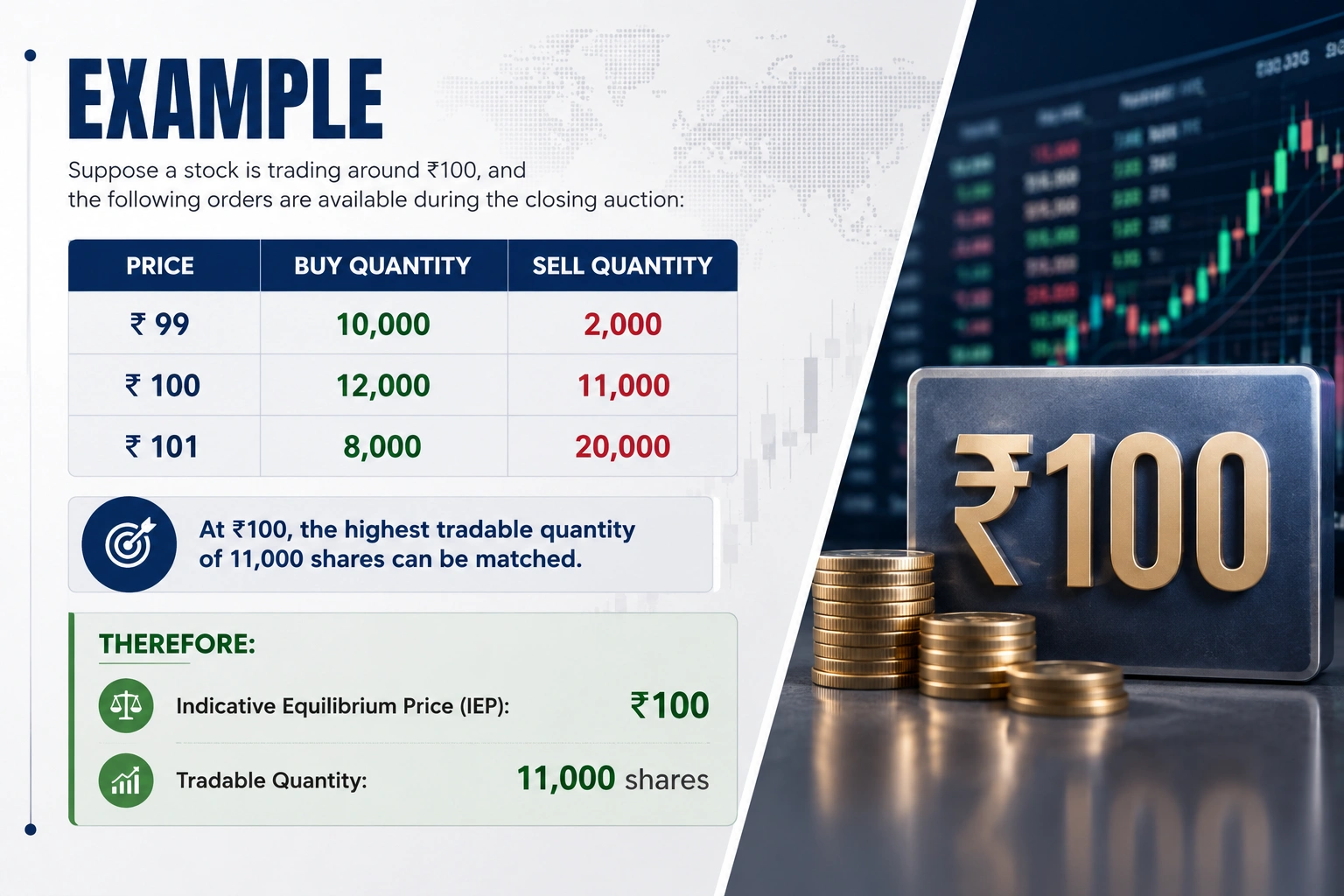
The final five minutes of CAS are used for order matching. Order matching is the process through which eligible buy and sell orders are matched based on the applicable auction rules. The closing price is determined using the equilibrium-price mechanism. The Equilibrium Price is the price at which the maximum volume can be executed.
In simple terms, the exchange compares the available buying and selling interest at different prices. It then identifies the price at which the largest possible number of shares can be matched. The equilibrium price determined through this process becomes the closing price of the eligible stock.
Example: How the Equilibrium Price Is Determined
Suppose a stock has a reference price of ₹100. During CAS, different buy and sell orders are available at different prices. Assume the exchange evaluates the orders and finds that the maximum executable quantity is available at ₹100.
In this case:
Equilibrium Price = ₹100
Maximum Executable Quantity = 8,000 shares
The equilibrium price of ₹100 becomes the closing price of the stock, subject to the applicable CAS rules. The important point is that the closing price is not simply the last traded price before 3:15 p.m. Instead, it is discovered through the auction by considering the available buy and sell interest.
Example: When the CAS Closing Price Differs From the Reference Price
The closing price discovered during CAS does not necessarily have to be the same as the reference price. Consider a stock with a reference price of ₹200.
The applicable CAS price band would be:
- Lower limit = ₹194
- Upper limit = ₹206
Suppose investors enter a large number of buy and sell orders during the auction. After evaluating the orders, the exchange determines that the maximum executable quantity is available at ₹204.
The equilibrium price would therefore be:
Equilibrium Price = ₹204
In this example:
- Reference Price = ₹200
- Equilibrium/Closing Price = ₹204
- Difference = ₹4
The closing price is therefore 2% higher than the reference price. It remains within the applicable ±3% CAS price band. This example shows why the final closing price of an eligible stock can differ from the price at which it was trading immediately before the CAS began.
What Is the CAS Price Band?
The price band specifies the maximum range within which the stock’s price can move during the Closing Auction Session.
SEBI has prescribed a price band of ±3% from the reference price during CAS.
Example: Reference Price of ₹500
Suppose the reference price is ₹500.
A 3% movement from ₹500 is:
3% of ₹500 = ₹15
Therefore:
- Lower limit = ₹500 − ₹15 = ₹485
- Upper limit = ₹500 + ₹15 = ₹515
The applicable CAS price range would therefore be:
₹485 to ₹515
The equilibrium price must be discovered within the applicable price band. SEBI has also specified that the price band for stock futures during the period from 3:15 p.m. to 3:40 p.m. will be aligned with the price band applicable during CAS.
The existing framework for dynamic flexing of price bands for stock futures will not apply during this period. It will continue to apply during the relevant period of the Continuous Trading Session.
What Happens After CAS?
CAS ends at 3:35 p.m. However, trading activity in related market segments continues beyond this time. The equity derivatives segment continues to operate until 3:40 p.m. on trading days. For the cash segment, the post-close session operates from 3:50 p.m. to 4:00 p.m.
During this post-close session, trades are executed at the closing price of the stocks. This means that the closing price discovered through CAS can also be used for transactions during the post-close session.
Example: Understanding the Complete CAS Process

Consider a stock with the following situation.
The stock’s VWAP between 3:00 p.m. and 3:15 p.m. is ₹100.
Therefore:
Reference Price = ₹100
The applicable CAS price band is ±3%.
Therefore:
Lower Price = ₹97
Upper Price = ₹103
At 3:20 p.m., the order-entry period begins. Suppose investors enter multiple buy and sell orders between ₹97 and ₹103. At one point during the auction, the exchange calculates an Indicative Equilibrium Price (IEP) of ₹101. At this price, suppose the total buy quantity is 15,000 shares while the total sell quantity is 12,000 shares.
The Indicative Imbalance Quantity is therefore 3,000 shares on the buy side. Additional orders may subsequently enter the auction. Suppose the available orders change and the maximum executable quantity is ultimately found at ₹102.
The final equilibrium price would then be:
Equilibrium Price = ₹102
Since ₹102 is within the applicable ₹97–₹103 price band, it can serve as the closing price, subject to the applicable auction rules. The stock’s final closing price would therefore be ₹102, even though its reference price was ₹100.
The introduction of CAS represents a shift from a VWAP-based closing-price mechanism to an auction-based price-discovery process for eligible stocks. By bringing buy and sell interest together during a dedicated closing session, the mechanism is designed to provide a more transparent way of determining the official closing price.
For investors and traders, understanding the timing of CAS, the reference-price calculation, permitted order types, price band, Indicative Equilibrium Price, Indicative Imbalance Quantity and equilibrium-price mechanism can make the new closing process easier to understand and follow.
Source
- https://www.sebi.gov.in/legal/circulars/jan-2026/introduction-of-closing-auction-session-cas-in-the-equity-cash-segment-and-certain-modifications-in-the-pre-open-auction-session_99122.html?
Disclaimer
If you have any concerns, questions, or wish to point out any discrepancies in our content, please feel free to write to us at content@hdfcsec.com.
Please Note: The information shared is intended solely for informational purposes and does not make any investment recommendations
HDFC SKY, one of India’s most trusted trading platforms, has been recognized with the Next-Gen Digi Content Awards 2025–26.
Disclaimer
At HDFC SKY*, we take utmost care and due diligence in curating and presenting news and market-related content. However, inadvertent errors or omissions may occasionally occur.
If you have any concerns, questions, or wish to point out any discrepancies in our content, please feel free to write to us at content@hdfcsec.com.
Please Note: The information shared is intended solely for informational purposes and does not make any investment recommendations.
HDFC SKY from HDFC Securities, one of most trusted trading platforms in India, has been recognized with the *Next-Gen Digi Content Awards 2025-26.
 Join Us
 Add as preferred source on Google


More Business News









Open Free Demat Account
Open Free Demat Account











Invest Anytime, Anywhere


By signing up I certify terms, conditions & privacy policy