Nifty 50
- Eternal₹317.4012.95 (4.25%)
- Shriram Finance₹865-35.90 (-3.98%)
- Apollo Hospitals₹7,730125.50 (1.65%)
- Adani Enterprises₹2,477-73.00 (-2.86%)
- ONGC₹227.502.50 (1.11%)
- JSW Steel₹1,185.50-34.50 (-2.83%)
- Asian Paints₹2,30722.20 (0.97%)
- Jio Financial ₹205.03-5.77 (-2.74%)
- TCS₹2,53023.10 (0.92%)
- Tata Steel₹167.67-4.66 (-2.70%)
- UltraTech Cement₹11,05092.00 (0.84%)
- Adani Ports₹1,702.70-47.30 (-2.70%)
- Maruti Suzuki₹11,23060.00 (0.54%)
- Tech Mahindra₹1,790-39.10 (-2.14%)
- Cipla₹1,3387.10 (0.53%)
- Tata Motors PV₹264.60-5.40 (-2.00%)
- Reliance Industries₹1,1905.50 (0.46%)
- Hindalco Industries₹869.85-15.75 (-1.78%)
- Axis Bank₹1,217.505.50 (0.45%)
- Trent₹2,727.50-48.30 (-1.74%)

- Offerings
- Tools & Platforms
Tools & Calculators
- Open API
- Calculators
- SIP Calculator
- CAGR Calculator
- Compound Interest Calculator
- FD Calculator
- RD Calculator
- EPF Calculator
- Retirement Calculator
- HDFC SIP Calculator
- Mutual Fund Return Calculator
- Lumpsum Calculator
- Step Up SIP Calculator
- ETF SIP Calculator
- Brokerage Calculator
- Equity Margin Calculator
- SWP Calculator
- EMI Calculator
- MTF Calculator
- Margin Pledge Calculator
- Algo Strategy
- Markets
Stocks
F&O
Mutual Funds
- More
India VIX Plunges 7.25% To 12.28 On July 2as Crude Oil Eases and Equities Extend Recovery
Authored By HDFC SKY | Last Modified: Jul 2, 2026 05:30 PM IST
Open Free Demat Account
Open Free Demat Account
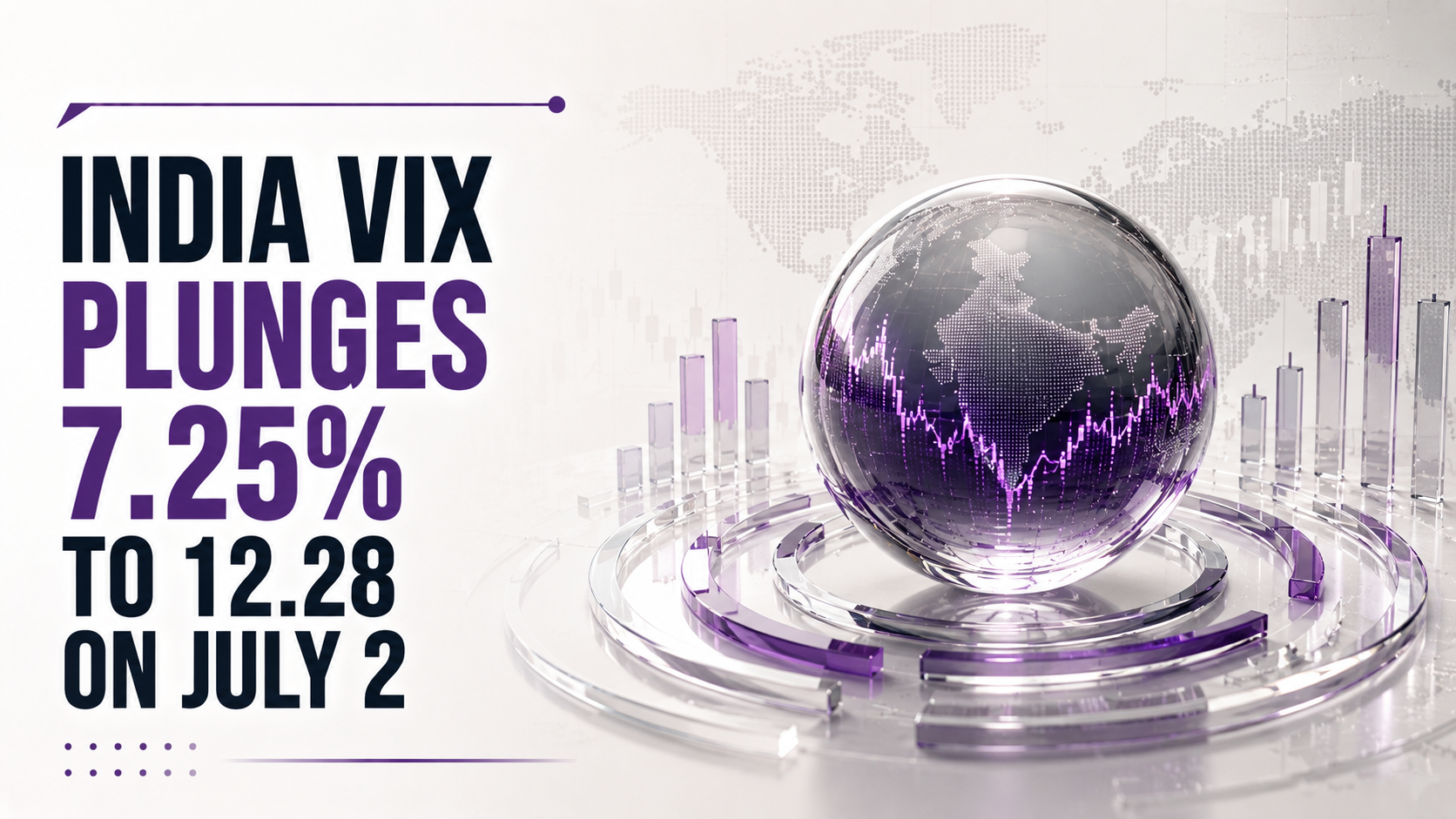
Mumbai, July 2: India VIX, the National Stock Exchange’s (NSE) volatility index, declined sharply during Thursday’s closing session, ending 7.25% lower at 12.28, down 0.96 points from the previous close of 13.24. The index remained firmly below the 13-mark, reflecting lower expected market volatility over the next 30 days as domestic equities extended their recovery amid easing global concerns, softer crude oil prices and broad-based buying across key sectors.
During the session, India VIX opened at 13.24, touched an intraday high of 13.29 and slipped to a day’s low of 12.19 before settling at 12.28. The latest closing level remains well below its 52-week high of 28.90, while staying comfortably above the 52-week low of 8.72.

India VIX Drops 7.25% As Lower Crude Prices Reduce Market Volatility
The sharp decline in India VIX coincided with improving conditions across domestic and global markets. Softer global crude oil prices emerged as one of the primary developments during the session after reports of progress in United States-Iran discussions eased concerns over energy supplies. Brent crude traded near $70 per barrel, reducing inflation-related worries for oil-importing economies, including India.
Alongside the decline in crude prices, Indian benchmark indices staged another strong recovery. The Sensex advanced by more than 500 points, while the Nifty 50 moved above 24,150 during intraday trade. Buying interest remained broad-based, with information technology, metals, automobiles, real estate and consumer durable stocks contributing to market gains.
Closing Levels At 12.28 Keep India VIX Near Calm Zone
Market data showed that India VIX finished the session at 12.28, after opening at 13.24 and moving within a trading range of 12.19 to 13.29. Compared with its previous close of 13.24, the latest reading reflected a decline of 7.25%, marking one of the steepest single-session falls recorded in recent weeks.
Historically, India VIX readings between 10 and 15 have generally represented relatively stable market conditions, while readings above 20 have coincided with heightened uncertainty. Although the index had climbed above 28 earlier in 2026 during periods of geopolitical tensions in West Asia, it has gradually retreated as those concerns eased.
The technical outlook for the index remained Neutral at the close. The day’s classic pivot level stood at 13.49, with resistance levels placed at 13.82, 14.41 and 14.74, while immediate support levels were identified at 12.90, 12.57 and 11.98.
Global Developments And Sectoral Strength Support Lower Volatility
Thursday’s movement in India VIX unfolded alongside several domestic and international developments. Reports indicating progress in diplomatic discussions involving the United States and Iran helped ease concerns surrounding crude oil supplies and shipping through the Strait of Hormuz. The decline in energy prices reduced one of the key sources of recent market uncertainty.
At the same time, Indian equities witnessed strong participation across multiple sectors. The Nifty IT index advanced by nearly 3%, while metal stocks also recovered during the session. Automobile shares extended their recent gains after manufacturers reported encouraging June 2026 sales numbers. Market participants also noted signs of moderation in foreign institutional selling, contributing to improved trading conditions during the day.
The broader market reflected this recovery, with advancing shares comfortably outnumbering declining stocks on the Bombay Stock Exchange (BSE).
India VIX Reflects Expected Market Swings Over 30 Days
India VIX measures the market’s expectation of volatility over the next 30 days, based on Nifty 50 option prices. Rather than tracking the direction of equity markets, the index estimates the extent of expected price fluctuations.
A higher India VIX generally indicates increased uncertainty and wider anticipated market movements, while lower readings suggest comparatively stable trading conditions. Thursday’s closing level of 12.28 placed the volatility gauge within the lower end of its historical trading range.
So far in 2026, the index has experienced considerable fluctuations, climbing above 28 during geopolitical uncertainties before steadily moving back towards lower levels as external risks moderated.
Seasonality Shows July Has Historically Favoured Lower India VIX
Historical data also points towards July being a relatively weaker month for India VIX. Over the past 18 years, the volatility index has delivered negative monthly returns in 15 instances during July.
The highest positive July movement recorded was 7.39% in 2011, while the steepest decline reached 24.22% in 2022. On average, July has recorded a negative return of 8.65%, with the average negative monthly movement standing at 11.27%.
Year-to-date, India VIX continues to remain 29.54% higher despite Thursday’s decline, highlighting the elevated volatility witnessed during earlier months of the year.
Earlier Volatility Spike Keeps 2026 Trading Range Elevated
Although Thursday’s decline brought India VIX back towards comparatively lower levels, the index has traded across a notably wide range during the past year. The current closing value of 12.28 remains significantly below the 52-week high of 28.90, recorded during periods of heightened geopolitical uncertainty, while remaining above the 52-week low of 8.72.
The movement reflects how market volatility has moderated after earlier episodes of uncertainty, with the latest session extending the recent trend of easing fluctuations across Indian equities.
India VIX ended the 2 July 2026 session at 12.28, down 7.25% from the previous close, while remaining within its 52-week range of 8.72 to 28.90. The decline coincided with lower crude oil prices, stronger benchmark indices and broad-based sectoral gains, while the index continued to indicate expected 30-day market volatility based on Nifty 50 options pricing.
Source
- https://www.nseindia.com/reports-indices-historical-vix
Disclaimer
If you have any concerns, questions, or wish to point out any discrepancies in our content, please feel free to write to us at content@hdfcsec.com.
Please Note: The information shared is intended solely for informational purposes and does not make any investment recommendations
Disclaimer
At HDFC SKY*, we take utmost care and due diligence in curating and presenting news and market-related content. However, inadvertent errors or omissions may occasionally occur.
If you have any concerns, questions, or wish to point out any discrepancies in our content, please feel free to write to us at content@hdfcsec.com.
Please Note: The information shared is intended solely for informational purposes and does not make any investment recommendations.
HDFC SKY from HDFC Securities, one of most trusted trading platforms in India, has been recognized with the *Next-Gen Digi Content Awards 2025-26.
 Join Us
 Add as preferred source on Google


More Markets News







Open Free Demat Account
Open Free Demat Account










Invest Anytime, Anywhere


By signing up I certify terms, conditions & privacy policy