Nifty 50
- Bajaj Auto₹9,994216.00 (2.21%)
- Tech Mahindra₹1,482.20-31.90 (-2.11%)
- Bharat Electronics₹374.606.45 (1.75%)
- Hindalco Industries₹896.70-3.65 (-0.41%)
- Asian Paints₹2,370.9031.80 (1.36%)
- ITC₹265.05-0.95 (-0.36%)
- Jio Financial ₹217.502.88 (1.34%)
- Axis Bank₹1,254.70-4.40 (-0.35%)
- TCS₹2,18327.00 (1.25%)
- Bharti Airtel₹1,801.90-3.20 (-0.18%)
- Trent₹2,95435.80 (1.23%)
- SBI₹958.20-0.90 (-0.09%)
- Reliance Industries₹1,183.3013.00 (1.11%)
- Mahindra & Mahindra₹2,826.9030.70 (1.10%)
- Adani Enterprises₹2,661.9027.50 (1.04%)
- HCL Technologies₹1,229.3012.60 (1.04%)

- Offerings
- Tools & Platforms
Tools & Calculators
- Open API
- Calculators
- SIP Calculator
- CAGR Calculator
- Compound Interest Calculator
- FD Calculator
- RD Calculator
- EPF Calculator
- Retirement Calculator
- HDFC SIP Calculator
- Mutual Fund Return Calculator
- Lumpsum Calculator
- Step Up SIP Calculator
- ETF SIP Calculator
- Brokerage Calculator
- Equity Margin Calculator
- SWP Calculator
- EMI Calculator
- MTF Calculator
- Margin Pledge Calculator
- Algo Strategy
- Markets
Stocks
F&O
Mutual Funds
- More
India VIX Rises 0.97% as Ceasefire Ends, Brent Tops $90
Authored By HDFC SKY | Last Modified: Aug 18, 2026 12:00 PM IST
Open Free Demat Account
Open Free Demat Account
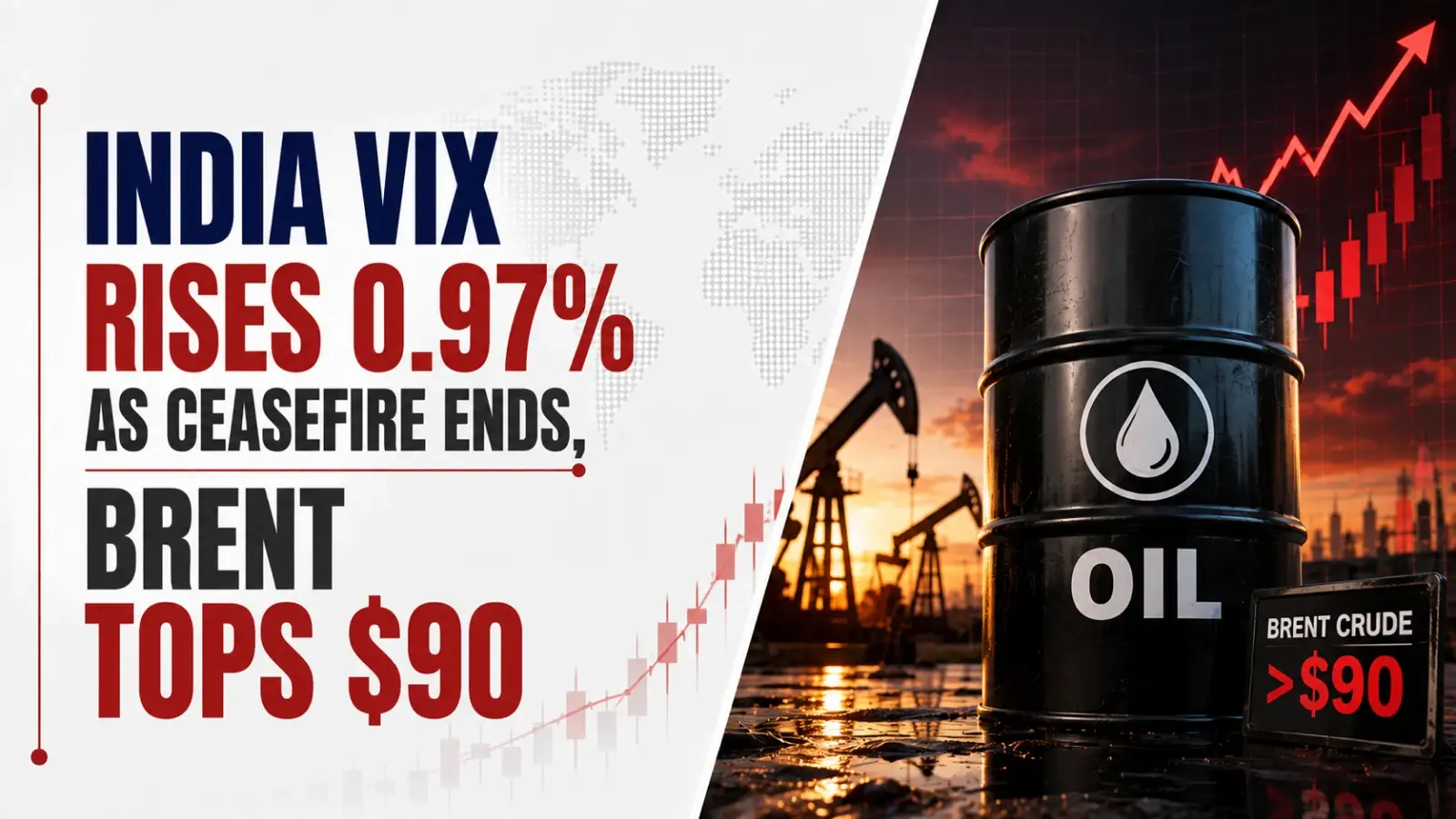
Mumbai, Aug 18: India VIX edged higher in the opening session on Tuesday as the expiry of the US-Iran ceasefire renewed geopolitical uncertainty and pushed Brent crude above $90 a barrel. The volatility index opened around 11.32, against Monday’s previous close of 11.33, and was at 11.44, up 0.11 or 0.97%, as of 10:00 IST. The move remained modest despite several risk factors weighing on global and Indian markets.

India VIX Opens at 11.32 As Risks Rise
India VIX opened around 11.32 before moving to an early-session high of 11.46 and a low of 10.14. Its 52-week range remained between 8.72 and 28.90. The opening move came as Indian equities faced weaker external cues, with the Sensex down around 300 points and the Nifty trading below 24,250 in early trade. The immediate market backdrop was shaped by geopolitical uncertainty, higher crude prices, elevated US Treasury yields and pressure on the rupee.
The volatility index measures expected volatility in the Nifty based on option prices. Therefore, the weaker opening setup for Indian equities was accompanied by upward pressure on India VIX, although the index did not register a sharp repricing in the opening minutes. The technical rating was NEUTRAL, with the Classic pivot at 11.40, resistance levels at 11.70, 12.08 and 12.38, and support levels at 11.02, 10.72 and 10.34. These levels reflected the previous day’s trading range.
Ceasefire Expiry Raises Geopolitical Risk
The expiry of the US-Iran ceasefire was the principal global development influencing the opening risk environment. Iran signalled a possible shift towards a “fully offensive” military posture, while the absence of fresh calming signals from Washington increased concerns over renewed military escalation.
The development moved global markets towards a risk-off tone and created upward pressure on India VIX. However, the effect was contained because the possibility of renewed tensions had already been known to markets following Monday’s developments. As a result, the ceasefire expiry added to volatility at the open without producing a major spike in the index.
Brent Above $90 Adds India-Specific Pressure
Brent crude became the key channel through which the geopolitical development affected Indian markets. Brent rose above $90 a barrel and reached around $91.20 in early Asian trading, with the move attributed to the ceasefire expiry and renewed concerns over supply.
For India, higher crude prices raise concerns around the import bill, inflation, the current account, corporate margins, the rupee and future interest-rate conditions. The rise in oil therefore added another layer of pressure to the opening market setup. The combination of geopolitical uncertainty and Brent above $90 placed upward pressure on India VIX through the expected increase in market volatility.
Rupee Near ₹95.72 Adds Currency Pressure
The oil shock also carried into the currency market. Traders expected the rupee to open around ₹95.68–95.72 per US dollar, compared with Monday’s close of ₹95.6025. Higher crude prices and elevated US Treasury yields were expected to put additional pressure on the Indian currency.
The weaker rupee added to the uncertainty surrounding inflation and external balances, providing a secondary upward influence on India VIX. The currency movement was linked closely to the oil and global yield developments rather than representing a separate primary trigger for the opening volatility.
RBI Intervention Limits Currency Volatility
The Reserve Bank of India (RBI) was reported to be intervening in the foreign-exchange market for the eighth consecutive session, with state-owned banks selling dollars to support the rupee.
The intervention worked in the opposite direction to the crude and geopolitical pressures. While higher oil prices increased pressure on the currency, the RBI’s market activity helped contain the risk of a disorderly rupee decline. This provided a volatility-dampening influence on India VIX during the opening setup and partially offset the pressure generated by crude and geopolitical developments.
US Yields at 5.321% Add Global Risk
US Treasury yields also moved higher as markets assessed the renewed geopolitical uncertainty. The US 30-year Treasury yield reached around 5.321%, while the 10-year yield rose to approximately 4.724%.
Higher US yields added to global financial-market pressure by increasing the relative attraction of US assets, tightening financial conditions and adding pressure to emerging-market currencies. For India VIX, the rise in yields was a secondary global factor, adding to the broader risk environment created by the US-Iran developments and higher crude prices.
Asian Stocks Fall as Risk-Off Tone Spreads
Weak Asian equity cues added to the pressure facing Indian markets at the open. The MSCI Asia-Pacific index was down 0.3%, while Japan’s Nikkei 225 fell 1.6%. South Korea’s KOSPI was broadly flat after initially moving higher.
The weakness reflected the broader response to geopolitical uncertainty and contributed to a less supportive opening environment for Indian equities. The negative regional cues added upward pressure to India VIX by increasing the possibility of a weaker Nifty opening, but they remained a secondary factor compared with the US-Iran ceasefire expiry and the rise in crude prices.
GIFT Nifty Signals a Weaker Indian Opening
Negative GIFT Nifty cues reinforced the expectation of a weaker domestic opening. The Nifty had closed at 24,287 on Monday, while early indications pointed towards a lower start on Tuesday.
Because India VIX is derived from Nifty option prices, expectations of a weaker opening can influence demand for downside protection and place upward pressure on implied volatility. However, the GIFT Nifty signal reflected the overnight global developments rather than representing an independent news event. The opening India VIX reading consequently remained only modestly above Monday’s close.
India VIX opened around 11.32 and stood at 11.44 by 10:00 IST, up 0.97%. The opening risk environment was shaped mainly by the US-Iran ceasefire expiry and Brent crude above $90, while rupee pressure, higher US yields and weak Asian cues added to volatility. RBI intervention provided a partial offset.
Source
- https://www.nseindia.com/reports-indices-historical-vix
Disclaimer
If you have any concerns, questions, or wish to point out any discrepancies in our content, please feel free to write to us at content@hdfcsec.com.
Please Note: The information shared is intended solely for informational purposes and does not make any investment recommendations
Disclaimer
At HDFC SKY*, we take utmost care and due diligence in curating and presenting news and market-related content. However, inadvertent errors or omissions may occasionally occur.
If you have any concerns, questions, or wish to point out any discrepancies in our content, please feel free to write to us at content@hdfcsec.com.
Please Note: The information shared is intended solely for informational purposes and does not make any investment recommendations.
HDFC SKY from HDFC Securities, one of most trusted trading platforms in India, has been recognized with the *Next-Gen Digi Content Awards 2025-26.
 Join Us
 Add as preferred source on Google


More Business News







Open Free Demat Account
Open Free Demat Account











Invest Anytime, Anywhere


By signing up I certify terms, conditions & privacy policy