Nifty 50
- Dr. Reddy's Labs₹1,310.9081.40 (6.62%)
- Shriram Finance₹825-40.00 (-4.62%)
- JSW Steel₹1,26074.50 (6.28%)
- Tata Consumer ₹936.50-27.40 (-2.84%)
- BSE₹3,359128.20 (3.97%)
- Bajaj Finance₹918.70-10.25 (-1.10%)
- Adani Ports₹1,752.5049.80 (2.92%)
- HDFC Life Insurance ₹519-4.75 (-0.91%)
- Eternal₹325.558.15 (2.57%)
- HDFC Bank₹688.05-4.75 (-0.69%)
- Max Healthcare₹83520.00 (2.45%)
- Sun Pharmaceutical₹1,740-8.00 (-0.46%)
- Kotak Mahindra Bank₹440.7510.25 (2.38%)
- HCL Technologies₹1,417-5.20 (-0.37%)
- Grasim Industries₹2,95056.00 (1.94%)
- Tata Motors PV₹263.70-0.90 (-0.34%)
- Coal India₹4057.55 (1.90%)
- Mahindra & Mahindra₹2,853.10-8.10 (-0.28%)
- Hindalco Industries₹885.6515.80 (1.82%)
- Power Grid Corp₹247-0.40 (-0.16%)

- Offerings
- Tools & Platforms
Tools & Calculators
- Open API
- Calculators
- SIP Calculator
- CAGR Calculator
- Compound Interest Calculator
- FD Calculator
- RD Calculator
- EPF Calculator
- Retirement Calculator
- HDFC SIP Calculator
- Mutual Fund Return Calculator
- Lumpsum Calculator
- Step Up SIP Calculator
- ETF SIP Calculator
- Brokerage Calculator
- Equity Margin Calculator
- SWP Calculator
- EMI Calculator
- MTF Calculator
- Margin Pledge Calculator
- Algo Strategy
- Markets
Stocks
F&O
Mutual Funds
- More
India's $1-bn EV Push: What It Means for EV and Commercial Vehicle Manufacturers
Authored By HDFC SKY | Last Modified: May 20, 2026 11:13 AM IST
Open Free Demat Account
Open Free Demat Account
Mumbai, May 20: The government is considering a package of incentives exceeding USD1 billion to accelerate private-sector adoption of electric buses and trucks, as the government intensifies its effort to wean commercial transportation off fossil fuels amid a deepening energy crisis.
According to a Bloomberg report early on Wednesday, the proposed programme, which is expected to run over a decade, will focus on India’s largely privately owned commercial vehicle fleet, with the largest share of funding likely earmarked for inter-city bus operators. Meetings involving the Prime Minister’s Office and industry stakeholders are expected later this month to finalise the contours of the plan, though the final budget size, eligible vehicle categories and subsidy structure remain under discussion.
The government’s urgency has been sharpened by fuel supply disruptions linked to the West Asia conflict, which have revived concerns over energy security and imported inflation. With India importing nearly 90% of its crude oil requirements, the country remains acutely exposed to geopolitical shocks — making the shift to domestic electric mobility not just a climate imperative but a strategic one.
If the programme is formally announced, here is how Indian equities are likely to respond:
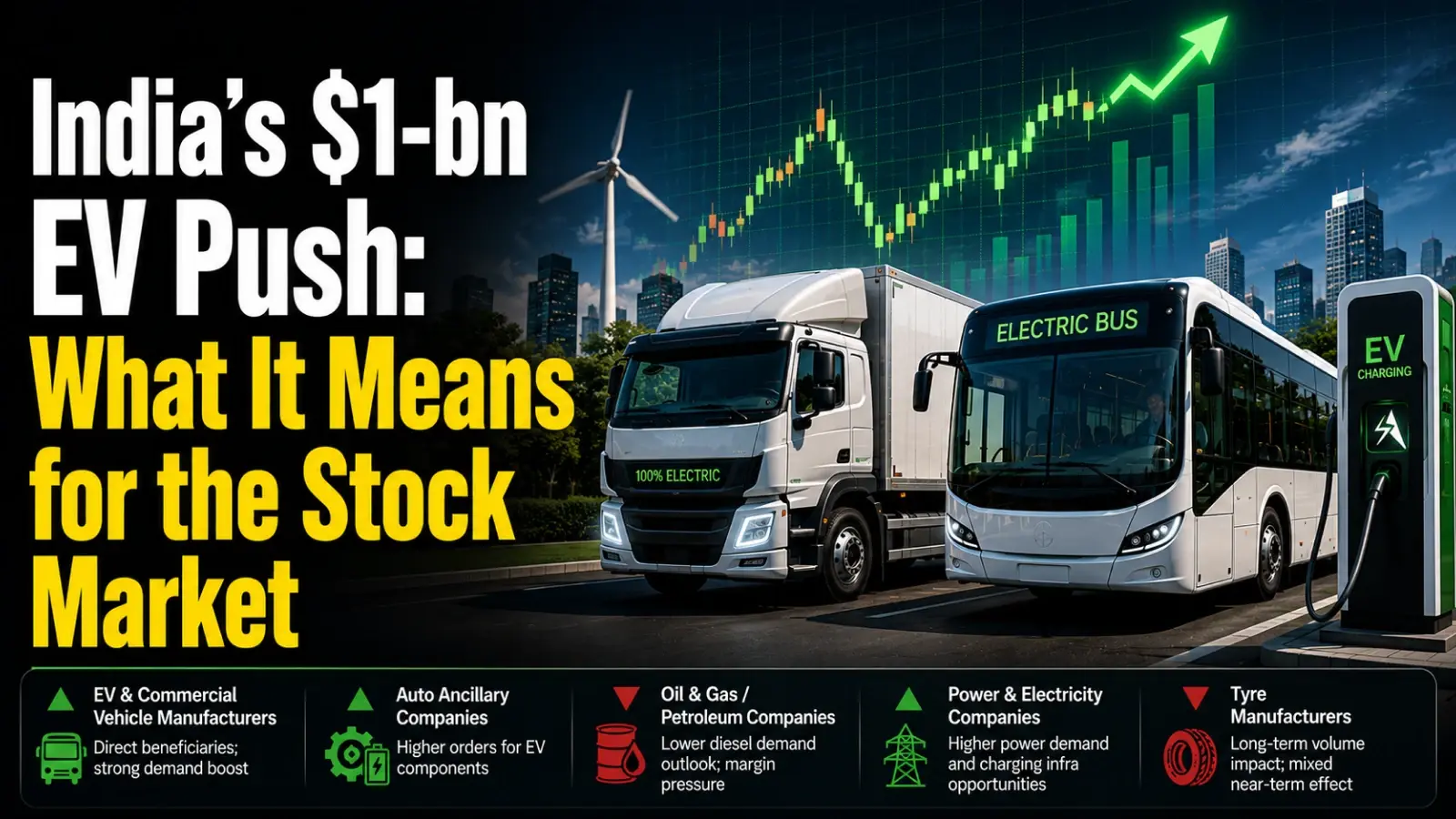
1. EV and commercial vehicle manufacturers (Tata Motors, Olectra Greentech, PMI Electro Mobility) would be direct beneficiaries.
A decade-long, billion-dollar incentive programme would materially improve demand visibility for electric bus and truck manufacturers, allowing them to scale production and invest in capacity with greater confidence. Tata Motors, which already supplies electric buses under government schemes, stands to capture a disproportionate share of incremental orders. Olectra Greentech, a pure-play electric bus manufacturer, could see a sharp re-rating as its order book expands and subsidy-backed demand reduces the price sensitivity that has historically slowed fleet adoption.
2. Auto ancillary firms supplying EV-specific components, such as battery management systems, electric drivetrains and charging infrastructure, would see order inflows rise.
As bus and truck manufacturers scale up, their tier-1 and tier-2 suppliers of EV-specific components would benefit from rising production volumes and long-term supply contracts. Companies such as Sona BLW Precision, Minda Industries and Samvardhana Motherson, which have been building out their EV component portfolios, would see their addressable market expand significantly. The multi-year nature of the scheme also offers supply chain vendors the revenue predictability needed to justify further capital investment in EV-compatible manufacturing lines.
3. Oil & gas and downstream petroleum stocks could face modest selling pressure.
A structural reduction in diesel consumption by commercial fleets, which account for a disproportionately large share of India’s fuel demand, would weigh on long-term volume projections for fuel retailers such as Indian Oil, BPCL and HPCL. While the impact would be gradual rather than immediate, investors may begin discounting lower refinery utilisation and weaker marketing margins over the next three to five years. PSU oil marketing companies, already under pressure from elevated crude import costs, could see their valuation multiples compress further as the clean mobility narrative gains policy momentum.
4. Power and electricity distribution companies, particularly those with renewable energy exposure, would stand to gain.
A large-scale shift of commercial vehicles to electric drivetrains would structurally boost electricity demand, benefiting power generators, grid infrastructure players and EV charging ecosystem companies. Firms such as Adani Green, Torrent Power, and NTPC, which are aggressively expanding into renewables, would see incremental long-term demand for clean power as commercial fleet operators seek to lower their total cost of ownership. Charging infrastructure developers and smart grid companies would similarly attract investor interest as the government’s EV push requires a parallel build-out of public and depot charging capacity.
5. Tyre manufacturers could face a nuanced, mildly negative read-through over the long term.
Commercial vehicles, especially heavy trucks and intercity buses, are among the highest-consuming segments for replacement tyres, and a structural shift to electric fleets which typically wear tyres differently and may over time reduce overall vehicle kilometres through optimised routing could subtly alter volume assumptions. Companies such as Apollo Tyres, MRF and CEAT, which derive meaningful revenue from commercial vehicle tyres, may not see immediate impact but analysts could begin adjusting long-run volume growth assumptions for this segment. In the near term, however, higher fleet additions driven by subsidies could actually lift tyre demand, making the stock-level impact a function of time horizon rather than direction.
Source:
- https://www.bloomberg.com/news/articles/2026-05-20/india-weighs-1-billion-aid-for-private-electric-buses-trucks
Disclaimer
If you have any concerns, questions, or wish to point out any discrepancies in our content, please feel free to write to us at content@hdfcsec.com.
Please Note: The information shared is intended solely for informational purposes and does not make any investment recommendations
Disclaimer
At HDFC SKY*, we take utmost care and due diligence in curating and presenting news and market-related content. However, inadvertent errors or omissions may occasionally occur.
If you have any concerns, questions, or wish to point out any discrepancies in our content, please feel free to write to us at content@hdfcsec.com.
Please Note: The information shared is intended solely for informational purposes and does not make any investment recommendations.
HDFC SKY from HDFC Securities, one of most trusted trading platforms in India, has been recognized with the *Next-Gen Digi Content Awards 2025-26.
 Join Us
 Add as preferred source on Google


More Markets News









Open Free Demat Account
Open Free Demat Account









Invest Anytime, Anywhere


By signing up I certify terms, conditions & privacy policy