Nifty 50
- Eternal₹317.4012.95 (4.25%)
- Shriram Finance₹865-35.90 (-3.98%)
- Apollo Hospitals₹7,730125.50 (1.65%)
- Adani Enterprises₹2,477-73.00 (-2.86%)
- ONGC₹227.502.50 (1.11%)
- JSW Steel₹1,185.50-34.50 (-2.83%)
- Asian Paints₹2,30722.20 (0.97%)
- Jio Financial ₹205.03-5.77 (-2.74%)
- TCS₹2,53023.10 (0.92%)
- Tata Steel₹167.67-4.66 (-2.70%)
- UltraTech Cement₹11,05092.00 (0.84%)
- Adani Ports₹1,702.70-47.30 (-2.70%)
- Maruti Suzuki₹11,23060.00 (0.54%)
- Tech Mahindra₹1,790-39.10 (-2.14%)
- Cipla₹1,3387.10 (0.53%)
- Tata Motors PV₹264.60-5.40 (-2.00%)
- Reliance Industries₹1,1905.50 (0.46%)
- Hindalco Industries₹869.85-15.75 (-1.78%)
- Axis Bank₹1,217.505.50 (0.45%)
- Trent₹2,727.50-48.30 (-1.74%)

- Offerings
- Tools & Platforms
Tools & Calculators
- Open API
- Calculators
- SIP Calculator
- CAGR Calculator
- Compound Interest Calculator
- FD Calculator
- RD Calculator
- EPF Calculator
- Retirement Calculator
- HDFC SIP Calculator
- Mutual Fund Return Calculator
- Lumpsum Calculator
- Step Up SIP Calculator
- ETF SIP Calculator
- Brokerage Calculator
- Equity Margin Calculator
- SWP Calculator
- EMI Calculator
- MTF Calculator
- Margin Pledge Calculator
- Algo Strategy
- Markets
Stocks
F&O
Mutual Funds
- More
Nasdaq Jumps 0.62% to 26,269, S&P 500 Rises 0.38% as Cooling PPI Data, Strong Earnings Offset Iran Tensions
Authored By HDFC SKY | Last Modified: Jul 16, 2026 09:17 AM IST
Open Free Demat Account
Open Free Demat Account
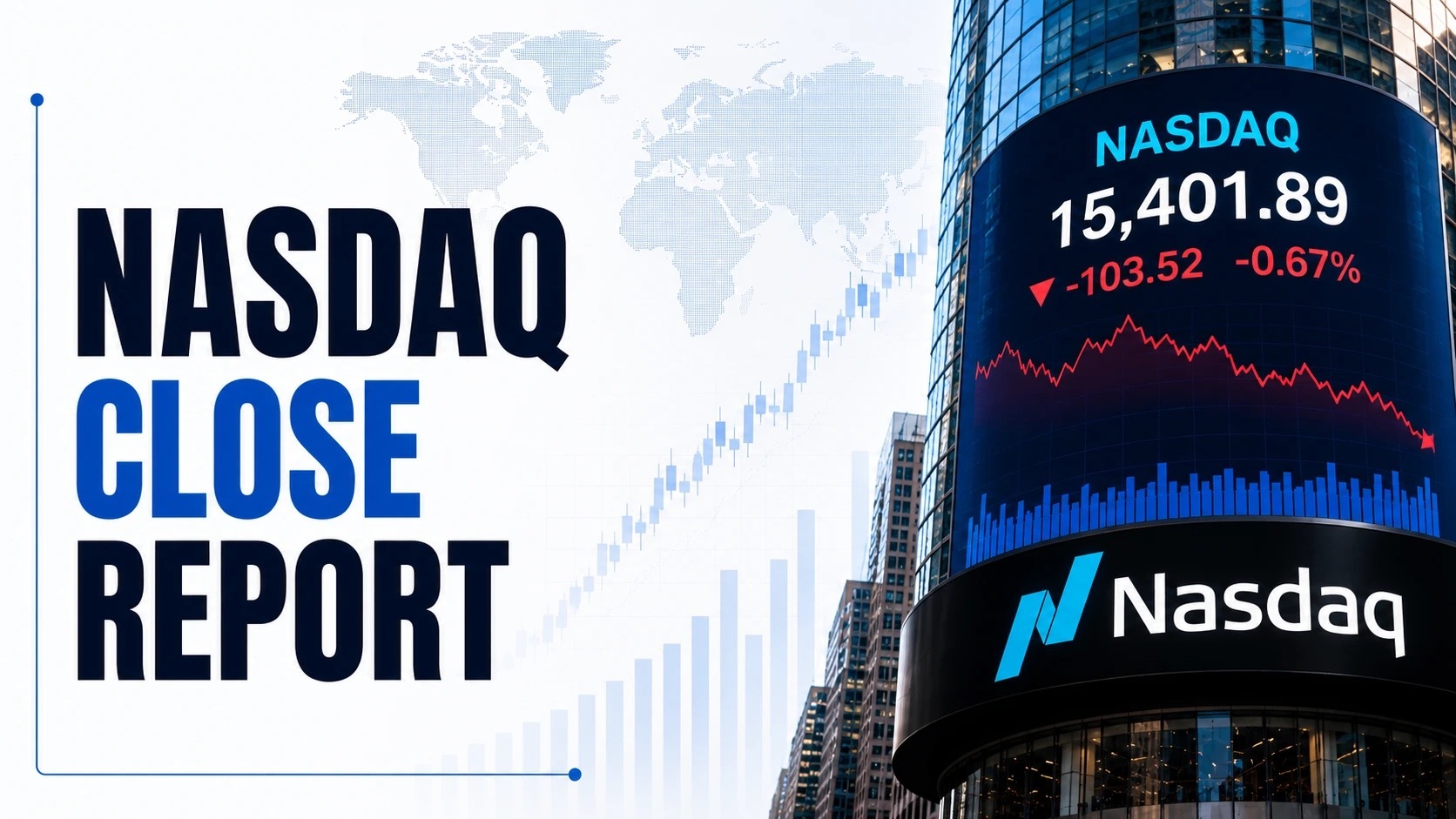
Mumbai, July 16: US stock markets closed higher for a second consecutive session on Wednesday, as softer-than-expected wholesale inflation data and a robust start to the second-quarter earnings season bolstered investor sentiment.
The tech-heavy Nasdaq Composite gained 162.22 points, or 0.62%, to settle at 26,269.23. The benchmark S&P 500 advanced 28.81 points, or 0.38%, to 7,572.40, while the blue-chip Dow Jones Industrial Average rose 150.37 points, or 0.29%, to 52,658.64.
Gains were broad-based, with the S&P 500 financial sector closing at a fresh record and the index moving within 0.5% of its June record high.

Cooling Producer Prices Reinforce Disinflation Narrative, Easing Fed Rate Hike Fears
The primary catalyst for Wednesday’s rally was the June Producer Price Index (PPI) report, which showed an unexpected decline. The PPI for final demand fell 0.3% month-on-month, marking the first monthly drop since August 2025 and reversing gains of 0.6% in May. The decline was driven by a 1.4% drop in final demand goods, the largest fall since July 2022, as energy prices eased during the month. On an unadjusted basis, the index rose 5.5% year-on-year, while core PPI, excluding volatile food, energy and trade services, edged 0.1% higher month-on-month.
The softer PPI reading followed Tuesday’s cooler-than-expected Consumer Price Index (CPI) report, which showed June CPI falling 0.4% monthly to an annual rate of 3.5%, below economist forecasts of 3.8%. Together, the data reinforced expectations that inflationary pressures are moderating, reducing pressure on the Federal Reserve to resume rate hikes.
Following the PPI release, New York Fed President John Williams offered a cautiously optimistic view, stating that “there are encouraging reasons to expect that inflation has peaked and should edge down in coming quarters”. The 10-year Treasury yield declined to 4.55% at 4 p.m. ET, down from 4.61% before the inflation reading.
Lucid Surges 29%, PayPal Jumps 17% as Top Gainers; Celcuity Drops 18%, Pentair Plunges 15% Lead Losers
The trading session witnessed sharp divergences across sectors, with several stocks delivering outsized moves on the back of company-specific catalysts and broader sector trends. Lucid Group (LCID) emerged as the top gainer, surging 28.79% to $5.95 after the electric vehicle maker denied bankruptcy rumors, with volume reaching 54 million shares. PayPal Holdings (PYPL) soared 17.20% to $55.52 following a Reuters report that Stripe and Advent International made a joint $53 billion buyout offer. Aehr Test Systems (AEHR) gained 21.91% to $87.79 on volume of 12.5 million shares, while ChronoScale Holdings (CHRN) jumped 28.77% to $29.63. BlackRock (BLK) advanced over 6.5% after reporting record $15.34 trillion in assets under management. Apple (AAPL) rose 4%, leading Magnificent Seven gains, while Alphabet (GOOGL) advanced 3.17% and Meta (META) rose 3.07%.
On the losing side, Celcuity Inc (CELC) plunged 17.60% to $91.51 on volume of 8.6 million shares. Pentair (PNR) dropped 15% to $64.33 after cutting its full-year sales guidance, now expecting a 4% to 7% decline. Applied Optoelectronics (AAOI) fell 13.04% to $109.09, while Universal Technical Institute (UTI) declined 13.55% to $40.33. Dell Technologies (DELL) fell 9.80% to $412.68, and Cerebras Systems (CBRS) dropped 9.71% to $184.01. Memory chip stocks extended losses, with Western Digital (WDC) tumbling 8.78%, Micron Technology (MU) falling 7.97%, and Marvell Technology (MRVL) dropping 7.27%. International Business Machines (IBM) fell nearly 3%, extending losses after Tuesday’s historic 25.21% plunge. In sector performance, Communication Services led gains, rising 2.8%, while Energy was the worst performer, down 1.5% .
Also Read: How to invest in US stocks
PayPal Surges 17% on $53 Billion Buyout Offer from Stripe and Advent International
PayPal Holdings (PYPL) emerged as the standout performer, soaring 17.20% to close at $55.52 and leading both the S&P 500 and Nasdaq gainers. The surge followed a Reuters report that payments processor Stripe and private equity firm Advent International had made a joint buyout offer valuing the company at more than $53 billion, or $60.50 per share — a roughly 28% premium to Tuesday’s closing price. The proposal, submitted earlier this month, is backed by approximately $50 billion in committed bank financing, with Stripe and Advent reportedly each owning a 50% stake under the proposed transaction. Trading volume in PayPal shares reached 89.3 million, approximately 446% above its three-month average.
IBM Extends Losses After Historic 25% Plunge on Disappointing Preliminary Results
International Business Machines (IBM) continued its decline, falling nearly 3% after Tuesday’s historic 25.21% plunge, the company’s sharpest single-day drop since going public. CEO Arvind Krishna warned investors that second-quarter results would disappoint, with revenue expected to grow just 1% to $17.2 billion and earnings per share down 2% to $2.27, both below Wall Street estimates of $17.9 billion and $3.01 per share. Krishna attributed the shortfall to clients shifting spending toward servers, storage and memory to secure supply-constrained infrastructure ahead of expected price increases, while prioritising cybersecurity investments over non-security deals with IBM. Infrastructure revenue is now expected to decline 7%, worse than previous guidance of a low single-digit decrease.
SpaceX Falls Below IPO Price for First Time as Post-Debut Rally Unravels
Space Exploration Technologies (SPCX) shares fell for a fourth consecutive session, briefly dropping below their $135 initial public offering price for the first time since the company’s record June debut. The stock dipped about 1% on Wednesday and closed at $135.27 per share. The decline follows a sharp pullback from post-listing highs above $225 that had briefly propelled the company’s market valuation above that of Silicon Valley giants. The selloff has erased nearly $850 billion in market value from the peak. The unwind comes despite the company’s recent induction into the Nasdaq-100 and ahead of its 13th Starship test flight scheduled for Thursday.
Magnificent Seven Stocks Rally as Apple Gains 4%, Alphabet and Meta Advance Over 3%
Most mega-cap technology stocks finished in positive territory. Apple (AAPL) led gains among the Magnificent Seven, rising 4%. Alphabet (GOOGL) advanced 3.17%, while GOOG gained 3.60%; META rose 3.07%; and Amazon (AMZN) climbed 3.02%. Microsoft (MSFT) added 2.78%, while Tesla (TSLA) bucked the trend, slipping 0.43%. The broad-based tech rally underscored continued investor appetite for AI infrastructure plays despite sector volatility.
Semiconductor Stocks Show Mixed Performance as Memory Names Extend Losses
Chip stocks delivered a mixed performance as sector volatility remained elevated. ASML Holding (ASML) rose 2.23% after reporting second-quarter results that exceeded expectations, with earnings per share of €7.59 beating estimates by €0.60, and raising its full-year sales forecast to €43-45 billion from a previous €36-40 billion, driven by strong AI-related semiconductor demand.
However, memory stocks continued their sharp declines: Western Digital (WDC) tumbled 8.78%, Micron Technology (MU) fell 7.97%, Marvell Technology (MRVL) dropped 7.27%, and Seagate Technology (STX) declined 5.69%. Intel (INTC) fell 4.45%, while Cisco Systems (CSCO) lost 4.54%. The volatility in semiconductor names reflects ongoing investor balancing between AI demand optimism and stretched valuations.
Also Read: US Stock market timings
BlackRock Assets Hit Record $15 Trillion as Profit Beats Estimates; Morgan Stanley Surges on Trading Strength
BlackRock (BLK) advanced over 6.5% after reporting record second-quarter results. Assets under management rose to a record $15.34 trillion, driven by buoyant markets and robust inflows into its iShares exchange-traded fund business. Net inflows stood at $192 billion, significantly higher than the previous year, while adjusted earnings came in at $13.91 per share, beating Street estimates of $12.59.
The company’s operating margins expanded to a near five-year high of 45.9%. Morgan Stanley (MS) added less than 1% after reporting second-quarter profit that beat estimates, with net income climbing to $5.58 billion, or $3.46 per share, above estimates of $2.94. The bank’s wealth management division posted record revenue of $8.9 billion, with total client assets reaching $10 trillion, while equities revenue jumped 69%.
Lucid Group Jumps 29% as EV Maker Denies Bankruptcy Rumours; Pentair Plunges 15% on Dour Forecast
Lucid Group (LCID) was the top gainer on the Nasdaq, surging 28.79% to $5.95 after the electric vehicle maker denied bankruptcy rumours that had circulated on social media. The stock’s trading volume reached 54 million shares, well above its three-month average of 19.7 million. Pentair (PNR) led S&P 500 losers, plunging 15% after the water treatment firm cut its full-year sales guidance and announced the resignation of its chief financial officer.
Pentair now expects 2026 sales to decline roughly 4% to 7%, reversing its previous guidance for growth of 2% to 4%, attributing the change primarily to inventory destocking in its Pool channel. The company also expects second-quarter adjusted earnings per share of approximately $1.12, down from $1.47 to $1.50, with sales of about $930 million, down 17% from prior outlook.
Communication Services Sector Leads S&P 500 Gains; Energy Sector Underperforms
Communication services stocks led S&P 500 sector gains, rising 2.8%, paced by Alphabet (GOOGL) and Take-Two Interactive Software (TTWO), which advanced 3%. Six of the 11 sectors tracked by the benchmark index finished in positive territory, with technology and industrials both declining 0.25%. The S&P 500 financial sector closed at a fresh record, supported by strong earnings from major banks. Energy was the worst performer, down 1.5%, as oil prices eased from session highs. Consumer-focused retail and travel and leisure stocks were clear outperformers, reflecting investor optimism about consumer resilience.
Wall Street Banks Signal Resilient Consumers as Loan Growth Picks Up
Major US banks expressed confidence in consumer strength, citing steady spending, rising loan balances and stable credit quality despite economic uncertainty and elevated borrowing costs. JPMorgan Chase, Bank of America and Wells Fargo reported mixed consumer loan growth, but credit card balances increased across all three lenders, supporting revenue from one of banking’s most profitable segments.
Executives pointed to a strong labour market and wage growth as key supports for households. Banks acknowledged risks from higher oil prices and inflation linked to the US-Iran conflict, but said delinquencies remain below expectations and consumer balance sheets continue to show resilience. JPMorgan Chase, currently valued at approximately $940 billion, moved closer to becoming the first US bank to reach a $1 trillion market capitalisation.
Geopolitical Tensions in Strait of Hormuz Keep Oil Prices Elevated; US Launches Fresh Strikes on Iran
Oil prices remained elevated as geopolitical tensions in the Middle East continued to escalate. US Central Command announced it had launched a fresh wave of strikes against Iran, targeting capabilities seen as threats to vessels in the Strait of Hormuz. West Texas Intermediate crude futures rose 1.2% to $80.25 per barrel, while Brent crude futures advanced 1.1% to $85.65 per barrel.
The developments came after President Donald Trump abandoned his demand that ships pay a 20% fee to transit the Strait, replacing it with trade and investment deals with Gulf states. Trump also claimed that Iran had expressed a willingness to negotiate, though defence analysts noted little indication that the latest escalation was nearing a diplomatic resolution.
Fed Beige Book Signals Modest Growth, Sticky Prices; Fed Officials Divided on Rate Path
The Federal Reserve’s Beige Book reported that US economic activity expanded at a slight to moderate pace in recent weeks, with employment largely steady across regions. Wage gains were modest, though some sectors saw upward pressure due to competition for skilled labour. Prices continued to rise at a moderate rate, driven in part by Middle East tensions and tariffs, while consumers showed increasing sensitivity to higher costs. Fed Governor Lisa Cook stated she is prepared to act if inflation fails to show signs of slowing soon, while noting she is willing to wait longer to assess price trends. Cook said inflation risks have increased due to AI-driven investment, tariff pressures and the US-Iran conflict, shifting the balance of risks away from employment concerns and towards inflation.
Market Outlook: Inflation Data and Geopolitical Risks Remain Key Focus
Investors continued to monitor inflation trends and geopolitical developments as the earnings season progresses. The cooler inflation data reduced expectations for a Federal Reserve rate hike, with markets now pricing a low probability of a July move. However, policymakers maintained a cautious stance, emphasising that more data is needed before confirming a sustained decline in price pressures. Fed Chair Kevin Warsh, testifying before the House Financial Services Committee, said the “inflation surge of the last five years will be a thing of the past”. Meanwhile, rising geopolitical tensions in the Middle East and higher oil prices have clouded the inflation outlook, adding uncertainty to the Fed’s policy path. Investors will look to retail sales data and jobless claims on Thursday for further signs of whether the economy is slowing enough to keep inflation under control without tipping into a meaningful downturn.
The combination of cooling inflation data and robust earnings has supported equity markets, though geopolitical risks and elevated oil prices remain key variables. Traders are positioning for potential volatility as Fed officials maintain a cautious stance, while consumer and corporate balance sheet strength provides a buffer against broader economic uncertainties. The evolution of Middle East tensions and their impact on energy prices will be critical in shaping the near-term market direction.
Source
- https://www.nasdaq.com/
- spglobal.com/spdji/en/indices/equity/sp-500/
- https://www.dowjones.com/
Disclaimer
If you have any concerns, questions, or wish to point out any discrepancies in our content, please feel free to write to us at content@hdfcsec.com.
Please Note: The information shared is intended solely for informational purposes and does not make any investment recommendations
Disclaimer
At HDFC SKY*, we take utmost care and due diligence in curating and presenting news and market-related content. However, inadvertent errors or omissions may occasionally occur.
If you have any concerns, questions, or wish to point out any discrepancies in our content, please feel free to write to us at content@hdfcsec.com.
Please Note: The information shared is intended solely for informational purposes and does not make any investment recommendations.
HDFC SKY from HDFC Securities, one of most trusted trading platforms in India, has been recognized with the *Next-Gen Digi Content Awards 2025-26.
 Join Us
 Add as preferred source on Google


More International News





Open Free Demat Account
Open Free Demat Account








Invest Anytime, Anywhere


By signing up I certify terms, conditions & privacy policy