Nifty 50
- Kotak Mahindra Bank₹4408.10 (1.88%)
- Titan Company₹4,377-173.00 (-3.80%)
- BSE₹3,35651.00 (1.54%)
- Adani Enterprises₹2,743-106.90 (-3.75%)
- Bharti Airtel₹1,833.9023.40 (1.29%)
- Hindalco Industries₹910.85-29.65 (-3.15%)
- ICICI Bank₹1,357.5014.70 (1.09%)
- JSW Steel₹1,230-29.60 (-2.35%)
- Coal India₹414.502.85 (0.69%)
- Bharat Electronics₹378.30-9.10 (-2.35%)
- Max Healthcare₹9085.50 (0.61%)
- Infosys₹992-21.85 (-2.16%)
- HDFC Life Insurance ₹546.052.10 (0.39%)
- Asian Paints₹2,372.10-52.10 (-2.15%)
- Bajaj Finance₹963.850.75 (0.08%)
- Mahindra & Mahindra₹2,800-55.00 (-1.93%)
- Apollo Hospitals₹7,9172.50 (0.03%)
- Adani Ports₹1,750.10-33.30 (-1.87%)
- L&T₹3,701.50-68.50 (-1.82%)

- Offerings
- Tools & Platforms
Tools & Calculators
- Open API
- Calculators
- SIP Calculator
- CAGR Calculator
- Compound Interest Calculator
- FD Calculator
- RD Calculator
- EPF Calculator
- Retirement Calculator
- HDFC SIP Calculator
- Mutual Fund Return Calculator
- Lumpsum Calculator
- Step Up SIP Calculator
- ETF SIP Calculator
- Brokerage Calculator
- Equity Margin Calculator
- SWP Calculator
- EMI Calculator
- MTF Calculator
- Margin Pledge Calculator
- Algo Strategy
- Markets
Stocks
F&O
Mutual Funds
- More
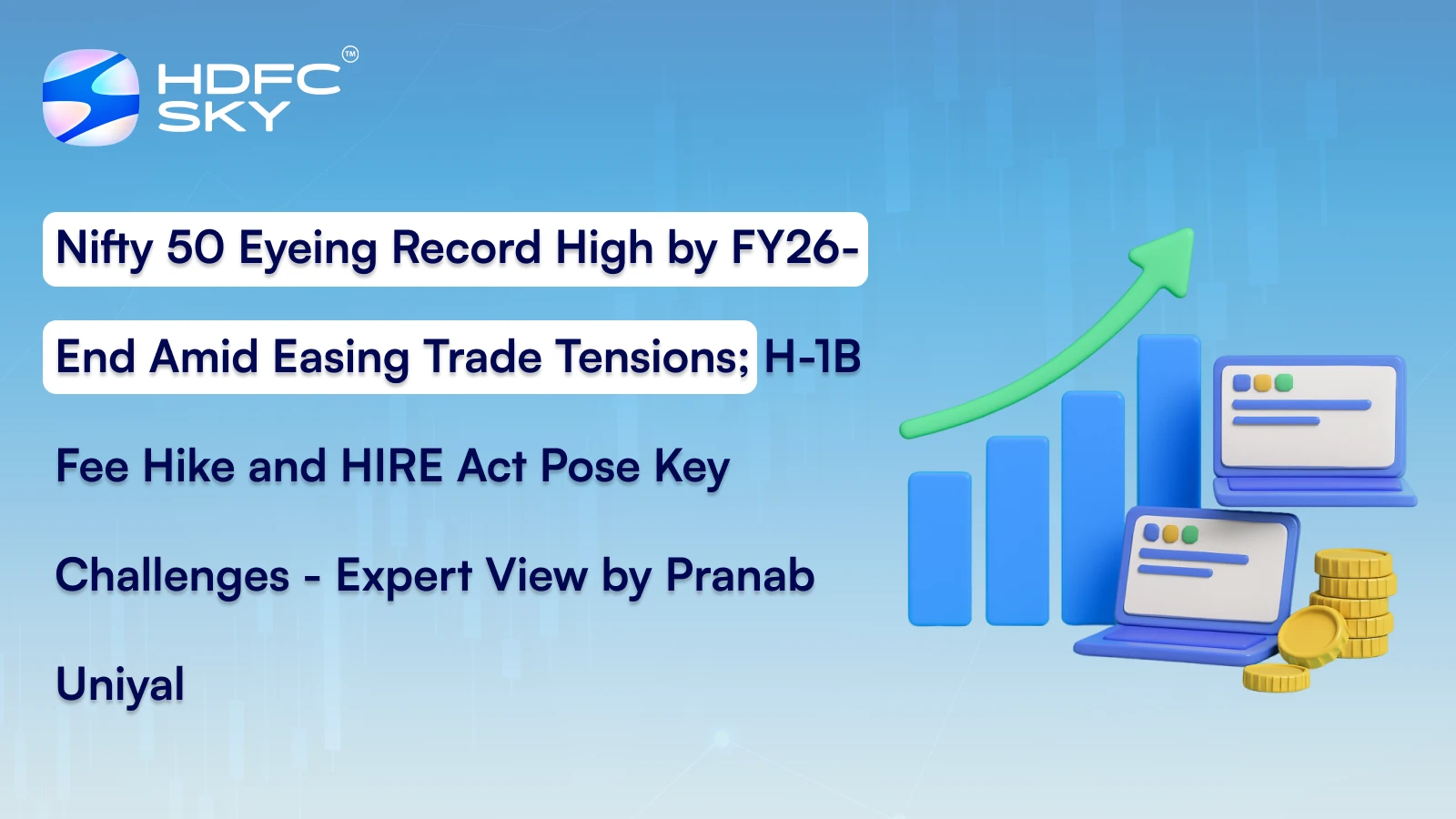
Nifty 50 Eyeing Record High by FY26-End Amid Easing Trade Tensions; H-1B Fee Hike and HIRE Act Pose Key Challenges - Expert View by Pranab Uniyal
Authored By Pranab Uniyal | Last Modified: Sep 23, 2025 07:46 PM IST
Open Free Demat Account
Open Free Demat Account
Mumbai, 23 September 2025: India’s benchmark index, the Nifty 50, is positioned for a potential record high by the end of FY26, driven by expectations of moderate valuations, sectoral earnings recovery, and domestic liquidity inflows, though external trade risks and US policy changes remain critical headwinds.

Nifty 50 Recovery Gains Momentum After Tariff-Driven Lows; Returns Lag Emerging Markets
The Nifty 50 has rebounded sharply from tariff-induced declines seen earlier this year, but annual returns remain largely flat to negative, reflecting underperformance relative to other emerging markets. Pranab Uniyal, Head of HDFC Trustee Services, said, “Trump’s reversal of liberation day tariffs marked a bottom, and Indian markets have rallied sharply from those lows.” Weak revenue growth among key sectors, sustained foreign investor selling, and elevated valuations contributed to the subdued performance. Strong domestic inflows, however, have cushioned the market against sharper corrections.
Large Sectors Like IT and Pharma Could Drive FY26 Upside, Provided Protectionist Measures Ease
Pranab Uniyal highlighted that if global tariff disputes moderate and major sectors such as Information Technology (IT) and pharmaceuticals avoid fresh protectionist actions, the Nifty 50 could reach new highs by FY26-end. The base case scenario assumes easing trade frictions, while upside could emerge if reforms accelerate and external barriers recede. Conversely, any significant disruption to IT exports may temper growth.
Sectoral Earnings Growth to Strengthen H2 FY26; Banking and Consumer Likely to Lead
Expectations of stronger earnings growth in the second half of FY26 are underpinned by potential interest rate cuts and Goods and Services Tax (GST) reductions that could benefit auto and consumer durable sectors. According to Uniyal, “stronger earnings growth, more moderate valuations, interest rate cuts and GST reductions could become tailwinds.” The earnings downgrade cycle has bottomed, with banking and consumer-focused stocks likely to spearhead recovery. He projects 15–17 percent Nifty earnings growth for FY27, reflecting improved corporate profitability.
H-1B Visa Fee Hike and Proposed HIRE Act Present Material Risks to Indian IT Exports
The steep increase in H-1B visa fees and the proposed HIRE Act, which seeks to levy a 25 percent tax on outsourcing payments, are flagged as key risks. Uniyal warned, “The H-1B visa fees, the HIRE Act…or other such measures could meaningfully impact India’s IT sector and its future growth.” Indian IT/ITES exports are valued at approximately USD 200 billion, contributing 7–8 percent of GDP and representing 13 percent of the Nifty 50, making any disruption a potential drag on BFSI, real estate, auto, and consumer durables sectors.
Domestic-Oriented Sectors Gain Preference Amid External Uncertainties
Uniyal emphasised the resilience of domestic-focused sectors that are less exposed to external risks. Large banks, real estate, original equipment manufacturers (OEMs) in the auto sector, cement, and consumer discretionary segments are expected to remain relatively robust, while IT, oil and gas, and fast-moving consumer goods (FMCG) face heightened uncertainty.
Valuation Normalisation Could Encourage Market Stability Post Trade Resolution
India’s valuation premium over emerging markets has moderated from nearly 100 percent last year to around 65 percent, closer to its long-term median. “Historically, foreign investment flows are sensitive to global conditions and domestic fundamentals,” Uniyal added, indicating that the current correction may stabilise markets once trade disputes ease. This adjustment, coupled with stabilising trade relations, may improve market resilience and support domestic and foreign participation once global tensions ease.
The Indian equity market’s trajectory is increasingly linked to sector-specific earnings and global trade developments. Domestic liquidity, moderate valuations, and easing policy uncertainties are likely to provide a stabilising backdrop for the Nifty 50, while H-1B visa fee increases and outsourcing-related legislation remain key risk factors for export-heavy sectors.
Disclaimer: At HDFC SKY, we take utmost care and due diligence in curating and presenting news and market-related content. However, inadvertent errors or omissions may occasionally occur.
If you have any concerns, questions, or wish to point out any discrepancies in our content, please feel free to write to us at content@hdfcsec.com.
Please note that the information shared is intended solely for informational purposes and does not make any investment recommendations
 Join Us
 Add as preferred source on Google


More Markets News


1 min read





Open Free Demat Account
Open Free Demat Account










Invest Anytime, Anywhere


By signing up I certify terms, conditions & privacy policy