Nifty 50
- Dr. Reddy's Labs₹1,310.9081.40 (6.62%)
- Shriram Finance₹825-40.00 (-4.62%)
- JSW Steel₹1,26074.50 (6.28%)
- Tata Consumer ₹936.50-27.40 (-2.84%)
- BSE₹3,359128.20 (3.97%)
- Bajaj Finance₹918.70-10.25 (-1.10%)
- Adani Ports₹1,752.5049.80 (2.92%)
- HDFC Life Insurance ₹519-4.75 (-0.91%)
- Eternal₹325.558.15 (2.57%)
- HDFC Bank₹688.05-4.75 (-0.69%)
- Max Healthcare₹83520.00 (2.45%)
- Sun Pharmaceutical₹1,740-8.00 (-0.46%)
- Kotak Mahindra Bank₹440.7510.25 (2.38%)
- HCL Technologies₹1,417-5.20 (-0.37%)
- Grasim Industries₹2,95056.00 (1.94%)
- Tata Motors PV₹263.70-0.90 (-0.34%)
- Coal India₹4057.55 (1.90%)
- Mahindra & Mahindra₹2,853.10-8.10 (-0.28%)
- Hindalco Industries₹885.6515.80 (1.82%)
- Power Grid Corp₹247-0.40 (-0.16%)

- Offerings
- Tools & Platforms
Tools & Calculators
- Open API
- Calculators
- SIP Calculator
- CAGR Calculator
- Compound Interest Calculator
- FD Calculator
- RD Calculator
- EPF Calculator
- Retirement Calculator
- HDFC SIP Calculator
- Mutual Fund Return Calculator
- Lumpsum Calculator
- Step Up SIP Calculator
- ETF SIP Calculator
- Brokerage Calculator
- Equity Margin Calculator
- SWP Calculator
- EMI Calculator
- MTF Calculator
- Margin Pledge Calculator
- Algo Strategy
- Markets
Stocks
F&O
Mutual Funds
- More
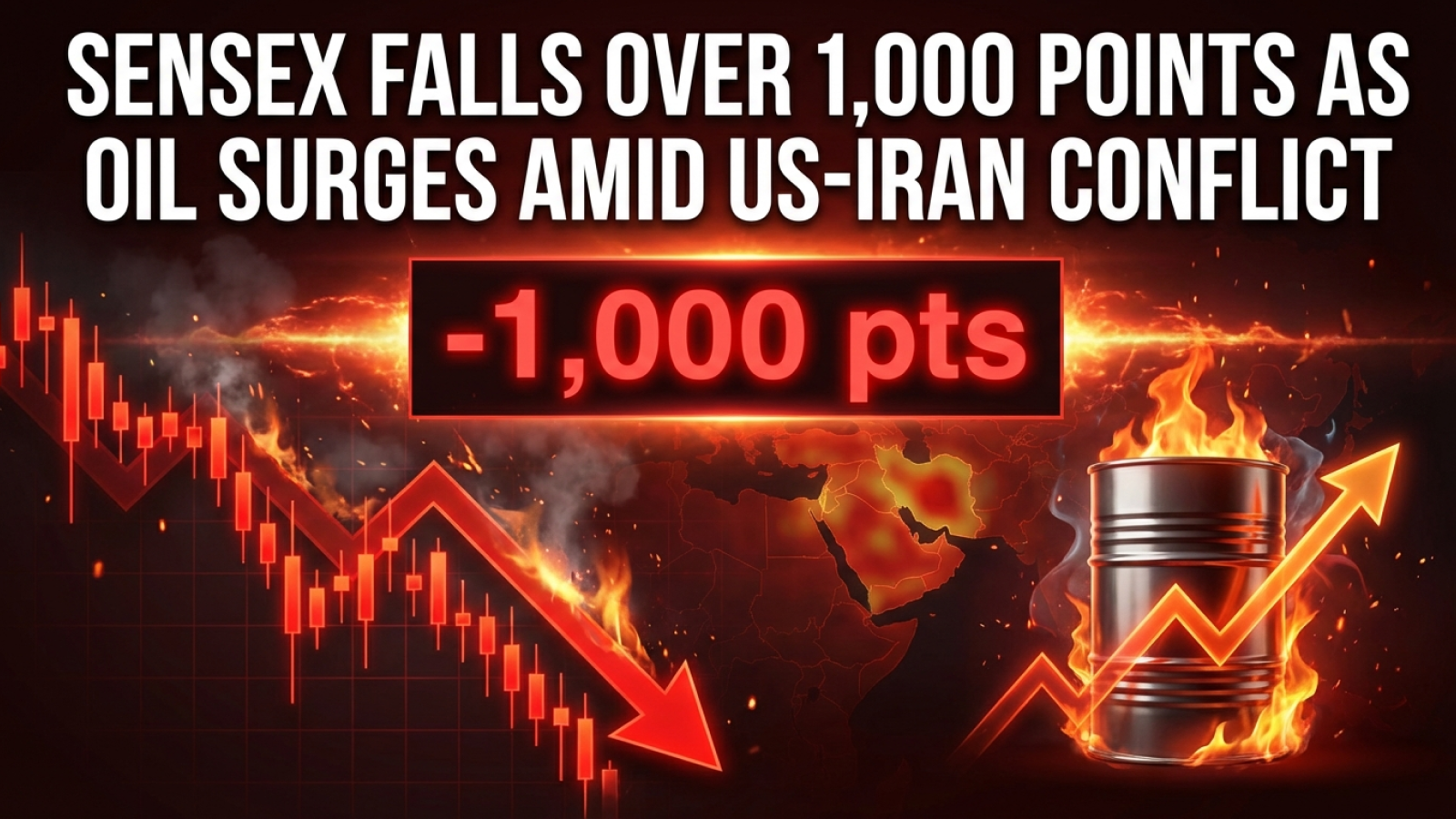
Sensex͏ Falls Over 1,000 Points As Oil S͏urges Amid US-Iran Conflict
Authored By HDFC SKY | Last Modified: Mar 30, 2026 10:52 AM IST
Open Free Demat Account
Open Free Demat Account
Mumbai, Ma͏rch 30: In͏dian equity ͏markets opened sharply lower on Monday, reflect͏ing elevated global uncertainty͏ and surging crude oil p͏rices. The BSE Sensex fell over 1,10͏0 points to trad͏e at 72,477.66, whi͏le the NSE͏ Nifty50 dropped 331 points to 22,488.20 at 9:16 a.m., ͏cont͏inuing losses from last week. The ea͏rly fall was followed by a partial recovery as selective buying emerged at lower levels, but overa͏ll market ͏sentiment remained fragile amid geopolitical tensions and macroeconomic concerns.

Sensex Tumb͏les ͏1,106 Points Amid Early Volat͏ility
Domestic equity benchmarks with significantwings i͏n the opening hours, ͏highlig͏hting a nervous market. At the͏ start of Monday’s trade, the Sensex plunged more than 1,000 points, while the Nifty50 fell close to 330 points, before partially ͏reco͏vering to 73,008.͏12 and 22,667.15 respectively by 9:35 am. The͏ intraday bounce reflected some bargain buying, but the overall t͏one re͏mained cautious. The In͏dia VIX, a key indicator of market volatility, ͏rose past 28, s͏ignalling el͏evated market fear and ͏the like͏lihood of sharp intraday moves. Analysts highlighted tha͏t despite the partial recovery from lows, the market remained under pressure, with investors closely watching developments in crude oil prices, ͏foreign institut͏i͏onal flows and currency movements.
US-Iran War Escalation Pushes Global Markets Into Risk-Off Mode
The key trigger behind Monday’s fall was the escalating conflict in West Asia. The US-Iran war has intensified, entering its fifth week with increased military activity and new participants joining the theatre. Rising geopolitical uncertainty has dampened global risk appetite, pushing international equity markets lower. Tokyo’s Topix index dropped 3.9%, Australia’s S&P/ASX 200 fell 1.2%, Hong Kong’s Hang Seng declined 1.7%, and Shanghai Composite slipped 1%. In the US, S&P 500 futures were down 0.5%, and Euro Stoxx 50 futures lost 1.5%, reflecting a broad-based risk-off sentiment.
Escalating tensions have also affected commodity markets, particularly crude oil. Brent crude surged to around $116 per barrel, reviving inflationary concerns globally and adding pressure on India’s import bill. Analysts noted that the war has disrupted India’s previously stable macroeconomic environment, shifting expectations from high growth and low inflation to lower GDP expansion, higher inflation, wider fiscal and current account deficits, and weaker earnings prospects for FY27.
Rising Crude Prices Push Oil and Gas Stocks Higher, LPG Disruptions Hit QSRs
While crude oil pressures weighed on the overall market, commodity-linked sectors demonstrated resilience. Oil marketing companies (OMCs) such as Indian Oil Corporation (IOC), Bharat Petroleum Corporation Limited (BPCL), and Hindustan Petroleum Corporation Limited (HPCL) rebounded nearly 2% from early lows, reflecting defensive buying amid rising crude. Hindalco emerged as the top Nifty gainer, climbing 3% after Iran targeted aluminium facilities in Bahrain and the UAE, highlighting how geopolitics is influencing sectoral performance.
Conversely, companies dependent on imported fuels faced operational pressures. Jubilant Foodworks, which operates Domino’s and Dunkin’ outlets in India, saw shares fall around 3% to Rs 442.60, after reports of constrained LPG supplies disrupted operations in some stores. The Middle East crisis has led the company to switch to alternative energy sources while coordinating with oil marketing companies to stabilise supplies. These sectoral movements underscored the uneven impact of geopolitical tensions on corporate performance, with commodity-linked and defensive sectors benefiting from safe-haven demand, while consumer-facing and fuel-dependent businesses were hit by supply disruptions.
FII Outflows and RBI Currency Measures Impact Market Liquidity
Sustained foreign institutional investor (FII) outflows continued to weigh on market sentiment. On Friday, FIIs sold shares worth Rs 4,367.30 crore, extending pressure on domestic benchmarks. Domestic institutional investors partially offset the impact with net purchases of Rs 3,566.15 crore, but the net effect left Indian equities in a cautious state.
The Reserve Bank of India’s (RBI) recent directive limiting total positions that banks can take in the onshore foreign exchange market to $100 million is expected to influence rupee movements and the banking sector. Analysts suggested that this move could support the rupee by triggering the unwinding of large dollar positions, but also keep banking stocks under scrutiny, with indices such as Nifty Bank struggling near the 50,000 mark. The Nifty Bank index has declined nearly 15% from its peak, reflecting weakness across major lenders, including Axis Bank, Kotak Mahindra Bank, and Max Healthcare Finance.
Sectoral Weakness Dominates with Defensive Gains In Commodities
Most sectors traded in the red, indicating broad-based selling pressure. Financials, banking, IT, and automobile stocks were the biggest drags, whereas metals, oil & gas, and defence segments showed selective strength. Defence stocks gained after the Defence Acquisition Council cleared proposals worth ₹2.38 lakh crore, with Garden Reach Shipbuilders & Engineers Limited leading gains over 3%.
Commodity-linked sectors offered a counterbalance, with OMCs rebounding from opening lows and Hindalco benefiting from aluminium-related geopolitical developments. Investors also closely tracked gold and silver futures, which were trading down 2% and 1.32%, respectively, reflecting reduced safe-haven demand in the face of rising equity volatility.
Indian Market Capitalisation Declines Sharply As Volatility Surges
The early market selloff erased about Rs 5 lakh crore in market capitalisation, taking BSE-listed firms from Rs 422 lakh crore to Rs 417 lakh crore. Analysts noted that the sharp fall, coupled with heightened India VIX levels above 28, indicates that traders and investors are preparing for further intraday swings. Selective buying at lower levels has provided some cushioning, but market participants remain highly attentive to crude oil prices, geopolitical developments, foreign flows, and currency movements as key market determinants.
The Indian stock market opened sharply lower on Monday, driven by escalating geopolitical tensions in West Asia and surging crude oil prices, with the Sensex falling over 1,100 points and Nifty50 down more than 330 points. Sustained foreign institutional outflows, RBI-imposed currency restrictions, and sectoral disparities amplified volatility, with defensive and commodity-linked stocks showing relative strength. Investors are expected to closely monitor global markets, crude prices, currency movements, and macroeconomic signals in the session ahead.
Sources
- https://www.nseindia.com/index-tracker/NIFTY%2050
- https://www.nseindia.com/index-tracker/NIFTY%20BANK
- https://www.niftyindices.com/indices/equity/sectoral-indices/nifty-auto
- https://www.niftyindices.com/indices/equity/broad-based-indices/NIFTY-Midcap-100
- https://www.niftyindices.com/indices/equity/broad-based-indices/nifty-smallcap-500
- https://www.niftyindices.com/indices/equity/sectoral-indices/nifty-oil-and-gas-index
- https://www.niftyindices.com/indices/equity/sectoral-indices/nifty-it
- https://www.bseindia.com/sensex/code/16/
- https://www.nseindia.com/
Disclaimer
If you have any concerns, questions, or wish to point out any discrepancies in our content, please feel free to write to us at content@hdfcsec.com.
Please Note: The information shared is intended solely for informational purposes and does not make any investment recommendations
Disclaimer
The information shared here is intended solely for informational and educational purposes and does not constitute investment recommendations. While we practice strict due diligence in curating daily market data, readers must perform independent research before trading. To flag any real-time data discrepancies or content concerns, please write to us at content@hdfcsec.com.
 Join Us
 Add as preferred source on Google


More Markets News










Open Free Demat Account
Open Free Demat Account












Invest Anytime, Anywhere


By signing up I certify terms, conditions & privacy policy