Nifty 50
- Bajaj Finance₹939.3013.30 (1.44%)
- Nestle₹1,186.90-37.00 (-3.02%)
- Cipla₹1,326.6012.60 (0.96%)
- HDFC Life Insurance ₹524.40-15.25 (-2.83%)
- UltraTech Cement₹10,94798.00 (0.90%)
- Tata Motors PV₹268.85-6.85 (-2.48%)
- Bajaj Auto₹10,15179.00 (0.78%)
- Tech Mahindra₹1,797.80-36.90 (-2.01%)
- ICICI Bank₹1,393.608.60 (0.62%)
- HDFC Bank₹692.85-14.10 (-1.99%)
- Bharti Airtel₹1,903.3011.60 (0.61%)
- Eternal₹306.20-6.15 (-1.97%)
- L&T₹3,656.4020.40 (0.56%)
- Trent₹2,769-53.00 (-1.88%)
- SBI₹967.504.50 (0.47%)
- Hindustan Unilever₹1,816.20-34.00 (-1.84%)
- Sun Pharmaceutical₹1,751.306.20 (0.36%)
- Adani Enterprises₹2,547.40-47.10 (-1.82%)
- BSE₹3,258.209.90 (0.30%)
- Power Grid Corp₹247.80-4.35 (-1.73%)

- Offerings
- Tools & Platforms
Tools & Calculators
- Open API
- Calculators
- SIP Calculator
- CAGR Calculator
- Compound Interest Calculator
- FD Calculator
- RD Calculator
- EPF Calculator
- Retirement Calculator
- HDFC SIP Calculator
- Mutual Fund Return Calculator
- Lumpsum Calculator
- Step Up SIP Calculator
- ETF SIP Calculator
- Brokerage Calculator
- Equity Margin Calculator
- SWP Calculator
- EMI Calculator
- MTF Calculator
- Margin Pledge Calculator
- Algo Strategy
- Markets
Stocks
F&O
Mutual Funds
- More
How to Understand Target Prices and Stop-Loss Levels in HDFC Sky MTF Research Calls
By HDFC SKY | Published at: Oct 22, 2026 02:22 PM IST
Open Free Demat Account
Open Free Demat Account
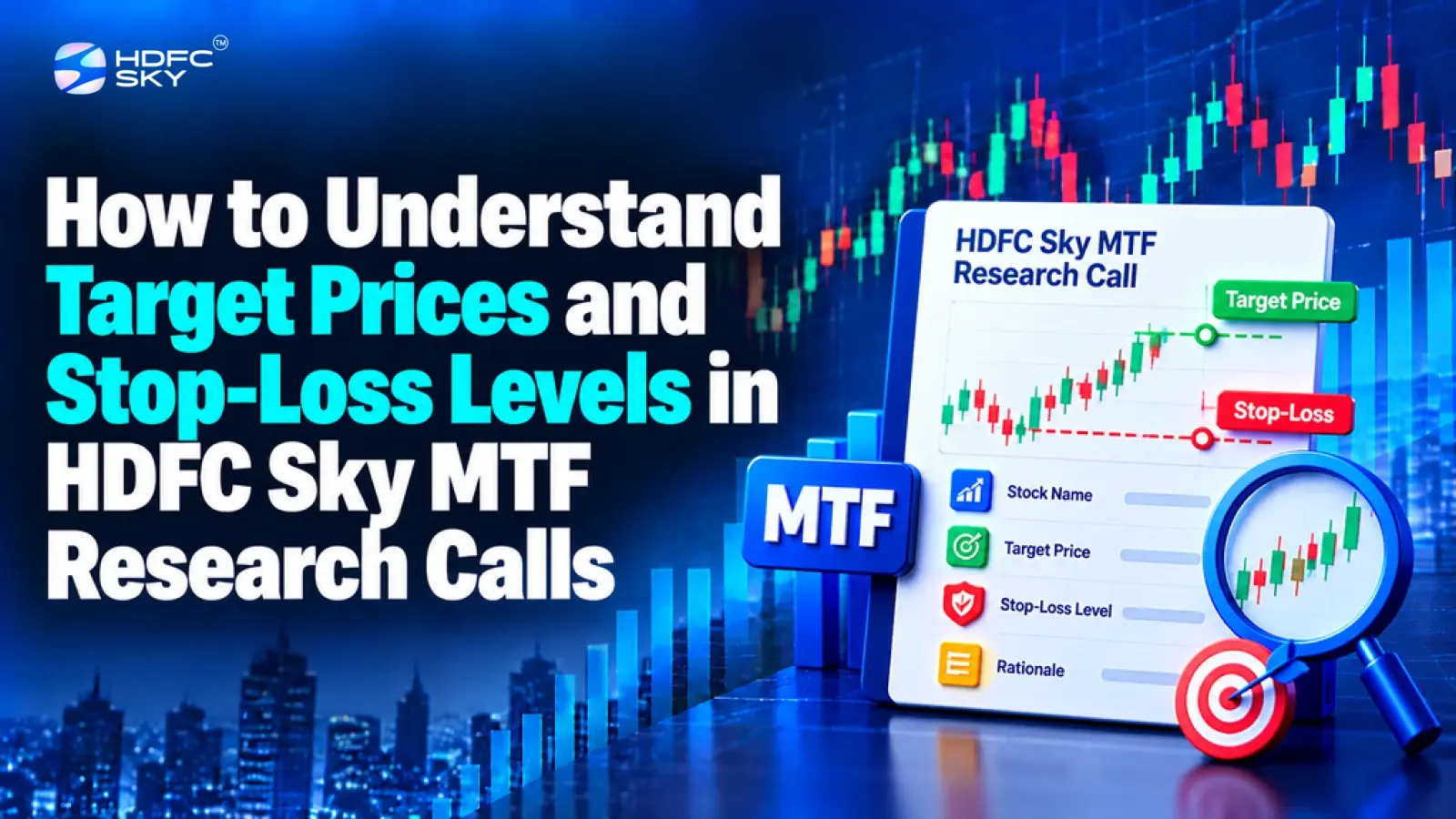
HDFC Sky MTF Research Calls provide price levels that help investors assess a stock recommendation’s potential upside and downside. These levels become particularly important when using borrowed funds through a Margin Trading Facility (MTF), where leverage and financing costs affect the outcome. Understanding the recommendation price, target, stop-loss and expected timeframe helps readers interpret the research, evaluate the potential risk-reward ratio and distinguish projected returns from actual trading results.
What Do HDFC Sky MTF Research Calls Show?
HDFC Sky’s MTF research recommendations display key details, including the recommendation price, target price, stop-loss, current market price, potential returns and estimated duration. Each field serves a different purpose.
- Action
Indicates the research recommendation, such as BUY. - Recommendation price
Provides the reference price for evaluating the call. The actual entry price may differ. - Target price
Specifies the research team’s price objective for the recommendation. - Stop-loss
Identifies the price level used to plan an exit if the trade moves against the research view. - Potential returns and timeframe
Show the estimated price return and the expected period associated with the call.
These figures are research estimates, not guaranteed outcomes. Readers should also check whether a recommendation remains open and review its latest displayed details before making a decision.
How to Interpret a Target Price
A target price helps readers estimate the potential price gain from the recommendation price. The percentage difference provides a straightforward measure of the projected upside.
Calculate Potential Upside
Suppose a research call has a recommendation price of ₹100 and a target price of ₹110.
Potential upside = (Target price − Recommendation price) ÷ Recommendation price × 100
In this example, the potential price gain is ₹10 per share, or 10%, before interest, brokerage, taxes and other applicable charges.
The target represents the research team’s price objective. It does not guarantee that the stock will reach that level within the stated timeframe.
Understand Target Execution
Investors must distinguish a research target from an order instruction. Reaching the target does not necessarily close an MTF position automatically.
Investors may place a sell order or use an available Good-Till-Triggered (GTT) order to initiate an exit when the specified price condition is met. A GTT trigger can place an order according to its configured conditions, but execution depends on factors such as liquidity, available counterparties and the order price.
Also Read: What Stocks Are Suitable for Margin Trading?
How to Interpret a Stop-Loss Level
A stop-loss identifies a price level for planning an exit when the market moves against the trade. It helps quantify the potential downside from the recommendation price.
Calculate Potential Downside
Suppose the recommendation price is ₹100 and the stop-loss is ₹95.
Potential downside = (Recommendation price − Stop-loss) ÷ Recommendation price × 100
The difference is ₹5 per share, equivalent to 5% of the recommendation price.
With a target of ₹110 and a stop-loss of ₹95, the potential reward is ₹10 per share against a potential loss of ₹5. This produces a hypothetical risk-reward ratio of 2:1 before costs.
A stop-loss does not guarantee the maximum loss. If the stock gaps below the trigger level or market liquidity is limited, the exit may occur at a less favourable price. Investors should also understand whether their selected order is a stop-loss limit or stop-loss market order, as their execution conditions differ.
How MTF Affects Risk and Returns
MTF enables investors to purchase eligible shares using their own capital alongside broker financing. This increases market exposure relative to the investor’s contribution, making price movements more significant for the capital committed.
For example, a ₹10 gain per share produces the same change in the stock’s value regardless of the funding method. However, the percentage impact on the investor’s initial contribution can be larger under MTF because that contribution represents only part of the position’s value.
Interest on the funded amount adds to the holding cost. HDFC Sky advertises an MTF interest rate of 1% per month, but investors should verify the applicable rate and terms before trading. Brokerage, taxes, pledge charges and other applicable costs may further reduce the final return.
A target and stop-loss help frame a trade’s potential price outcomes, but neither accounts automatically for every cost or removes the possibility of a loss. The projected price return should therefore be considered separately from the investor’s net result after charges.
Conclusion
Target prices and stop-loss levels help investors evaluate the potential upside and downside of HDFC Sky MTF research calls. Their practical value depends on the entry price, execution conditions, financing costs and market movements. Understanding these factors helps readers assess research estimates without treating them as guaranteed returns or fixed limits on losses.


FAQs
What if a stock's current market price differs from its recommendation price?
Does a 2:1 risk-reward ratio mean a trade is likely to succeed?
Can a target price or stop-loss change after a research call is published?
Does a GTT order guarantee an exit at the target or stop-loss price?
How do MTF interest charges affect a research call's projected return?

Open Free Demat Account
Open Free Demat Account
Popular Posts
- 10 Interesting Facts About NSE You Probably Didn’t KnowLast Updated: Sep 30, 2026
- 8-4-3 Rule of SIP - How Does That Work?Last Updated: Jul 30, 2025
- Let's view more exciting Post!
Popular Post from Margin Trading
- HDFC Sky MTF vs Regular Delivery: Understanding Buying PowerLast Updated: Oct 22, 2026
- How to Manage Limited Capital Using HDFC SKY MTFLast Updated: Oct 22, 2026
- HDFC SKY MTF Research Calls vs Your Own Stock AnalysisLast Updated: Oct 21, 2026
- How to Understand Margin and Costs for HDFC Sky MTF BasketsLast Updated: Oct 21, 2026
- How to Compare HDFC Sky MTF-Eligible Stocks by SectorLast Updated: Oct 21, 2026
- Let's view more exciting Post!
Popular Post from Blogs
- “Bounce Back” Theme Gains Traction in 2026Last Updated: Apr 8, 2026
- 5 Takeaways for Tax Payers from the Budget 2025Last Updated: Jan 29, 2026
- Let’s view more exciting Posts

Invest Anytime, Anywhere


By signing up I certify terms, conditions & privacy policy