Nifty 50
- Bharti Airtel₹1,90917.30 (0.91%)
- Nestle₹1,187.40-36.50 (-2.98%)
- Bajaj Finance₹934.458.45 (0.91%)
- HDFC Life Insurance ₹525.05-14.60 (-2.71%)
- UltraTech Cement₹10,92778.00 (0.72%)
- Coal India₹397.50-10.00 (-2.45%)
- ICICI Bank₹1,393.308.30 (0.60%)
- Tata Motors PV₹269.15-6.55 (-2.38%)
- Bajaj Auto₹10,13058.00 (0.58%)
- Eternal₹305.30-7.05 (-2.26%)
- Cipla₹1,319.605.60 (0.43%)
- Tech Mahindra₹1,794.30-40.40 (-2.20%)
- L&T₹3,649.8013.80 (0.38%)
- Trent₹2,765.60-56.40 (-2.00%)
- SBI₹965.652.65 (0.28%)
- Power Grid Corp₹247.15-5.00 (-1.98%)
- BSE₹3,254.506.20 (0.19%)
- HDFC Bank₹693.45-13.50 (-1.91%)
- Hindustan Unilever₹1,816.20-34.00 (-1.84%)

- Offerings
- Tools & Platforms
Tools & Calculators
- Open API
- Calculators
- SIP Calculator
- CAGR Calculator
- Compound Interest Calculator
- FD Calculator
- RD Calculator
- EPF Calculator
- Retirement Calculator
- HDFC SIP Calculator
- Mutual Fund Return Calculator
- Lumpsum Calculator
- Step Up SIP Calculator
- ETF SIP Calculator
- Brokerage Calculator
- Equity Margin Calculator
- SWP Calculator
- EMI Calculator
- MTF Calculator
- Margin Pledge Calculator
- Algo Strategy
- Markets
Stocks
F&O
Mutual Funds
- More
- HDFC Sky MTF vs Regular Delivery: Key Differences
- How HDFC Sky MTF Increases Buying Power
- Example: Buying Shares Worth ₹1,00,000
- Interest Costs and Other MTF Charges
- Holding Period and Pledge Requirements
- How Leverage Affects Gains and Losses
- Stock Eligibility and Margin Requirements
- Which Option Should Investors Consider?
- Conclusion
- FAQs
HDFC Sky MTF vs Regular Delivery: Understanding Buying Power
By HDFC SKY | Published at: Oct 22, 2026 01:22 PM IST
Open Free Demat Account
Open Free Demat Account
Buying shares requires sufficient capital, but the amount you need upfront depends on how you fund the purchase. HDFC Sky’s Margin Trading Facility (MTF) lets investors buy eligible stocks using a combination of their own funds and broker financing, while regular delivery requires the full purchase amount from their available funds.
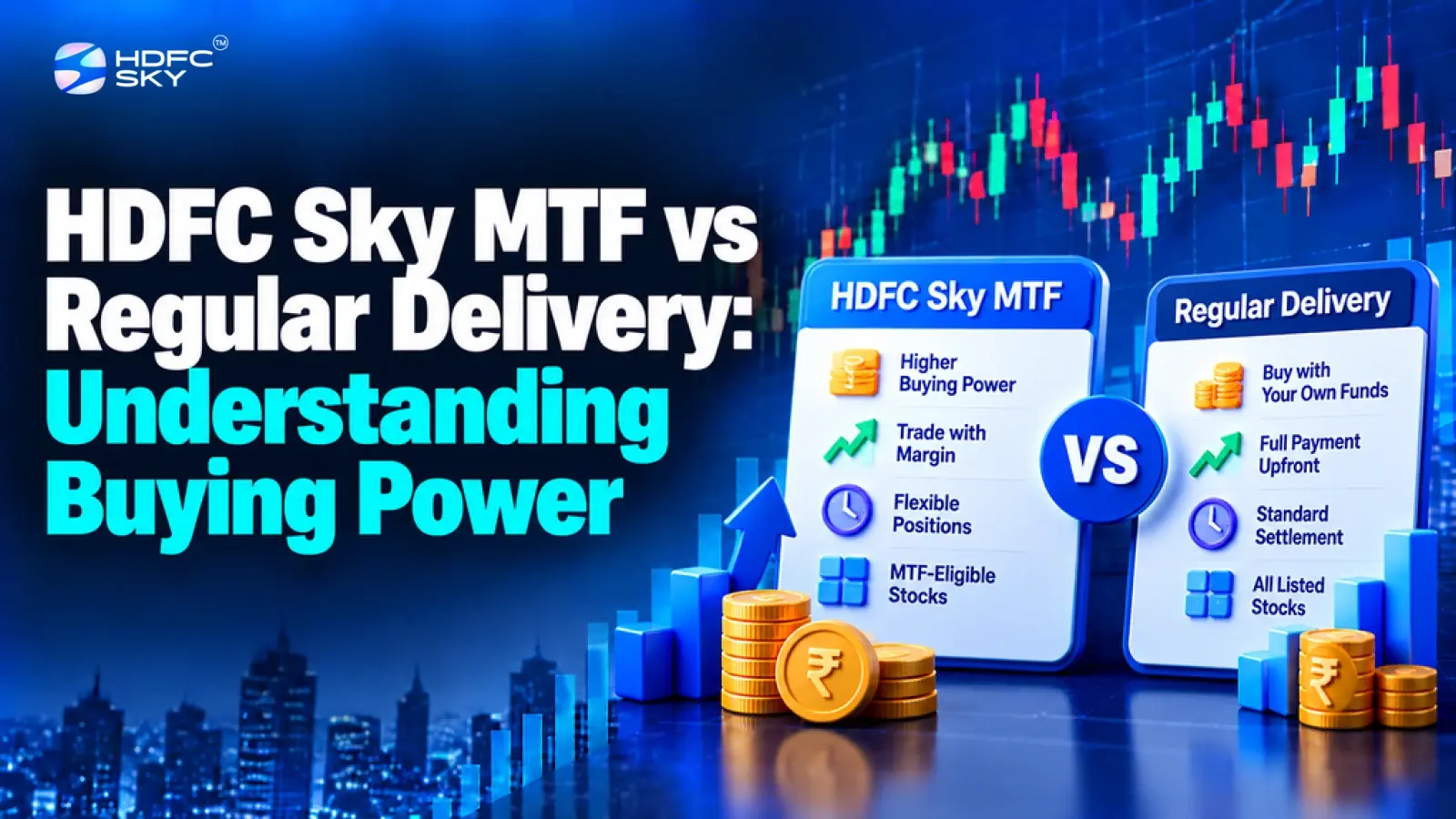
The key difference between HDFC Sky MTF and regular delivery is buying power. MTF offers up to 5X buying power on eligible securities, subject to stock-specific margin requirements. However, this additional exposure comes with interest charges, pledge requirements and the risk of forced liquidation. Understanding these differences helps investors assess the capital, costs and risks associated with each method.
HDFC Sky MTF vs Regular Delivery: Key Differences
MTF and regular delivery differ in how purchases are funded, how much capital investors must contribute and what obligations apply while holding shares.
|
Particulars |
HDFC Sky MTF | Regular Delivery |
| Initial capital | A portion of the purchase value |
Full purchase value |
|
Buying power |
Up to 5X on eligible securities | Based on available funds |
| Broker financing | Available for the funded portion |
Not required |
|
Interest charges |
Applicable on the funded amount | No MTF financing interest |
| Pledge requirement | Pledge authorisation is required |
No MTF-related pledge |
|
Holding period |
Subject to broker terms and applicable limits | Shares can generally remain in the demat account indefinitely |
| Margin shortfall | May require additional funds and can lead to square-off |
No MTF margin shortfall or related square-off |
|
Main consideration |
Higher exposure with additional costs and risks | Full capital commitment without MTF borrowing |
The choice depends on whether investors prioritise greater buying power or prefer to purchase shares entirely with their own funds.
How HDFC Sky MTF Increases Buying Power
HDFC Sky MTF allows investors to purchase eligible securities by contributing an initial margin while the broker finances the remaining amount. This can increase the value of shares an investor can purchase with a given amount of capital.
HDFC Sky advertises up to 5X buying power. However, the actual leverage depends on the stock’s eligibility and applicable margin requirements. Investors should check the official MTF stock list before placing an order.
Example: Buying Shares Worth ₹1,00,000
Assume an eligible stock qualifies for 5X leverage and requires an initial margin of 20%.
|
Particulars |
HDFC Sky MTF | Regular Delivery |
| Total purchase value | ₹1,00,000 |
₹1,00,000 |
|
Investor’s contribution |
₹20,000 | ₹1,00,000 |
| Broker-funded amount | ₹80,000 |
₹0 |
|
MTF interest |
Applicable | Not applicable |
Under these assumptions, ₹20,000 can support a ₹1,00,000 stock position through MTF, compared with a ₹1,00,000 capital requirement for regular delivery.
The example is illustrative and excludes brokerage, taxes, pledge charges and financing interest. Actual margin requirements may differ by security, and 20% margin should not be assumed for every MTF-eligible stock.
Interest Costs and Other MTF Charges
Higher buying power does not mean the additional exposure is free. Investors pay interest on the amount financed by HDFC Sky, along with other applicable trading and pledge-related charges.
HDFC Sky currently advertises an MTF interest rate of 1% per month, equivalent to 12% per annum. The applicable rate, calculation method and other terms should be confirmed before trading through the official MTF pricing page.
For example, if the broker funds ₹80,000 at a rate of 1% per month, the indicative interest would be ₹800 for a 30-day period, assuming a constant funded amount and a simple monthly calculation. Actual charges depend on the applicable interest calculation and account terms.
Interest increases the cost of holding a position. Regular delivery avoids MTF financing interest because the investor pays the full purchase value upfront, although standard brokerage, taxes and other applicable charges may still apply.
Also Read: What Stocks Are Suitable for Margin Trading?
Holding Period and Pledge Requirements
MTF positions can be carried forward beyond the purchase day, subject to HDFC Sky’s terms, margin requirements and applicable position limits. Investors should not assume that MTF positions can remain open indefinitely under the same conditions.
HDFC Sky’s support documentation states that positions may be automatically squared off after the specified holding limit, currently described in its documentation as T+275 days. Corporate actions or changes in stock eligibility can also affect open positions. Investors should verify the current rules before taking a position.
MTF purchases also require pledge authorisation through CDSL. The purchased securities serve as collateral for the funded amount, and investors must complete the required authorisation within the applicable deadline. Failure to authorise a pledge can lead to square-off under the broker’s terms.
Investors can also use HDFC Sky’s Margin Pledge facility to pledge eligible existing holdings as collateral. The recognised collateral value depends on applicable valuation rules and haircuts. Pledging shares does not eliminate the risks associated with market movements or borrowing.
How Leverage Affects Gains and Losses
Leverage increases market exposure relative to the investor’s initial capital. As a result, a given share-price movement can have a larger percentage impact on the margin contributed.
Consider the ₹1,00,000 position funded with ₹20,000 of investor capital and ₹80,000 of broker financing.
- If the share price rises by 10%: The position gains ₹10,000 before interest and other costs. This equals 50% of the initial ₹20,000 contribution.
- If the share price falls by 10%: The position loses ₹10,000 before costs, also equal to 50% of the initial contribution.
In regular delivery, the same ₹1,00,000 position experiences the same ₹10,000 change in market value. However, the investor has committed the full ₹1,00,000 rather than ₹20,000.
These figures illustrate the effect of leverage on the initial capital, not a guaranteed return. Interest, transaction costs, further price movements and margin requirements affect the final outcome. A severe decline can exhaust the investor’s initial contribution, and losses may exceed it.
Stock Eligibility and Margin Requirements
Not every listed stock qualifies for MTF, and eligible securities may carry different margin multipliers. HDFC Sky’s published stock list displays the applicable multipliers so investors can assess their potential buying power before placing an order.
Investors should check the eligible stock list and the margin displayed on the order screen rather than assume every security offers 5X leverage.
Margin requirements may also change as exchange rules, stock eligibility or broker risk assessments change. Investors must maintain the required margin throughout the position. If a price decline creates a shortfall, they may need to add funds or collateral. Failure to meet applicable requirements can result in the broker squaring off the position.
Which Option Should Investors Consider?
HDFC Sky MTF may suit investors who want greater stock-market exposure without paying the full purchase value upfront and who understand the associated interest, collateral and margin obligations.
Regular delivery may suit investors who prefer to use their own capital, avoid MTF financing costs and hold shares without MTF-specific margin requirements or holding limits.
Neither method removes market risk. The appropriate choice depends on available capital, investment horizon, tolerance for losses and the ability to meet any additional funding requirements.
Conclusion
HDFC Sky MTF and regular delivery differ primarily in how they fund stock purchases. MTF provides up to 5X buying power on eligible securities, allowing investors to control a larger position with a smaller initial contribution. In return, it introduces interest expenses, pledge requirements and the possibility of forced liquidation.
Regular delivery requires the full purchase value upfront but avoids MTF financing interest and related margin obligations. Comparing the initial capital requirement with the total holding cost and potential downside helps investors understand which method better fits their financial circumstances.


FAQs
How much buying power does HDFC Sky MTF provide?
Does HDFC Sky charge interest on MTF positions?
Does MTF interest apply on weekends and market holidays?
Can investors hold MTF shares indefinitely?
Why do different MTF stocks require different margins?

Open Free Demat Account
Open Free Demat Account
Popular Posts
- 10 Interesting Facts About NSE You Probably Didn’t KnowLast Updated: Sep 30, 2026
- 8-4-3 Rule of SIP - How Does That Work?Last Updated: Jul 30, 2025
- Let's view more exciting Post!
Popular Post from Margin Trading
- How to Understand Target Prices and Stop-Loss Levels in HDFC Sky MTF Research CallsLast Updated: Oct 22, 2026
- How to Manage Limited Capital Using HDFC SKY MTFLast Updated: Oct 22, 2026
- HDFC SKY MTF Research Calls vs Your Own Stock AnalysisLast Updated: Oct 21, 2026
- How to Understand Margin and Costs for HDFC Sky MTF BasketsLast Updated: Oct 21, 2026
- How to Compare HDFC Sky MTF-Eligible Stocks by SectorLast Updated: Oct 21, 2026
- Let's view more exciting Post!
Popular Post from Blogs
- “Bounce Back” Theme Gains Traction in 2026Last Updated: Apr 8, 2026
- 5 Takeaways for Tax Payers from the Budget 2025Last Updated: Jan 29, 2026
- Let’s view more exciting Posts


Invest Anytime, Anywhere


By signing up I certify terms, conditions & privacy policy