Nifty 50
- Apollo Hospitals₹8,027.50361.50 (4.72%)
- BSE₹3,287.20-47.60 (-1.43%)
- ITC₹26611.00 (4.31%)
- Reliance Industries₹1,170.30-7.70 (-0.65%)
- Eicher Motors₹7,050282.50 (4.17%)
- JSW Steel₹1,168-7.20 (-0.61%)
- TCS₹2,15680.00 (3.85%)
- Cipla₹1,301-5.80 (-0.44%)
- HCL Technologies₹1,216.7039.80 (3.38%)
- Adani Ports₹1,76153.00 (3.10%)
- Infosys₹1,023.4026.40 (2.65%)
- Shriram Finance₹940.4523.20 (2.53%)
- Tata Motors PV₹279.906.90 (2.53%)
- UltraTech Cement₹10,675249.00 (2.39%)

- Offerings
- Tools & Platforms
Tools & Calculators
- Open API
- Calculators
- SIP Calculator
- CAGR Calculator
- Compound Interest Calculator
- FD Calculator
- RD Calculator
- EPF Calculator
- Retirement Calculator
- HDFC SIP Calculator
- Mutual Fund Return Calculator
- Lumpsum Calculator
- Step Up SIP Calculator
- ETF SIP Calculator
- Brokerage Calculator
- Equity Margin Calculator
- SWP Calculator
- EMI Calculator
- MTF Calculator
- Margin Pledge Calculator
- Algo Strategy
- Markets
Stocks
F&O
Mutual Funds
- More
The F&O Expiry Rally: Why Markets Often Move Up on Thursdays and What Drives It
By Aseem Shrivastava | Updated at: May 27, 2026 06:28 PM IST
Open Free Demat Account
Open Free Demat Account
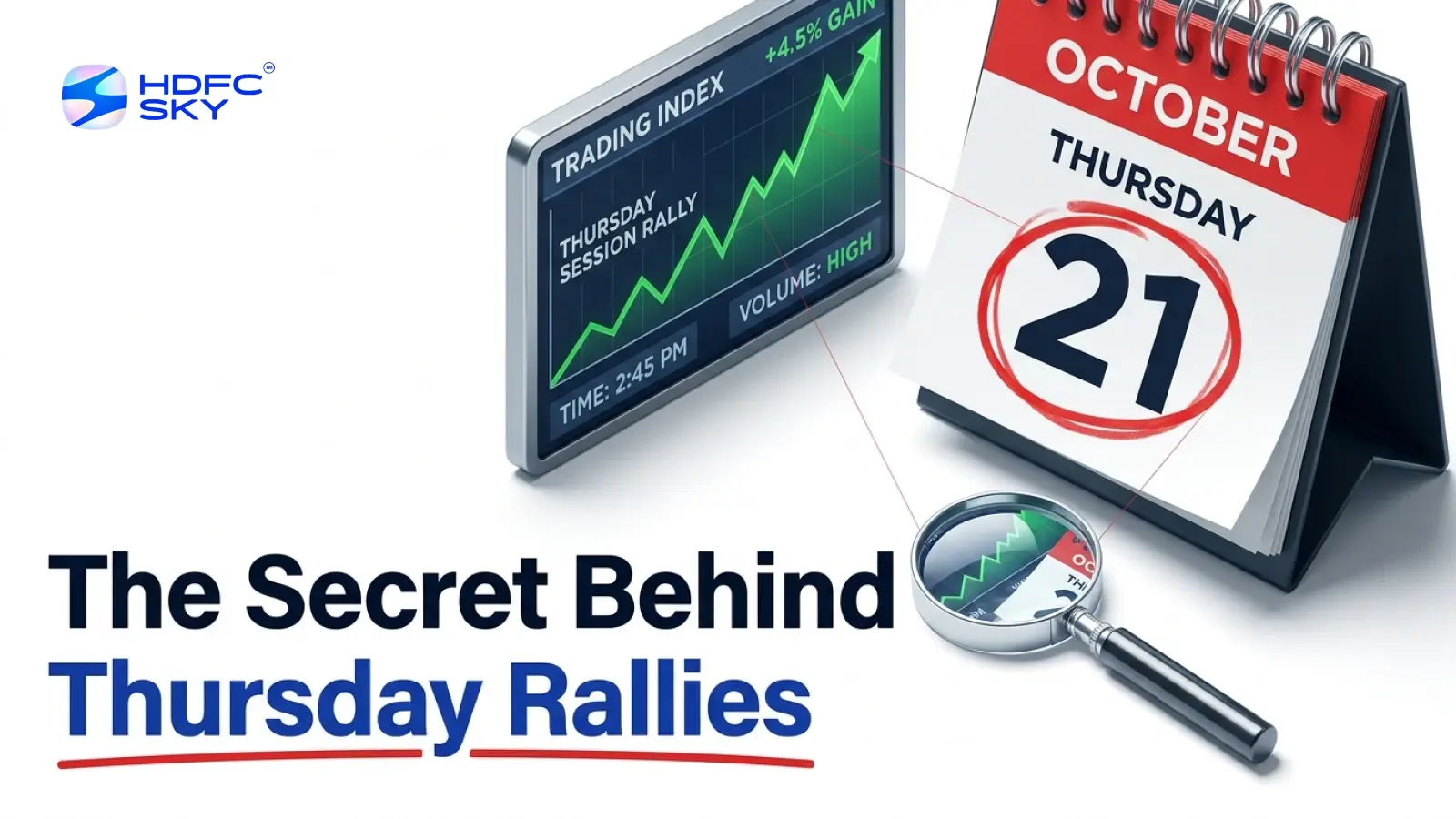
Have you ever watched stock markets on a Thursday afternoon and witnessed a surprising surge in the final hour of trading?
This is not random luck or a stroke of market optimism. It is a well-documented phenomenon known as the F&O expiry rally. Understanding this can help you decipher what genuinely drives the market versus what is just technical noise.
The Thursday Shift
Before September 2025, Thursday served as the universal expiry day for most index futures and options contracts across Indian exchanges. This created a single day of intense volatility.
Then SEBI stepped in with a clear goal, to reduce overcrowding and spread out market volatility more evenly across the week. The regulator issued a new directive. It restricted each exchange to a single weekly expiry day.
The National Stock Exchange (NSE) chose Tuesday for its flagship Nifty contracts. The Bombay Stock Exchange (BSE) secured Thursday for its Sensex and Bankex contracts.
What happened next surprised many market participants. The BSE’s decision to keep Thursday paid off handsomely. Traders and investors quickly adapted to the new schedule. Open interest in Sensex derivatives jumped from around 17 lakh contracts to nearly 60 lakh contracts after the shift.
Premium average daily turnover also rose by 19% in the first week alone. So when you see a sharp Thursday rally in 2026, you are primarily watching BSE’s expiry day in action—not NSE’s.
This single change transformed Thursday from just another trading day into the focal point of weekly derivative activity, especially for Sensex and Bankex traders.
Also Read: The day a typo in a large-cap order crashed a stock 40% in four minutes
Short Covering That Drives the Rally
The single biggest reason markets move up on expiry day is short covering. Short selling means betting that a stock or index will fall. Short covering is the buyback phase of a short sale.
Here’s the catch. Every short seller must buy back the shares before the contract expires. Imagine thousands of traders doing this simultaneously on a Thursday afternoon. That rush creates a buying wave that pushes prices higher, regardless of whether anyone actually wants to buy for the long term.
How do you spot a short covering rally? Look for a simple pattern—prices rise while open interest falls. Open interest refers to the total number of active contracts. When prices go up but open interest shrinks, it means traders are closing their short positions rather than opening new long ones. Short covering rallies can be explosive, but they rarely last long. They are technical moves driven by positioning, not by genuine optimism about the economy.
Time Decay (Theta)
Time decay, also known as Theta among traders, plays a massive role on expiry day. Option premiums lose their time value fastest on the final day. Traders who sold options hoping they would expire worthless suddenly panic when the market holds its ground. This forced rush to close losing positions adds significant fuel to the fire and further pushes the market upward. The result is a self-reinforcing cycle of buying pressure.
The Institutional Push
Large institutional traders like Foreign Institutional Investors (FIIs) don’t just close positions; they ‘roll them over’ to the next month. This means they shift their derivatives position from the current month’s contract to the next month’s contract at a pre-determined price.
If a significant number of traders choose not to roll over their short positions, the volume of buying required to close them all out is immense, leading to a sharp spike in the index.
For example, experts tracking the market noted that rollovers for the Nifty in May 2026 were at 71.4%, which was slightly below the usual average, indicating that some market participants preferred to close out their bets completely. This collective action is a key driver of those sharp index movements.
The STT Factor
Here is a critical update. From April 1, 2026, the government increased Securities Transaction Tax (STT) on futures and options trading significantly, by 150% on futures and 50% on options. This makes speculation more expensive. Higher costs might reduce the intensity of expiry day rallies. Fewer traders mean less forced buying. The core mechanics remain the same, but the volume of participants could shrink.
Why This Actually Matters for You
As a first-time investor, you do not need to react to every market move—especially on expiry day. But it helps to understand what is happening.
The main lesson is simple: do not assume a sudden market rise means the market is truly getting stronger. Sometimes prices go up only because traders are closing their positions, not because investors are confident about the future.
These short-term moves can create excitement, but they often do not last.
Your best strategy is usually to stay calm, focus on your long-term goals, and avoid making decisions based on one day’s market action. Sometimes, the smartest move is simply to watch and learn.
Conclusion
F&O expiry day rallies happen because short sellers must buy back their positions, time decay forces panicked exits from options traders, and everyone rushes to close contracts before they vanish at the closing bell. Now you know the real story behind those Thursday spikes.



Open Free Demat Account
Open Free Demat Account
Popular Posts
- 10 Interesting Facts About NSE You Probably Didn’t KnowLast Updated: Sep 30, 2026
- 8-4-3 Rule of SIP - How Does That Work?Last Updated: Jul 30, 2025
- Let's view more exciting Post!
Popular Post from Market WTF by Sky
- Why Q4 Results "Beat Estimates" But Stocks FellLast Updated: May 27, 2026
- Why Oil Falling Is Sometimes Bad For Markets: The Counterintuitive Logic ExplainedLast Updated: May 27, 2026
- Why Did Adani Stocks Drop 60% After a 106-Page Research Report Nobody Paid for?Last Updated: May 27, 2026
- The VIX Spike Nobody Saw Coming: Decoding What Caused The 2024 India Volatility ShockLast Updated: May 27, 2026
- The Day a Typo in a Large-Cap Order Crashed a Stock 40% in Four MinutesLast Updated: May 27, 2026
- Let's view more exciting Post!
Popular Post from Blogs
- “Bounce Back” Theme Gains Traction in 2026Last Updated: Apr 8, 2026
- 5 Takeaways for Tax Payers from the Budget 2025Last Updated: Jan 29, 2026
- Let’s view more exciting Posts


Invest Anytime, Anywhere


By signing up I certify terms, conditions & privacy policy